
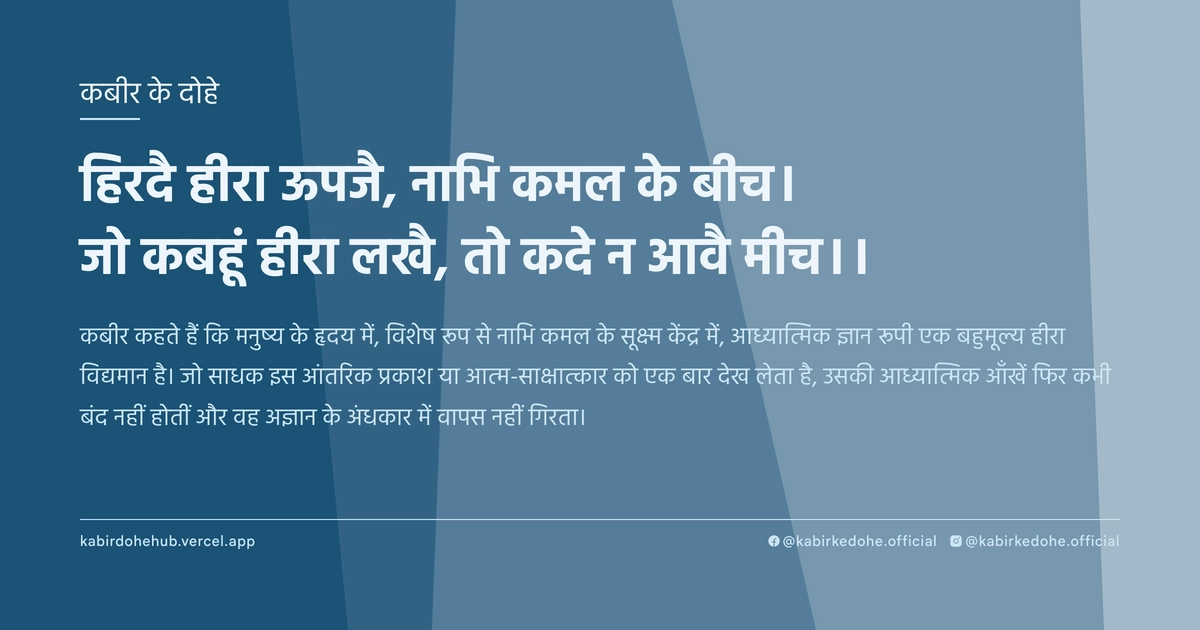
हिरदै हीरा ऊपजै, नाभि कमल के बीच।
जो कबहूं हीरा लखै, तो कदे न आवै मीच।।
Hirdai heera upjai, nabhi kamal ke beech. Jo kabahun heera lakhai, to kade na aavai meech.
इस पृष्ठ पर इस कबीर दोहे का अर्थ (meaning), हिंदी व्याख्या और अंग्रेज़ी अनुवाद, दार्शनिक विश्लेषण और व्यावहारिक जीवन सीख दी गई है। यह दोहा अंतर ज्योति (The Inner Light) विषय से जुड़ा है — Kabir doha meaning and explanation in Hindi and English.
अर्थ (Meaning):
कबीर कहते हैं कि मनुष्य के हृदय में, विशेष रूप से नाभि कमल के सूक्ष्म केंद्र में, आध्यात्मिक ज्ञान रूपी एक बहुमूल्य हीरा विद्यमान है। जो साधक इस आंतरिक प्रकाश या आत्म-साक्षात्कार को एक बार देख लेता है, उसकी आध्यात्मिक आँखें फिर कभी बंद नहीं होतीं और वह अज्ञान के अंधकार में वापस नहीं गिरता।
Kabir asserts that within the human heart, specifically at the center of the navel lotus, there exists a priceless diamond of spiritual wisdom. Once a seeker perceives this inner radiance or realizes the Self, their spiritual vision remains permanently open, and they never again succumb to the blindness of ignorance.
व्याख्या (Interpretation):
यहाँ 'हीरा' भौतिक रत्न नहीं, बल्कि शुद्ध चेतना या आत्मा का प्रतीक है। 'नाभि कमल' कुंडलिनी शक्ति और सूक्ष्म शरीर के ऊर्जा केंद्रों को दर्शाता है जहाँ परमात्मा का वास माना गया है। कबीर समझाते हैं कि सत्य बाहर नहीं, बल्कि हमारे भीतर गहराई में छिपा है। जब माया का पर्दा हटता है, तब यह आंतरिक हीरा चमकता है। यह अनुभव द्वैत को समाप्त कर अद्वैत की स्थिति में ले जाता है। एक बार जब आत्मा का मिलन परमात्मा से हो जाता है, तो वह स्थिति अपरिवर्तनीय होती है। यह जागृति मनुष्य को सांसारिक मोह और भ्रम से पूरी तरह मुक्त कर देती है।
Here, the 'diamond' is not a physical gem but a symbol of pure consciousness or the Atman. The 'navel lotus' refers to the energy centers of the subtle body where the Divine is believed to reside. Kabir explains that Truth is not external but hidden deep within. When the veil of Maya is lifted, this inner diamond radiates. This experience dissolves duality, leading to the state of Advaita (non-duality). Once the soul merges with the Divine, the state becomes irreversible. This awakening completely liberates the human from worldly attachments and the illusions of the ego.
दार्शनिक विश्लेषण (Philosophical Analysis):
कबीर का यह दोहा निर्गुण भक्ति की पराकाष्ठा है, जहाँ ईश्वर को किसी मूर्ति या मंदिर में नहीं, बल्कि स्वयं के भीतर खोजा जाता है। यह विचार अद्वैत वेदांत के 'अहं ब्रह्मास्मि' (मैं ही ब्रह्म हूँ) के सिद्धांत से मेल खाता है, जहाँ व्यक्तिगत आत्मा और सार्वभौमिक चेतना एक ही हैं। कबीर ने अपने समय के कर्मकांडों और बाहरी आडंबरों का खंडन किया, यह तर्क देते हुए कि मोक्ष के लिए तीर्थयात्रा या कठिन अनुष्ठानों की आवश्यकता नहीं है, बल्कि अंतर्मुखी होने की आवश्यकता है।
सूफी मत के 'इन्सान-ए-कामिल' (पूर्ण मनुष्य) की अवधारणा यहाँ स्पष्ट है, जहाँ हृदय को खुदा का घर माना गया है। कबीर का 'हीरा' उसी ईश्वरीय नूर का प्रतीक है। वे बताते हैं कि अहंकार (Ego) वह धूल है जिसने इस हीरे को ढक रखा है। जब तक साधक अपने अहंकार को मिटाता नहीं, वह इस आंतरिक प्रकाश को नहीं देख सकता।
मनोवैज्ञानिक स्तर पर, यह दोहा अवचेतन मन की गहराइयों में छिपी वास्तविक क्षमता और शांति की खोज की बात करता है। कबीर यह स्पष्ट करते हैं कि आध्यात्मिक जागृति कोई बाहरी उपलब्धि नहीं, बल्कि एक आंतरिक अनावरण (unveiling) है।
ऐतिहासिक रूप से, कबीर ने जाति और धर्म की सीमाओं को तोड़कर एक ऐसा मार्ग दिखाया जो केवल अनुभव पर आधारित था। उन्होंने यह सिद्ध किया कि ज्ञान किसी विशेष वर्ग की बपौती नहीं है, बल्कि हर मनुष्य के भीतर वह 'हीरा' मौजूद है, चाहे वह किसी भी सामाजिक स्तर से हो।
अंततः, यह दोहा हमें चेतावनी देता है कि बाहरी दुनिया की चमक अक्सर हमें आंतरिक संपदा से दूर ले जाती है। वास्तविक धन वह है जो नष्ट नहीं होता और जो मृत्यु के बाद भी आत्मा के साथ रहता है। यह भौतिकवाद के विरुद्ध एक सशक्त आध्यात्मिक प्रहार है।
This couplet represents the pinnacle of Nirgun Bhakti, where the Divine is sought not in idols or temples, but within oneself. This aligns with the Advaita Vedanta principle of 'Aham Brahmasmi' (I am Brahman), where the individual soul and universal consciousness are one. Kabir rejected the rituals and outward displays of his era, arguing that liberation requires introspection rather than pilgrimages or rigorous ceremonies.
The Sufi concept of 'Insan-e-Kamil' (the Perfect Human) is evident here, as the heart is regarded as the house of God. Kabir's 'diamond' symbolizes that divine light (Noor). He suggests that the ego is the dust that obscures this diamond; until the seeker annihilates the ego, the inner radiance remains hidden.
On a psychological level, this verse speaks to the discovery of innate potential and peace hidden within the depths of the subconscious. Kabir clarifies that spiritual awakening is not an external achievement but an internal unveiling.
Historically, Kabir broke the barriers of caste and religion, proposing a path based solely on experiential truth. He proved that spiritual knowledge is not the monopoly of a specific class; the 'diamond' exists within every human, regardless of social standing.
Ultimately, the verse warns that the glitter of the external world often distracts us from our inner wealth. True wealth is that which is indestructible and remains with the soul beyond death. It is a powerful spiritual critique of materialism.
मूल संदेश (Core Message):
- बाहरी खोज एक भ्रम है; सत्य केवल भीतर है।
- अहंकार वह पर्दा है जो आत्म-प्रकाश को रोकता है।
- एक बार जागी हुई चेतना कभी वापस नहीं सोती।
- मौन ही वह भाषा है जिससे आंतरिक हीरा बोलता है।
- आप स्वयं वह पूर्णता हैं जिसे आप बाहर खोज रहे हैं।
- External searching is an illusion; Truth lies only within.
- The ego is the veil that obstructs self-radiance.
- Once awakened, consciousness never returns to sleep.
- Silence is the language through which the inner diamond speaks.
- You are the very wholeness you seek outside.
व्यावहारिक उदाहरण (Practical Example):
वाराणसी के एक पुराने घाट पर रहने वाली एक वृद्ध विधवा, जानकी, का जीवन केवल दूसरों के लिए भोजन बनाने और मंदिर की सफाई करने में बीता। वह जीवन भर दूसरों की सेवा करती रही, लेकिन उसके मन में हमेशा एक खालीपन था। वह सोचती थी कि शायद उसने पर्याप्त पूजा-पाठ नहीं किया, इसलिए उसे शांति नहीं मिल रही।
एक दिन उसकी मुलाकात एक घुमक्कड़ फकीर से हुई, जिसने उसे कबीर का यह दोहा सुनाया। फकीर ने उससे कहा, "माता, तुम बाहर की धूल साफ कर रही हो, लेकिन अपने भीतर के हीरे को देखना भूल गई हो।"
जानकी ने पहले तो इसे साधारण बात समझा, लेकिन फिर उसने फकीर की सलाह मानकर हर दिन एक घंटा मौन रहकर अपने भीतर झांकना शुरू किया। उसने बाहरी दुनिया की शिकायतों और अपनी पुरानी यादों को किनारे रखकर केवल अपनी सांसों पर ध्यान केंद्रित किया।
शुरुआत में उसे केवल शोर सुनाई दिया—पुरानी कड़वाहटें, दुख और अकेलेपन की चीखें। लेकिन धीरे-धीरे वह शोर शांत होने लगा। एक सुबह, जब वह गंगा के किनारे बैठी थी, उसे अचानक एक असीम शांति का अनुभव हुआ।
उसे महसूस हुआ कि जिस ईश्वर को वह मंदिर की मूर्तियों में खोज रही थी, वह वास्तव में उसके अपने हृदय की धड़कन में समाया हुआ है। वह खालीपन, जो उसे सालों से सता रहा था, अब एक पूर्णता में बदल गया था।
उसने महसूस किया कि उसकी पूरी जिंदगी की सेवा वास्तव में उस आंतरिक हीरे को तराशने की प्रक्रिया थी। अब उसे किसी बाहरी मान्यता या सामाजिक सम्मान की आवश्यकता नहीं थी।
उसका व्यवहार बदल गया। अब वह केवल कर्तव्यवश सेवा नहीं करती थी, बल्कि उसके चेहरे पर एक अलौकिक मुस्कान रहती थी। लोग उससे पूछने लगे कि उसे इस उम्र में इतनी शांति कैसे मिली।
जानकी बस इतना कहती, "मैंने बाहर ढूंढना बंद कर दिया और भीतर देखना शुरू किया।" उसकी आंखों में अब एक ऐसी चमक थी जो कभी नहीं बुझी, ठीक वैसे ही जैसे कबीर ने कहा था कि एक बार हीरा दिख जाए तो आंखें फिर नहीं मूंदतीं।
Janaki, an elderly widow living on an old ghat in Varanasi, spent her life cooking for others and cleaning temples. Though she served everyone, a persistent void lingered in her heart. She believed her lack of peace was due to insufficient rituals and prayers.
One day, she met a wandering fakir who recited this doha of Kabir. The fakir told her, "Mother, you are cleaning the external dust, but you have forgotten to look at the diamond within."
Initially, Janaki dismissed this as simple talk, but she eventually followed the fakir's advice, spending an hour each day in silence, gazing inward. She set aside the complaints of the world and her old memories, focusing solely on her breath.
At first, she heard only noise—old bitterness, sorrows, and the screams of loneliness. But gradually, the noise subsided. One morning, while sitting by the Ganges, she experienced an overwhelming sense of peace.
She realized that the God she had been searching for in temple idols was actually residing within her own heartbeat. The void that had haunted her for years transformed into a state of wholeness.
She understood that her entire life of service had actually been a process of polishing that inner diamond. She no longer craved external validation or social respect.
Her behavior changed. She no longer served out of mere duty; a divine smile now graced her face. People began to ask how she found such peace at her age.
Janaki would simply reply, "I stopped searching outside and started looking within." There was now a light in her eyes that would never fade, just as Kabir said—once the diamond is seen, the eyes never close again.
अभ्यास मार्गदर्शन (Practice Guidance):
- प्रतिदिन 20 मिनट 'नाभि ध्यान' का अभ्यास करें, जहाँ अपना ध्यान नाभि केंद्र पर केंद्रित कर आंतरिक प्रकाश की कल्पना करें।
- एक डायरी लिखें जिसमें आप उन क्षणों को दर्ज करें जब आपने बाहरी शोर के बावजूद आंतरिक शांति महसूस की।
- स्व-पूछताछ (Self-Inquiry) का अभ्यास करें: जब भी क्रोध या ईर्ष्या आए, पूछें "यह भावना कहाँ से आ रही है और इसके पीछे छिपा असली 'मैं' कौन है?"
- निदान चेकलिस्ट: क्या आप अभी भी अपनी खुशी के लिए बाहरी परिस्थितियों पर निर्भर हैं? क्या आप दूसरों की राय को अपनी पहचान मान रहे हैं? यदि हाँ, तो आप अभी भी 'हीरे' से दूर हैं।
- Practice 'Navel Meditation' for 20 minutes daily, focusing your attention on the navel center and visualizing an inner light.
- Maintain a journal to record moments when you felt inner peace despite external chaos.
- Practice Self-Inquiry: Whenever anger or jealousy arises, ask, "Where is this emotion coming from, and who is the real 'I' behind it?"
- Diagnostic Checklist: Are you still dependent on external circumstances for happiness? Do you mistake others' opinions for your identity? If yes, you are still distant from the 'diamond'.
चिंतन प्रश्न (Reflection Questions):
- यदि आपकी सभी सामाजिक उपलब्धियां और पहचान छीन ली जाएं, तो आपके भीतर क्या बचेगा?
- आप अपनी आत्मा की शांति को बाहरी दुनिया की शोर-शराबे वाली प्रशंसाओं से कैसे अलग करते हैं?
- क्या आपका 'डिजिटल अहंकार' (सोशल मीडिया इमेज) आपको आपके वास्तविक आंतरिक स्वरूप से दूर ले जा रहा है?
- वह कौन सा डर है जो आपको अपनी आँखें बंद कर अपने भीतर झांकने से रोकता है?
- क्या आप वास्तव में स्वतंत्र हैं, या आप केवल अपनी आदतों और कंडीशनिंग के गुलाम हैं?
- If all your social achievements and identities were stripped away, what would remain within you?
- How do you distinguish the peace of your soul from the noisy praises of the external world?
- Is your 'digital ego' (social media image) distancing you from your authentic inner self?
- What is the fear that prevents you from closing your eyes and looking within?
- Are you truly free, or are you merely a slave to your habits and conditioning?