
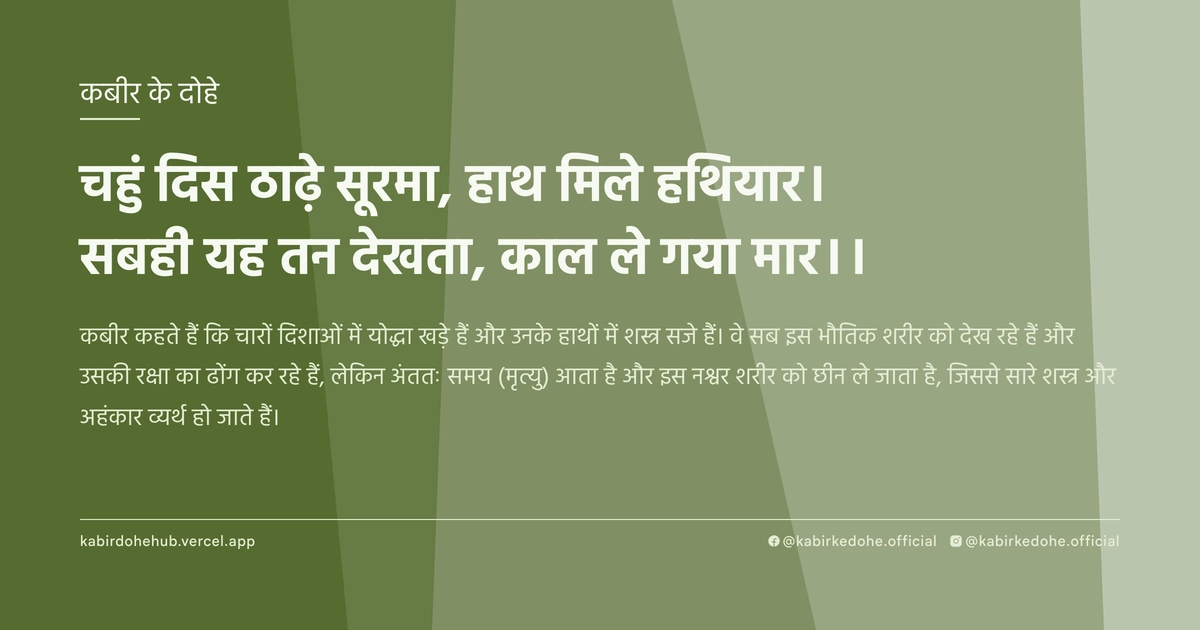
चहुं दिस ठाढ़े सूरमा, हाथ मिले हथियार।
सबही यह तन देखता, काल ले गया मार।।
Chahun dis thade surma, hath mile hathiyar. Sabhi yeh tan dekhta, kaal le gaya maar.
इस पृष्ठ पर इस कबीर दोहे का अर्थ (meaning), हिंदी व्याख्या और अंग्रेज़ी अनुवाद, दार्शनिक विश्लेषण और व्यावहारिक जीवन सीख दी गई है। यह दोहा मृतुक्यता (Mortality) विषय से जुड़ा है — Kabir doha meaning and explanation in Hindi and English.
अर्थ (Meaning):
कबीर कहते हैं कि चारों दिशाओं में योद्धा खड़े हैं और उनके हाथों में शस्त्र सजे हैं। वे सब इस भौतिक शरीर को देख रहे हैं और उसकी रक्षा का ढोंग कर रहे हैं, लेकिन अंततः समय (मृत्यु) आता है और इस नश्वर शरीर को छीन ले जाता है, जिससे सारे शस्त्र और अहंकार व्यर्थ हो जाते हैं।
Kabir observes that warriors stand in all directions, armed with weapons, guarding the physical body. While they focus on the external defense of the flesh, the inevitable force of Time (Death) arrives and strikes, rendering all weapons and worldly pride utterly useless as the body perishes.
व्याख्या (Interpretation):
यह दोहा शरीर की नश्वरता और अहंकार के भ्रम का चित्रण है। 'सूरमा' और 'हथियार' यहाँ केवल बाहरी सैनिकों के प्रतीक नहीं हैं, बल्कि हमारे भीतर के उन मानसिक रक्षा-तंत्रों और अहंकारों के प्रतीक हैं जो हमें यह विश्वास दिलाते हैं कि हम इस भौतिक संसार में सुरक्षित और स्थायी हैं। यह निरगुण भक्ति का सार है, जहाँ कबीर बताते हैं कि आत्मा (Atman) अमर है, लेकिन हम माया (Maya) के प्रभाव में आकर इस नश्वर शरीर को ही अपनी पहचान मान लेते हैं। जब काल (समय) आता है, तो यह द्वैत समाप्त हो जाता है और व्यक्ति को अहसास होता है कि जिस शरीर की उसने रक्षा की, वह तो केवल मिट्टी थी। यह अद्वैत वेदांत के उस सत्य की ओर संकेत करता है जहाँ शरीर का विसर्जन ही वास्तविक सत्य के प्रकटीकरण का मार्ग है।
This couplet serves as a stark depiction of bodily transience and the illusion of ego. The 'warriors' and 'weapons' are not merely physical soldiers but metaphors for the psychological defense mechanisms and the ego that convince us of our permanence and security in the material world. It embodies the essence of Nirgun Bhakti, where Kabir asserts that while the Soul (Atman) is eternal, we are blinded by Maya (illusion), mistakenly identifying ourselves with the perishable body. When 'Kaal' (Time/Death) arrives, this duality collapses, revealing that the body we fought so hard to protect was merely clay. It points toward the Advaita Vedanta truth: the dissolution of the physical form is the only gateway to realizing the singular, eternal Truth.
दार्शनिक विश्लेषण (Philosophical Analysis):
कबीर का यह दृष्टिकोण उनके युग के सामाजिक और धार्मिक पाखंडों के विरुद्ध एक कड़ा प्रहार है। उस समय लोग बाहरी कर्मकांडों, जातिगत श्रेष्ठता और शारीरिक शक्ति को ही मोक्ष का मार्ग मानते थे। कबीर ने इस 'शारीरिक सुरक्षा' के भ्रम को तोड़कर यह समझाया कि असली युद्ध बाहरी दुनिया से नहीं, बल्कि अपने भीतर के अहंकार से है।
दार्शनिक रूप से, यह दोहा सूफीवाद के 'फना' (अहंकार का विनाश) और अद्वैत वेदांत के 'माया' सिद्धांत का संगम है। सूफी संत मानते हैं कि जब तक 'मैं' (अहंकार) जीवित है, तब तक 'वह' (ईश्वर) नहीं मिल सकता। कबीर यहाँ चेतावनी दे रहे हैं कि हम अपनी पूरी ऊर्जा शरीर को सजाने और बचाने में लगा देते हैं, जबकि आध्यात्मिक विकास की उपेक्षा करते हैं।
यह विश्लेषण यह स्पष्ट करता है कि 'हथियार' वास्तव में हमारी आसक्तियाँ, हमारी उपाधियाँ और हमारा सामाजिक दर्जा हैं। हम सोचते हैं कि हमारा धन, पद या शक्ति हमें मृत्यु से बचा लेगी, लेकिन काल के सामने ये सब शून्य हैं। यह एक मनोवैज्ञानिक रूपांतरण की मांग करता है जहाँ व्यक्ति बाहरी सुरक्षा के बजाय आंतरिक शांति और आत्म-साक्षात्कार की खोज करे।
कबीर का विरोध केवल शस्त्रों से नहीं, बल्कि उस मानसिकता से है जो शरीर को ही सत्य मानती है। वे सिखाते हैं कि मृत्यु डरावनी नहीं है, बल्कि वह एक दर्पण है जो हमें हमारी वास्तविक स्थिति दिखाता है। जब हम यह स्वीकार कर लेते हैं कि शरीर नश्वर है, तब हम वास्तव में उस 'अविनाशी' तत्व की खोज शुरू करते हैं जो समय की सीमाओं से परे है।
अंततः, यह दोहा हमें यह याद दिलाता है कि जीवन का वास्तविक उद्देश्य बाहरी किलाबंदी करना नहीं, बल्कि उस आंतरिक प्रकाश को जगाना है जो मृत्यु के बाद भी शेष रहता है। यह भौतिकवाद का पूर्ण त्याग और चेतना के विस्तार का आह्वान है।
Kabir's perspective is a fierce critique of the social and religious hypocrisies of his era. At a time when people viewed external rituals, caste superiority, and physical prowess as the paths to salvation, Kabir shattered the illusion of 'physical security,' arguing that the real battle is not against the external world, but against the internal ego.
Philosophically, this doha is a convergence of the Sufi concept of 'Fana' (annihilation of the self) and the Advaita Vedanta theory of 'Maya.' Sufi saints believe that as long as the 'I' (ego) exists, the 'He' (Divine) cannot be realized. Kabir warns that we expend all our energy decorating and defending the body, while neglecting spiritual evolution.
This analysis clarifies that the 'weapons' are actually our attachments, titles, and social status. We believe our wealth, position, or power will shield us from death, but before the gaze of Time, these are all void. This demands a psychological transformation where the individual shifts focus from external fortification to internal peace and self-realization.
Kabir's opposition is not merely to weapons, but to the mindset that perceives the body as the ultimate reality. He teaches that death is not a terror, but a mirror reflecting our true state. Once we accept the perishability of the body, we begin the quest for the 'Indestructible' element that exists beyond the boundaries of time.
Ultimately, this doha reminds us that the true purpose of life is not to build external fortresses, but to ignite the inner light that persists after death. It is a call for the total renunciation of materialism and the expansion of consciousness.
मूल संदेश (Core Message):
- बाहरी सुरक्षा का भ्रम ही सबसे बड़ा बंधन है।
- अहंकार के शस्त्र मृत्यु के सामने शून्य हैं।
- शरीर नश्वर है, केवल चेतना शाश्वत है।
- समर्पण ही वास्तविक विजय का एकमात्र मार्ग है।
- माया की दीवारों को तोड़कर शून्य में विलीन हों।
- The illusion of external security is the greatest bondage.
- The weapons of ego are void in the face of death.
- The body is transient; only consciousness is eternal.
- Surrender is the only path to true victory.
- Break the walls of Maya and merge into the Void.
व्यावहारिक उदाहरण (Practical Example):
वाराणसी के घाटों पर रहने वाले एक वृद्ध विधवा, जानकी, का जीवन अत्यंत कठिन था। उन्होंने अपना पूरा जीवन अपने परिवार की सेवा और सामाजिक मर्यादाओं की रक्षा करने में बिता दिया। उनके लिए उनकी 'मर्यादा' और 'पवित्रता' ही उनके हथियार थे, जिनसे वे समाज के तानों और अपनी आंतरिक रिक्तता से लड़ती थीं। वे हमेशा इस बात का ध्यान रखती थीं कि दुनिया उन्हें एक 'आदर्श विधवा' के रूप में देखे।
जानकी का पूरा दिन पूजा-पाठ और इस बात की चिंता में बीतता था कि उनकी छवि खराब न हो। वे अपने शरीर को उपवासों और कठोर नियमों से तपाती थीं, यह सोचकर कि यह तपस्या उन्हें स्वर्ग दिलाएगी। उनके लिए यह अनुशासन ही वह 'सूरमा' था जो उनकी आत्मा की रक्षा कर रहा था।
एक दिन, उन्होंने घाट पर एक फकीर को देखा जो बिना किसी बाहरी आडंबर के, केवल एक फटे हुए कपड़े में, परम आनंद में डूबा हुआ था। वह फकीर हंसते हुए कह रहा था, 'मिट्टी का घर है, मिट्टी में मिल जाएगा, फिर क्यों इस दीवार को रंगने में जीवन बिताया?'
जानकी को पहले तो यह बात अपमानजनक लगी। उन्होंने सोचा कि यह व्यक्ति उनकी तपस्या और उनके जीवन भर के अनुशासन का मजाक उड़ा रहा है। उन्होंने अपने मानसिक हथियारों से उस फकीर को गलत साबित करने की कोशिश की।
लेकिन उसी रात, जानकी ने एक भयानक सपना देखा। उन्होंने देखा कि वे एक भव्य किले में बंद हैं, और चारों ओर सैनिक खड़े हैं। अचानक, एक काला साया (काल) आया और उसने एक झटके में उस किले को धूल में मिला दिया। सैनिक गायब हो गए, और जानकी अकेली खड़ी थीं, उनके पास न तो उनकी मर्यादा थी, न उनकी तपस्या का अहंकार।
जब वे जागीं, तो उनकी आँखों में आँसू थे। उन्हें अहसास हुआ कि जिस 'छवि' और 'मर्यादा' की उन्होंने जीवन भर रक्षा की, वह केवल एक मानसिक हथियार था जिसने उन्हें वास्तविक प्रेम और शांति से दूर रखा था।
अगले दिन, जानकी ने अपने कठोर नियमों को त्याग दिया। उन्होंने दूसरों की सेवा करना शुरू किया, लेकिन बिना इस उम्मीद के कि उन्हें 'पुण्य' मिले। उन्होंने अपनी पहचान एक 'आदर्श विधवा' के रूप में नहीं, बल्कि एक साधारण मनुष्य के रूप में स्वीकार की।
उन्होंने महसूस किया कि जब हम शरीर और उसकी सामाजिक पहचान को बचाने की कोशिश छोड़ देते हैं, तब हम वास्तव में स्वतंत्र होते हैं। उनकी आंतरिक शांति अब किसी बाहरी मान्यता की मोहताज नहीं थी।
जानकी का रूपांतरण यह था कि उन्होंने 'रक्षा' (Defense) को 'समर्पण' (Surrender) में बदल दिया। अब वे मृत्यु से डरती नहीं थीं, क्योंकि उन्होंने जान लिया था कि जो मरता है वह केवल शरीर है, वह स्वयं तो वह अनंत प्रकाश हैं।
अंततः, जानकी ने पाया कि असली मुक्ति हथियारों (अहंकार) को छोड़कर, शून्य में विलीन होने में है।
Janaki, an elderly widow living on the ghats of Varanasi, led a life of extreme hardship. She spent her entire existence serving her family and guarding social boundaries. For her, 'propriety' and 'purity' were her weapons, which she used to fight the taunts of society and her own internal emptiness. She was obsessed with the world seeing her as an 'ideal widow.'
Janaki's days were spent in rituals and constant worry that her image might be tarnished. She disciplined her body with fasts and rigid rules, believing this penance would secure her a place in heaven. To her, this discipline was the 'warrior' guarding her soul.
One day, she encountered a fakir on the ghats, dressed in a single tattered cloth, immersed in absolute bliss. The fakir laughed and said, 'This is a house of clay, it shall return to clay; why spend a lifetime painting the walls?'
Initially, Janaki found this offensive. She felt the man was mocking her lifelong discipline and penance. She attempted to use her mental weapons to prove the fakir wrong.
However, that night, Janaki had a vivid dream. She saw herself enclosed in a magnificent fortress, surrounded by soldiers. Suddenly, a dark shadow (Time/Death) appeared and reduced the fortress to dust in a single stroke. The soldiers vanished, and Janaki stood alone, stripped of her propriety and the ego of her penance.
Upon waking, her eyes were filled with tears. She realized that the 'image' and 'dignity' she had spent her life defending were merely mental weapons that had kept her away from real love and peace.
The next day, Janaki abandoned her rigid rules. She began serving others, not for the sake of earning 'merit,' but out of simple compassion. She stopped identifying as an 'ideal widow' and accepted herself as a simple human being.
She realized that when we stop trying to protect the body and its social identity, we truly become free. Her inner peace was no longer dependent on external validation.
Janaki's transformation was the shift from 'Defense' to 'Surrender.' She no longer feared death, for she understood that only the body dies, while she herself was that eternal light.
Ultimately, Janaki discovered that true liberation lies in dropping the weapons of ego and merging into the Void.
अभ्यास मार्गदर्शन (Practice Guidance):
- प्रतिदिन 20 मिनट 'शवासन' का अभ्यास करें और कल्पना करें कि आपका शरीर धीरे-धीरे मिट्टी में मिल रहा है, जिससे केवल आपकी शुद्ध चेतना शेष रह जाए।
- एक डायरी लिखें जिसमें उन 'मानसिक हथियारों' (जैसे पद, प्रतिष्ठा, सही होने का दावा) की सूची बनाएं जिनका उपयोग आप अपनी असुरक्षाओं को छिपाने के लिए करते हैं।
- व्यवहार परिवर्तन: जब भी आप किसी विवाद में खुद को सही साबित करने की कोशिश करें, तो रुकें और सोचें—'क्या यह जीत मेरे अंत समय में कोई मूल्य रखेगी?'
- निदान चेकलिस्ट: यदि आप अभी भी अपनी सामाजिक छवि की चिंता अधिक करते हैं या मृत्यु के विचार से घबराते हैं, तो इसका अर्थ है कि आप अभी भी 'हथियारों' के सहारे जी रहे हैं।
- Practice 'Shavasana' for 20 minutes daily, visualizing your body slowly returning to the earth, leaving only your pure consciousness behind.
- Maintain a journal listing the 'mental weapons' (such as status, reputation, or the need to be right) that you use to mask your insecurities.
- Behavioral Change: Whenever you feel the urge to prove yourself right in an argument, pause and ask—'Will this victory hold any value at the moment of my death?'
- Diagnostic Checklist: If you are still preoccupied with your social image or terrified by the thought of death, you are still relying on 'weapons' for security.
चिंतन प्रश्न (Reflection Questions):
- वे कौन से 'हथियार' हैं जिन्हें मैंने अपनी पहचान बनाने के लिए संजोया है, और यदि वे आज छीन लिए जाएं, तो मेरा अस्तित्व क्या बचेगा?
- मैं अपनी सार्वजनिक छवि (Digital/Social Ego) को बचाने के लिए अपनी आंतरिक शांति का कितना बलिदान करता हूँ?
- क्या मेरी नैतिकता वास्तव में करुणा से प्रेरित है, या यह केवल समाज में 'अच्छा' दिखने का एक रक्षा-तंत्र है?
- मृत्यु का विचार मुझे भयभीत करता है या यह मुझे वर्तमान क्षण में अधिक गहराई से जीने के लिए प्रेरित करता है?
- मेरे जीवन का वह कौन सा हिस्सा है जहाँ मैं अभी भी एक 'योद्धा' की तरह लड़ रहा हूँ, जबकि मुझे एक 'साधक' की तरह समर्पित होना चाहिए?
- What are the 'weapons' I have collected to build my identity, and if they were stripped away today, what of my existence would remain?
- How much of my inner peace do I sacrifice to maintain my public image (Digital/Social Ego)?
- Is my morality truly driven by compassion, or is it merely a defense mechanism to appear 'good' in society?
- Does the thought of death terrify me, or does it inspire me to live the present moment more deeply?
- In which area of my life am I still fighting like a 'warrior,' when I should be surrendering like a 'seeker'?