
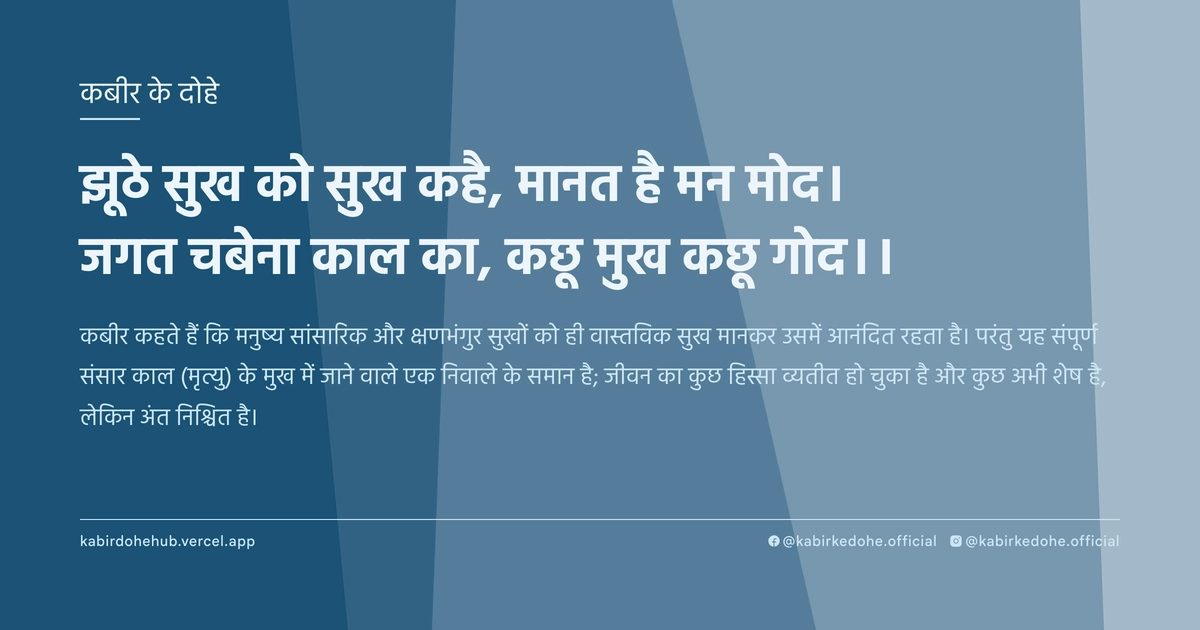
झूठे सुख को सुख कहै, मानत है मन मोद।
जगत चबेना काल का, कछू मुख कछू गोद।।
Jhuthe sukh ko sukh kahe, manat hai man mod. Jagat chabena kaal ka, kachhu mukh kachhu god.
इस पृष्ठ पर इस कबीर दोहे का अर्थ (meaning), हिंदी व्याख्या और अंग्रेज़ी अनुवाद, दार्शनिक विश्लेषण और व्यावहारिक जीवन सीख दी गई है। यह दोहा अनित्य (Impermanence) विषय से जुड़ा है — Kabir doha meaning and explanation in Hindi and English.
अर्थ (Meaning):
कबीर कहते हैं कि मनुष्य सांसारिक और क्षणभंगुर सुखों को ही वास्तविक सुख मानकर उसमें आनंदित रहता है। परंतु यह संपूर्ण संसार काल (मृत्यु) के मुख में जाने वाले एक निवाले के समान है; जीवन का कुछ हिस्सा व्यतीत हो चुका है और कुछ अभी शेष है, लेकिन अंत निश्चित है।
Kabir observes that humans mistake transient, worldly pleasures for true happiness, finding joy in illusions. He asserts that the entire world is merely a morsel of food for Time (Death); a portion of our existence has already been consumed, and while some remains, the inevitable end is certain for all.
व्याख्या (Interpretation):
इस दोहे का शाब्दिक अर्थ है कि हम भौतिक सुखों को सुख समझते हैं, लेकिन वास्तव में वे काल के जाल हैं। रूपकात्मक रूप से, 'चबेना' (निवाला) जीवन की नश्वरता को दर्शाता है। यहाँ कबीर 'निर्गुण भक्ति' की ओर संकेत करते हैं, जहाँ बाहरी दुनिया को 'माया' कहा गया है। यह अद्वैत वेदांत के उस सत्य को उजागर करता है कि जब तक हम शरीर और अहंकार को सत्य मानते हैं, हम काल के अधीन रहेंगे। वास्तविक सुख केवल उस अविनाशी आत्मा (ब्रह्म) में है जो समय और मृत्यु से परे है। यह विरोधाभास है कि मनुष्य उसी चीज़ को संजोने की कोशिश करता है जो हर क्षण उससे छिन रही है।
Literally, the verse warns against equating material comfort with genuine bliss. Metaphorically, the 'chabena' (morsel) symbolizes the fragility of human existence. Kabir invokes Nirgun Bhakti, framing the external world as 'Maya'—a cosmic illusion. This aligns with Advaita Vedanta, suggesting that as long as one identifies with the ego and the physical body, they remain subject to the laws of Time. True happiness resides only in the indestructible Atman-Brahman, which transcends the temporal cycle. The central paradox lies in the human tendency to cling desperately to a reality that is actively dissolving.
दार्शनिक विश्लेषण (Philosophical Analysis):
कबीर का यह दोहा उनके युग के कर्मकांडीय आडंबरों और भौतिक आसक्ति के विरुद्ध एक सशक्त प्रहार है। उन्होंने देखा कि लोग तीर्थों और बाहरी अनुष्ठानों में सुख खोज रहे थे, जबकि वे समय की क्रूरता से अनभिज्ञ थे। कबीर यहाँ सूफी मत के 'फना' (अहंकार का विनाश) और वेदांत के 'विवेक' (नश्वर और अनश्वर के बीच भेद) का समन्वय करते हैं।
उनका तर्क है कि सामाजिक प्रतिष्ठा, धन और शारीरिक सुख केवल मानसिक भ्रम हैं। जब मनुष्य यह समझ लेता है कि वह 'काल' का भोजन है, तो उसका अहंकार स्वतः समाप्त होने लगता है। यह मनोवैज्ञानिक रूपांतरण है जहाँ भय, वैराग्य में बदल जाता है।
कबीर जाति और धर्म की सीमाओं को तोड़कर एक सार्वभौमिक सत्य प्रस्तुत करते हैं: मृत्यु ही एकमात्र अटल सत्य है। वे चेतावनी देते हैं कि जो व्यक्ति केवल 'मुख' (वर्तमान उपभोग) और 'गोद' (भविष्य की संचयित इच्छाओं) में उलझा है, वह कभी भी उस शाश्वत शांति को प्राप्त नहीं कर सकता जो केवल आत्म-साक्षात्कार से आती है।
यहाँ 'काल' केवल मृत्यु नहीं, बल्कि समय की वह धारा है जो निरंतर परिवर्तन लाती है। यह विश्लेषण हमें सिखाता है कि आध्यात्मिक प्रगति के लिए पहले इस सत्य को स्वीकार करना आवश्यक है कि यह संसार एक अस्थायी सराय है।
अंततः, कबीर का दर्शन हमें बाहरी दुनिया के शोर से हटाकर आंतरिक मौन की ओर ले जाता है, जहाँ आत्मा का परमात्मा से मिलन होता है और द्वैत का अंत होता है।
This Doha is a potent critique of the ritualistic pomposity and material attachments prevalent during Kabir's era. He observed people seeking salvation through pilgrimages and external rites, remaining blissfully ignorant of the relentless march of Time. Kabir synthesizes the Sufi concept of 'Fana' (annihilation of the ego) with the Vedantic 'Viveka' (discrimination between the eternal and the ephemeral).
He argues that social prestige, wealth, and sensory pleasures are mere psychological delusions. Once a human realizes they are but a 'morsel' for Time, the ego begins to dissolve. This is a profound psychological transformation where the fear of death evolves into a spiritual detachment (Vairagya).
By stripping away caste and religious identities, Kabir presents a universal truth: death is the only absolute certainty. He warns that those preoccupied with 'the mouth' (current consumption) and 'the lap' (accumulated future desires) can never attain the eternal peace found only through self-realization.
In this context, 'Kaal' (Time) is not just the end of life, but the cosmic force of constant change. This analysis teaches us that spiritual progress requires the prerequisite acceptance that the material world is a temporary inn.
Ultimately, Kabir's philosophy shifts the focus from the external noise to internal silence, leading the seeker toward the union of Atman and Brahman, effectively ending the illusion of duality.
मूल संदेश (Core Message):
- सांसारिक सुख एक छलावा है, जो अंततः दुख की ओर ले जाता है।
- समय सबसे शक्तिशाली है; इसके सामने अहंकार का कोई अस्तित्व नहीं है।
- संग्रह की इच्छा को त्यागना ही वास्तविक स्वतंत्रता का मार्ग है।
- मृत्यु का स्मरण हमें वर्तमान में जागरूक और करुणामयी बनाता है।
- आत्मा का आनंद भौतिक वस्तुओं से परे, आंतरिक शून्य में निहित है।
- अहंकार का विसर्जन ही परमात्मा से मिलन की एकमात्र शर्त है।
- Worldly pleasure is a mirage that ultimately leads to suffering.
- Time is the supreme power; before it, the ego has no existence.
- Renouncing the urge to accumulate is the path to true liberation.
- Remembering death makes us conscious and compassionate in the present.
- The soul's bliss lies beyond material objects, within the inner void.
- The dissolution of the ego is the sole condition for union with the Divine.
व्यावहारिक उदाहरण (Practical Example):
एक समय की बात है, वाराणसी के घाटों पर रहने वाले एक वृद्ध बुनकर थे, जिनका नाम माधव था। माधव अपने जीवन भर की मेहनत से रेशमी वस्त्र बुनते थे और उन्हें लगता था कि उनकी संपत्ति और उनकी कला ही उनकी असली पहचान और सुख है। वे अपने परिवार और समाज में अपनी प्रतिष्ठा को लेकर अत्यंत गर्वित थे।
माधव का पूरा दिन इस चिंता में बीतता था कि उनके गोदाम में कितना कपड़ा बचा है और वे अगले साल कितनी अधिक कमाई कर सकते हैं। उनके लिए सुख का अर्थ था—अधिक धन, अधिक सम्मान और एक सुरक्षित भविष्य। वे अक्सर अपने पड़ोसियों को उपदेश देते थे कि जीवन का आनंद केवल संचय में है।
एक दिन, माधव ने देखा कि उनके सबसे करीबी मित्र और एक सफल व्यापारी का अचानक निधन हो गया। वह व्यक्ति जिस समय मरा, उसके पास अपार संपत्ति थी, लेकिन उसकी अंतिम यात्रा में केवल विलाप था, कोई सुख नहीं। माधव को गहरा धक्का लगा। उन्हें महसूस हुआ कि जिस 'सुख' को वे संजो रहे थे, वह वास्तव में काल के मुख का एक निवाला मात्र था।
उसी शाम, माधव की मुलाकात एक फकीर से हुई जिसने उन्हें कबीर का यह दोहा सुनाया। फकीर ने कहा, 'माधव, तुम रेशम के धागे बुन रहे हो, लेकिन क्या तुमने अपने जीवन के धागों को देखा है? जो आज तुम्हारी गोद में है, वह कल काल के मुख में होगा।'
यह बात माधव के हृदय में गहराई तक उतर गई। उन्होंने महसूस किया कि उन्होंने अपना पूरा जीवन केवल 'संग्रह' करने में बिता दिया, लेकिन 'जीने' और 'जानने' में कुछ नहीं किया। उनका अहंकार, जो उनकी संपत्ति पर टिका था, अचानक ढह गया।
माधव ने अपनी जीवनशैली बदल दी। उन्होंने अपनी संपत्ति का एक बड़ा हिस्सा उन बुनकरों की मदद के लिए समर्पित कर दिया जो गरीबी में जी रहे थे। उन्होंने अब केवल लाभ के लिए नहीं, बल्कि सेवा और संतोष के लिए बुनना शुरू किया।
अब जब वे सुबह उठते, तो वे धन की गणना नहीं करते थे, बल्कि इस बात का आनंद लेते थे कि वे आज जीवित हैं और किसी की मदद कर सकते हैं। उनके चेहरे पर एक ऐसी शांति थी जो पहले कभी नहीं देखी गई थी।
माधव ने जान लिया था कि असली सुख बाहरी वस्तुओं के संचय में नहीं, बल्कि इस बोध में है कि हम इस संसार में केवल यात्री हैं। उन्होंने भौतिक सुखों के मोह को त्याग कर आंतरिक संतोष को अपनाया।
अंततः, माधव की मृत्यु जब हुई, तो वे भयभीत नहीं थे। वे मुस्कुरा रहे थे, क्योंकि उन्होंने पहले ही समझ लिया था कि यह शरीर काल का निवाला है, लेकिन उनकी आत्मा उस अनंत सत्य का हिस्सा बन चुकी है।
Once, in the ghats of Varanasi, lived an elderly weaver named Madhav. Madhav spent his entire life weaving exquisite silk fabrics, believing that his wealth and his craft were his true identity and source of happiness. He was immensely proud of his prestige within his family and society.
Madhav's days were consumed by calculating how much fabric remained in his warehouse and how much more profit he could earn the following year. For him, happiness meant more money, higher status, and a guaranteed secure future. He often lectured his neighbors that the joy of life lay solely in accumulation.
One day, Madhav witnessed the sudden passing of his closest friend, a highly successful merchant. At the moment of death, that man possessed immense wealth, yet his final journey was marked only by lamentation, not happiness. Madhav was deeply shaken. He realized that the 'happiness' he was hoarding was actually just a morsel for Time.
That evening, Madhav encountered a wandering dervish who recited this specific Doha of Kabir. The dervish asked, 'Madhav, you weave threads of silk, but have you looked at the threads of your own life? What is in your lap today will be in the mouth of Time tomorrow.'
These words penetrated Madhav's heart. He realized he had spent his entire existence merely 'collecting' without ever truly 'living' or 'knowing.' His ego, which rested upon his riches, suddenly collapsed.
Madhav transformed his lifestyle. He dedicated a significant portion of his wealth to help fellow weavers living in extreme poverty. He stopped weaving for mere profit and began weaving for service and contentment.
Now, upon waking, he no longer counted his coins but rejoiced in the fact that he was alive and could be of use to someone. A peace settled upon his face that had never been seen before.
Madhav had learned that true happiness does not lie in the accumulation of external objects, but in the realization that we are merely travelers in this world. He abandoned the attachment to material pleasures and embraced inner fulfillment.
Ultimately, when Madhav's time came, he was not afraid. He died with a smile, for he had already understood that while the body is a morsel for Time, the soul is a part of the infinite Truth.
अभ्यास मार्गदर्शन (Practice Guidance):
- प्रतिदिन 20 मिनट मौन ध्यान करें, जहाँ आप स्वयं को एक 'साक्षी' के रूप में देखें और विचार करें कि आपका शरीर और विचार समय के साथ कैसे बदल रहे हैं।
- एक 'नश्वरता जर्नल' (Impermanence Journal) बनाएँ। हर दिन एक ऐसी चीज़ लिखें जिसे आपने कभी बहुत महत्वपूर्ण माना था, लेकिन अब वह आपके लिए अर्थहीन हो गई है।
- व्यवहार परिवर्तन: सप्ताह में एक बार अपनी किसी प्रिय भौतिक वस्तु का त्याग करें या उसे किसी जरूरतमंद को दें, ताकि 'संग्रह' की प्रवृत्ति कम हो सके।
- निदान चेकलिस्ट: क्या आप भविष्य की चिंता में वर्तमान का आनंद खो रहे हैं? क्या आपकी खुशी बाहरी उपलब्धियों पर निर्भर है? यदि हाँ, तो आप अभी भी 'माया' के प्रभाव में हैं।
- Practice 20 minutes of silent meditation daily, observing yourself as a 'witness' and contemplating how your body and thoughts are constantly shifting with time.
- Maintain an 'Impermanence Journal.' Each day, record one thing you once considered vital but has now become meaningless to you.
- Behavioral Shift: Once a week, detach yourself from a cherished material possession by gifting it to someone in need, thereby reducing the instinct of accumulation.
- Diagnostic Checklist: Are you losing the present moment to anxiety about the future? Is your happiness dependent on external achievements? If yes, you are still under the influence of 'Maya'.
चिंतन प्रश्न (Reflection Questions):
- यदि आज आपका सब कुछ छिन जाए, तो आपके व्यक्तित्व में क्या शेष बचेगा?
- आप अपनी सामाजिक छवि (Digital/Social Ego) को बनाए रखने के लिए कितना मानसिक तनाव झेलते हैं?
- क्या आपकी 'सफलता' की परिभाषा दूसरों की अपेक्षाओं पर आधारित है या आपकी अपनी आत्मा की शांति पर?
- आप मृत्यु के विचार से डरते हैं या उसे एक मुक्ति के रूप में देखते हैं? यह डर आपके वर्तमान निर्णयों को कैसे प्रभावित करता है?
- वह कौन सा 'निवाला' है जिसे आप अभी भी अपनी गोद में पकड़े हुए हैं और छोड़ने से डर रहे हैं?
- क्या आप वास्तव में स्वतंत्र हैं, या आप अपनी इच्छाओं के गुलाम हैं जिन्हें आप 'सुख' का नाम देते हैं?
- If everything were stripped away from you today, what would remain of your identity?
- How much mental stress do you endure to maintain your social image (Digital/Social Ego)?
- Is your definition of 'success' based on the expectations of others or the peace of your own soul?
- Do you fear the thought of death, or do you see it as liberation? How does this fear influence your current decisions?
- What is the 'morsel' you are still clutching in your lap, fearing to let go?
- Are you truly free, or are you a slave to desires that you mislabel as 'happiness'?