
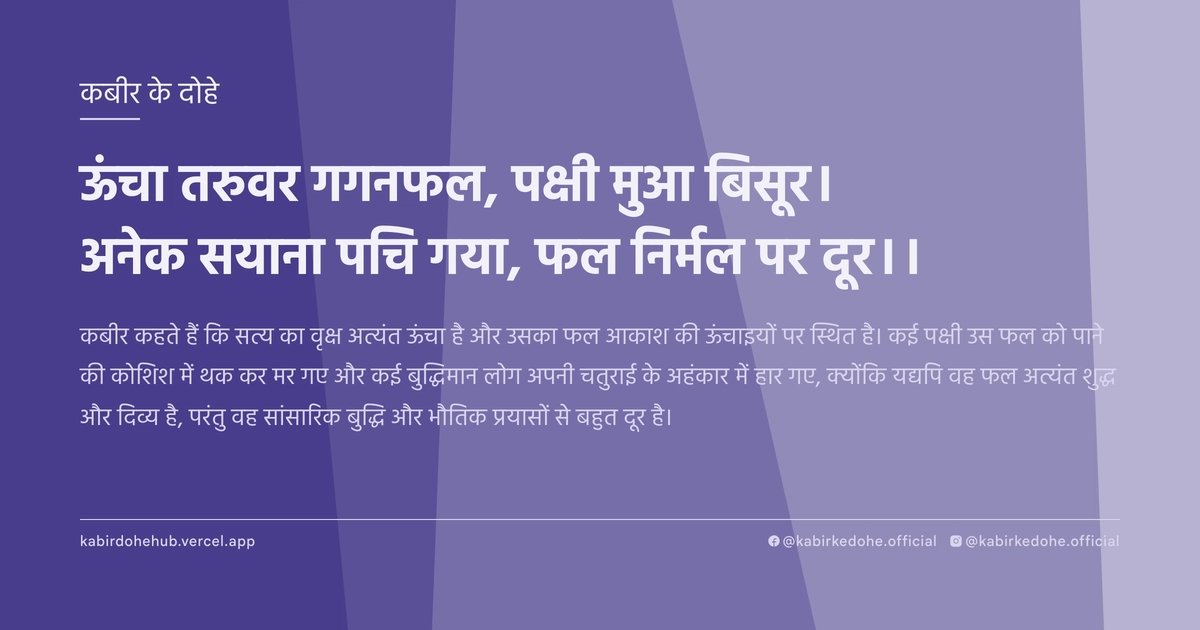
ऊंचा तरुवर गगनफल, पक्षी मुआ बिसूर।
अनेक सयाना पचि गया, फल निर्मल पर दूर।।
Uncha taruvar gaganphal, pakshi mua bisoor. Anek sayana pachi gaya, phal nirmal par door.
इस पृष्ठ पर इस कबीर दोहे का अर्थ (meaning), हिंदी व्याख्या और अंग्रेज़ी अनुवाद, दार्शनिक विश्लेषण और व्यावहारिक जीवन सीख दी गई है। यह दोहा अनित्य (Impermanence) विषय से जुड़ा है — Kabir doha meaning and explanation in Hindi and English.
अर्थ (Meaning):
कबीर कहते हैं कि सत्य का वृक्ष अत्यंत ऊंचा है और उसका फल आकाश की ऊंचाइयों पर स्थित है। कई पक्षी उस फल को पाने की कोशिश में थक कर मर गए और कई बुद्धिमान लोग अपनी चतुराई के अहंकार में हार गए, क्योंकि यद्यपि वह फल अत्यंत शुद्ध और दिव्य है, परंतु वह सांसारिक बुद्धि और भौतिक प्रयासों से बहुत दूर है।
Kabir observes that the tree of Truth is toweringly high, with its fruit hanging in the celestial heights. Many birds, symbolizing seekers, perished in their desperate struggle to reach it, and many who deemed themselves wise were defeated by their own intellect, for while the fruit is pure and divine, it remains distant from those relying on worldly logic and physical effort.
व्याख्या (Interpretation):
इस दोहे का शाब्दिक अर्थ एक ऊंचे वृक्ष और उसकी पहुंच से बाहर के फल से है, लेकिन यह वास्तव में 'परमतत्व' या 'मोक्ष' का रूपक है। 'ऊंचा तरुवर' उस अनंत चेतना का प्रतीक है जिसे प्राप्त करना साधारण मानवीय प्रयासों से संभव नहीं है। 'पक्षी' उन साधकों को दर्शाता है जो केवल बाहरी कर्मकांडों या तीव्र इच्छाओं के बल पर सत्य को पाना चाहते हैं, लेकिन अंततः निराशा में डूब जाते हैं। 'सयाना' वह व्यक्ति है जो अपनी बौद्धिक क्षमता और तर्क (Logic) पर गर्व करता है, परंतु आध्यात्मिक सत्य तर्क का विषय नहीं, बल्कि अनुभव का विषय है। यहाँ 'निर्मल फल' निर्गुण ब्रह्म की उस अवस्था को कहते हैं जहाँ कोई द्वैत नहीं रहता। यह विरोधाभास यह दर्शाता है कि सत्य सबके सामने है, फिर भी वह उन लोगों से दूर है जो अपने 'अहंकार' और 'माया' के चश्मे से उसे देखते हैं। अंततः, यह दोहा हमें बताता है कि केवल बौद्धिक विश्लेषण से नहीं, बल्कि पूर्ण समर्पण और अहंकार के विसर्जन से ही उस परम सत्य तक पहुँचा जा सकता है।
Literally, the verse describes a towering tree with fruit beyond reach, but it serves as a profound metaphor for the 'Supreme Truth' or 'Moksha'. The 'towering tree' symbolizes the infinite consciousness that cannot be scaled by ordinary human effort. The 'birds' represent seekers who rely solely on external rituals or desperate cravings, only to perish in frustration. The 'wise' (sayana) refer to those who trust their intellectual prowess and logic, failing to realize that spiritual truth is not a subject of debate but of direct experience. The 'pure fruit' signifies the state of Nirgun Brahman, where all duality ceases to exist. This paradox highlights that while Truth is omnipresent, it remains distant from those viewing it through the lens of 'Maya' (illusion) and 'Ahankar' (ego). Ultimately, the doha teaches that the Divine is not attained through intellectual gymnastics, but through the annihilation of the self and absolute surrender to the formless void.
दार्शनिक विश्लेषण (Philosophical Analysis):
कबीर का यह दोहा उनके युग के धार्मिक पाखंड और केवल किताबी ज्ञान पर आधारित विद्वत्ता पर एक तीखा प्रहार है। उस समय समाज में ब्राह्मणवादी कर्मकांड और सूफी मत के कुछ बाहरी रूपों का बोलबाला था, जहाँ लोग केवल मंत्रों या लंबी प्रार्थनाओं के माध्यम से ईश्वर को पाने का दावा करते थे। कबीर यहाँ 'निर्गुण भक्ति' का समर्थन करते हैं, जहाँ ईश्वर किसी आकार या स्थान में नहीं, बल्कि स्वयं के भीतर स्थित है। वे स्पष्ट करते हैं कि जो व्यक्ति स्वयं को 'सयाना' या बुद्धिमान मानता है, वह वास्तव में सत्य से सबसे दूर है क्योंकि उसका अहंकार ही उसके और परमात्मा के बीच की सबसे बड़ी दीवार है।
अद्वैत वेदांत के परिप्रेक्ष्य में, यह दोहा 'माया' के प्रभाव को दर्शाता है। माया वह पर्दा है जो हमें यह विश्वास दिलाता है कि सत्य 'दूर' है या उसे 'प्राप्त' करना है। जब तक साधक यह सोचता है कि वह फल (सत्य) को 'पाने' की कोशिश कर रहा है, तब तक वह द्वैत (Duality) में फंसा रहता है। सत्य को पाया नहीं जाता, बल्कि स्वयं को मिटाकर उसमें लीन हुआ जाता है। कबीर का दर्शन यहाँ सूफी मत के 'फना' (अहंकार का विनाश) के करीब है, जहाँ प्रेमी (साधक) का अस्तित्व मिट जाता है और केवल प्रिय (ईश्वर) शेष रहता है।
कबीर जाति और वर्ण व्यवस्था के कट्टर विरोधी थे। उनके लिए 'सयाना' होने का अर्थ उच्च कुल में जन्म लेना या शास्त्र पढ़ना नहीं था, बल्कि वह आंतरिक शुद्धि थी जो किसी भी जाति का व्यक्ति प्राप्त कर सकता था। वे तर्क देते हैं कि यदि केवल विद्वत्ता से मोक्ष मिलता, तो दुनिया के सभी पंडित मुक्त होते। लेकिन मोक्ष के लिए 'भाव' और 'प्रेम' की आवश्यकता होती है, न कि पांडित्य की।
मनोवैज्ञानिक स्तर पर, यह दोहा मानवीय महत्वाकांक्षा और उसकी सीमाओं की व्याख्या करता है। मनुष्य अक्सर बाहरी उपलब्धियों को आध्यात्मिक प्रगति मान लेता है। हम जीवन भर 'फल' की तलाश में भागते रहते हैं, यह भूल जाते हैं कि फल की खोज में हम अपनी सहजता और शांति खो देते हैं। कबीर हमें चेतावनी देते हैं कि अत्यधिक बौद्धिक प्रयास कभी-कभी सत्य के मार्ग में बाधा बन जाते हैं, क्योंकि वे मन को और अधिक जटिल बना देते हैं।
अंततः, यह विश्लेषण हमें इस निष्कर्ष पर ले जाता है कि 'निर्मल फल' वह शांति है जो तब आती है जब हम यह स्वीकार कर लेते हैं कि हम अपनी सीमित बुद्धि से असीमित ईश्वर को नहीं जीत सकते। जब 'मैं' (अहंकार) मरता है, तभी वह फल, जो अब तक 'दूर' प्रतीत हो रहा था, वास्तव में हमारे भीतर ही प्रकट होता है। यह दूरी भौतिक नहीं, बल्कि मानसिक और आध्यात्मिक है।
Kabir's doha is a sharp critique of the religious hypocrisy and bookish scholarship prevalent during his era. At a time when society was dominated by Brahmanical rituals and certain external forms of Sufism, many claimed to reach God through mere mantras or lengthy prayers. Kabir advocates for 'Nirgun Bhakti', where the Divine is not found in a specific form or location but resides within the self. He asserts that the person who considers themselves 'wise' (sayana) is actually furthest from the Truth, as their ego acts as the primary barrier between the soul and the Supreme.
From the perspective of Advaita Vedanta, this verse illustrates the influence of 'Maya'. Maya is the veil that convinces us that Truth is 'distant' or something to be 'attained'. As long as the seeker believes they are 'striving' for the fruit, they remain trapped in duality. Truth is not captured; rather, one merges into it by erasing the individual self. Kabir's philosophy here aligns closely with the Sufi concept of 'Fana' (annihilation of the ego), where the lover (seeker) vanishes, leaving only the Beloved (Divine).
Kabir was a fierce opponent of the caste system and social hierarchies. To him, being 'wise' did not mean being born into a high caste or reading scriptures, but achieving an inner purity accessible to anyone regardless of birth. He argues that if scholarship alone led to liberation, all pundits would be liberated. However, salvation requires 'Bhav' (devotion) and 'Prem' (love), not mere erudition.
Psychologically, the doha explores human ambition and its inherent limitations. Humans often mistake external achievements for spiritual progress. We spend our lives chasing the 'fruit', forgetting that in this pursuit, we lose our innate simplicity and peace. Kabir warns that excessive intellectual striving can become an obstacle, as it further complicates the mind and distances it from the direct experience of Being.
Ultimately, this analysis leads to the conclusion that the 'pure fruit' is the peace that arrives when we accept that our limited intellect cannot conquer the limitless Divine. When the 'I' (ego) dies, the fruit that seemed 'distant' is revealed to be within us all along. The distance is not physical, but mental and spiritual—a gap created by the illusion of separation.
मूल संदेश (Core Message):
- बौद्धिक अहंकार सत्य के मार्ग में सबसे बड़ी बाधा है।
- सत्य तर्क से नहीं, बल्कि पूर्ण समर्पण से प्राप्त होता है।
- बाहरी खोज अक्सर आंतरिक शून्यता को छिपाने का प्रयास होती है।
- सादगी और प्रेम, पांडित्य से कहीं अधिक शक्तिशाली हैं।
- जब 'खोजने वाला' मिट जाता है, तब 'खोजा जाने वाला' प्रकट होता है।
- Intellectual ego is the greatest obstacle on the path to Truth.
- Truth is realized through absolute surrender, not through logic.
- External searching is often an attempt to hide internal emptiness.
- Simplicity and love are far more powerful than scholarship.
- When the 'seeker' vanishes, the 'Sought' is revealed.
व्यावहारिक उदाहरण (Practical Example):
एक समय की बात है, वाराणसी के घाटों पर माधव नाम का एक अत्यंत विद्वान पंडित रहता था। माधव ने चारों वेदों का अध्ययन किया था और शहर के सबसे बड़े विद्वानों में गिना जाता था। वह अपनी बुद्धि पर इतना गर्व करता था कि वह हर चर्चा में दूसरों को नीचा दिखाता था। उसका मानना था कि यदि वह कठिनतम ग्रंथों का विश्लेषण कर ले, तो वह ईश्वर के रहस्य को सुलझा लेगा। वह दिन-रात शास्त्रों को पढ़ता, तर्क करता और यह सिद्ध करने में लगा रहता कि मोक्ष केवल गहन अध्ययन से ही संभव है।
उसी घाट के पास, एक बूढ़ा मल्लाह रहता था जिसका नाम रहमत था। रहमत अनपढ़ था, लेकिन उसका हृदय करुणा और प्रेम से भरा था। वह नाव चलाते समय अक्सर गुनगुनाता और ईश्वर को याद करता। माधव अक्सर रहमत का मज़ाक उड़ाता और कहता, "अरे मूर्ख, तू इन गीतों से क्या पाएगा? ईश्वर को पाने के लिए बुद्धि और शास्त्र चाहिए, जो तेरे पास नहीं हैं।"
रहमत बस मुस्कुराता और कहता, "पंडित जी, मैं तो बस उस प्रेमी की तरह हूँ जो अपने प्रिय की याद में रोता है, मुझे आपकी तरह तर्क करना नहीं आता।"
एक दिन माधव एक बहुत बड़ी आध्यात्मिक बहस में हिस्सा लेने गया। वहाँ एक संत ने एक ऐसा प्रश्न पूछा जिसका उत्तर किसी शास्त्र में नहीं था। माधव ने घंटों तर्क किया, अपनी सारी विद्वत्ता लगा दी, लेकिन वह उत्तर नहीं खोज पाया। वह मानसिक तनाव और क्रोध में इतना डूब गया कि उसे लगा कि उसकी पूरी दुनिया ढह गई है। वह हताश होकर घाट पर बैठा था, उसके मन में उथल-पुथल मची थी।
तभी उसने देखा कि रहमत अपनी नाव पर शांति से बैठा है, उसकी आँखों में एक असीम संतोष था। माधव ने चिढ़कर पूछा, "तू इतना खुश क्यों है? तुझे तो कुछ पता ही नहीं है!"
रहमत ने शांति से उत्तर दिया, "पंडित जी, मैं यह नहीं जानता कि ईश्वर कौन है, मैं बस यह जानता हूँ कि वह मेरे साथ है। मैंने उसे खोजने की कोशिश छोड़ दी, और जैसे ही मैंने खोज बंद की, मुझे महसूस हुआ कि वह तो यहीं है।"
माधव को अचानक कबीर का वह दोहा याद आया—"अनेक सयाना पचि गया, फल निर्मल पर दूर।" उसे अहसास हुआ कि उसकी सारी विद्वत्ता एक ऊंचे पेड़ की टहनी पर चढ़ने की कोशिश जैसी थी, जिसमें वह थक कर चूर हो गया था, जबकि रहमत ने बस पेड़ की जड़ में बैठकर शांति पाई थी।
उस दिन माधव का अहंकार टूट गया। उसने अपनी पोथियाँ एक तरफ रखीं और पहली बार रहमत के साथ बैठकर मौन रहकर उस 'निर्मल फल' को महसूस करने की कोशिश की।
उसने सीखा कि सत्य तर्क का विषय नहीं, बल्कि समर्पण का विषय है। माधव अब भी पढ़ता था, लेकिन अब वह ज्ञान का उपयोग दूसरों को नीचा दिखाने के लिए नहीं, बल्कि स्वयं को मिटाने के लिए करता था।
उसका जीवन अब शास्त्रों के बोझ से मुक्त होकर प्रेम की सरलता में बदल गया था।
Once, on the ghats of Varanasi, lived a highly learned scholar named Madhav. Madhav had studied the four Vedas and was considered one of the city's greatest intellectuals. He was so proud of his intellect that he often belittled others in discussions. He believed that if he could analyze the most complex texts, he would solve the mystery of God. He spent his days and nights reading scriptures, arguing, and trying to prove that liberation was possible only through profound study.
Near the same ghat lived an old boatman named Rahmat. Rahmat was illiterate, but his heart was overflowing with compassion and love. While rowing his boat, he would often hum melodies and remember the Divine. Madhav frequently mocked Rahmat, saying, "You fool, what will you achieve with these songs? To reach God, one needs intellect and scriptures, which you lack."
Rahmat would simply smile and reply, "Pandit ji, I am merely like a lover who weeps in memory of the Beloved; I do not know how to argue like you."
One day, Madhav participated in a grand spiritual debate. A saint there posed a question whose answer was not found in any scripture. Madhav argued for hours, employing all his erudition, but he could not find the answer. He became so consumed by mental stress and anger that he felt his entire world collapsing. He sat on the ghat, devastated and restless.
Just then, he saw Rahmat sitting peacefully on his boat, an infinite contentment in his eyes. Madhav asked irritably, "Why are you so happy? You know nothing!"
Rahmat replied calmly, "Pandit ji, I do not know who God is; I only know that He is with me. I stopped trying to 'find' Him, and the moment I stopped searching, I realized He was already here."
Madhav suddenly remembered Kabir's doha—"Many wise ones were defeated, the pure fruit remains distant." He realized that all his scholarship was like trying to climb the highest branch of a tree, leaving him exhausted, while Rahmat had simply found peace by sitting at the root.
That day, Madhav's ego shattered. He set aside his manuscripts and, for the first time, sat with Rahmat in silence, trying to feel that 'pure fruit'.
He learned that Truth is not a matter of logic, but of surrender.
Madhav continued to read, but he no longer used knowledge to belittle others; instead, he used it to dissolve himself.
His life, once burdened by the weight of scriptures, transformed into the simplicity of love.
अभ्यास मार्गदर्शन (Practice Guidance):
- प्रतिदिन 20 मिनट 'मौन चिंतन' का अभ्यास करें, जहाँ आप किसी भी विचार को सही या गलत साबित करने का प्रयास न करें, बस साक्षी भाव से देखें।
- एक 'अहंकार डायरी' लिखें: दिन भर में जब भी आप किसी को अपनी बुद्धि से नीचा दिखाएं या खुद को श्रेष्ठ महसूस करें, उसे लिखें और विश्लेषण करें कि वह कौन सा डर था जिसने आपको ऐसा करने पर मजबूर किया।
- व्यवहार परिवर्तन: सप्ताह में एक बार किसी ऐसे व्यक्ति की बात सुनें जिसे समाज 'अज्ञानी' मानता है, और बिना किसी निर्णय (Judgment) के उनके जीवन के सरल सत्य को समझने का प्रयास करें।
- डायग्नोस्टिक चेकलिस्ट: यदि आप अभी भी सत्य को 'प्राप्त' करने के लिए संघर्ष कर रहे हैं, तनावग्रस्त हैं, या दूसरों की आध्यात्मिक स्थिति पर टिप्पणी कर रहे हैं, तो इसका अर्थ है कि आप अभी भी 'सयाना' (बौद्धिक अहंकार) के जाल में हैं।
- Practice 20 minutes of 'Silent Contemplation' daily, where you do not attempt to prove any thought right or wrong, but simply observe as a witness.
- Maintain an 'Ego Diary': Whenever you belittle someone with your intellect or feel superior during the day, record it and analyze the underlying fear that drove that need for superiority.
- Behavioral Shift: Once a week, listen deeply to someone whom society deems 'uneducated' or 'ignorant', and try to understand the simple truths of their life without any judgment.
- Diagnostic Checklist: If you are still struggling to 'attain' Truth, feeling stressed by the lack of progress, or commenting on others' spiritual states, it indicates you are still trapped in the web of 'Sayana' (intellectual ego).
चिंतन प्रश्न (Reflection Questions):
- क्या मेरी बौद्धिक क्षमताएं मुझे सत्य के करीब ले जा रही हैं, या वे मेरे चारों ओर एक ऐसा किला बना रही हैं जिसमें मैं कैद हूँ?
- मैं अपनी सार्वजनिक पहचान (विद्वान, सफल, ज्ञानी) को बचाने के लिए अपने भीतर की कितनी अज्ञानता को छिपाता हूँ?
- क्या मैं वास्तव में सत्य को जानना चाहता हूँ, या मैं केवल 'सत्य जानने वाले' के रूप में पहचाना जाना चाहता हूँ?
- मेरे जीवन का वह कौन सा क्षेत्र है जहाँ मैं तर्क का उपयोग केवल अपनी गलतियों को सही ठहराने के लिए करता हूँ?
- यदि मुझसे मेरी सारी डिग्रियाँ और ज्ञान छीन लिया जाए, तो मेरी आत्मा के पास ईश्वर के सामने पेश करने के लिए क्या बचेगा?
- क्या मैं उन लोगों का सम्मान करता हूँ जो सरल हैं, या मैं गुप्त रूप से उनकी सरलता को मूर्खता समझता हूँ?
- Are my intellectual capabilities bringing me closer to Truth, or are they building a fortress around me in which I am imprisoned?
- How much of my inner ignorance do I hide to preserve my public identity as a scholar, successful person, or knowledgeable individual?
- Do I truly desire to know the Truth, or do I simply wish to be recognized as 'one who knows the Truth'?
- In which area of my life do I use logic merely to justify my own mistakes?
- If all my degrees and knowledge were stripped away, what would remain in my soul to present before the Divine?
- Do I genuinely respect those who are simple, or do I secretly mistake their simplicity for ignorance?