
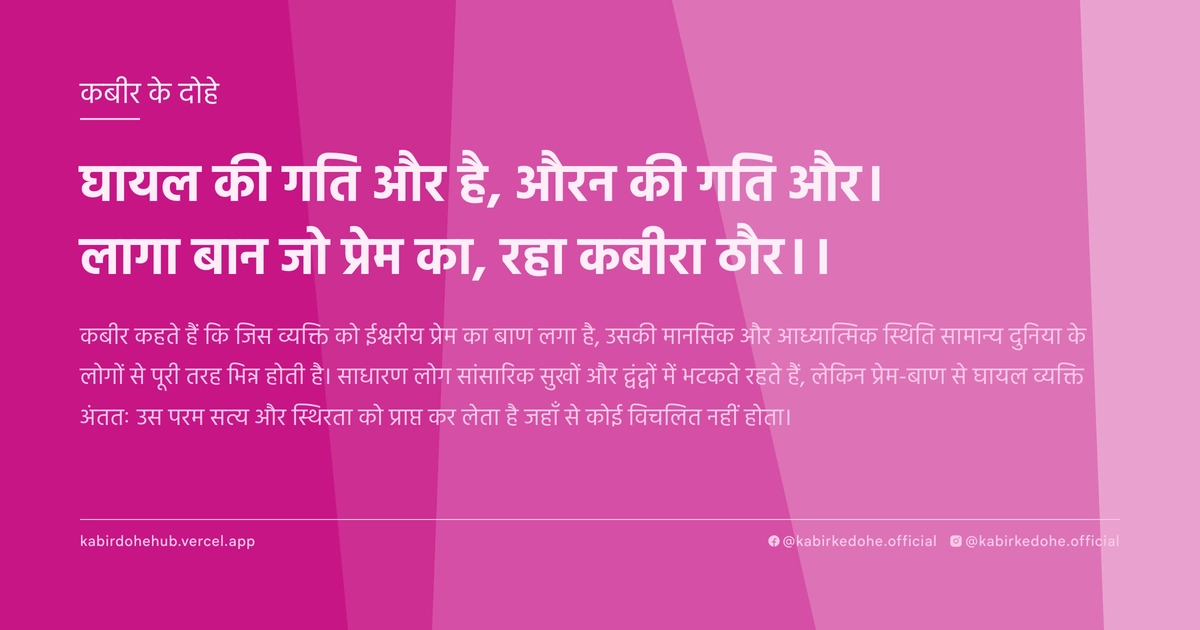
घायल की गति और है, औरन की गति और।
लागा बान जो प्रेम का, रहा कबीरा ठौर।।
Ghayal ki gati aur hai, auran ki gati aur. Laga baan jo prem ka, raha kabira thaur.
इस पृष्ठ पर इस कबीर दोहे का अर्थ (meaning), हिंदी व्याख्या और अंग्रेज़ी अनुवाद, दार्शनिक विश्लेषण और व्यावहारिक जीवन सीख दी गई है। यह दोहा भक्ति (Bhakti) विषय से जुड़ा है — Kabir doha meaning and explanation in Hindi and English.
अर्थ (Meaning):
कबीर कहते हैं कि जिस व्यक्ति को ईश्वरीय प्रेम का बाण लगा है, उसकी मानसिक और आध्यात्मिक स्थिति सामान्य दुनिया के लोगों से पूरी तरह भिन्न होती है। साधारण लोग सांसारिक सुखों और द्वंद्वों में भटकते रहते हैं, लेकिन प्रेम-बाण से घायल व्यक्ति अंततः उस परम सत्य और स्थिरता को प्राप्त कर लेता है जहाँ से कोई विचलित नहीं होता।
Kabir asserts that the state of one struck by the arrow of divine love is fundamentally different from that of the ordinary world. While common people wander in the turbulence of worldly desires and dualities, the one wounded by the arrow of love attains a state of ultimate stillness and permanence, reaching a sanctuary from which there is no further wandering.
व्याख्या (Interpretation):
यहाँ 'घायल' होना कोई शारीरिक चोट नहीं, बल्कि अहंकार का विनाश है। साधारण मनुष्य की 'गति' माया के चक्र में घूमना है, जहाँ वह जन्म, मृत्यु और इच्छाओं के बीच झूलता है। जब प्रेम का बाण (दिव्य विरह) हृदय में लगता है, तो वह व्यक्ति बाहरी दुनिया के प्रति उदासीन हो जाता है। यह स्थिति निर्गुण भक्ति की पराकाष्ठा है, जहाँ भक्त और भगवान के बीच का द्वैत समाप्त हो जाता है। कबीर यहाँ एक विरोधाभास प्रस्तुत करते हैं: जिसे दुनिया 'घायल' या 'पागल' समझती है, वही वास्तव में 'ठौर' यानी परम स्थिरता और मोक्ष को प्राप्त करता है। यह अद्वैत वेदांत के उस सत्य को दर्शाता है जहाँ आत्मा का परमात्मा में विलीनीकरण ही एकमात्र वास्तविक गंतव्य है।
Being 'wounded' here does not signify physical injury, but the annihilation of the ego. The 'gati' or trajectory of the ordinary person is a circular drift within the illusions of Maya, oscillating between desire and despair. When the arrow of divine love (the agony of separation) pierces the heart, the seeker becomes indifferent to external validations. This represents the pinnacle of Nirgun Bhakti, where the duality between the devotee and the Divine dissolves. Kabir presents a profound paradox: the one whom the world perceives as 'broken' or 'mad' is the only one who has found the 'thaur'—the ultimate sanctuary of stillness. This mirrors the Advaita Vedanta truth that the merging of Atman into Brahman is the only authentic destination.
दार्शनिक विश्लेषण (Philosophical Analysis):
कबीर का यह दोहा मध्यकालीन भारत के उस सामाजिक और धार्मिक परिवेश में लिखा गया जहाँ कर्मकांड और बाहरी आडंबरों का बोलबाला था। कबीर ने स्पष्ट किया कि ईश्वर को पाने के लिए किसी मंदिर, मस्जिद या कठिन तपस्या की आवश्यकता नहीं है, बल्कि केवल 'प्रेम' ही वह कुंजी है जो हृदय के द्वार खोलती है। यह दृष्टिकोण सूफीवाद के 'इश्क-ए-हकीकी' (ईश्वरीय प्रेम) से गहराई से मेल खाता है, जहाँ प्रेमी अपने अस्तित्व को मिटाकर प्रिय (ईश्वर) में विलीन हो जाता है।
दार्शनिक स्तर पर, 'प्रेम का बाण' उस आध्यात्मिक जागृति का प्रतीक है जो मनुष्य को उसकी अज्ञानता (Avidya) से मुक्त करती है। जब तक मनुष्य स्वयं को शरीर या सामाजिक पहचान मानता है, वह 'औरन' (दूसरों) की तरह भटकता रहता है। लेकिन जैसे ही वह अपनी वास्तविक प्रकृति को पहचानता है, उसका अहंकार नष्ट हो जाता है। यह अहंकार का विनाश ही वह 'घाव' है जो वास्तव में उसे मुक्त करता है।
कबीर यहाँ जाति और धर्म के भेदों को पूरी तरह नकारते हैं। उनके लिए प्रेम एक सार्वभौमिक शक्ति है जो किसी विशेष संप्रदाय की बपौती नहीं है। वे बताते हैं कि जो लोग केवल शास्त्रों को पढ़ते हैं या माला जपते हैं बिना हृदय में प्रेम के, वे अभी भी 'औरन की गति' में हैं। वास्तविक भक्ति वह है जो व्यक्ति को पूरी तरह बदल दे और उसे एक ऐसी स्थिति में ले जाए जहाँ वह संसार में रहते हुए भी संसार से मुक्त हो।
मनोवैज्ञानिक रूप से, यह दोहा 'समर्पण' (Surrender) की बात करता है। जब मनुष्य अपनी इच्छाओं का त्याग कर पूर्णतः ईश्वर के प्रति समर्पित होता है, तो उसका मानसिक संघर्ष समाप्त हो जाता है। यह समर्पण ही उसे उस 'ठौर' पर पहुँचाता है जहाँ शांति और स्थिरता का वास है। यहाँ 'घायल' होना वास्तव में एक आध्यात्मिक सर्जरी है, जहाँ अज्ञानता के ट्यूमर को प्रेम के बाण से हटाया जाता है।
अंततः, यह दोहा हमें सिखाता है कि आध्यात्मिक मार्ग पर चलने का अर्थ सुख की खोज नहीं, बल्कि उस 'दिव्य पीड़ा' को स्वीकार करना है जो हमें शुद्ध करती है। यह पीड़ा हमें यह एहसास दिलाती है कि हम इस भौतिक जगत के नहीं, बल्कि उस अनंत चेतना के अंश हैं। जब यह बोध गहरा होता है, तब व्यक्ति की गति बदल जाती है और वह उस परम सत्य में स्थिर हो जाता है जिसे कबीर 'ठौर' कहते हैं।
This couplet was composed during a medieval Indian era dominated by rigid ritualism and external religious displays. Kabir clarifies that reaching the Divine requires neither temples, mosques, nor arduous penance; rather, 'Love' is the sole key that unlocks the heart's door. This perspective aligns deeply with the Sufi concept of 'Ishq-e-Haqiqi' (Divine Love), where the lover annihilates their own existence to merge with the Beloved.
Philosophically, the 'arrow of love' symbolizes the spiritual awakening that liberates a human from ignorance (Avidya). As long as a person identifies with the body or a social persona, they continue the 'gati' of the masses—wandering in circles. However, the moment they recognize their true nature, the ego is shattered. This destruction of the ego is the 'wound' that actually sets them free.
Kabir completely rejects the divisions of caste and creed. For him, love is a universal force, not the property of any specific sect. He suggests that those who merely read scriptures or chant beads without heartfelt love are still caught in the 'trajectory of others.' True devotion is that which transforms the individual entirely, allowing them to live in the world while remaining detached from it.
Psychologically, the verse speaks of 'Surrender.' When a human relinquishes their personal desires and surrenders completely to the Divine, their internal conflict ceases. This surrender leads them to the 'thaur'—the sanctuary of absolute peace. Being 'wounded' is, in essence, a spiritual surgery where the tumor of ignorance is excised by the arrow of love.
Ultimately, the doha teaches that the spiritual path is not about seeking pleasure, but about embracing the 'divine agony' that purifies the soul. This pain serves as a reminder that we do not belong to this material plane, but are fragments of an infinite consciousness. When this realization deepens, the individual's trajectory shifts, and they stabilize in the ultimate truth that Kabir calls the 'thaur'.
मूल संदेश (Core Message):
- सांसारिक दौड़ केवल भ्रम और थकान पैदा करती है।
- अहंकार का टूटना ही वास्तविक आध्यात्मिक जन्म है।
- दिव्य प्रेम वह अग्नि है जो अशुद्धियों को जला देती है।
- स्थिरता बाहरी दुनिया में नहीं, आंतरिक समर्पण में है।
- जब 'मैं' मिटता है, तभी 'वह' प्रकट होता है।
- The worldly race produces only illusion and exhaustion.
- The breaking of the ego is the true spiritual birth.
- Divine love is the fire that incinerates all impurities.
- Stillness is found not in the external world, but in internal surrender.
- Only when the 'I' vanishes does the 'Divine' manifest.
व्यावहारिक उदाहरण (Practical Example):
एक समय की बात है, वाराणसी के घाटों पर माधव नाम का एक बुनकर रहता था। माधव बहुत कुशल था, लेकिन उसका मन हमेशा अशांत रहता था। वह अपनी जाति, अपनी प्रतिष्ठा और अपने धन को लेकर हमेशा चिंतित रहता था। वह शहर के सबसे बड़े पंडितों और मौलवियों के पास जाता, दान देता और कठिन व्रत रखता, फिर भी उसे वह शांति नहीं मिली जिसे वह खोज रहा था। वह 'औरन की गति' में था—दौड़ रहा था, लेकिन कहीं पहुँच नहीं रहा था।
एक दिन उसकी मुलाकात एक फकीर से हुई जो सड़क किनारे बैठा था। फकीर ने माधव की बेचैनी देखी और बस इतना कहा, "तू जिसे खोज रहा है, वह बाहर नहीं, तेरे भीतर के उस घाव में है जिसे तू भरने की कोशिश कर रहा है।"
माधव को पहले तो यह बात समझ नहीं आई। लेकिन धीरे-धीरे उसने महसूस किया कि उसकी सारी चिंताएँ उसके 'अहंकार' से जुड़ी थीं। वह चाहता था कि लोग उसे 'महान बुनकर' कहें, वह चाहता था कि उसका बेटा सबसे बड़ा विद्वान बने। उसने महसूस किया कि यह 'मैं' और 'मेरा' ही वह बोझ है जो उसे थका रहा है।
एक रात, माधव ने अपनी सारी उपलब्धियों और अपनी पहचान को ईश्वर के चरणों में समर्पित कर दिया। उसने रोते हुए प्रार्थना की, "हे प्रभु, मैं इस अहंकार के बोझ से थक गया हूँ, मुझे अपने प्रेम के बाण से घायल कर दो ताकि मैं मिट जाऊँ।"
उस क्षण, माधव के भीतर कुछ टूट गया। वह 'घायल' हो गया। अब उसे इस बात की परवाह नहीं थी कि लोग उसके बारे में क्या सोचते हैं या उसका व्यापार कितना बढ़ रहा है। उसने देखा कि उसके सामने खड़ा भिखारी भी वही ईश्वर है और उसका दुश्मन भी वही ईश्वर है।
उसका व्यवहार पूरी तरह बदल गया। वह अब केवल पैसे के लिए कपड़े नहीं बुनता था, बल्कि हर धागे में प्रेम पिरोने लगा। उसकी आँखों में एक ऐसी चमक और चेहरे पर ऐसी शांति आ गई जो पहले कभी नहीं थी।
लोग हैरान थे कि माधव अब पहले से ज्यादा खुश है, जबकि उसके पास अब पहले जैसा अहंकार नहीं है। वह अब विवादों में नहीं पड़ता था, बल्कि सबकी मदद करता था।
जब उससे पूछा गया कि यह बदलाव कैसे आया, तो उसने मुस्कुराकर कहा, "मैं अब तक भाग रहा था, लेकिन जब प्रेम के बाण ने मुझे घायल किया, तब जाकर मैं ठहर पाया।"
माधव अब उस 'ठौर' पर था जहाँ न कोई डर था, न कोई लालच। वह दुनिया में था, लेकिन दुनिया उसके भीतर नहीं थी।
उसका जीवन अब एक निरंतर प्रार्थना बन गया था, और उसकी शांति दूसरों के लिए एक प्रेरणा बन गई।
Once, in the ghats of Varanasi, lived a weaver named Madhav. Madhav was highly skilled, but his mind was perpetually restless. He was constantly anxious about his caste, his prestige, and his wealth. He visited the city's most renowned priests and clerics, gave lavish donations, and observed rigorous fasts, yet the peace he sought remained elusive. He was in the 'gati' of others—running incessantly but arriving nowhere.
One day, he encountered a wandering fakir sitting by the roadside. Seeing Madhav's agitation, the fakir simply said, "That which you seek is not outside, but within that wound you are so desperately trying to heal."
At first, Madhav did not understand. But gradually, he realized that all his anxieties were tied to his 'ego.' He wanted to be called the 'greatest weaver'; he wanted his son to be the most learned scholar. He realized that this 'I' and 'Mine' was the very burden exhausting him.
One night, Madhav surrendered all his achievements and his identity at the feet of the Divine. He prayed with tears, "O Lord, I am exhausted by this burden of ego; pierce me with the arrow of Your love so that I may vanish."
In that moment, something within Madhav broke. He became 'wounded.' He no longer cared what people thought of him or how much his business grew. He began to see that the beggar before him was the Divine, and his enemy was also the Divine.
His behavior transformed completely. He no longer wove cloth merely for money; he began weaving love into every thread. A radiance appeared in his eyes and a serenity on his face that had never been there before.
People were astonished that Madhav was now happier than ever, despite having lost his arrogance. He no longer engaged in conflicts; instead, he helped everyone unconditionally.
When asked how this change occurred, he smiled and said, "I was running until now, but when the arrow of love wounded me, I finally found the place to stand still."
Madhav was now at that 'thaur' where there was neither fear nor greed. He was in the world, but the world was no longer within him.
His life became a continuous prayer, and his peace became an inspiration for all around him.
अभ्यास मार्गदर्शन (Practice Guidance):
- प्रतिदिन 20 मिनट मौन रहकर यह विचार करें कि आपकी कौन सी पहचान (नाम, पद, रिश्ता) आपको वास्तव में बांधे हुए है और उसे मानसिक रूप से समर्पित करें।
- एक 'अहंकार डायरी' लिखें: दिन भर में जब भी आपको क्रोध, ईर्ष्या या श्रेष्ठता का अनुभव हो, उसे लिखें और विश्लेषण करें कि वहाँ 'मैं' कहाँ खड़ा था।
- सेवा का अभ्यास: किसी ऐसे व्यक्ति की निस्वार्थ मदद करें जिससे आपका कोई संबंध नहीं है, यह महसूस करते हुए कि आप स्वयं की ही सेवा कर रहे हैं।
- निदान चेकलिस्ट: क्या आप अभी भी दूसरों की प्रशंसा पर खुश और आलोचना पर दुखी होते हैं? यदि हाँ, तो आप अभी भी 'औरन की गति' में हैं। क्या आप अकेलेपन में भी पूर्ण महसूस करते हैं? यदि हाँ, तो आप 'ठौर' की ओर बढ़ रहे हैं।
- Spend 20 minutes daily in silence, contemplating which identity (name, position, relationship) truly binds you, and mentally surrender it to the Divine.
- Maintain an 'Ego Diary': Whenever you feel anger, jealousy, or a sense of superiority during the day, record it and analyze where the 'I' was standing.
- Practice selfless service: Help someone with whom you have no connection, realizing that you are serving the Divine within them.
- Diagnostic Checklist: Do you still feel elated by praise and crushed by criticism? If yes, you are still in the 'gati' of others. Do you feel complete even in solitude? If yes, you are moving toward the 'thaur'.
चिंतन प्रश्न (Reflection Questions):
- यदि आपकी सारी सामाजिक उपलब्धियाँ और पद छीन लिए जाएँ, तो आपके पास क्या बचेगा?
- आपकी वह कौन सी गुप्त इच्छा है जो आपको शांति से बैठने नहीं देती और आपको निरंतर 'दौड़ाती' रहती है?
- क्या आप वास्तव में प्रेम करते हैं, या आप केवल उस प्रेम के बदले में मिलने वाले सुख और प्रशंसा से प्रेम करते हैं?
- आपके जीवन का वह कौन सा 'घाव' है जिसे आप छिपाते रहे हैं, लेकिन वही आपकी मुक्ति का द्वार बन सकता है?
- डिजिटल युग में, आपकी ऑनलाइन छवि (Digital Ego) आपको वास्तविक सत्य से कितना दूर ले जा रही है?
- If all your social achievements and titles were stripped away, what would remain of you?
- What is that secret desire that prevents you from sitting in peace and keeps you 'running' incessantly?
- Do you truly love, or do you only love the pleasure and validation that come as a result of love?
- What is that 'wound' in your life that you have hidden, which could actually become the gateway to your liberation?
- In the digital age, how far is your online persona (Digital Ego) distancing you from the actual truth?