
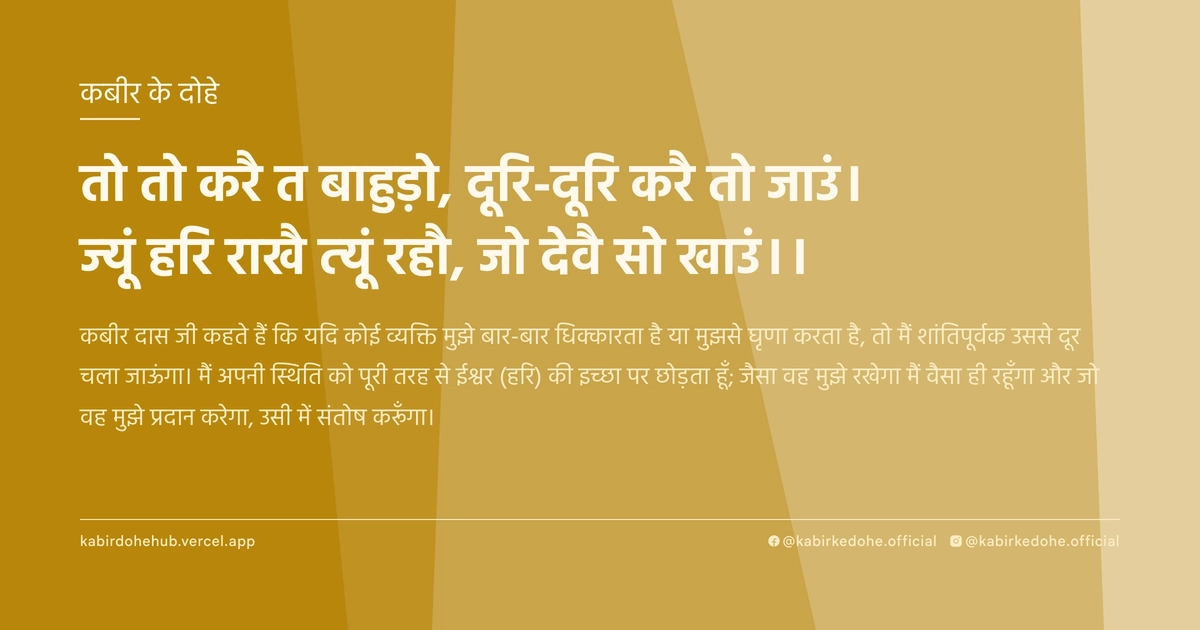
तो तो करै त बाहुड़ो, दूरि-दूरि करै तो जाउं।
ज्यूं हरि राखै त्यूं रहौ, जो देवै सो खाउं।।
To to karai ta bahudo, doori-doori karai to jaun. Jyoon Hari rakhai tyoon rahou, jo devai so khaun.
इस पृष्ठ पर इस कबीर दोहे का अर्थ (meaning), हिंदी व्याख्या और अंग्रेज़ी अनुवाद, दार्शनिक विश्लेषण और व्यावहारिक जीवन सीख दी गई है। यह दोहा संतोष (Contentment) विषय से जुड़ा है — Kabir doha meaning and explanation in Hindi and English.
अर्थ (Meaning):
कबीर दास जी कहते हैं कि यदि कोई व्यक्ति मुझे बार-बार धिक्कारता है या मुझसे घृणा करता है, तो मैं शांतिपूर्वक उससे दूर चला जाऊंगा। मैं अपनी स्थिति को पूरी तरह से ईश्वर (हरि) की इच्छा पर छोड़ता हूँ; जैसा वह मुझे रखेगा मैं वैसा ही रहूँगा और जो वह मुझे प्रदान करेगा, उसी में संतोष करूँगा।
Kabir suggests that if someone repeatedly insults or rejects him, he will simply distance himself from them without conflict. He advocates for a state of total surrender to the Divine Will (Hari), accepting whatever life circumstances and sustenance the Creator provides with absolute contentment and equanimity.
व्याख्या (Interpretation):
यह दोहा पूर्ण समर्पण और वैराग्य की पराकाष्ठा को दर्शाता है। 'दूर-दूरि' जाने का अर्थ केवल भौतिक दूरी नहीं, बल्कि मानसिक आसक्ति का त्याग है। यहाँ 'हरि' केवल एक देवता नहीं, बल्कि उस निराकार ब्रह्म (Nirgun Brahman) का प्रतीक है जो संपूर्ण अस्तित्व को संचालित करता है। कबीर माया के जाल से मुक्त होने की बात कर रहे हैं, जहाँ मनुष्य दूसरों की प्रतिक्रियाओं से अपनी खुशी तय करता है। जब साधक यह समझ जाता है कि आत्मा और परमात्मा एक हैं (Advaita), तब वह बाहरी प्रशंसा या निंदा से ऊपर उठ जाता है। यह विरोधाभास है कि पूर्ण समर्पण में ही वास्तविक स्वतंत्रता निहित है।
This couplet depicts the pinnacle of surrender and detachment. 'Moving far away' signifies not just physical distance, but the severance of emotional attachment to the ego's validation. 'Hari' here represents the Formless Absolute (Nirgun Brahman) that governs all existence. Kabir addresses the liberation from Maya, where humans typically tie their happiness to external reactions. Once the seeker realizes the non-duality of Atman and Brahman, they transcend the duality of praise and insult. The central paradox is that absolute surrender to the Divine Will is the only path to true spiritual autonomy.
दार्शनिक विश्लेषण (Philosophical Analysis):
कबीर का यह दृष्टिकोण उनके युग के कट्टरपंथी धार्मिक संघर्षों के प्रति एक मौन प्रतिक्रिया है। उन्होंने देखा कि कैसे लोग धर्म और जाति के नाम पर एक-दूसरे से घृणा करते थे। इस दोहे में वे 'अहंकार' के विसर्जन की बात करते हैं। जब हम कहते हैं 'मैं' अपमानित महसूस कर रहा हूँ, तो वह 'मैं' ही बंधन है। कबीर का दर्शन सूफी मत के 'फना' (अस्तित्व का मिट जाना) और अद्वैत वेदांत के 'अहं ब्रह्मास्मि' का संगम है।
वे कर्मकांडों और सामाजिक प्रतिष्ठा की दौड़ को निरर्थक मानते हैं। उनके लिए, ईश्वर की इच्छा में रजामंदी (Raza) ही सर्वोच्च साधना है। यह केवल भाग्यवादिता नहीं है, बल्कि एक मनोवैज्ञानिक रूपांतरण है जहाँ व्यक्ति बाहरी दुनिया की अस्थिरता से हटकर आंतरिक स्थिरता की ओर बढ़ता है।
यहाँ 'जो देवै सो खाउं' केवल भोजन की बात नहीं है, बल्कि जीवन के हर अनुभव—सुख और दुख—को प्रसाद के रूप में स्वीकार करने की कला है। यह मानसिक शांति का वह स्तर है जहाँ व्यक्ति प्रतिक्रिया (Reaction) के बजाय प्रतिक्रिया-रहित साक्षी (Witness) बन जाता है।
ऐतिहासिक रूप से, कबीर ने समाज के सबसे निचले तबके को यह सिखाया कि उनकी गरिमा किसी बाहरी मान्यता की मोहताज नहीं है, बल्कि वह उनके भीतर के ईश्वर से जुड़ी है। यह सामाजिक विद्रोह का एक सूक्ष्म लेकिन शक्तिशाली रूप है।
अंततः, यह दोहा हमें सिखाता है कि जब हम अपनी इच्छाओं को ब्रह्मांडीय इच्छा के साथ संरेखित करते हैं, तो संघर्ष समाप्त हो जाता है। यह द्वैत (Dualism) से अद्वैत (Non-dualism) की यात्रा है, जहाँ 'देने वाला' और 'लेने वाला' दोनों एक ही चेतना के रूप हैं।
Kabir's perspective is a silent yet potent response to the rigid religious conflicts of his era. He witnessed how people clung to caste and creed, fueling hatred. In this verse, he advocates for the dissolution of the 'I-ego'. The feeling of being insulted only exists because the ego believes it possesses a separate identity that can be harmed.
His philosophy merges the Sufi concept of 'Fana' (annihilation of the self) with the Advaita Vedanta realization of non-duality. He views the pursuit of social status and ritualistic purity as distractions from the internal truth. For Kabir, alignment with the Divine Will (Raza) is the highest form of spiritual practice.
This is not mere fatalism, but a profound psychological transformation. By shifting focus from external volatility to internal stillness, the seeker moves from reaction to observation. The phrase 'whatever He gives, I shall eat' transcends physical sustenance; it is an invitation to accept every life experience—joy or agony—as a divine offering (Prasad).
Historically, Kabir empowered the marginalized by teaching that their dignity did not depend on societal validation but on their inherent connection to the Formless Divine. This was a subtle yet revolutionary act of social defiance through spiritual sovereignty.
Ultimately, the couplet teaches that conflict ends when individual desire aligns with the cosmic flow. It is a journey from duality to non-duality, where the giver, the receiver, and the gift are recognized as manifestations of a single, universal consciousness.
मूल संदेश (Core Message):
- बाहरी संघर्षों से दूरी ही आंतरिक शांति का द्वार है।
- अहंकार का विसर्जन ही वास्तविक स्वतंत्रता की पहली शर्त है।
- ईश्वर की इच्छा को स्वीकार करना मानसिक तनाव का अंत है।
- संतोष वह धन है जो किसी भी भौतिक संपत्ति से बड़ा है।
- हम केवल माध्यम हैं, कर्ता नहीं; यह बोध ही मुक्ति है।
- Distancing oneself from external conflicts is the gateway to inner peace.
- The dissolution of ego is the primary condition for true liberation.
- Accepting the Divine Will is the ultimate cure for mental stress.
- Contentment is a wealth far greater than any material possession.
- Realizing we are mere instruments, not the doers, is the path to freedom.
व्यावहारिक उदाहरण (Practical Example):
वाराणसी के एक पुराने घाट पर रामदीन नाम का एक वृद्ध नाविक रहता था। वह स्वभाव से अत्यंत सरल था, लेकिन उसके पड़ोस के अन्य नाविक उसे उसकी गरीबी और उसकी सादगी के कारण अक्सर नीचा दिखाते थे। कुछ लोग उसे 'मूर्ख' कहते और उसकी नाव की पुरानी स्थिति का मजाक उड़ाते थे।
रामदीन ने कभी पलटकर जवाब नहीं दिया। जब लोग उसे अपशब्द कहते, वह बस मुस्कुराता और धीरे से अपनी नाव लेकर दूर चला जाता। वह मानता था कि जो लोग उसे कोस रहे हैं, वे वास्तव में अपने ही भीतर के क्रोध से लड़ रहे हैं।
एक बार एक धनी व्यापारी ने रामदीन को बहुत बुरा-भला कहा क्योंकि उसकी नाव थोड़ी धीमी थी। व्यापारी ने उसे 'अक्षम' और 'बेकार' कहा। रामदीन ने शांत भाव से कहा, "सेठ जी, यह नाव और मेरी गति उसी की इच्छा है जिसने मुझे बनाया है।"
व्यापारी को पहले तो यह बात बेतुकी लगी, लेकिन रामदीन की आँखों में एक ऐसी शांति थी जो उसने बड़े-बड़े विद्वानों में भी नहीं देखी थी। रामदीन के पास बहुत कम संसाधन थे, लेकिन वह कभी शिकायत नहीं करता था।
वह दिन भर में जो भी थोड़ा-बहुत कमाता, उसमें से एक हिस्सा किसी भूखे को खिला देता। वह कहता, "हरि ने दिया है, तो हरि का ही हिस्सा है।"
धीरे-धीरे, उसकी इस अडिग शांति ने उस व्यापारी को प्रभावित किया। व्यापारी ने महसूस किया कि वह अपनी अपार संपत्ति के बावजूद हमेशा तनाव में रहता है, जबकि रामदीन शून्य में भी पूर्ण है।
एक दिन व्यापारी ने रामदीन से पूछा, "तुम्हें अपमान से दुख क्यों नहीं होता?" रामदीन ने उत्तर दिया, "दुख तब होता है जब मैं खुद को इस शरीर और नाम से जोड़ता हूँ। मैं तो बस एक माध्यम हूँ।"
इस 'कबीर ट्विस्ट' ने व्यापारी के जीवन को बदल दिया। उसने समझा कि बाहरी सम्मान एक भ्रम है और वास्तविक शांति केवल संतोष और समर्पण में है। उसने अपनी संपत्ति का उपयोग परोपकार के लिए करना शुरू किया और अहंकार का त्याग कर दिया।
On an ancient ghat in Varanasi lived an elderly boatman named Ramdin. He was simple and humble, but other boatmen in the vicinity often belittled him due to his poverty and unassuming nature. Some called him a 'fool' and mocked the dilapidated state of his boat.
Ramdin never retaliated. Whenever people hurled insults, he would simply smile and quietly row his boat away. He believed that those who cursed him were actually fighting their own inner turmoil.
Once, a wealthy merchant harshly berated Ramdin because his boat was moving slowly. The merchant called him 'incompetent' and 'useless'. Ramdin replied calmly, "Seth ji, this boat and my pace are the will of the One who created me."
At first, the merchant found this absurd, but he noticed a profound stillness in Ramdin's eyes—a peace he hadn't seen even in great scholars. Despite having minimal resources, Ramdin never complained.
Whatever small amount he earned in a day, he would share a portion with someone hungrier than himself, saying, "It was given by Hari, so it belongs to Hari."
Gradually, this unwavering equanimity affected the merchant. He realized that despite his immense wealth, he lived in constant stress, while Ramdin was complete even in nothingness.
One day, the merchant asked, "Why doesn't the insult hurt you?" Ramdin replied, "Pain occurs only when I identify myself with this body and this name. I am merely a medium."
This 'Kabir Twist' transformed the merchant's life. He understood that external validation is an illusion and true peace lies in contentment and surrender. He began using his wealth for philanthropy and consciously shed his ego.
अभ्यास मार्गदर्शन (Practice Guidance):
- प्रतिदिन 15 मिनट 'साक्षी भाव' का अभ्यास करें: अपने विचारों और भावनाओं को बिना किसी निर्णय के केवल देखें, जैसे आप किसी और को देख रहे हों।
- जब कोई आपकी आलोचना करे, तो तुरंत प्रतिक्रिया देने के बजाय 10 सेकंड का मौन रखें और स्वयं से पूछें, "क्या यह मेरी आत्मा का अपमान है या मेरे अहंकार का?"
- एक 'कृतज्ञता पत्रिका' (Gratitude Journal) बनाएँ, जिसमें उन चीजों को लिखें जो आपको बिना मांगे मिली हैं, ताकि 'जो देवै सो खाउं' का भाव विकसित हो।
- निदान चेकलिस्ट: यदि आप किसी की बात पर घंटों सोचते हैं या बदला लेने की इच्छा रखते हैं, तो समझें कि आप अभी भी माया और अहंकार के प्रभाव में हैं।
- Practice 'Witness Consciousness' for 15 minutes daily: Observe your thoughts and emotions without judgment, as if you are watching a stranger.
- When criticized, maintain a 10-second silence before reacting and ask yourself, "Is this an insult to my soul, or to my ego?"
- Maintain a 'Gratitude Journal' listing things received without effort, cultivating the mindset of 'accepting whatever is given'.
- Diagnostic Checklist: If you ruminate on an insult for hours or harbor a desire for revenge, recognize that you are still under the influence of Maya and ego.
चिंतन प्रश्न (Reflection Questions):
- मेरी पहचान का वह कौन सा हिस्सा है जिसे मैं दूसरों की राय के आधार पर सुरक्षित रखने की कोशिश करता हूँ?
- क्या मैं वास्तव में ईश्वर की इच्छा पर विश्वास करता हूँ, या मैं केवल तब विश्वास करता हूँ जब परिणाम मेरी इच्छा के अनुकूल होते हैं?
- मेरे जीवन में 'अपमान' की परिभाषा क्या है, और यह परिभाषा मेरे अहंकार को कैसे पोषित करती है?
- यदि कल मेरी सारी सामाजिक प्रतिष्ठा छीन ली जाए, तो मेरे भीतर क्या बचेगा?
- मैं अपनी डिजिटल पहचान (Social Media Ego) को बनाए रखने के लिए कितनी मानसिक ऊर्जा व्यर्थ करता हूँ?
- Which part of my identity am I desperately trying to protect based on others' opinions?
- Do I truly trust the Divine Will, or do I only trust it when the outcome aligns with my desires?
- What is my personal definition of 'insult', and how does this definition nourish my ego?
- If all my social status were stripped away tomorrow, what would remain within me?
- How much mental energy do I waste maintaining my digital ego on social media?