
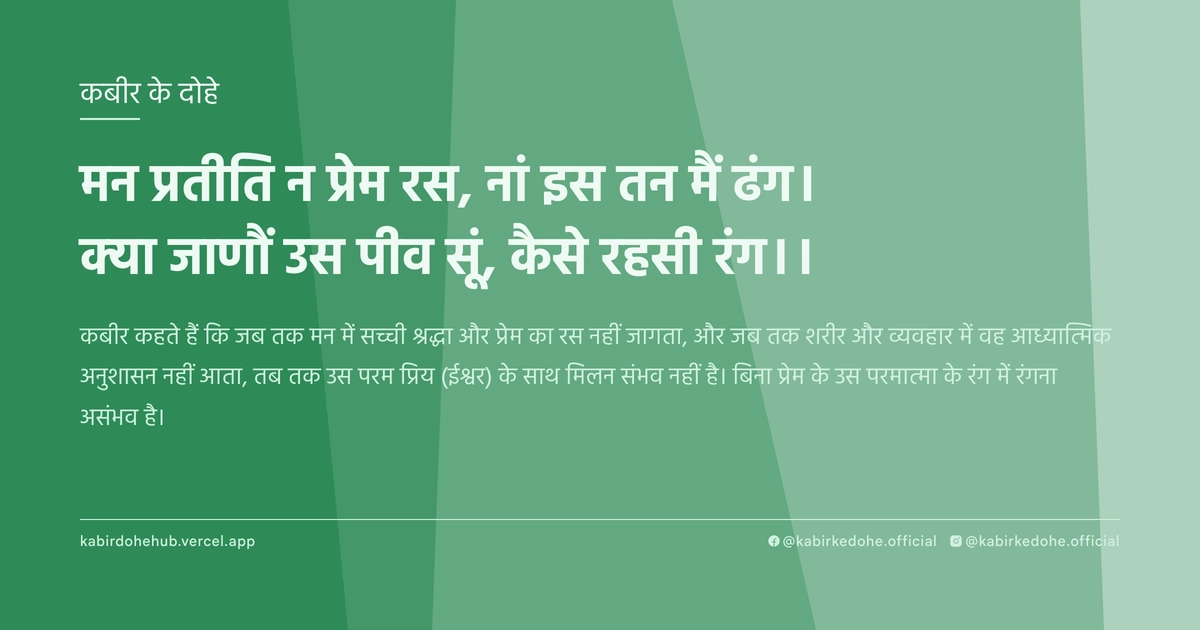
मन प्रतीति न प्रेम रस, नां इस तन मैं ढंग।
क्या जाणौं उस पीव सूं, कैसे रहसी रंग।।
Man prateet na prem ras, na is tan main dhang. Kya jaanoun us peev soon, kaise rahasi rang.
इस पृष्ठ पर इस कबीर दोहे का अर्थ (meaning), हिंदी व्याख्या और अंग्रेज़ी अनुवाद, दार्शनिक विश्लेषण और व्यावहारिक जीवन सीख दी गई है। यह दोहा भक्ति (Bhakti) विषय से जुड़ा है — Kabir doha meaning and explanation in Hindi and English.
अर्थ (Meaning):
कबीर कहते हैं कि जब तक मन में सच्ची श्रद्धा और प्रेम का रस नहीं जागता, और जब तक शरीर और व्यवहार में वह आध्यात्मिक अनुशासन नहीं आता, तब तक उस परम प्रिय (ईश्वर) के साथ मिलन संभव नहीं है। बिना प्रेम के उस परमात्मा के रंग में रंगना असंभव है।
Kabir asserts that as long as the heart lacks genuine faith and the essence of divine love, and as long as the physical existence lacks the proper spiritual alignment, one cannot know the Beloved. Without the alchemy of love, it is impossible to be dyed in the eternal color of the Divine.
व्याख्या (Interpretation):
इस दोहे में कबीर 'प्रतीति' (विश्वास) और 'प्रेम रस' को आध्यात्मिक जागृति की अनिवार्य शर्तें मानते हैं। 'ढंग' का अर्थ यहाँ केवल बाहरी व्यवहार नहीं, बल्कि आंतरिक लय और अनुशासन है। वे बताते हैं कि परमात्मा कोई बाहरी वस्तु नहीं, बल्कि एक अनुभव है जो केवल प्रेम के माध्यम से प्राप्त होता है। यह निर्गुण भक्ति का सार है जहाँ ईश्वर किसी मूर्ति में नहीं, बल्कि हृदय की गहन तड़प में मिलता है। माया ने मनुष्य को ऐसा भ्रम दिया है कि वह बाहरी कर्मकांडों से मोक्ष पा लेगा, जबकि सत्य केवल आत्म-समर्पण में है। यहाँ 'रंग' का अर्थ है पूर्ण विलय, जहाँ आत्मा और परमात्मा का द्वैत समाप्त हो जाता है और केवल एक ही चेतना शेष रहती है।
In this couplet, Kabir identifies 'Prateeti' (faith) and 'Prem Ras' (the essence of love) as the indispensable prerequisites for spiritual awakening. 'Dhang' refers not merely to outward conduct, but to an inner rhythmic alignment and spiritual discipline. He posits that the Divine is not an external entity to be found, but an experience accessed solely through the gateway of love. This is the core of Nirgun Bhakti, where the Formless is encountered not in idols, but in the profound longing of the heart. Maya has cast a veil of illusion, leading humans to believe that ritualistic piety grants liberation, whereas truth resides only in absolute surrender. The 'color' (rang) symbolizes total dissolution, where the duality between Atman and Brahman vanishes, leaving only a single, unified consciousness.
दार्शनिक विश्लेषण (Philosophical Analysis):
कबीर का यह विचार उनके युग के कट्टरपंथ और शुष्क कर्मकांडों के विरुद्ध एक सशक्त प्रतिक्रिया था। उन्होंने देखा कि लोग मंदिर और मस्जिदों में तो जाते थे, लेकिन उनके भीतर प्रेम और करुणा का अभाव था। उनके लिए धर्म का अर्थ बाहरी दिखावा नहीं, बल्कि आंतरिक रूपांतरण था। यह दृष्टिकोण सूफी मत के 'इश्क-ए-हकीकी' (ईश्वरीय प्रेम) से गहराई से मेल खाता है, जहाँ प्रेमी और प्रिय का मिलन ही अंतिम लक्ष्य है।
अद्वैत वेदांत के परिप्रेक्ष्य में, यह दोहा अज्ञान (Avidya) के विनाश की बात करता है। जब तक अहंकार (Ego) जीवित है, तब तक 'प्रेम रस' नहीं बह सकता क्योंकि अहंकार पृथकता पैदा करता है। प्रेम वह अग्नि है जो इस पृथकता के भ्रम को जला देती है। कबीर यहाँ स्पष्ट करते हैं कि ज्ञान केवल बौद्धिक विमर्श से नहीं, बल्कि भावनात्मक गहनता से आता है।
वे जाति और वर्ग के भेदों को नकारते हुए यह संदेश देते हैं कि ईश्वर तक पहुँचने का मार्ग केवल हृदय की पवित्रता है। उनके समय में ब्राह्मणवादी श्रेष्ठता और मुल्लाओं के कट्टरपन ने सत्य को ढक दिया था। कबीर ने 'प्रेम' को एकमात्र मापदंड बनाकर सबको समान स्तर पर खड़ा कर दिया।
मनोवैज्ञानिक स्तर पर, यह दोहा 'संज्ञानात्मक विसंगति' को संबोधित करता है। हम अक्सर वह होने का दावा करते हैं जो हम वास्तव में नहीं हैं। जब तक हमारा 'तन' (व्यवहार) और 'मन' (विश्वास) एक ही दिशा में नहीं चलते, तब तक आंतरिक संघर्ष बना रहता है।
अंततः, यह दोहा हमें सिखाता है कि आध्यात्मिक उपलब्धि कोई उपलब्धि नहीं है, बल्कि एक विसर्जन है। जब व्यक्ति स्वयं को पूरी तरह मिटा देता है, तभी वह उस 'पीव' (प्रियतम) के रंग में रंग पाता है। यह शून्य की अवस्था है जहाँ 'मैं' समाप्त होता है और 'वह' प्रकट होता है।
Kabir's insight serves as a potent reaction against the rigid orthodoxy and sterile ritualism of his era. He observed that while people frequented temples and mosques, they lacked genuine love and compassion. For him, religion was not an external performance but an internal metamorphosis. This perspective aligns deeply with the Sufi concept of 'Ishq-e-Haqiqi' (Divine Love), where the union of the Lover and the Beloved is the ultimate teleology.
From the lens of Advaita Vedanta, this couplet speaks to the annihilation of Avidya (ignorance). As long as the ego persists, the 'essence of love' cannot flow, for the ego is the very architect of separation. Love is the alchemical fire that incinerates the illusion of duality. Kabir clarifies that true knowledge is not derived from intellectual discourse, but from emotional depth.
By rejecting caste and class hierarchies, he asserts that the only valid credential for accessing the Divine is the purity of the heart. In an age dominated by Brahmanical superiority and clerical rigidity, Kabir democratized spirituality by making love the sole metric of progress.
Psychologically, the verse addresses the state of cognitive dissonance. We often claim a spiritual identity that our actions do not mirror. Until the 'tan' (conduct) and 'man' (belief) are synchronized in a single direction, internal conflict persists, preventing the experience of peace.
Ultimately, this couplet teaches that spiritual attainment is not an acquisition, but a dissolution. Only when the individual completely erases the self can they be dyed in the color of the 'Peev' (Beloved). This is the state of Shunya (void), where the 'I' ceases to exist and the Universal Truth manifests.
मूल संदेश (Core Message):
- बाहरी कर्मकांड बिना आंतरिक प्रेम के व्यर्थ हैं।
- सच्ची श्रद्धा केवल हृदय के समर्पण से जन्म लेती है।
- अहंकार वह दीवार है जो हमें परमात्मा से अलग करती है।
- प्रेम ही वह एकमात्र माध्यम है जिससे द्वैत समाप्त होता है।
- आध्यात्मिक रंग केवल पूर्ण आत्म-विलय से प्राप्त होता है।
- External rituals are void without the presence of internal love.
- True faith is born only from the absolute surrender of the heart.
- The ego is the only wall separating the seeker from the Divine.
- Love is the sole medium through which the illusion of duality dissolves.
- The spiritual hue is attained only through complete self-annihilation.
व्यावहारिक उदाहरण (Practical Example):
वाराणसी के एक पुराने घाट पर माधव नाम का एक वृद्ध बुनकर रहता था। वह अपनी कला में निपुण था, लेकिन उसका मन हमेशा अशांत रहता था। वह प्रतिदिन घंटों पूजा करता, दान देता और शास्त्रों का पाठ करता, फिर भी उसे वह शांति नहीं मिली जिसकी वह तलाश कर रहा था। उसे लगता था कि वह बहुत धार्मिक है, लेकिन उसके व्यवहार में अहंकार और दूसरों के प्रति तिरस्कार था।
एक दिन उसने एक फकीर को देखा जो घाट की सीढ़ियों पर बैठा था। फकीर के पास न धन था, न कोई बड़ा आश्रम, लेकिन उसके चेहरे पर एक ऐसी चमक और शांति थी जिसे माधव ने कभी नहीं देखा था। माधव ने उससे पूछा, "मैं इतना जप करता हूँ, फिर भी मुझे वह आनंद क्यों नहीं मिलता जो आपके पास है?"
फकीर मुस्कुराया और बोला, "माधव, तुम धागों को तो सही से बुनते हो, लेकिन अपने मन के धागों में प्रेम का रंग नहीं डाला। तुम्हारी पूजा केवल एक कर्तव्य है, प्रेम नहीं। तुम ईश्वर को पाने की कोशिश कर रहे हो, जबकि तुम्हें केवल प्रेम बनना है।"
माधव को यह बात समझ नहीं आई, लेकिन उसने फकीर के साथ समय बिताना शुरू किया। उसने देखा कि फकीर हर जीव—चाहे वह कुत्ता हो या कोई भिखारी—से ऐसे बात करता था जैसे वह साक्षात ईश्वर हो। माधव ने महसूस किया कि उसकी अपनी 'भक्ति' केवल उसकी सामाजिक छवि को निखारने का एक साधन थी।
धीरे-धीरे माधव ने अपनी पूजा के तरीके बदले। अब वह केवल मंत्र नहीं पढ़ता था, बल्कि उन मंत्रों के अर्थ को अपने व्यवहार में उतारने लगा। उसने अपने साथ काम करने वाले गरीब मजदूरों की मदद करना शुरू किया, न कि उपकार के भाव से, बल्कि इस भाव से कि वे सब उसी एक परमात्मा का अंश हैं।
एक दिन, जब वह एक बीमार साथी बुनकर की सेवा कर रहा था, उसे अचानक एक तीव्र अनुभूति हुई। उसे महसूस हुआ कि वह और वह बीमार व्यक्ति अलग नहीं हैं। उस क्षण, उसके भीतर का अहंकार पूरी तरह टूट गया और उसकी आँखों से आँसू बहने लगे।
यह वह 'प्रेम रस' था जिसकी बात कबीर ने की थी। माधव को समझ आया कि अब तक वह केवल 'ढंग' (औपचारिकता) का पालन कर रहा था, लेकिन अब उसका मन वास्तव में 'प्रतीति' (विश्वास) से भर गया था।
उसकी कला और भी निखर गई, लेकिन अब वह प्रसिद्धि के लिए नहीं, बल्कि प्रेम के लिए बुनता था। वह अब उस 'पीव' के रंग में रंग चुका था, और उसका जीवन एक जीवंत प्रार्थना बन गया था।
On an ancient ghat in Varanasi lived an elderly weaver named Madhav. He was a master of his craft, yet his mind remained a storm of restlessness. He spent hours in ritual prayer, gave lavish donations, and recited scriptures, but the peace he sought remained elusive. He believed himself to be deeply religious, yet his conduct was laced with arrogance and a subtle disdain for others.
One day, he noticed a wandering fakir sitting on the stone steps of the ghat. The fakir possessed neither wealth nor a sanctuary, yet his face radiated a serenity and luminosity that Madhav had never encountered. Madhav asked, "I chant for hours, yet why do I lack the bliss that you possess?"
The fakir smiled and replied, "Madhav, you weave your threads with precision, but you have failed to dye the threads of your own heart with love. Your worship is merely a duty, not a devotion. You are trying to 'attain' God, whereas you should simply strive to 'become' love."
Madhav did not immediately grasp this, but he began spending time with the fakir. He observed that the fakir spoke to every living being—be it a stray dog or a beggar—as if they were the Divine Himself. Madhav realized that his own 'devotion' was merely a tool to polish his social image.
Gradually, Madhav shifted his practice. He stopped merely reciting mantras and began embodying their essence in his behavior. He started helping the impoverished laborers in his workshop, not out of a sense of charity, but from the conviction that they were all fragments of the same Universal Soul.
One day, while tending to a sick fellow weaver, he experienced a sudden, piercing realization. He felt that there was no distinction between himself and the suffering man. In that moment, his ego shattered completely, and tears streamed down his face.
This was the 'Prem Ras' (essence of love) that Kabir spoke of. Madhav understood that until then, he had only been following the 'Dhang' (formalities), but now his heart was truly filled with 'Prateeti' (faith).
His art flourished even further, but he no longer wove for fame; he wove out of love. He had finally been dyed in the color of the 'Peev' (Beloved), and his life became a living prayer.
अभ्यास मार्गदर्शन (Practice Guidance):
- प्रतिदिन 20 मिनट मौन बैठें और विचार करें कि क्या आपके कार्य आपके आध्यात्मिक दावों के अनुरूप हैं।
- एक 'प्रेम डायरी' लिखें जिसमें उन क्षणों को दर्ज करें जब आपने बिना किसी स्वार्थ या अहंकार के किसी की सहायता की।
- अभ्यास करें कि हर व्यक्ति में उस 'परम प्रिय' को देखें; दिन में कम से कम तीन बार अजनबियों के प्रति करुणा का भाव जगाएं।
- डायग्नोस्टिक चेकलिस्ट: क्या मैं दूसरों की मदद इसलिए करता हूँ ताकि मैं 'अच्छा' दिखूँ? क्या मेरी प्रार्थनाएँ केवल माँगने के लिए हैं या समर्पण के लिए? क्या मैं धर्म के नाम पर दूसरों को छोटा महसूस कराता हूँ?
- Sit in silence for 20 minutes daily and contemplate whether your actions align with your spiritual claims.
- Maintain a 'Love Journal' recording moments where you helped others without any motive of self-gain or ego.
- Practice seeing the 'Beloved' in every individual; consciously evoke compassion for at least three strangers every day.
- Diagnostic Checklist: Do I help others to maintain an image of being 'good'? Are my prayers merely petitions or acts of surrender? Do I use religion as a tool to feel superior to others?
चिंतन प्रश्न (Reflection Questions):
- क्या मेरी धार्मिकता वास्तव में प्रेम पर आधारित है, या यह केवल एक सामाजिक मुखौटा है?
- यदि मेरे जीवन से सभी बाहरी पहचान (पद, प्रतिष्ठा, धर्म) हटा दी जाएं, तो क्या मेरे भीतर कोई प्रेम शेष रहेगा?
- मैं किन लोगों को प्रेम करने में असमर्थ हूँ, और वह कौन सा अहंकार है जो मुझे रोकता है?
- क्या मैं ईश्वर को एक 'पुरस्कार' के रूप में चाहता हूँ या एक 'अनुभव' के रूप में?
- मेरे व्यवहार का वह कौन सा 'ढंग' है जो मुझे वास्तव में आध्यात्मिक होने से रोकता है?
- Is my religiosity truly based on love, or is it merely a social mask?
- If all external identities (status, prestige, religion) were stripped away, would any love remain within me?
- Which people am I unable to love, and what specific ego-barrier prevents me from doing so?
- Do I desire the Divine as a 'reward' to be won or as an 'experience' to be lived?
- What specific 'habit' or 'formality' in my behavior prevents me from being truly spiritual?