
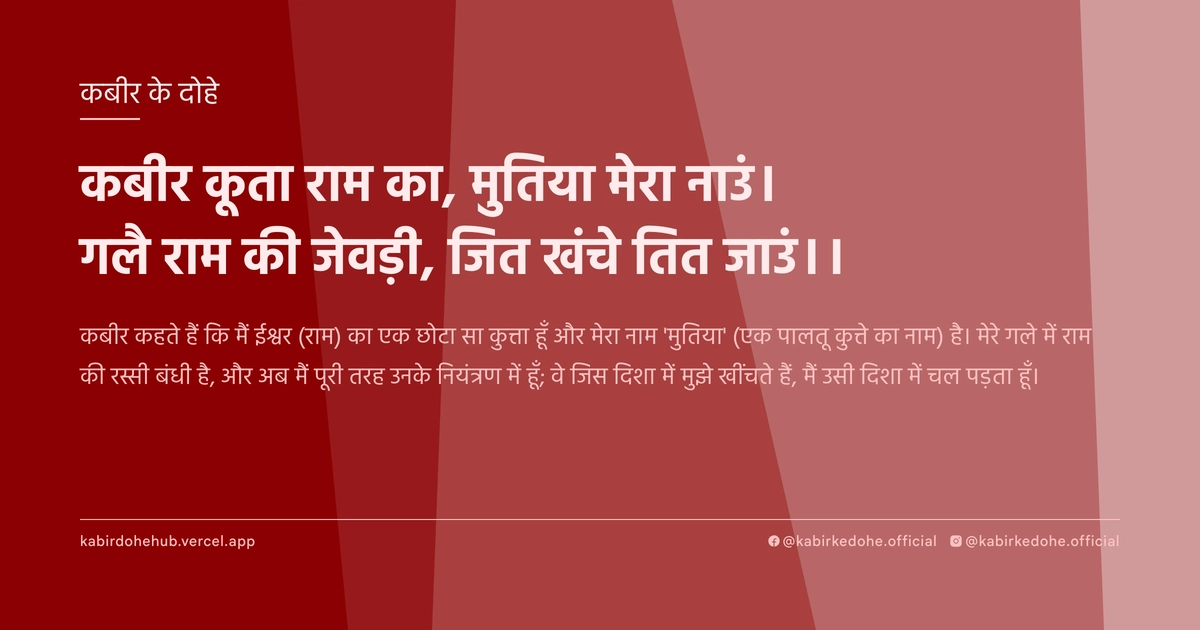
कबीर कूता राम का, मुतिया मेरा नाउं।
गलै राम की जेवड़ी, जित खंचे तित जाउं।।
Kabir koota Ram ka, mutiya mera naun. Galai Ram ki jevadi, jit khanche tit jaun.
इस पृष्ठ पर इस कबीर दोहे का अर्थ (meaning), हिंदी व्याख्या और अंग्रेज़ी अनुवाद, दार्शनिक विश्लेषण और व्यावहारिक जीवन सीख दी गई है। यह दोहा प्रपत्ति (Surrender) विषय से जुड़ा है — Kabir doha meaning and explanation in Hindi and English.
अर्थ (Meaning):
कबीर कहते हैं कि मैं ईश्वर (राम) का एक छोटा सा कुत्ता हूँ और मेरा नाम 'मुतिया' (एक पालतू कुत्ते का नाम) है। मेरे गले में राम की रस्सी बंधी है, और अब मैं पूरी तरह उनके नियंत्रण में हूँ; वे जिस दिशा में मुझे खींचते हैं, मैं उसी दिशा में चल पड़ता हूँ।
Kabir declares himself to be a humble dog of the Divine (Ram), calling himself 'Mutiya' (a common pet name). He describes having a leash around his neck held by the Divine; wherever the Master pulls the string, he follows without resistance, signifying total surrender.
व्याख्या (Interpretation):
शाब्दिक रूप से, कबीर स्वयं को एक वफादार कुत्ते के रूप में प्रस्तुत कर रहे हैं, लेकिन यह एक गहरा आध्यात्मिक रूपक है। यहाँ 'कुत्ता' बनना अहंकार के पूर्ण विनाश का प्रतीक है, जहाँ साधक अपनी व्यक्तिगत इच्छाओं को पूरी तरह त्याग देता है। 'मुतिया' नाम इस बात को दर्शाता है कि वह अब अपनी पुरानी पहचान से मुक्त होकर केवल ईश्वर की संपत्ति बन गया है। 'जेवड़ी' या रस्सी वह प्रेम और भक्ति का बंधन है जो आत्मा को परमात्मा से जोड़ता है। यह निर्गुण भक्ति की उस अवस्था को दर्शाता है जहाँ द्वैत समाप्त हो जाता है और केवल समर्पण बचता है। यह स्थिति अद्वैत वेदांत के उस सत्य के करीब है जहाँ 'मैं' का अस्तित्व समाप्त हो जाता है और केवल 'ब्रह्म' शेष रहता है। अंततः, यह दोहा यह सिखाता है कि वास्तविक स्वतंत्रता केवल पूर्ण समर्पण में ही निहित है।
Literally, Kabir presents himself as a loyal dog, but this is a profound spiritual metaphor. Being a 'dog' symbolizes the total annihilation of the ego, where the seeker relinquishes all personal desires. The name 'Mutiya' signifies that he has shed his former identity to become solely the property of the Divine. The 'jevadi' or leash represents the bond of love and devotion that ties the soul to the Infinite. This reflects the state of Nirgun Bhakti where duality vanishes, leaving only surrender. It aligns with Advaita Vedanta's truth where the 'I' dissolves, and only Brahman remains. Ultimately, the doha teaches that true liberation is found only in absolute surrender to the Divine Will.
दार्शनिक विश्लेषण (Philosophical Analysis):
कबीर का यह दोहा मध्यकालीन भारत के सामाजिक और धार्मिक परिवेश में एक क्रांतिकारी कदम था। उस समय धर्म अक्सर कर्मकांडों, जातिगत श्रेष्ठता और बाहरी आडंबरों में जकड़ा हुआ था। कबीर ने स्वयं को 'कुत्ता' कहकर उन सभी सामाजिक पदानुक्रमों और मानवीय अहंकार को चुनौती दी, जो मनुष्य को ईश्वर से दूर रखते हैं। यह सूफी मत के 'फना' (अहंकार का विलीनीकरण) के सिद्धांत से गहराई से जुड़ा है, जहाँ प्रेमी अपने अस्तित्व को अपने प्रिय (ईश्वर) में पूरी तरह मिटा देता है।
दार्शनिक स्तर पर, यह दोहा 'शरणागति' के सिद्धांत की व्याख्या करता है। जब तक मनुष्य अपनी बुद्धि और इच्छाओं के बल पर चलने की कोशिश करता है, वह माया के जाल में फंसा रहता है। जैसे ही वह अपनी इच्छाशक्ति को परमात्मा को सौंप देता है, वह माया के प्रभाव से मुक्त हो जाता है। यह अद्वैत वेदांत के उस विचार को पुष्ट करता है कि आत्मा और परमात्मा अलग नहीं हैं, लेकिन अहंकार की दीवार इस एकता को छुपा लेती है।
कबीर यहाँ ritualism के बजाय 'भाव' को प्रधानता देते हैं। उनके लिए मंदिर या मस्जिद जाना उतना महत्वपूर्ण नहीं है जितना कि हृदय का पूर्ण समर्पण। वे यह समझाते हैं कि ईश्वर को पाने का सबसे छोटा रास्ता अहंकार का विसर्जन है। यदि आप स्वयं को शून्य कर लें, तो ईश्वर स्वयं आपको संचालित करने लगते हैं।
मनोवैज्ञानिक रूप से, यह 'कंट्रोल' की इच्छा को छोड़ने की प्रक्रिया है। मनुष्य अक्सर अपने जीवन की परिस्थितियों से लड़ता है, जिससे दुख पैदा होता है। कबीर का 'रस्सी' वाला रूपक यह बताता है कि जब हम जीवन के प्रवाह (Divine Will) के साथ बहना सीख जाते हैं, तो संघर्ष समाप्त हो जाता है और शांति का उदय होता है।
अंततः, यह दोहा हमें सिखाता है कि विनम्रता कोई कमजोरी नहीं, बल्कि उच्चतम आध्यात्मिक शक्ति है। जो स्वयं को सबसे नीचा (कुत्ते के समान) मान लेता है, वही वास्तव में सबसे ऊंचा उठ जाता है क्योंकि उसने उस 'मैं' को मार दिया है जो उसे सीमित करता था।
This doha is a revolutionary act within the social and religious landscape of medieval India. At a time when religion was shackled by rituals, caste superiority, and outward displays of piety, Kabir challenges all social hierarchies and human ego by calling himself a 'dog.' This is deeply connected to the Sufi concept of 'Fana' (annihilation of the self), where the lover completely dissolves their existence into the Beloved (the Divine).
Philosophically, the doha explains the principle of 'Sharanagati' or total surrender. As long as a human attempts to navigate life through their own intellect and desires, they remain trapped in the web of Maya. The moment they surrender their will to the Divine, they are liberated from the illusions of the material world. This reinforces the Advaita Vedanta notion that the Atman and Brahman are not separate, but the wall of ego obscures this unity.
Kabir prioritizes 'Bhava' (inner emotion) over ritualism. For him, visiting temples or mosques is insignificant compared to the total surrender of the heart. He argues that the shortest path to the Divine is the dissolution of the ego. If one can become a 'zero,' the Divine takes over the steering of their life.
Psychologically, this is a process of releasing the need for control. Humans often suffer because they fight against the circumstances of their lives. Kabir's metaphor of the 'leash' suggests that when we learn to flow with the Divine Will, struggle ceases and a profound peace emerges.
Ultimately, the doha teaches that humility is not a weakness but the highest spiritual power. He who considers himself the lowest (like a dog) actually rises the highest, for he has slain the 'I' that kept him limited and separate.
मूल संदेश (Core Message):
- अहंकार का विसर्जन ही वास्तविक आध्यात्मिक उदय है।
- पूर्ण समर्पण भय को शांति में बदल देता है।
- ईश्वर की इच्छा में अपनी इच्छा को मिलाना ही मुक्ति है।
- विनम्रता वह द्वार है जिससे परमात्मा प्रवेश करते हैं।
- जब 'मैं' मिटता है, तब केवल 'वह' शेष रहता है।
- The dissolution of ego is the only true spiritual ascent.
- Absolute surrender transforms fear into profound peace.
- Merging one's will with the Divine Will is liberation.
- Humility is the gateway through which the Divine enters.
- When the 'I' vanishes, only 'He' remains.
व्यावहारिक उदाहरण (Practical Example):
एक समय की बात है, बनारस के घाटों पर रहने वाला एक वृद्ध बुनकर था जिसका नाम माधव था। माधव अपनी कला में निपुण था, लेकिन उसका स्वभाव अत्यंत अहंकारी था। वह मानता था कि उसके द्वारा बुने गए वस्त्र दुनिया में सबसे श्रेष्ठ हैं और वह अपनी श्रेष्ठता का प्रदर्शन हर किसी के सामने करता था।
एक दिन, माधव की मुलाकात एक घुमक्कड़ साधु से हुई। साधु ने माधव के वस्त्रों की प्रशंसा की, लेकिन जब माधव ने गर्व से अपनी कला का बखान किया, तो साधु ने मुस्कुराते हुए कहा, "तुम्हारी कला सुंदर है, लेकिन तुम्हारा अहंकार इस वस्त्र के धागों से भी अधिक उलझा हुआ है।"
माधव को यह बात चुभी, लेकिन उसने साधु से पूछा कि इस अहंकार से मुक्ति कैसे मिले। साधु ने उसे कबीर का यह दोहा सुनाया और कहा, "जब तक तुम खुद को मालिक समझते रहोगे, तुम अपनी ही बनाई सीमाओं के कैदी रहोगे। जिस दिन तुम खुद को ईश्वर का एक छोटा सा सेवक, एक वफादार कुत्ते जैसा मान लोगे, उस दिन तुम वास्तव में स्वतंत्र हो जाओगे।"
माधव ने इस बात को गहराई से सोचा। उसने महसूस किया कि उसकी सारी उपलब्धियां वास्तव में उसकी नहीं, बल्कि उस ईश्वरीय प्रेरणा की थीं जिसने उसे यह कौशल दिया। उसने धीरे-धीरे अपने जीवन में बदलाव लाना शुरू किया।
अब वह अपने वस्त्रों को अपनी श्रेष्ठता का प्रमाण नहीं, बल्कि ईश्वर की सेवा का माध्यम मानने लगा। उसने गरीब लोगों के लिए मुफ्त में कपड़े बुनना शुरू कर दिया। जब भी कोई उसकी प्रशंसा करता, वह मन ही मन कहता, "मैं तो बस एक छोटा सा सेवक हूँ, जो उस मालिक की इच्छा से यह कार्य कर रहा है।"
एक बार शहर के एक बड़े सेठ ने उसे बहुत अधिक धन का लालच दिया ताकि वह केवल उसके लिए विशेष वस्त्र बनाए और दूसरों को अनदेखा करे। पहले वाला माधव तुरंत मान जाता, लेकिन अब वह 'राम की रस्सी' से बंधा था। उसने विनम्रता से मना कर दिया और कहा कि वह केवल वहीं जाएगा जहाँ उसकी अंतरात्मा और उसका मालिक उसे निर्देशित करेंगे।
उसने पाया कि जैसे ही उसने अपनी 'मर्जी' को ईश्वर की 'मर्जी' में विलीन किया, उसके मन का तनाव गायब हो गया। वह अब परिणामों की चिंता नहीं करता था।
माधव का जीवन अब एक शांत नदी की तरह था। वह अब भी बुनता था, लेकिन अब वह धागों को नहीं, बल्कि अपने अहंकार को सुलझा रहा था। उसकी विनम्रता ने उसे पूरे शहर में सम्मानित बना दिया, लेकिन उसके लिए वह सम्मान अब मायने नहीं रखता था क्योंकि वह 'मुतिया' बन चुका था।
Once, in the ghats of Varanasi, lived an elderly weaver named Madhav. Madhav was masterly in his craft, but his nature was intensely arrogant. He believed the fabrics he wove were the finest in the world and flaunted his superiority to everyone he met.
One day, Madhav encountered a wandering monk. The monk praised Madhav's work, but when Madhav began boasting about his skill, the monk smiled and said, "Your art is beautiful, but your ego is more tangled than the threads of your cloth."
Stung by these words, Madhav asked how he could be free from this ego. The monk recited this doha of Kabir and told him, "As long as you consider yourself the master, you will remain a prisoner of the boundaries you have created. The day you view yourself as a humble servant of the Divine, like a loyal dog, you will truly be free."
Madhav pondered this deeply. He realized that all his achievements were not his own, but the result of the Divine inspiration that gave him the skill. He slowly began to transform his life.
He stopped viewing his weaving as a proof of his superiority and started seeing it as a medium of service. He began weaving clothes for the poor for free. Whenever someone praised him, he would whisper to himself, "I am but a small servant, acting upon the will of my Master."
Once, a wealthy merchant offered him a vast sum of money to weave exclusive garments only for him, ignoring others. The old Madhav would have agreed instantly, but now he was bound by 'Ram's leash.' He politely declined, stating he would only go where his conscience and his Master directed him.
He discovered that as soon as he merged his 'will' into the 'Divine Will,' the stress in his mind vanished. He no longer worried about the outcomes of his actions.
Madhav's life became like a calm river. He still wove, but he was no longer untangling threads; he was untangling his ego. His humility made him respected throughout the city, but that respect no longer mattered to him because he had become 'Mutiya.'
अभ्यास मार्गदर्शन (Practice Guidance):
- प्रतिदिन 15 मिनट के लिए मौन बैठें और कल्पना करें कि आपकी व्यक्तिगत इच्छाएं एक रस्सी की तरह हैं जिन्हें आप परमात्मा को सौंप रहे हैं।
- एक 'समर्पण जर्नल' बनाएँ। हर दिन एक ऐसी घटना लिखें जहाँ आपने अपनी जिद छोड़ी और परिस्थिति को स्वीकार किया।
- जब भी क्रोध या अहंकार महसूस हो, मन में दोहराएं: "मैं केवल एक माध्यम हूँ, कर्ता वह परमात्मा है।"
- निदान चेकलिस्ट: क्या मैं अभी भी परिणामों को नियंत्रित करने की कोशिश कर रहा हूँ? क्या मैं दूसरों से अपनी श्रेष्ठता सिद्ध करने की कोशिश कर रहा हूँ? यदि हाँ, तो आप अभी भी अपनी 'रस्सी' खुद पकड़ने की कोशिश कर रहे हैं।
- Sit in silence for 15 minutes daily, visualizing your personal desires as a leash that you are handing over to the Divine.
- Maintain a 'Surrender Journal.' Each day, record one instance where you let go of your stubbornness and accepted the flow of circumstances.
- Whenever anger or ego arises, repeat internally: "I am merely an instrument; the Divine is the only Doer."
- Diagnostic Checklist: Am I still trying to control the outcomes? Am I still trying to prove my superiority over others? If yes, you are still trying to hold your own leash.
चिंतन प्रश्न (Reflection Questions):
- मेरे जीवन का वह कौन सा हिस्सा है जिसे मैं किसी भी कीमत पर नियंत्रित करना चाहता हूँ?
- यदि मेरी सारी सामाजिक पहचान (पद, प्रतिष्ठा, नाम) छीन ली जाए, तो क्या मैं अभी भी शांत रह पाऊंगा?
- क्या मेरी भक्ति वास्तव में समर्पण है, या मैं ईश्वर को अपनी इच्छाएं पूरी करने का साधन मान रहा हूँ?
- मैं अपनी श्रेष्ठता सिद्ध करने के लिए किन सूक्ष्म तरीकों का उपयोग करता हूँ?
- क्या मैं वास्तव में 'अज्ञात' के हाथों निर्देशित होने का साहस रखता हूँ?
- Which part of my life am I desperately trying to control at any cost?
- If all my social identities (status, reputation, name) were stripped away, would I still be at peace?
- Is my devotion truly surrender, or am I using the Divine as a means to fulfill my own desires?
- What subtle methods do I use to prove my superiority over others?
- Do I truly possess the courage to be guided by the 'Unknown'?