
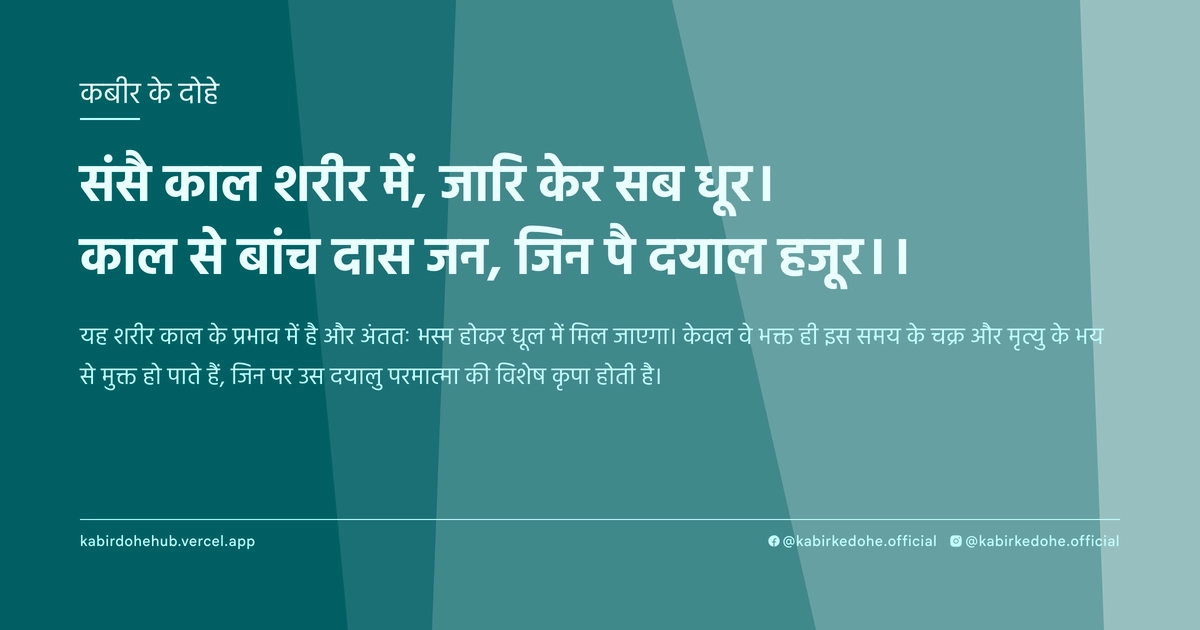
संसै काल शरीर में, जारि केर सब धूर।
काल से बांच दास जन, जिन पै दयाल हजूर।।
Sansai kaal shareer mein, jaari ker sab dhoor. Kaal se baanch daas jan, jin pai dayal hazoor.
इस पृष्ठ पर इस कबीर दोहे का अर्थ (meaning), हिंदी व्याख्या और अंग्रेज़ी अनुवाद, दार्शनिक विश्लेषण और व्यावहारिक जीवन सीख दी गई है। यह दोहा मृतुक्यता (Mortality) विषय से जुड़ा है — Kabir doha meaning and explanation in Hindi and English.
अर्थ (Meaning):
यह शरीर काल के प्रभाव में है और अंततः भस्म होकर धूल में मिल जाएगा। केवल वे भक्त ही इस समय के चक्र और मृत्यु के भय से मुक्त हो पाते हैं, जिन पर उस दयालु परमात्मा की विशेष कृपा होती है।
This physical body is subject to the relentless march of time and will eventually be reduced to ashes and dust. Only those seekers, upon whom the Merciful Divine showers grace, can transcend the cycle of time and the inevitability of death.
व्याख्या (Interpretation):
साब्दिक अर्थ यह है कि मृत्यु अटल है और शरीर नश्वर है। रूपकात्मक रूप से, 'काल' केवल समय नहीं बल्कि अज्ञानता और अहंकार का वह बंधन है जो आत्मा को जन्म-मृत्यु के चक्र में जकड़े रखता है। निर्गुण भक्ति के संदर्भ में, यह दोहा बताता है कि जब तक साधक स्वयं को शरीर मानता है, वह भयभीत रहता है। जैसे ही वह अद्वैत वेदांत के सत्य को पहचानता है कि वह शरीर नहीं बल्कि अविनाशी आत्मा है, वह 'काल' से परे हो जाता है। माया का पर्दा हटते ही यह स्पष्ट होता है कि केवल परमात्मा की कृपा (अनुग्रह) ही वह कुंजी है जो इस भ्रम को तोड़ सकती है।
Literally, the verse speaks of the inevitability of death and the fragility of the flesh. Metaphorically, 'Kaal' (Time/Death) represents the bondage of ignorance and the ego that traps the soul in the cycle of Samsara. In the context of Nirgun Bhakti, the doha suggests that as long as the seeker identifies with the physical form, they remain a prisoner of fear. By aligning with Advaita Vedanta, the realization dawns that the true self is not the perishable body but the eternal Atman. The paradox lies in the fact that while the body must perish, the essence is timeless; this liberation is achieved through the 'Grace' of the formless Divine, which dissolves the illusion of duality.
दार्शनिक विश्लेषण (Philosophical Analysis):
कबीर का यह दोहा उस युग की उपज है जहाँ कर्मकांड और बाहरी आडंबरों का बोलबाला था। कबीर ने स्पष्ट किया कि न तो तीर्थयात्रा और न ही कठिन व्रत शरीर को काल से बचा सकते हैं। उनका दर्शन सूफी मत के 'फना' (अहंकार का विनाश) और वेदांत के 'ब्रह्म' के करीब है। वे सिखाते हैं कि मृत्यु का भय वास्तव में शरीर के प्रति मोह का भय है।
ऐतिहासिक रूप से, कबीर ने जाति और धर्म के भेदों को नकारते हुए यह संदेश दिया कि मृत्यु सबको समान कर देती है। यह 'महाशमशान' की अवधारणा है जहाँ राजा और रंक दोनों धूल बन जाते हैं। यह बोध मनुष्य को विनम्र बनाता है और उसे सांसारिक अहंकार से मुक्त करता है।
दार्शनिक स्तर पर, यहाँ 'दयालु हजूर' का अर्थ किसी बाहरी देवता से नहीं, बल्कि उस आंतरिक चेतना के जागरण से है जो हमें यह याद दिलाती है कि हम समय से परे हैं। यह मनोवैज्ञानिक रूपांतरण है जहाँ भय, प्रेम में बदल जाता है।
अद्वैत वेदांत के अनुसार, जब तक 'मैं' और 'तू' का भेद है, तब तक काल का प्रभाव है। जब साधक यह अनुभव करता है कि वह स्वयं वह अनंत सत्य है, तब काल का अस्तित्व समाप्त हो जाता है। यह शून्य में विलीन होने की प्रक्रिया है।
अंततः, कबीर का प्रहार उन लोगों पर है जो केवल बाहरी दिखावे से मोक्ष की आशा करते हैं। वे वास्तविक मुक्ति को आंतरिक शुद्धि और पूर्ण समर्पण (Surrender) में देखते हैं, जहाँ अहंकार की आहुति दी जाती है।
Kabir’s verse emerges from an era dominated by rigid ritualism and caste hierarchies. He asserts that neither pilgrimages nor ascetic penance can shield the physical body from the inevitable decay of time. His philosophy mirrors the Sufi concept of 'Fana' (annihilation of the self) and the Vedantic pursuit of Brahman. He posits that the fear of death is actually a fear of losing the ego's perceived identity.
Historically, Kabir challenged the social stratification of his time by reminding humanity that death is the ultimate equalizer. This is the concept of the 'Great Crematorium,' where the distinctions between a king and a pauper vanish into dust. This realization is intended to strip away worldly pride and instill a profound sense of humility.
Philosophically, the 'Merciful Divine' (Dayaal Hazoor) does not refer to a distant deity but to the awakening of the inner consciousness. It is a psychological shift where the terror of extinction is replaced by the peace of eternal belonging. The 'grace' mentioned is the catalyst for this spiritual awakening.
From the perspective of Advaita Vedanta, time exists only as long as the illusion of duality (Maya) persists. When the seeker realizes the non-duality of the Atman and Brahman, they transcend the linear constraints of birth and death. They move from the temporal to the timeless.
Ultimately, Kabir critiques those who seek salvation through superficial means. He argues that true liberation requires the total surrender of the ego. Only when the 'I' is incinerated can the eternal essence emerge, free from the shackles of Kaal.
मूल संदेश (Core Message):
- शरीर मिट्टी है, आत्मा अनंत है।
- मृत्यु अंत नहीं, बल्कि एक रूपांतरण है।
- अहंकार का विसर्जन ही वास्तविक मुक्ति है।
- परमात्मा की कृपा ही समय के बंधन को तोड़ती है।
- मोह का त्याग ही शांति का एकमात्र मार्ग है।
- The body is clay; the soul is infinite.
- Death is not an end, but a transformation.
- The dissolution of ego is the only true liberation.
- Divine grace is the only key to break the shackles of time.
- Renouncing attachment is the sole path to lasting peace.
व्यावहारिक उदाहरण (Practical Example):
वाराणसी के घाटों पर रहने वाले एक वृद्ध विधवा, जानकी, का जीवन केवल यादों और शोक के इर्द-गिर्द घूमता था। वह अपने मृत पति और बच्चों के विरह में इतनी डूबी थी कि उसने वर्तमान जीवन को पूरी तरह त्याग दिया था। वह हर दिन मणिकर्णिका घाट पर जलती चिताओं को देखती और सोचती कि उसका दुख सबसे बड़ा है।
उसका पूरा अस्तित्व एक गहरे अवसाद में था, जहाँ वह मृत्यु को एक शत्रु मानती थी जिसने उससे सब कुछ छीन लिया। वह घंटों तक अपनी पुरानी तस्वीरों को पकड़कर रोती रहती, यह मानकर कि उसका अस्तित्व उन्हीं खोए हुए रिश्तों में था।
एक दिन उसकी मुलाकात एक घुमक्कड़ साधु से हुई, जिसने उसे कबीर का यह दोहा सुनाया। साधु ने उससे पूछा, 'जानकी, तुम उस धूल के लिए रो रही हो जो पहले ही उड़ चुकी है, या उस आत्मा के लिए जो कभी मरी ही नहीं?'
जानकी को पहले तो यह बात कठोर लगी, लेकिन धीरे-धीरे उसने चिंतन करना शुरू किया। उसने महसूस किया कि वह अपने शरीर और अपने रिश्तों के मोह को ही अपना 'स्व' मान बैठी थी।
उसने देखा कि घाट पर जलने वाला हर शरीर अंततः एक ही राख बन जाता है। चाहे वह अमीर हो या गरीब, दुखी हो या सुखी, काल सबको एक समान कर देता है।
इस बोध ने उसके भीतर एक 'कबीर ट्विस्ट' पैदा किया। उसने महसूस किया कि यदि शरीर नश्वर है, तो उसके साथ जुड़ा दुख भी नश्वर है। उसने अपने शोक को एक गहरे वैराग्य में बदल दिया।
उसने घाट पर आने वाले अन्य दुखी लोगों की सेवा करना शुरू किया। अब वह रोती नहीं थी, बल्कि दूसरों के आंसुओं को पोंछने वाली एक शांत मार्गदर्शक बन गई।
उसने पाया कि जब उसने अपनी व्यक्तिगत पहचान और नुकसान के मोह को छोड़ दिया, तो उसे एक ऐसी शांति मिली जो समय और मृत्यु से परे थी।
उसका जीवन अब शोक का घर नहीं, बल्कि करुणा का केंद्र बन गया था। उसने जान लिया था कि केवल वह तत्व ही बचता है जो काल से परे है।
अंततः, जानकी ने मृत्यु के भय को जीत लिया और जीवन के अंतिम क्षणों तक एक ऐसी मुस्कान के साथ जी, जो केवल परमात्मा की कृपा से संभव थी।
In the ancient alleys of Varanasi lived Janaki, an elderly widow whose existence was woven from the threads of grief and longing. She lived in the shadow of her deceased husband and children, viewing her life as a void left by those who had departed.
Every day, she sat by the Manikarnika Ghat, watching the funeral pyres. To her, the fire was a cruel thief, and death was an enemy that had stripped her of every joy. She clung to old photographs, believing her identity was tied to these lost relationships.
Her world was a cycle of mourning, where she felt her pain was the heaviest in the universe. She existed in a state of spiritual paralysis, unable to see anything beyond her own loss.
One evening, she encountered a wandering mystic who recited Kabir’s doha about the body turning to dust. The mystic asked her, 'Janaki, are you weeping for the dust that has already flown away, or for the soul that never died?'
Initially, Janaki found the words harsh. However, the seed of inquiry was planted. She began to contemplate the nature of the ashes she saw every day at the ghats.
She realized that regardless of status, love, or pain, every body eventually merged into the same grey dust. The 'Kaal' that she feared as a thief was actually the great leveler, stripping away all illusions.
This realization triggered a 'Kabir Twist' in her psyche. She understood that if the body is perishable, then the grief attached to the body is also an illusion. She shifted her identity from a 'mourning widow' to a 'witness of eternity.'
Janaki stopped clinging to the past and began serving other grieving souls who came to the ghats. Her personal tragedy became a bridge of empathy for others.
She discovered that by letting go of the ego's demand for permanence in a temporary world, she accessed a profound, unshakable peace.
Her life transformed from a house of mourning into a sanctuary of compassion. She no longer feared the end, for she had found the timeless essence within.
In her final years, Janaki lived with a luminous serenity, embodying the grace of the Divine that transcends the cycle of birth and death.
अभ्यास मार्गदर्शन (Practice Guidance):
- प्रतिदिन 15 मिनट 'शवासन' में लेटकर यह चिंतन करें कि शरीर पंचतत्वों का मेल है और एक दिन मिट्टी में मिल जाएगा।
- एक डायरी लिखें जिसमें आप अपनी उन चीजों की सूची बनाएं जिनसे आप अत्यधिक जुड़ाव महसूस करते हैं, और फिर स्वयं से पूछें: 'क्या यह मेरे बिना भी रहेगा? क्या मैं इसके बिना रहूँगा?'
- व्यवहार परिवर्तन: जब भी क्रोध या अहंकार महसूस हो, तो याद करें कि यह शरीर और यह स्थिति क्षणभंगुर है।
- निदान चेकलिस्ट: क्या मैं मृत्यु के विचार से डरता हूँ? क्या मैं अपनी भौतिक उपलब्धियों को ही अपनी पहचान मानता हूँ? यदि हाँ, तो आप अभी भी 'काल' के प्रभाव में हैं।
- Practice 15 minutes of 'Shavasana' daily, consciously contemplating that the body is a temporary assembly of five elements destined to return to earth.
- Maintain a journal listing your strongest attachments; ask yourself: 'Will this exist without me? Will I exist without this?' to detach the ego from the object.
- Behavioral Shift: Whenever anger or pride arises, pause and remind yourself that both the emotion and the physical form are transient sparks in the wind.
- Diagnostic Checklist: Do I recoil at the thought of death? Do I equate my worth with material possessions? If yes, you are still operating under the illusion of Kaal.
चिंतन प्रश्न (Reflection Questions):
- यदि आज मेरा शरीर धूल बन जाए, तो दुनिया में मेरा क्या प्रभाव बचेगा?
- मैं अपनी डिजिटल पहचान (सोशल मीडिया) को कितना सच मानता हूँ, जबकि वह भी एक आभासी माया है?
- मेरे भीतर का वह कौन सा हिस्सा है जो मृत्यु के बाद भी जीवित रहेगा?
- क्या मेरा धर्म और मेरी जाति मेरी आत्मा की पहचान हैं, या केवल सामाजिक मुखौटे?
- मैं अपनी उपलब्धियों पर गर्व करता हूँ, लेकिन क्या वे समय की मार से बच पाएंगी?
- If my body were to turn to dust today, what essence of my existence would truly remain?
- How much of my identity is tied to my digital persona, and is that not just another layer of Maya?
- Which part of my being exists independently of time, age, and physical decay?
- Are my religious and social labels my true identity, or merely masks I wear in the theater of the world?
- I take pride in my achievements, but can any of them withstand the relentless erosion of time?