
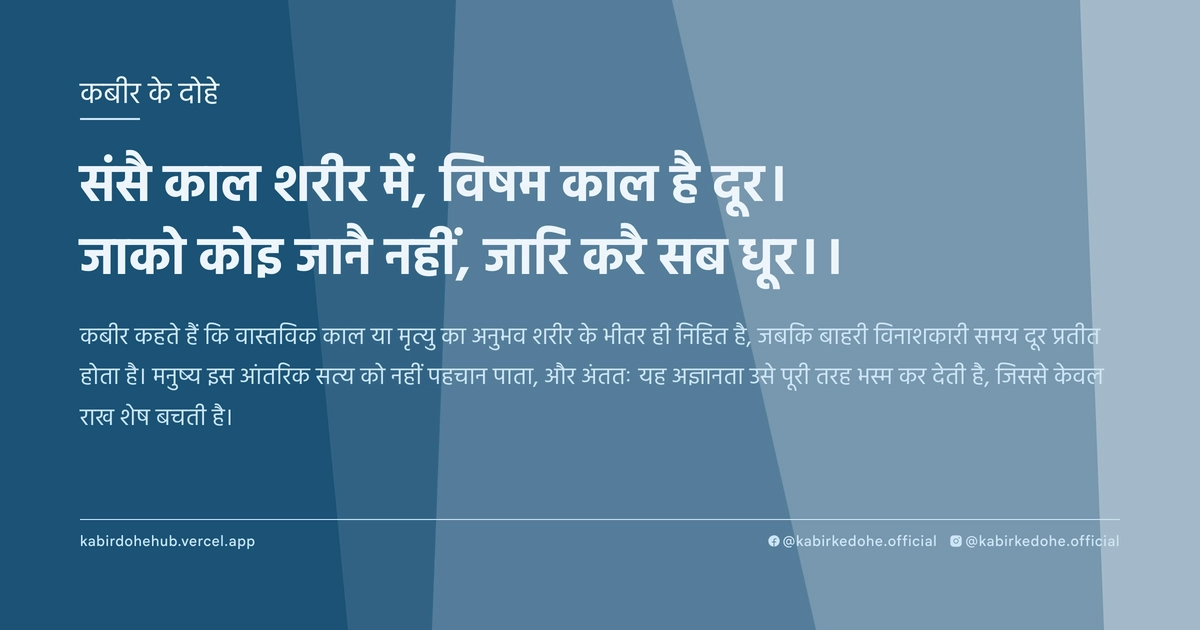
संसै काल शरीर में, विषम काल है दूर।
जाको कोइ जानै नहीं, जारि करै सब धूर।।
Sansai kaal shareer me, visham kaal hai door. Jako koi jaane nahi, jaari kare sab dhoor.
इस पृष्ठ पर इस कबीर दोहे का अर्थ (meaning), हिंदी व्याख्या और अंग्रेज़ी अनुवाद, दार्शनिक विश्लेषण और व्यावहारिक जीवन सीख दी गई है। यह दोहा मृतुक्यता (Mortality) विषय से जुड़ा है — Kabir doha meaning and explanation in Hindi and English.
अर्थ (Meaning):
कबीर कहते हैं कि वास्तविक काल या मृत्यु का अनुभव शरीर के भीतर ही निहित है, जबकि बाहरी विनाशकारी समय दूर प्रतीत होता है। मनुष्य इस आंतरिक सत्य को नहीं पहचान पाता, और अंततः यह अज्ञानता उसे पूरी तरह भस्म कर देती है, जिससे केवल राख शेष बचती है।
Kabir asserts that the true essence of time and death resides within the physical body itself, while the external, destructive force of time seems distant. Because humans fail to recognize this internal reality, they remain oblivious until the fire of existence reduces everything to mere ash.
व्याख्या (Interpretation):
शाब्दिक रूप से यह दोहा मृत्यु की अनिवार्यता की बात करता है, लेकिन गहरा अर्थ 'अहंकार' और 'माया' के विनाश से जुड़ा है। यहाँ 'काल' केवल समय नहीं, बल्कि वह अविद्या है जो आत्मा को शरीर से जोड़ती है। निर्गुण भक्ति के अनुसार, जब तक साधक यह नहीं समझता कि शरीर नश्वर है और केवल शुद्ध चेतना (ब्रह्म) शाश्वत है, वह माया के जाल में फंसा रहता है। यह विरोधाभास है कि हम बाहर मृत्यु को खोजते हैं जबकि वह हमारे भीतर हर क्षण घटित हो रही है। जब यह बोध जागता है, तो वह 'अग्नि' बन जाता है जो झूठे अहंकार को जलाकर भस्म कर देती है, जिससे आत्मा का परमात्मा से मिलन संभव होता है।
Literally, this couplet speaks of the inevitability of death, but its deeper resonance lies in the annihilation of the ego and Maya. Here, 'Kaal' is not merely chronological time, but the spiritual ignorance that binds the Atman to the physical vessel. In the tradition of Nirgun Bhakti, unless the seeker realizes that the body is transient and only pure consciousness (Brahman) is eternal, they remain trapped in illusion. The central paradox is that we perceive death as an external event, whereas it is an internal process occurring every moment. Once this realization ignites, it becomes a transformative fire that incinerates the false identity, leaving behind only the primordial truth of non-duality.
दार्शनिक विश्लेषण (Philosophical Analysis):
कबीर का यह विचार उनके युग के कर्मकांडीय आडंबरों पर एक करारा प्रहार है। उस समय लोग बाहरी तीर्थों और कठिन अनुष्ठानों के माध्यम से मोक्ष खोज रहे थे, जबकि कबीर का दावा था कि मुक्ति का मार्ग शरीर के भीतर की जागरूकता में है। यह दृष्टिकोण अद्वैत वेदांत के करीब है, जहाँ 'अहं ब्रह्मास्मि' का बोध ही अंतिम सत्य है।
सूफी मत के 'फना' (अहंकार का विनाश) की अवधारणा यहाँ स्पष्ट दिखती है। कबीर कहते हैं कि जब तक 'मैं' का अस्तित्व है, तब तक 'वह' (परमात्मा) नहीं मिल सकता। शरीर के भीतर का 'काल' वास्तव में वह वासना और मोह है जो हमें सत्य से दूर रखता है।
ऐतिहासिक रूप से, कबीर ने जाति और धर्म की सीमाओं को तोड़कर एक ऐसे ईश्वर की बात की जो निराकार है। उनके लिए शरीर एक पिंजरा है और आत्मा एक पक्षी। यदि पक्षी यह नहीं जानता कि पिंजरा कच्चा है, तो वह जीवन भर कैद रहता है।
मनोवैज्ञानिक स्तर पर, यह दोहा मृत्यु के भय को स्वीकार करने और उसे रूपांतरण के उपकरण के रूप में उपयोग करने का सुझाव देता है। जब हम यह स्वीकार कर लेते हैं कि सब कुछ 'धूर' (राख) होना है, तब सांसारिक आसक्तियों का प्रभाव कम होने लगता है।
अंततः, यह विश्लेषण स्पष्ट करता है कि कबीर का 'भस्म' करना नकारात्मक नहीं, बल्कि सकारात्मक है। यह अशुद्धियों का दहन है ताकि शुद्ध स्वर्ण (आत्मा) प्रकट हो सके। यह ritualism के विरुद्ध एक क्रांतिकारी आध्यात्मिक विद्रोह है।
Kabir's insight serves as a scathing critique of the ritualistic pomposity of his era. While contemporaries sought liberation through external pilgrimages and rigid orthopraxy, Kabir insisted that the gateway to salvation lay in internal awareness. This alignment with Advaita Vedanta emphasizes that the realization of 'Aham Brahmasmi' (I am Brahman) is the only ultimate truth.
The Sufi concept of 'Fana'—the annihilation of the self—is vividly present here. Kabir posits that as long as the 'I' exists, the Divine cannot be realized. The 'Kaal' within the body is actually the veil of desire and attachment that obscures the primordial light of the soul.
Historically, Kabir dismantled caste and religious hierarchies by advocating for a formless (Nirgun) God. He viewed the body as a cage and the soul as a bird; the tragedy lies in the bird's ignorance of the cage's fragility, leading to a lifetime of unnecessary captivity.
Psychologically, this verse encourages the practitioner to embrace the fear of death and utilize it as a tool for transformation. By accepting that all material forms are destined to become 'dhoor' (ash), the grip of worldly attachment naturally loosens.
Ultimately, the act of 'burning' in Kabir's poetry is not a destructive force but a purgative one. It is the incineration of the ego's dross to reveal the pure gold of the spirit, representing a revolutionary spiritual rebellion against the superficiality of organized religion.
मूल संदेश (Core Message):
- बाहरी मृत्यु से अधिक खतरनाक आंतरिक अज्ञानता है।
- अहंकार का विनाश ही वास्तविक आध्यात्मिक जन्म है।
- शरीर नश्वर है, केवल शुद्ध चेतना ही शाश्वत सत्य है।
- माया का पर्दा तभी हटता है जब हम स्वयं को जलाते हैं।
- शांति श्मशान में नहीं, बल्कि वर्तमान के बोध में है।
- स्वयं को जानना ही ईश्वर को जानने का एकमात्र मार्ग है।
- Internal ignorance is far more perilous than physical death.
- The annihilation of the ego is the only true spiritual birth.
- The body is transient; only pure consciousness is the eternal truth.
- The veil of Maya lifts only when we incinerate the false self.
- Peace resides not in the graveyard, but in the awareness of the present.
- Self-realization is the sole path to realizing the Divine.
व्यावहारिक उदाहरण (Practical Example):
वाराणसी के घाटों पर रहने वाली एक वृद्ध विधवा, जानकी, का जीवन केवल परंपराओं और शोक के इर्द-गिर्द सिमटा था। वह हर दिन गंगा में दीप जलाती और मृत्यु के बाद की दुनिया के बारे में सोचती, लेकिन अपने भीतर की कड़वाहट और पुराने दुखों को कभी नहीं छोड़ा।
वह मानती थी कि मोक्ष केवल मृत्यु के बाद मिलता है, इसलिए उसने अपने वर्तमान जीवन को केवल एक प्रतीक्षा कक्ष बना लिया था। वह अपने परिवार के सदस्यों से मन ही मन नाराज रहती थी, यह सोचकर कि उन्होंने उसे अकेला छोड़ दिया।
एक दिन उसकी मुलाकात एक घुमक्कड़ साधु से हुई जिसने उसे कबीर का यह दोहा सुनाया। साधु ने कहा, 'माँ, तुम मृत्यु को श्मशान में खोज रही हो, जबकि वह तुम्हारे भीतर की नफरत में जीवित है।'
जानकी को पहले यह बात समझ नहीं आई। उसने तर्क दिया कि वह तो धार्मिक है और हर दिन पूजा करती है। साधु ने मुस्कुराकर पूछा, 'क्या तुम्हारी पूजा ने तुम्हारे भीतर के क्रोध को जलाया है, या वह अभी भी जीवित है?'
उस रात जानकी ने पहली बार गहराई से विचार किया। उसने महसूस किया कि वह जिस 'काल' (मृत्यु) से डरती थी या जिसका इंतज़ार करती थी, वह वास्तव में उसके भीतर की वह जड़ता थी जिसने उसे जीवित होते हुए भी मृत बना दिया था।
उसने महसूस किया कि उसका अहंकार, जो उसे 'त्यागी' और 'पवित्र' होने का भ्रम देता था, वास्तव में सबसे बड़ा बंधन था। उसने अपनी कड़वाहट को स्वीकार किया और उसे क्षमा की अग्नि में झोंकने का निर्णय लिया।
धीरे-धीरे, जानकी ने अपने उन रिश्तेदारों को माफ करना शुरू किया जिनसे वह वर्षों से बात नहीं की थी। उसने पाया कि जैसे-जैसे उसका क्रोध 'भस्म' हुआ, उसके भीतर एक असीम शांति का जन्म हुआ।
अब वह केवल मृत्यु की प्रतीक्षा नहीं करती थी, बल्कि हर पल को पूर्णता से जीने लगी। उसने समझा कि असली मोक्ष श्मशान की राख में नहीं, बल्कि जीवित रहते हुए अहंकार को राख करने में है।
उसका व्यवहार बदल गया; वह अब अन्य दुखी महिलाओं की मदद करने लगी। उसकी आँखों में अब शोक नहीं, बल्कि एक दिव्य चमक थी।
जानकी का जीवन अब एक उदाहरण था कि कैसे आंतरिक मृत्यु (अहंकार का अंत) वास्तव में वास्तविक जीवन की शुरुआत होती है।
Janaki, an elderly widow living on the ghats of Varanasi, had a life confined to traditions and mourning. Every day she lit lamps in the Ganges, contemplating the afterlife, yet she never released the bitterness and old grievances harbored within her heart.
She believed that liberation occurred only after death, effectively turning her present existence into a mere waiting room. She harbored silent resentment toward her family, feeling abandoned in her old age.
One day, she encountered a wandering ascetic who recited this specific Doha of Kabir. The ascetic remarked, 'Mother, you seek death at the cremation grounds, while it lives vibrantly within your hatred.'
Janaki was initially perplexed. She argued that she was religious and performed her prayers diligently. The ascetic smiled and asked, 'Has your prayer incinerated the anger within you, or does it still breathe?'
That night, Janaki reflected deeply. She realized that the 'Kaal' (death/time) she feared or awaited was actually the spiritual inertia that had rendered her dead while still breathing.
She recognized that her ego, which gave her the illusion of being a 'renunciant' and 'pure,' was in fact her greatest shackle. She decided to acknowledge her bitterness and cast it into the fire of forgiveness.
Slowly, Janaki began to forgive the relatives she had shunned for years. She discovered that as her anger was 'reduced to ash,' an infinite peace blossomed within her.
She no longer waited for death; instead, she began to live every moment with absolute presence. She understood that true liberation is not found in the ashes of the pyre, but in burning the ego while alive.
Her behavior transformed; she started supporting other grieving women. The sorrow in her eyes was replaced by a divine radiance.
Janaki's life became a testament to the truth that internal death—the annihilation of the ego—is the only way to experience true life.
अभ्यास मार्गदर्शन (Practice Guidance):
- प्रतिदिन 20 मिनट मौन ध्यान करें, जहाँ आप अपने शरीर की नश्वरता और सांसों के आने-जाने पर ध्यान केंद्रित करें।
- एक 'अहंकार डायरी' लिखें: दिन भर में उन क्षणों को नोट करें जब आपको लगा कि 'मैं' सही हूँ और दूसरा गलत, फिर विश्लेषण करें कि वह 'मैं' कौन था।
- व्यवहार परिवर्तन: जब भी क्रोध या ईर्ष्या महसूस हो, कल्पना करें कि यह भावना एक सूखी लकड़ी है जिसे आप ज्ञान की अग्नि में जला रहे हैं।
- निदान चेकलिस्ट: क्या मैं अभी भी दूसरों को बदलने की कोशिश कर रहा हूँ? क्या मैं अपनी पहचान अपने पद, संपत्ति या रिश्तों से जोड़ रहा हूँ? यदि हाँ, तो 'काल' अभी भी सक्रिय है।
- Practice 20 minutes of silent meditation daily, focusing on the transience of the body and the rhythmic flow of the breath.
- Maintain an 'Ego Journal': Note moments during the day when you felt 'I' was right and others were wrong, then analyze who that 'I' actually was.
- Behavioral Shift: Whenever anger or jealousy arises, visualize the emotion as dry wood being incinerated in the fire of spiritual awareness.
- Diagnostic Checklist: Am I still attempting to control or change others? Do I derive my identity from status, wealth, or relationships? If yes, the 'Kaal' of ego is still active.
चिंतन प्रश्न (Reflection Questions):
- यदि आज मेरा शरीर राख हो जाए, तो मेरे व्यक्तित्व का वह कौन सा हिस्सा है जो कभी नष्ट नहीं होगा?
- मैं अपनी सार्वजनिक छवि (Digital/Social Ego) को बचाने के लिए अंदर से कितना झूठ बोल रहा हूँ?
- क्या मेरी धार्मिकता वास्तव में मुझे विनम्र बना रही है, या यह मेरे अहंकार को पोषण दे रही है?
- मेरे भीतर वह कौन सी 'पुरानी कड़वाहट' है जिसे मैं पकड़े हुए हूँ, जो वास्तव में मुझे अंदर से मार रही है?
- क्या मैं वास्तव में स्वतंत्र हूँ, या मैं अपनी आदतों और धारणाओं का एक कैदी हूँ?
- यदि मैं अपनी सभी उपलब्धियों और रिश्तों को हटा दूँ, तो 'मैं' कौन हूँ?
- If my body were to turn to ash today, which part of my being would remain indestructible?
- How much falsehood do I maintain internally just to preserve my public image or digital ego?
- Is my spirituality truly making me humble, or is it merely feeding a subtle form of pride?
- What 'ancient bitterness' am I clinging to that is actually killing me from within?
- Am I truly free, or am I merely a prisoner of my own habits and conditioned perceptions?
- If I strip away all my achievements and relationships, who is the 'I' that remains?