
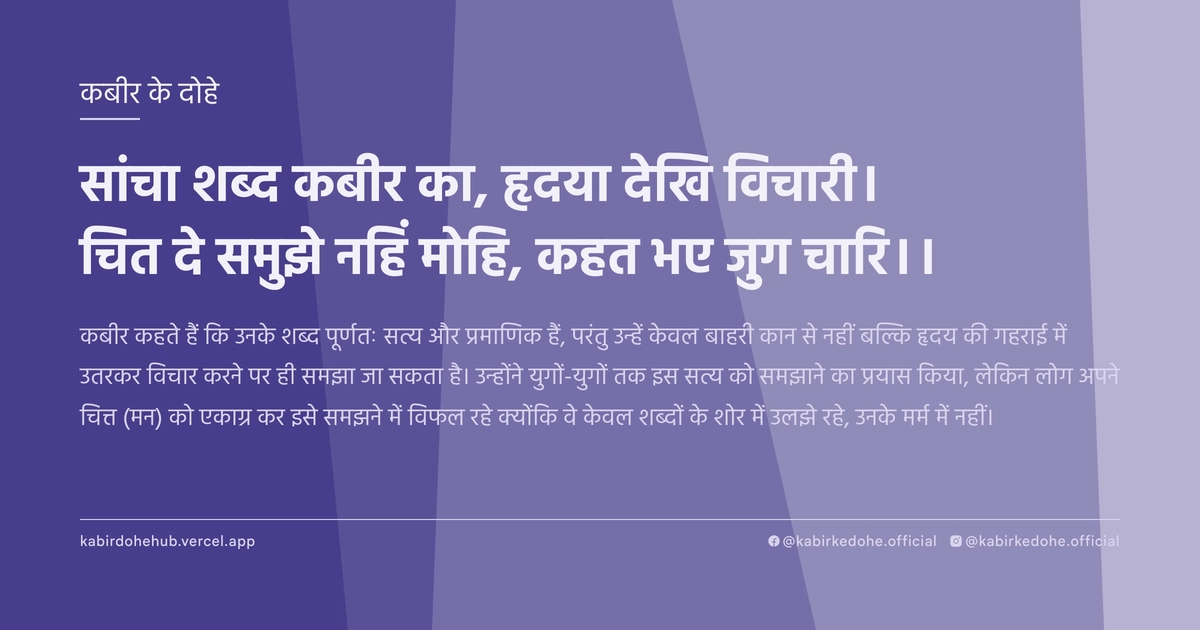
सांचा शब्द कबीर का, हृदया देखि विचारी।
चित दे समुझे नहिं मोहि, कहत भए जुग चारि।।
Sancha shabd kabir ka, hridaya dekh vichari. Chit de samujhe nahin mohi, kahat bhaye jug chari.
इस पृष्ठ पर इस कबीर दोहे का अर्थ (meaning), हिंदी व्याख्या और अंग्रेज़ी अनुवाद, दार्शनिक विश्लेषण और व्यावहारिक जीवन सीख दी गई है। यह दोहा सत्य (Truth) विषय से जुड़ा है — Kabir doha meaning and explanation in Hindi and English.
अर्थ (Meaning):
कबीर कहते हैं कि उनके शब्द पूर्णतः सत्य और प्रमाणिक हैं, परंतु उन्हें केवल बाहरी कान से नहीं बल्कि हृदय की गहराई में उतरकर विचार करने पर ही समझा जा सकता है। उन्होंने युगों-युगों तक इस सत्य को समझाने का प्रयास किया, लेकिन लोग अपने चित्त (मन) को एकाग्र कर इसे समझने में विफल रहे क्योंकि वे केवल शब्दों के शोर में उलझे रहे, उनके मर्म में नहीं।
Kabir asserts that his words are the absolute truth, yet they can only be grasped if one examines them through the lens of the heart. He laments that despite speaking these truths for ages, people fail to comprehend them because they do not surrender their consciousness or focus their inner mind to perceive the essence beyond the literal sounds.
व्याख्या (Interpretation):
इस दोहे का शाब्दिक अर्थ है कि कबीर की वाणी सत्य है, जिसे हृदय से महसूस करना चाहिए। रूपकात्मक स्तर पर, 'हृदय' यहाँ केवल शारीरिक अंग नहीं, बल्कि चेतना के उस केंद्र का प्रतीक है जहाँ अहंकार का विसर्जन होता है। कबीर यहाँ 'चित' (मन) की चंचलता और अज्ञान की बात कर रहे हैं। यह निरगुण भक्ति का सार है, जहाँ ईश्वर किसी बाहरी मूर्ति में नहीं बल्कि अंतरात्मा में स्थित है। माया ने मनुष्य की दृष्टि को इतना धुंधला कर दिया है कि वह सत्य को सामने देखकर भी नहीं पहचान पाता। यह द्वैत (मनुष्य और ईश्वर का अलग होना) की स्थिति है, जबकि सत्य अद्वैत है। जब तक साधक अपने बौद्धिक अहंकार को त्याग कर हृदय के समर्पण में नहीं उतरता, तब तक 'सांचा शब्द' केवल शब्द ही रहता है, अनुभव नहीं बनता।
Literally, the verse claims Kabir's words are true and must be contemplated by the heart. Metaphorically, the 'heart' represents the seat of intuitive consciousness where the ego dissolves. Kabir highlights the struggle of the 'Chit' (mind), which is often clouded by Maya (illusion), preventing the seeker from recognizing the formless Truth. This reflects the core of Nirgun Bhakti, where the Divine is not an external entity but the innermost essence. The paradox lies in the fact that while the truth is eternally present, the human condition of duality creates a veil of ignorance. Only when the seeker moves from intellectual analysis to spiritual surrender can the non-duality of Atman and Brahman be realized. The 'four ages' signify the timeless struggle of humanity to look inward rather than outward.
दार्शनिक विश्लेषण (Philosophical Analysis):
कबीर का यह दोहा उनके युग के धार्मिक पाखंड और केवल किताबी ज्ञान पर आधारित धर्म के विरुद्ध एक सशक्त प्रहार है। उस समय समाज कर्मकांडों और बाहरी आडंबरों में इतना लिप्त था कि सत्य की खोज केवल ग्रंथों के रटने तक सीमित हो गई थी। कबीर ने इस 'बौद्धिक अहंकार' को चुनौती दी। उनका दर्शन अद्वैत वेदांत से मेल खाता है, जहाँ आत्मा और परमात्मा एक ही हैं, लेकिन अज्ञान के कारण हम स्वयं को अलग मानते हैं।
सूफीवाद के प्रभाव में, कबीर 'इश्क' या प्रेम की बात करते हैं, जो केवल हृदय से संभव है। उनके लिए सत्य कोई तर्कसंगत निष्कर्ष नहीं है जिसे मस्तिष्क से सिद्ध किया जा सके, बल्कि यह एक 'अनुभूति' है। वे बताते हैं कि जब तक मन (चित्त) में वासनाएँ और अहंकार मौजूद हैं, तब तक सत्य का बोध असंभव है।
कबीर ने जाति और धर्म की दीवारों को तोड़कर एक ऐसे मार्ग की बात की जो सार्वभौमिक है। उन्होंने स्पष्ट किया कि सत्य किसी विशेष धर्मग्रंथ की बपौती नहीं है, बल्कि वह हर मनुष्य के भीतर मौजूद है। ritualism (कर्मकांड) केवल बाहरी आवरण है, जबकि वास्तविक धर्म आंतरिक रूपांतरण है।
मनोवैज्ञानिक स्तर पर, यह दोहा संज्ञानात्मक विसंगति (cognitive dissonance) को दर्शाता है। मनुष्य सत्य को सुनना चाहता है, लेकिन उसे स्वीकार करने के लिए जिस 'हृदय परिवर्तन' की आवश्यकता होती है, वह कठिन होता है। अहंकार सत्य को स्वीकार करने के बजाय उसे तर्क की कसौटी पर कसकर खारिज करना चाहता है।
अंततः, कबीर यह संदेश देते हैं कि सत्य की प्राप्ति के लिए 'श्रवण' (सुनना) पर्याप्त नहीं है, बल्कि 'मनन' (चिंतन) और 'निदिध्यासन' (गहन ध्यान) अनिवार्य है। जब तक साधक अपने अस्तित्व के केंद्र में नहीं उतरता, तब तक वह केवल शब्दों का संग्रह करता रहता है, सत्य का साक्षात्कार नहीं करता।
This Doha is a potent critique of the religious hypocrisy and rote scholarship prevalent during Kabir's era. Society was deeply entrenched in ritualism and external displays of piety, reducing spiritual pursuit to the mere recitation of scriptures. Kabir challenges this 'intellectual arrogance,' asserting that truth is not found in the ink of a book but in the pulse of the heart.
His philosophy aligns closely with Advaita Vedanta, emphasizing the non-duality of the self and the absolute. The perceived separation between the seeker and the Divine is an illusion created by Maya. By urging the listener to look into the 'heart,' Kabir is directing them toward the realization that the Atman is identical to Brahman.
Influenced by Sufism, Kabir emphasizes the role of divine love and intuitive longing. For him, Truth is not a logical conclusion to be reached through syllogisms but an experiential realization. He argues that as long as the 'Chit' (mind) is cluttered with desires and ego, the resonance of the Truth remains unheard.
Kabir's rejection of caste and creed is central here; he posits a universal path that transcends social constructs. He suggests that Truth is not the monopoly of any specific religion or scripture but is an inherent quality of human existence. Rituals are merely shells; the kernel is the internal transformation of the soul.
Psychologically, the verse addresses the resistance to change. Humans often seek truth superficially but recoil when it demands the annihilation of the ego. The 'four ages' mentioned symbolize the perennial human tendency to prioritize the noise of the world over the silence of the soul.
Ultimately, Kabir teaches that hearing is not understanding. True comprehension requires a shift from the cognitive mind to the intuitive heart, transforming a literal statement into a living experience of the Infinite.
मूल संदेश (Core Message):
- बौद्धिक ज्ञान सत्य का मार्ग नहीं, बल्कि केवल एक संकेत है।
- सत्य को तर्क से नहीं, बल्कि हृदय के समर्पण से पाया जाता है।
- अहंकार वह पर्दा है जो हमें स्वयं के भीतर के ईश्वर से अलग करता है।
- बाहरी अनुष्ठानों की तुलना में आंतरिक रूपांतरण कहीं अधिक मूल्यवान है।
- जब 'मैं' मिटता है, तभी 'वह' (परमात्मा) प्रकट होता है।
- Intellectual knowledge is not the path to Truth, but merely a signpost.
- Truth is realized through the surrender of the heart, not the logic of the mind.
- The ego is the veil that separates us from the Divinity within.
- Internal transformation is infinitely more valuable than external rituals.
- Only when the 'I' vanishes does the 'Infinite' reveal itself.
व्यावहारिक उदाहरण (Practical Example):
वाराणसी के एक पुराने मोहल्ले में माधव नाम का एक वृद्ध बुनकर रहता था। माधव अपनी कला में निपुण था, लेकिन उसका मन हमेशा अशांत रहता था। वह शहर के बड़े-बड़े पंडितों के पास जाता, कठिन मंत्रों का जाप करता और महंगे अनुष्ठान करवाता ताकि उसे 'मोक्ष' मिल सके। वह शास्त्रों को रट चुका था और धर्म की हर बारीकी जानता था, फिर भी उसके भीतर एक खालीपन था।
एक दिन वह एक साधारण से संत के पास गया और अपनी समस्या बताई। संत ने उसे कोई नया मंत्र नहीं दिया, बल्कि केवल इतना कहा, "माधव, तुम शब्दों को बहुत जानते हो, लेकिन क्या तुमने कभी अपने भीतर की खामोशी को सुना है?" माधव को यह बात बहुत सरल और निरर्थक लगी। उसने सोचा कि एक साधारण व्यक्ति उसे क्या सिखाएगा जो बड़े पंडित नहीं सिखा पाए।
अगले कुछ दिनों तक माधव ने उस संत की बातों पर विचार किया। उसने महसूस किया कि वह अब तक सत्य को एक 'वस्तु' की तरह खोज रहा था जिसे बाहर से प्राप्त किया जा सके। उसने अपनी दिनचर्या बदली। अब वह करघे पर कपड़ा बुनते समय केवल धागों को नहीं देखता था, बल्कि उस लय को महसूस करने लगा जो उसके भीतर चल रही थी।
धीरे-धीरे उसने पाया कि जब वह अहंकार छोड़ देता है कि "मैं एक महान बुनकर हूँ" या "मैं एक बड़ा भक्त हूँ", तब उसके काम में एक दैवीय आनंद आने लगा। उसने पाया कि जिस शांति को वह अनुष्ठानों में खोज रहा था, वह वास्तव में उसके अपने हृदय की गहराई में छिपी थी।
एक शाम, जब वह एक गरीब पड़ोसी की मदद कर रहा था, उसे अचानक अहसास हुआ कि सेवा और करुणा ही वह 'सांचा शब्द' है जिसे वह किताबों में खोज रहा था। उसका अहंकार पूरी तरह टूट गया और वह रो पड़ा।
उसने महसूस किया कि पंडितों के मंत्र केवल शब्द थे, लेकिन हृदय की करुणा वास्तविक सत्य थी। उसने अब बाहरी दिखावे छोड़ दिए और सादगी को अपनाया।
माधव अब केवल कपड़ा नहीं बुनता था, बल्कि वह हर धागे में ईश्वर की उपस्थिति महसूस करता था। उसकी शांति अब बाहरी परिस्थितियों पर निर्भर नहीं थी।
यह 'कबीर ट्विस्ट' था—जब उसने बौद्धिक ज्ञान को हृदय के अनुभव में बदला, तब उसे वह सत्य मिला जो युगों से उसके सामने था, पर वह उसे देख नहीं पा रहा था।
In an old alley of Varanasi lived Madhav, an elderly weaver. Madhav was a master of his craft, yet his mind was perpetually restless. He visited renowned pundits, chanted complex mantras, and performed expensive rituals in hopes of attaining 'Moksha.' He had memorized scriptures and knew every nuance of religious law, yet a profound emptiness lingered within him.
One day, he approached a simple wandering saint and shared his distress. The saint did not offer a new mantra but simply asked, "Madhav, you know many words, but have you ever listened to the silence within you?" To Madhav, this seemed overly simple and irrelevant. He wondered how a common man could teach him what the great scholars could not.
Over the following days, Madhav contemplated the saint's words. He realized he had been treating Truth as an 'object' to be acquired from the outside. He shifted his practice. While weaving on his loom, he stopped focusing merely on the threads and began to feel the rhythmic pulse of existence within himself.
Slowly, he discovered that when he let go of the identity of being a "great weaver" or a "devout believer," a divine joy permeated his work. He found that the peace he sought through rituals was actually hidden in the depths of his own heart.
One evening, while helping a destitute neighbor, it dawned on him that selfless service and compassion were the 'True Words' he had been searching for in books. His ego shattered, and he wept in realization.
He understood that the pundits' mantras were mere sounds, but the compassion of the heart was the living Truth. He abandoned all external pretenses and embraced a life of radical simplicity.
Madhav no longer just wove cloth; he felt the presence of the Divine in every single thread. His peace was no longer dependent on external circumstances.
This was the 'Kabir Twist'—by shifting from intellectual accumulation to heart-centered experience, he finally perceived the Truth that had been standing before him for a lifetime.
अभ्यास मार्गदर्शन (Practice Guidance):
- प्रतिदिन 20 मिनट 'साक्षी भाव' का अभ्यास करें: अपने विचारों को बिना किसी निर्णय के देखें, जैसे वे किसी और के हों।
- स्व-पूछताछ जर्नल: प्रतिदिन एक ऐसा क्षण लिखें जब आपका 'अहंकार' (मैं सही हूँ) आपके 'हृदय' (करुणा) पर हावी रहा।
- मौन व्रत: सप्ताह में एक बार कुछ घंटों के लिए पूर्ण मौन रहें, ताकि शब्दों का शोर कम हो और आंतरिक ध्वनि सुनाई दे।
- निदान चेकलिस्ट: क्या मैं सत्य को केवल तर्क से सिद्ध करने की कोशिश कर रहा हूँ? क्या मेरी भक्ति केवल शब्दों तक सीमित है? क्या मैं दूसरों को सुधारने से पहले स्वयं के भीतर झाँकता हूँ?
- Practice 'Witness Consciousness' for 20 minutes daily: Observe your thoughts without judgment, as if they belong to someone else.
- Self-Inquiry Journaling: Daily record one instance where your 'Ego' (the need to be right) overrode your 'Heart' (compassion).
- Vow of Silence: Observe complete silence for a few hours once a week to diminish the noise of words and hear the inner resonance.
- Diagnostic Checklist: Am I trying to prove the Truth through logic alone? Is my devotion limited to words? Do I look within myself before attempting to correct others?
चिंतन प्रश्न (Reflection Questions):
- क्या मेरी आध्यात्मिक पहचान वास्तव में आंतरिक शांति के लिए है, या यह केवल मेरी सामाजिक छवि (Digital/Social Ego) को बेहतर बनाने का एक साधन है?
- मैं किन शब्दों या धारणाओं के पीछे छिपकर अपने वास्तविक डर और असुरक्षाओं को नजरअंदाज करता हूँ?
- यदि मुझसे मेरे सभी धार्मिक और बौद्धिक लेबल छीन लिए जाएं, तो मेरे भीतर क्या बचेगा?
- क्या मैं सत्य को सुनने के लिए तैयार हूँ, या मैं केवल वही सुनना चाहता हूँ जो मेरे मौजूदा विश्वासों की पुष्टि करे?
- मेरे जीवन का वह कौन सा हिस्सा है जहाँ मैं 'जानने' का दावा करता हूँ, लेकिन 'अनुभव' करने से डरता हूँ?
- Is my spiritual identity truly for inner peace, or is it merely a tool to enhance my social image (Digital/Social Ego)?
- Behind which words or beliefs do I hide to ignore my deepest fears and insecurities?
- If all my religious and intellectual labels were stripped away, what would remain of me?
- Am I truly open to hearing the Truth, or do I only seek confirmation of my existing biases?
- In which area of my life do I claim to 'know' the truth, yet fear to actually 'experience' it?