
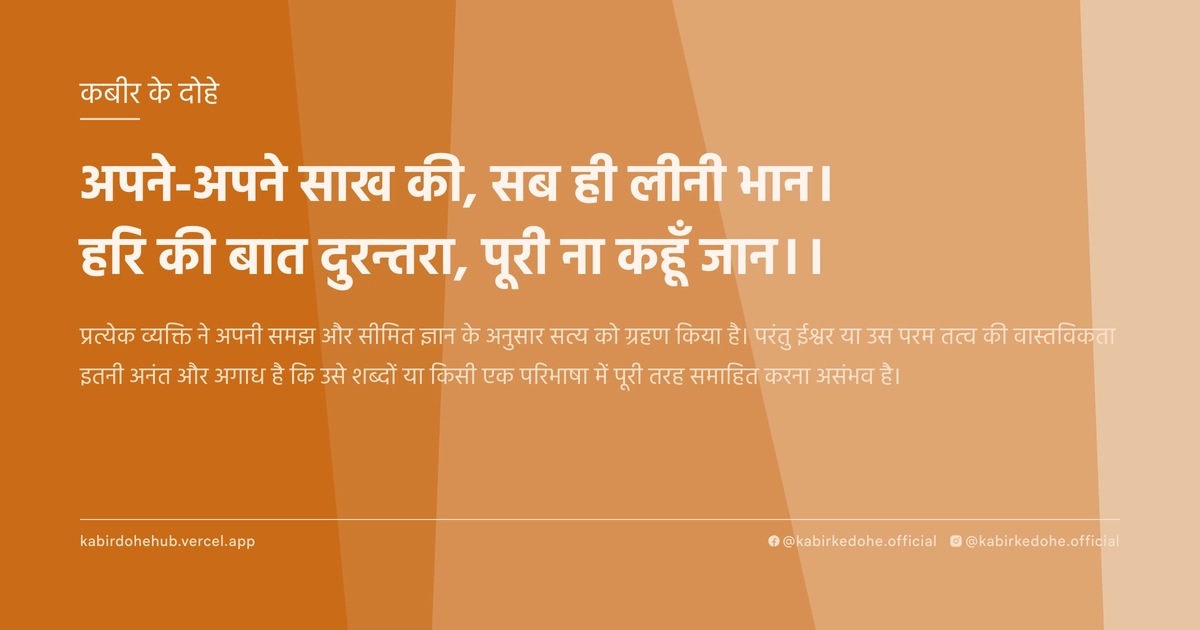
अपने-अपने साख की, सब ही लीनी भान।
हरि की बात दुरन्तरा, पूरी ना कहूँ जान।।
Apne-apne sakh ki, sab hi leeni bhaan. Hari ki baat durantara, poori na kahun jaan.
इस पृष्ठ पर इस कबीर दोहे का अर्थ (meaning), हिंदी व्याख्या और अंग्रेज़ी अनुवाद, दार्शनिक विश्लेषण और व्यावहारिक जीवन सीख दी गई है। यह दोहा सत्य (Truth) विषय से जुड़ा है — Kabir doha meaning and explanation in Hindi and English.
अर्थ (Meaning):
प्रत्येक व्यक्ति ने अपनी समझ और सीमित ज्ञान के अनुसार सत्य को ग्रहण किया है। परंतु ईश्वर या उस परम तत्व की वास्तविकता इतनी अनंत और अगाध है कि उसे शब्दों या किसी एक परिभाषा में पूरी तरह समाहित करना असंभव है।
Every individual has grasped the truth according to their own limited perception and personal evidence. However, the reality of the Divine is so vast and infinite that it defies complete definition or total comprehension through human language.
व्याख्या (Interpretation):
इस दोहे में कबीर मानवीय ज्ञान की सीमितता और ईश्वरीय अनंतता के बीच के विरोधाभास को दर्शाते हैं। 'साख' यहाँ व्यक्तिगत प्रमाण या अनुभव को दर्शाता है। कबीर कहते हैं कि हम जिसे सत्य मानते हैं, वह वास्तव में हमारे अपने दृष्टिकोण का एक छोटा सा हिस्सा है। यह निर्गुण भक्ति का मूल है, जहाँ ईश्वर किसी आकार या नाम में नहीं, बल्कि एक निराकार चेतना में है। माया हमें यह विश्वास दिलाती है कि हमने सत्य को 'जान' लिया है, जबकि वास्तव में हम केवल अपनी धारणाओं को सत्य मान रहे होते हैं। यह आत्मा और ब्रह्म के उस अद्वैत संबंध की ओर संकेत है जिसे केवल अनुभव किया जा सकता है, वर्णित नहीं।
In this couplet, Kabir highlights the paradox between the finitude of human knowledge and the infinity of the Divine. 'Saakh' refers to personal evidence or subjective experience. Kabir suggests that what we perceive as truth is merely a fragment seen through the lens of our own limited perspective. This is the essence of Nirgun Bhakti, where the Divine is not a persona but a formless consciousness. Maya creates the illusion that we have 'captured' the truth, while we are merely clinging to our own interpretations. It points toward the Advaita non-duality of Atman and Brahman, suggesting that the Ultimate Reality can be experienced but never fully articulated in words.
दार्शनिक विश्लेषण (Philosophical Analysis):
कबीर का यह कथन उस युग की धार्मिक कट्टरता पर एक गहरा प्रहार है जहाँ पंडित और मुल्ला अपने-अपने ग्रंथों को अंतिम सत्य मानते थे। वे यह स्पष्ट करते हैं कि कोई भी एक धर्म या शास्त्र ईश्वर का पूर्ण विवरण नहीं दे सकता। यह दृष्टिकोण सूफीवाद के 'फना' और अद्वैत वेदांत के 'माया' सिद्धांत से मेल खाता है, जहाँ व्यक्तिगत अहंकार (I-ness) ही सत्य को देखने में सबसे बड़ी बाधा है।
ऐतिहासिक रूप से, कबीर ने बाहरी कर्मकांडों और शास्त्र-ज्ञान के अहंकार को चुनौती दी। उनके लिए 'ज्ञान' वह नहीं है जो किताबों में लिखा है, बल्कि वह है जो हृदय के अनुभव से उपजता है। जब कोई व्यक्ति यह स्वीकार कर लेता है कि वह सब कुछ नहीं जानता, तभी वास्तविक खोज शुरू होती है।
दार्शनिक स्तर पर, 'दुरंतरा' शब्द उस सत्य की ओर इशारा करता है जो सीमाओं से परे है। यह मनोवैज्ञानिक रूपांतरण की मांग करता है—एक ऐसी स्थिति जहाँ साधक अपने 'सही होने' के दावे को त्याग देता है। यह अहंकार का विसर्जन है, क्योंकि जब तक 'मैं जानता हूँ' का भाव रहता है, तब तक सत्य ओझल रहता है।
यह दोहा हमें सिखाता है कि सत्य बहुआयामी है। जिस प्रकार एक हाथी को छूने वाले अलग-अलग लोग उसके अलग-अलग हिस्सों को ही पूरा हाथी मान लेते हैं, वैसे ही मनुष्य अपनी सीमित बुद्धि से ईश्वर को परिभाषित करने की कोशिश करता है। कबीर यहाँ विनम्रता का मार्ग प्रशस्त करते हैं।
अंततः, यह संदेश है कि ईश्वर को 'पहचानना' किसी बौद्धिक व्यायाम का परिणाम नहीं है, बल्कि यह एक मौन समर्पण है। जब शब्द समाप्त हो जाते हैं, वहीं से उस अनंत की वास्तविक पहचान शुरू होती है।
Kabir's assertion is a profound critique of the religious dogmatism of his era, where pundits and mullahs claimed their respective scriptures held the absolute truth. He clarifies that no single religion or text can provide an exhaustive description of the Divine. This perspective aligns with the Sufi concept of 'Fana' (annihilation of self) and the Advaita Vedanta principle of 'Maya', where the individual ego is the primary obstacle to perceiving Truth.
Historically, Kabir challenged the arrogance of ritualism and scriptural scholarship. For him, 'knowledge' is not what is written in books, but what emerges from the direct experience of the heart. Real spiritual inquiry begins only when a seeker acknowledges the limitation of their own understanding.
Philosophically, the term 'Durantara' points to a reality that transcends all boundaries. This demands a psychological transformation—a state where the seeker relinquishes the claim of 'being right.' This is the dissolution of the ego, for as long as the feeling of 'I know' persists, the Truth remains obscured.
The couplet teaches us that Truth is multidimensional. Just as blind men touching different parts of an elephant mistake those parts for the whole animal, humans attempt to define God through the narrow lens of their intellect. Kabir advocates for a path of radical humility.
Ultimately, the message is that 'recognizing' the Divine is not the result of an intellectual exercise, but a silent surrender. Where words end, the actual recognition of the Infinite begins.
मूल संदेश (Core Message):
- बौद्धिक अहंकार सत्य की प्राप्ति में सबसे बड़ी बाधा है।
- सत्य को शब्दों में बांधना उसे सीमित करना है।
- विनम्रता ही वह द्वार है जिससे अनंत का अनुभव होता है।
- व्यक्तिगत अनुभव सत्य का एक हिस्सा हो सकते हैं, पूर्ण सत्य नहीं।
- परम तत्व को जानने के लिए 'जानने वाले' का मिटना आवश्यक है।
- Intellectual arrogance is the primary barrier to realizing Truth.
- Attempting to define Truth in words is to limit the Infinite.
- Humility is the only gateway to experiencing the Absolute.
- Personal experience is a fragment of truth, not the totality.
- To know the Divine, the 'knower' must first vanish.
व्यावहारिक उदाहरण (Practical Example):
वाराणसी के एक पुराने घाट पर रहने वाली एक वृद्ध विधवा, जानकी, का जीवन केवल पूजा-पाठ और नियमों के इर्द-गिर्द घूमता था। वह मानती थी कि उसने शास्त्रों का पूरा ज्ञान प्राप्त कर लिया है और वह जानती थी कि मोक्ष का मार्ग क्या है। वह अक्सर अन्य महिलाओं को उनके 'गलत' तरीकों के लिए टोकती थी।
एक दिन उसकी मुलाकात एक घुमंतू फकीर से हुई जो केवल मौन रहकर मुस्कुराता था। जानकी ने उसे अपने ज्ञान के तर्क दिए और बताया कि ईश्वर केवल उन्हीं को मिलता है जो कठोर नियमों का पालन करते हैं। फकीर ने कुछ नहीं कहा, बस उसे एक बहती नदी की ओर देखने का इशारा किया।
जानकी ने देखा कि नदी का पानी हर पत्थर से टकराकर अपना रास्ता बदल रहा था, फिर भी वह अंततः समुद्र की ओर ही जा रहा था। फकीर ने तब धीरे से कहा, 'माँ, तुम नदी के एक पत्थर को पकड़कर बैठी हो और कह रही हो कि यही पूरा रास्ता है।'
यह बात जानकी के हृदय में गहरे तक चुभ गई। उसे अहसास हुआ कि उसका 'ज्ञान' वास्तव में एक संकीर्ण दीवार बन गया था जिसने उसे वास्तविक ईश्वर से दूर कर दिया था। उसने महसूस किया कि उसकी कठोरता वास्तव में उसके अहंकार का रूप थी।
अगले कुछ महीनों में, जानकी का व्यवहार बदलने लगा। उसने दूसरों को सही या गलत ठहराना बंद कर दिया। उसने पाया कि जब उसने 'सब जानने' का दावा छोड़ा, तो उसे लोगों के दुख और उनकी करुणा अधिक स्पष्ट दिखने लगी।
उसने देखा कि एक गरीब बच्चे की निस्वार्थ मुस्कान में भी वही 'हरि' थे, जिन्हें वह केवल कठिन मंत्रों में खोज रही थी। उसका अहंकार धीरे-धीरे पिघलने लगा और वह अधिक शांत और प्रेमपूर्ण हो गई।
अब वह घाट पर बैठकर केवल मंत्र नहीं पढ़ती थी, बल्कि चुपचाप लोगों की सेवा करती थी। उसने सीखा कि सत्य को शब्दों में बांधना उसे कैद करना है, जबकि उसे अनुभव करना उसे मुक्त करना है।
जानकी की यह यात्रा एक 'कबीर ट्विस्ट' थी—जहाँ ज्ञान के विनाश ने वास्तव में बोध के जन्म को संभव बनाया। उसने पाया कि पूर्ण पहचान शब्दों में नहीं, बल्कि उस मौन में है जहाँ 'मैं' समाप्त हो जाता है।
Janaki, an elderly widow living on an ancient ghat in Varanasi, spent her life revolving around rituals and strict rules. She believed she had mastered the scriptures and knew the exact path to salvation. She often corrected other women, pointing out their 'incorrect' ways of worship.
One day, she met a wandering fakir who remained mostly silent, wearing a gentle smile. Janaki attempted to impress him with her theological arguments, explaining that God is only attained through rigorous adherence to tradition.
The fakir said nothing but pointed toward the flowing river. Janaki observed how the water collided with various stones, changing its course repeatedly, yet inevitably moving toward the ocean.
The fakir whispered, 'Mother, you are clutching a single stone in the river and claiming it is the entire path.'
These words pierced Janaki's heart. She realized that her 'knowledge' had become a narrow wall, isolating her from the living reality of the Divine. She saw that her rigidity was merely a mask for her ego.
Over the following months, Janaki's behavior shifted. She stopped labeling others as right or wrong. She discovered that once she abandoned the claim of 'knowing everything,' she could finally see the suffering and compassion of others clearly.
She noticed that the selfless smile of a poor child held the same 'Hari' she had been searching for in complex mantras. Her ego began to melt, replaced by a profound sense of peace and love.
She no longer spent her days solely reciting texts; instead, she quietly served those around her. She learned that binding Truth in words is to imprison it, while experiencing it is to be liberated.
Janaki's journey was a 'Kabir Twist'—where the destruction of intellectual certainty paved the way for actual realization. She found that true recognition lies not in words, but in the silence where the 'I' vanishes.
अभ्यास मार्गदर्शन (Practice Guidance):
- प्रतिदिन 20 मिनट 'मौन चिंतन' करें, जहाँ आप किसी भी विचार को सही या गलत ठहराने के बजाय केवल उसे देखें।
- एक डायरी लिखें जिसमें आप उन तीन धारणाओं को दर्ज करें जिन्हें आप 'अंतिम सत्य' मानते हैं, और फिर स्वयं से पूछें—'यदि यह सत्य न हो, तो क्या होगा?'
- व्यवहार परिवर्तन: जब भी आप किसी को सुधारने की इच्छा महसूस करें, तो रुकें और मन में कहें, 'मेरा ज्ञान सीमित है, शायद उनका सत्य अलग है।'
- निदान चेकलिस्ट: क्या आप दूसरों के विचारों पर तुरंत प्रतिक्रिया देते हैं? क्या आप अपनी मान्यताओं के प्रति अत्यधिक रक्षात्मक हैं? यदि हाँ, तो आप अभी भी 'साख' (सीमित ज्ञान) के जाल में हैं।
- Practice 20 minutes of 'Silent Observation' daily, watching your thoughts without labeling them as right or wrong.
- Keep a journal where you list three beliefs you consider 'Absolute Truths,' then ask yourself: 'What if this is not the whole truth?'
- Behavioral Shift: Whenever you feel the urge to correct someone, pause and mentally acknowledge: 'My knowledge is limited; their truth may be different.'
- Diagnostic Checklist: Do you react impulsively to opposing views? Are you overly defensive about your beliefs? If yes, you are still trapped in the illusion of 'Saakh' (limited knowledge).
चिंतन प्रश्न (Reflection Questions):
- क्या मेरी धार्मिक या वैचारिक पहचान मुझे दूसरों से जोड़ रही है या अलग कर रही है?
- मैं अपनी 'सही होने' की आवश्यकता के पीछे किस डर को छिपा रहा हूँ?
- क्या मेरा डिजिटल व्यक्तित्व (सोशल मीडिया) मेरी वास्तविक आंतरिक खोज को दबा रहा है?
- यदि मेरे जीवन के सभी विश्वास आज छीन लिए जाएँ, तो मैं कौन रहूँगा?
- क्या मैं सत्य की खोज कर रहा हूँ, या केवल अपनी मौजूदा मान्यताओं की पुष्टि?
- Is my religious or ideological identity connecting me to others or isolating me?
- What fear am I hiding behind my desperate need to be 'right'?
- Is my digital persona masking the void of my actual internal inquiry?
- If all my beliefs were stripped away today, who would I be?
- Am I searching for the Truth, or merely seeking confirmation of my existing biases?