
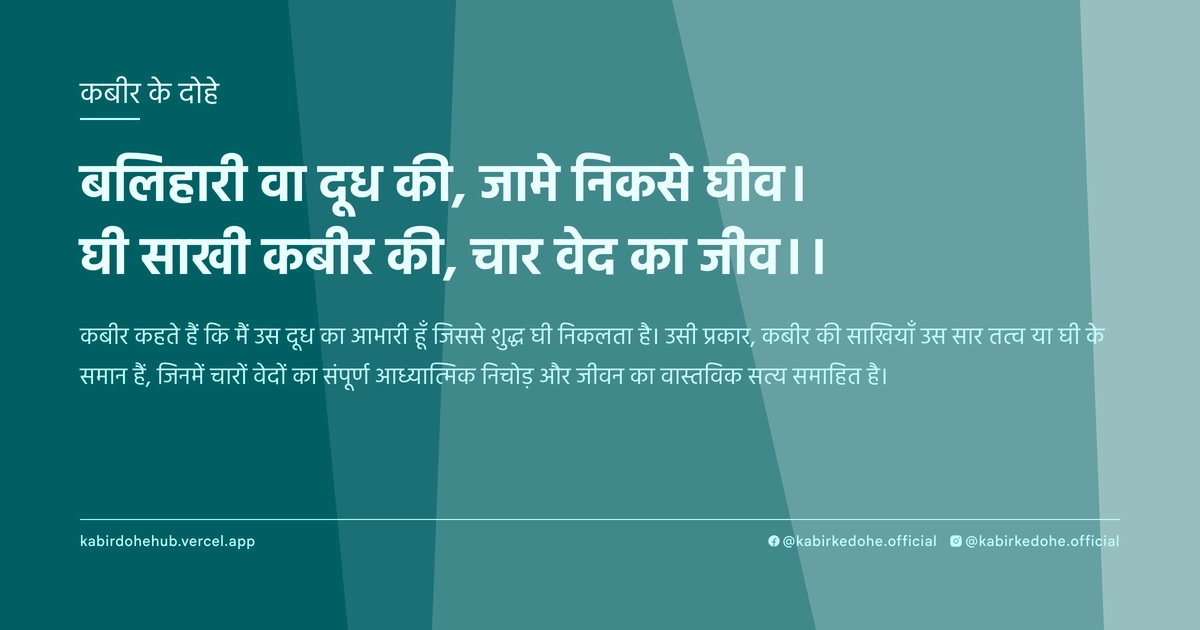
बलिहारी वा दूध की, जामे निकसे घीव।
घी साखी कबीर की, चार वेद का जीव।।
Balihari va doodh ki, jaame nikse gheed. Ghee sakhi kabir ki, chaar ved ka jeev.
इस पृष्ठ पर इस कबीर दोहे का अर्थ (meaning), हिंदी व्याख्या और अंग्रेज़ी अनुवाद, दार्शनिक विश्लेषण और व्यावहारिक जीवन सीख दी गई है। यह दोहा सत्य (Truth) विषय से जुड़ा है — Kabir doha meaning and explanation in Hindi and English.
अर्थ (Meaning):
कबीर कहते हैं कि मैं उस दूध का आभारी हूँ जिससे शुद्ध घी निकलता है। उसी प्रकार, कबीर की साखियाँ उस सार तत्व या घी के समान हैं, जिनमें चारों वेदों का संपूर्ण आध्यात्मिक निचोड़ और जीवन का वास्तविक सत्य समाहित है।
Kabir expresses profound gratitude for the milk from which pure clarified butter (ghee) is extracted. He asserts that his couplets (Sakhis) are like that essence—the ghee—containing the distilled spiritual truth and the living soul of the four Vedas, stripped of unnecessary ritualism.
व्याख्या (Interpretation):
इस दोहे में दूध और घी का रूपक सत्य की खोज की प्रक्रिया को दर्शाता है। दूध यहाँ शास्त्र, परंपराओं और बाहरी ज्ञान का प्रतीक है, जबकि घी उस 'सार' या 'तत्व' का प्रतीक है जिसे मंथन के बाद प्राप्त किया जाता है। कबीर का तर्क है कि वेदों का विशाल ज्ञान महत्वपूर्ण है, लेकिन वह ज्ञान तब तक व्यर्थ है जब तक उसे अनुभव में न बदला जाए। निर्गुण भक्ति के परिप्रेक्ष्य में, यह 'साकार' से 'निराकार' की यात्रा है। माया वह दूध है जिसमें सत्य छिपा है, और साधना वह मंथन है जिससे आत्मा (घी) अलग होती है। यह अद्वैत वेदांत के उस सिद्धांत को पुष्ट करता है जहाँ ब्रह्म सर्वव्यापी है, परंतु उसे केवल शुद्ध चेतना के माध्यम से ही पहचाना जा सकता है।
In this couplet, the metaphor of milk and ghee illustrates the process of seeking Truth. Milk represents scriptures, traditions, and external knowledge, while ghee symbolizes the 'essence' or 'core' extracted after rigorous churning. Kabir argues that while the vast knowledge of the Vedas is significant, it remains inert unless transformed into lived experience. Within the framework of Nirgun Bhakti, this is the journey from the 'form' to the 'formless'. Maya is the milk in which the Truth is hidden, and spiritual practice (Sadhana) is the churning process that separates the Soul (ghee) from the illusion. This reinforces the Advaita Vedanta principle that Brahman is omnipresent, yet can only be realized through a purified consciousness, highlighting the paradox that the Truth is hidden in plain sight, requiring only the effort of internal distillation.
दार्शनिक विश्लेषण (Philosophical Analysis):
कबीर का यह कथन उनके समय के धार्मिक कट्टरपंथ और केवल लिपियों के ज्ञान पर आधारित पाण्डित्य के विरुद्ध एक सशक्त प्रहार है। मध्यकालीन भारत में, वेदों का ज्ञान केवल उच्च जातियों तक सीमित था और उसे पवित्रता के नाम पर सुरक्षित रखा गया था। कबीर ने इस एकाधिकार को चुनौती देते हुए यह स्थापित किया कि सत्य किसी भाषा, जाति या पुस्तक का मोहताज नहीं है। उनके लिए 'साखी' (साक्ष्य) वह जीवित प्रमाण है जो किताबी ज्ञान से ऊपर है।
दार्शनिक स्तर पर, यह सूफी मत के 'हकीकत' (परम सत्य) और 'मरीफत' (ज्ञान) के मेल जैसा है। सूफीवाद की तरह, कबीर भी बाहरी कर्मकांडों को खोखला मानते थे। वे कहते हैं कि यदि आप हज़ारों ग्रंथ पढ़ लें लेकिन अपने भीतर के अहंकार को नहीं मिटा पाए, तो वह ज्ञान केवल एक बोझ है। घी का निकलना अहंकार के विसर्जन और शुद्ध प्रेम के उदय का प्रतीक है।
अद्वैत वेदांत के अनुसार, आत्मा और परमात्मा एक ही हैं। कबीर इस एकता को 'सार' कहते हैं। वेदों के 'जीव' का अर्थ है उनकी आत्मा। जब कोई व्यक्ति शास्त्रों के शब्दों को छोड़कर उनके मर्म को समझता है, तब वह वास्तव में वेदों को पढ़ रहा होता है। कबीर यहाँ ज्ञान के लोकतंत्रीकरण की बात कर रहे हैं, जहाँ अनुभवजन्य सत्य (Experiential Truth) को सैद्धांतिक सत्य (Theoretical Truth) पर वरीयता दी गई है।
मनोवैज्ञानिक रूप से, यह प्रक्रिया 'संश्लेषण' (Synthesis) की है। मनुष्य अक्सर सूचनाओं के ढेर में खो जाता है। कबीर हमें सिखाते हैं कि सूचना (Information) और ज्ञान (Knowledge) के बीच का अंतर ही 'मंथन' है। जब हम अपने जीवन के अनुभवों को आत्म-चिंतन की अग्नि में तपाते हैं, तब केवल वही बचता है जो शाश्वत है।
अंततः, यह दोहा हमें यह समझाता है कि धर्म का उद्देश्य अनुष्ठान करना नहीं, बल्कि उस शुद्ध तत्व को प्राप्त करना है जो हमें ब्रह्मांडीय चेतना से जोड़ता है। कबीर की साखियाँ वह संक्षिप्त मार्ग हैं जो हमें सीधे उस गंतव्य तक ले जाती हैं, जहाँ शब्दों की आवश्यकता समाप्त हो जाती है और केवल मौन अनुभव शेष रहता है।
Kabir's statement is a powerful critique of the religious orthodoxy and the scholarly pride based solely on textual literacy prevalent during his era. In medieval India, Vedic knowledge was restricted to upper castes and guarded under the guise of purity. Kabir challenged this monopoly, asserting that Truth is not hostage to any language, caste, or book. For him, the 'Sakhi' (witness/evidence) is the living proof that transcends bookish knowledge.
Philosophically, this mirrors the Sufi concepts of 'Haqiqat' (Ultimate Truth) and 'Ma'rifat' (Gnosis). Like the Sufis, Kabir viewed external rituals as hollow. He posited that reading thousands of texts is futile if one cannot annihilate the ego. The extraction of ghee symbolizes the dissolution of the 'I' and the emergence of pure, unconditional love.
According to Advaita Vedanta, the Atman and Brahman are identical. Kabir refers to this unity as the 'essence'. The 'soul of the four Vedas' implies that the spirit of the texts is more vital than the literal words. When a seeker moves beyond the letter of the law to the spirit of the truth, they are truly engaging with the Vedas. Kabir advocates for the democratization of knowledge, prioritizing experiential truth over theoretical dogma.
Psychologically, this process is one of 'Synthesis'. Humans often drown in a sea of information. Kabir teaches that the gap between information and wisdom is bridged by 'churning'—the act of critical self-reflection. When we subject our life experiences to the fire of introspection, only that which is eternal remains.
Ultimately, this couplet teaches that the purpose of religion is not to perform rituals, but to attain that pure element that connects the individual to universal consciousness. Kabir's couplets serve as a concise map, leading the seeker to a destination where words cease to exist and only silent realization remains.
मूल संदेश (Core Message):
- शास्त्रों का अध्ययन केवल शुरुआत है, अनुभव ही अंतिम लक्ष्य है।
- बाहरी कर्मकांड दूध की तरह हैं; आंतरिक रूपांतरण ही असली घी है।
- अहंकार का विसर्जन ही आध्यात्मिक ज्ञान का वास्तविक निचोड़ है।
- सत्य किसी पुस्तक में नहीं, बल्कि जीवित आचरण में बसता है।
- सादगी और प्रेम ही वेदों का सर्वोच्च और अंतिम सार हैं।
- Studying scriptures is only the beginning; lived experience is the ultimate goal.
- External rituals are like milk; internal transformation is the true ghee.
- The dissolution of ego is the actual essence of spiritual knowledge.
- Truth resides not in a book, but in living conduct.
- Simplicity and love are the highest and final essence of the Vedas.
व्यावहारिक उदाहरण (Practical Example):
वाराणसी के घाटों पर रहने वाले एक वृद्ध बुनकर थे, जिनका नाम रामदीन था। रामदीन ने अपना पूरा जीवन रेशमी साड़ियाँ बुनने में बिता दिया था। वे बहुत धार्मिक थे और हर दिन घंटों मंदिर में बिताते थे, वेदों के मंत्रों का पाठ सुनते थे, लेकिन उनके मन में हमेशा एक बेचैनी रहती थी। उन्हें लगता था कि धर्म केवल नियमों और परंपराओं का पालन है, जिसमें कोई वास्तविक शांति नहीं है।
एक दिन उनकी मुलाकात एक घुमंतू फकीर से हुई, जिसने उन्हें कबीर का यह दोहा सुनाया। फकीर ने उनसे पूछा, 'रामदीन, क्या तुम केवल दूध पीकर खुश हो, या तुम्हें उस घी की तलाश है जो दूध के भीतर छिपा है?' रामदीन उलझन में पड़ गए। फकीर ने समझाया कि मंदिर जाना और मंत्र पढ़ना 'दूध' है, लेकिन उस प्रार्थना से जो करुणा और प्रेम पैदा होता है, वह 'घी' है।
रामदीन ने महसूस किया कि वे अब तक केवल बाहरी आवरण को पकड़कर बैठे थे। उन्होंने अपनी पूजा की पद्धति बदली। अब वे केवल मंत्र नहीं पढ़ते थे, बल्कि यह देखते थे कि क्या उनके शब्दों का प्रभाव उनके व्यवहार पर पड़ रहा है। उन्होंने देखा कि वे अक्सर अपने छोटे सहायकों के साथ कठोर व्यवहार करते थे, जबकि वे खुद को एक 'धार्मिक' व्यक्ति मानते थे।
एक शाम, जब एक युवा सहायक ने गलती से एक महंगी साड़ी का धागा तोड़ दिया, तो रामदीन का पुराना स्वभाव उसे डांटने के लिए उबला। लेकिन तभी उन्हें 'घी' की याद आई—वह सार जो करुणा है। उन्होंने उस युवक को डांटने के बजाय उसे गले लगाया और कहा, 'धागा तो फिर जुड़ जाएगा, लेकिन तुम्हारा विश्वास नहीं टूटना चाहिए।'
उस क्षण रामदीन को वह शांति मिली जो उन्हें वर्षों के वेदों के पाठ से नहीं मिली थी। उन्होंने अनुभव किया कि वास्तविक धर्म किसी पुस्तक में नहीं, बल्कि दूसरे के प्रति संवेदना में है। उनका अहंकार, जो उन्हें 'ज्ञानी' होने का भ्रम देता था, धीरे-धीरे पिघलने लगा।
अब रामदीन केवल एक बुनकर नहीं थे, बल्कि वे अपने मोहल्ले के लिए शांति के प्रतीक बन गए। वे अब शास्त्रों की बहस में नहीं पड़ते थे, बल्कि चुपचाप लोगों की मदद करते थे। जब लोग उनसे उनकी शांति का रहस्य पूछते, तो वे बस मुस्कुराकर कबीर का वह दोहा दोहरा देते थे।
उन्होंने सीखा कि ज्ञान का संचय करना दूध इकट्ठा करने जैसा है, लेकिन उस ज्ञान को प्रेम में बदलना घी निकालने जैसा है। उनकी सादगी ही अब उनका सबसे बड़ा शास्त्र बन गई थी।
रामदीन की कहानी यह दर्शाती है कि जब हम कर्मकांडों के 'दूध' से ऊपर उठकर करुणा के 'घी' तक पहुँचते हैं, तब जीवन वास्तव में सार्थक होता है।
In the ghats of Varanasi lived an elderly weaver named Ramdeen. Ramdeen had spent his entire life weaving silk sarees. He was deeply religious, spending hours in temples and listening to the recitation of Vedic hymns, yet a persistent restlessness lingered in his heart. He felt that religion was merely a set of rules and traditions, devoid of any real peace.
One day, he met a wandering fakir who recited this specific couplet of Kabir. The fakir asked him, 'Ramdeen, are you content merely drinking the milk, or are you searching for the ghee hidden within it?' Ramdeen was perplexed. The fakir explained that visiting temples and chanting mantras is the 'milk,' but the compassion and love that arise from that prayer are the 'ghee.'
Ramdeen realized he had been clinging only to the outer shell. He changed his approach to worship. He no longer just recited mantras; he began to observe if those words influenced his behavior. He noticed that he was often harsh with his young assistants, despite considering himself a 'religious' man.
One evening, when a young assistant accidentally broke a thread in an expensive saree, Ramdeen's old nature surged to scold him. But then, he remembered the 'ghee'—the essence of compassion. Instead of shouting, he embraced the youth and said, 'The thread can be tied again, but your confidence must not be broken.'
In that moment, Ramdeen found a peace that years of Vedic recitations had not provided. He experienced that true religion lies not in a book, but in empathy for another. His ego, which had blinded him with the illusion of being a 'scholar,' began to melt away.
Ramdeen was no longer just a weaver; he became a symbol of peace in his neighborhood. He stopped engaging in scriptural debates and instead quietly helped those in need. When people asked the secret of his tranquility, he would simply smile and repeat Kabir's couplet.
He learned that accumulating knowledge is like gathering milk, but transforming that knowledge into love is like extracting ghee. His simplicity became his greatest scripture.
Ramdeen's story illustrates that when we rise above the 'milk' of ritualism to reach the 'ghee' of compassion, life truly becomes meaningful.
अभ्यास मार्गदर्शन (Practice Guidance):
- दैनिक आत्म-मंथन: प्रतिदिन 15 मिनट मौन बैठें और विचार करें कि आज आपके किन कार्यों में केवल 'दिखावा' (दूध) था और कहाँ 'सच्ची भावना' (घी) थी।
- ज्ञान का प्रयोग: किसी भी धार्मिक या आध्यात्मिक पुस्तक से एक विचार लें और उसे केवल पढ़ने के बजाय, उसे पूरे दिन एक व्यावहारिक कार्य (जैसे किसी की निस्वार्थ मदद) में बदलें।
- अहंकार की पहचान: जब भी आप खुद को दूसरों से अधिक 'ज्ञानी' या 'धार्मिक' महसूस करें, तो रुकें और पूछें—'क्या यह मेरा अहंकार बोल रहा है या मेरी आत्मा?'
- निदान चेकलिस्ट: क्या मैं नियमों के पालन में अधिक व्यस्त हूँ या प्रेम के अभ्यास में? क्या मेरा ज्ञान मुझे विनम्र बना रहा है या अभिमानी? यदि उत्तर 'नियम' और 'अभिमान' है, तो आप अभी भी केवल दूध पी रहे हैं।
- Daily Self-Churning: Sit in silence for 15 minutes daily and reflect on which of your actions today were mere 'show' (milk) and where there was 'genuine intent' (ghee).
- Application of Knowledge: Take one insight from a spiritual text and, instead of just reading it, transform it into a practical act of selfless service throughout the day.
- Ego Identification: Whenever you feel more 'knowledgeable' or 'religious' than others, pause and ask—'Is this my ego speaking, or my soul?'
- Diagnostic Checklist: Am I more occupied with following rules or practicing love? Is my knowledge making me humble or arrogant? If the answer is 'rules' and 'arrogance,' you are still merely drinking the milk.
चिंतन प्रश्न (Reflection Questions):
- मेरे जीवन में 'दूध' (औपचारिकताएं) क्या हैं और 'घी' (वास्तविक मूल्य) क्या हैं?
- क्या मैं अपनी धार्मिक पहचान का उपयोग दूसरों को नीचा दिखाने के लिए एक ढाल की तरह करता हूँ?
- यदि मुझसे मेरी सभी डिग्रियाँ और धार्मिक लेबल छीन लिए जाएँ, तो मेरे भीतर क्या बचेगा?
- मैं कितनी बार सत्य को जानने के बजाय, सत्य के बारे में 'बात' करने में समय बिताता हूँ?
- मेरे भीतर का वह कौन सा 'कठोर दूध' है जिसे मुझे करुणा की अग्नि से घी में बदलना है?
- What are the 'milk' (formalities) and 'ghee' (real values) in my own life?
- Do I use my religious or intellectual identity as a shield to feel superior to others?
- If all my degrees and religious labels were stripped away, what would remain within me?
- How often do I spend time 'talking' about the truth rather than actually 'knowing' it?
- What is that 'hardened milk' within me that needs to be transformed into ghee through the fire of compassion?