
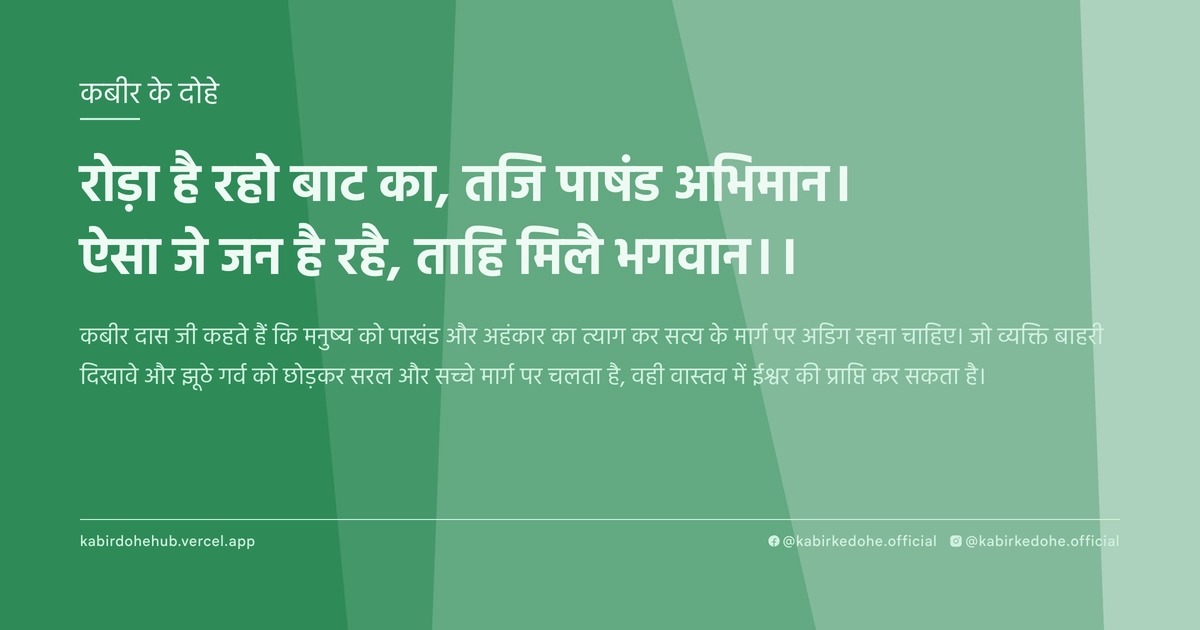
रोड़ा है रहो बाट का, तजि पाषंड अभिमान।
ऐसा जे जन है रहै, ताहि मिलै भगवान।।
Roda hai raho baat ka, taji pashand abhimaan. Aisa je jan hai rahai, taahi milai bhagwan.
इस पृष्ठ पर इस कबीर दोहे का अर्थ (meaning), हिंदी व्याख्या और अंग्रेज़ी अनुवाद, दार्शनिक विश्लेषण और व्यावहारिक जीवन सीख दी गई है। यह दोहा सत्य (Truth) विषय से जुड़ा है — Kabir doha meaning and explanation in Hindi and English.
अर्थ (Meaning):
कबीर दास जी कहते हैं कि मनुष्य को पाखंड और अहंकार का त्याग कर सत्य के मार्ग पर अडिग रहना चाहिए। जो व्यक्ति बाहरी दिखावे और झूठे गर्व को छोड़कर सरल और सच्चे मार्ग पर चलता है, वही वास्तव में ईश्वर की प्राप्ति कर सकता है।
Kabir asserts that one must abandon the shackles of hypocrisy and the arrogance of spiritual pride to remain steadfast on the path of truth. Only those who renounce outward pretension and the ego's vanity can truly realize the Divine presence within and around them.
व्याख्या (Interpretation):
इस दोहे का शाब्दिक अर्थ है कि पाखंड और अहंकार को त्यागकर सही रास्ते पर चलो। आध्यात्मिक स्तर पर, 'पाषंड' केवल धार्मिक ढोंग नहीं, बल्कि वह मानसिक पर्दा है जिसे हम अपनी पहचान बनाने के लिए ओढ़ते हैं। 'अभिमान' वह सूक्ष्म अहंकार है जो हमें यह विश्वास दिलाता है कि हम दूसरों से अधिक पवित्र या ज्ञानी हैं। यह निरगुण भक्ति का सार है, जहाँ ईश्वर किसी मंदिर या मस्जिद में नहीं, बल्कि अहंकार शून्य हृदय में निवास करता है। जब साधक माया के भ्रम को तोड़ता है, तब उसे अनुभव होता है कि आत्मा और परमात्मा वास्तव में एक ही हैं। यह द्वैत से अद्वैत की ओर संक्रमण है, जहाँ 'मैं' का विसर्जन ही 'उस' की प्राप्ति है।
Literally, the verse urges the seeker to discard hypocrisy and pride to walk the true path. Metaphorically, 'Paashand' represents not just religious ritualism, but the psychological masks we wear to project a curated spiritual identity. 'Abhimaan' is the subtle ego that whispers that one is more enlightened or pious than another. This aligns with Nirgun Bhakti, where the Divine is not a distant entity in a temple, but the formless essence residing in a heart void of ego. By piercing the veil of Maya, the seeker realizes the non-duality of Atman and Brahman. The central paradox is that one must 'become nothing' to 'become everything'; the annihilation of the individual 'I' is the only gateway to the Universal Truth.
दार्शनिक विश्लेषण (Philosophical Analysis):
कबीर का यह संदेश उनके युग के सामाजिक और धार्मिक परिवेश की एक तीखी प्रतिक्रिया है, जहाँ कर्मकांड और जातिगत श्रेष्ठता चरम पर थी। उन्होंने स्पष्ट किया कि मोक्ष किसी विशेष जन्म, जाति या कठिन बाहरी अनुष्ठान से नहीं, बल्कि आंतरिक शुद्धि से मिलता है। यह दृष्टिकोण अद्वैत वेदांत के करीब है, जो मानता है कि अज्ञानता (अविद्या) ही वह एकमात्र बाधा है जो हमें हमारी वास्तविक प्रकृति से अलग करती है।
सूफी मत के 'फना' (अहंकार का विनाश) की अवधारणा यहाँ स्पष्ट दिखती है। कबीर के अनुसार, जब तक व्यक्ति यह सोचता है कि वह 'भक्त' है, तब तक वह वास्तव में ईश्वर से दूर है, क्योंकि 'भक्त' होने का बोध भी एक प्रकार का अहंकार है। वे ritualism का विरोध इसलिए करते हैं क्योंकि बाहरी क्रियाएं अक्सर आंतरिक शून्यता को छिपाने का साधन बन जाती हैं।
मनोवैज्ञानिक स्तर पर, पाखंड एक रक्षा तंत्र है। हम समाज में स्वीकार्य दिखने के लिए एक मुखौटा पहनते हैं, लेकिन यह मुखौटा अंततः हमारी आत्मा को कैद कर लेता है। कबीर इस मुखौटे को उतारने की चुनौती देते हैं। वे कहते हैं कि सत्य का मार्ग सीधा है, लेकिन हमारा अहंकार उसे जटिल बना देता है।
भक्ति आंदोलन के भीतर, कबीर ने 'सहज मार्ग' पर जोर दिया। उनके लिए ईश्वर कोई बाहरी पुरस्कार नहीं, बल्कि एक आंतरिक वास्तविकता है। यदि कोई व्यक्ति स्वयं को श्रेष्ठ समझने के अभिमान में है, तो वह वास्तव में अज्ञान के अंधेरे में है, चाहे वह कितने भी शास्त्रों का ज्ञाता क्यों न हो।
अंततः, यह दोहा हमें सिखाता है कि आध्यात्मिक प्रगति का पैमाना यह नहीं है कि हमने कितनी पूजा की, बल्कि यह है कि हमने अपने भीतर के कितने अहंकार को मिटाया। सत्य की खोज बाहरी तीर्थों में नहीं, बल्कि स्वयं के भीतर की ईमानदारी में निहित है।
Kabir’s message is a visceral reaction to the socio-religious climate of his era, characterized by rigid ritualism and caste-based spiritual hierarchies. He posits that liberation is not a product of birth, caste, or arduous external rites, but a result of internal purification. This mirrors the core of Advaita Vedanta, which suggests that ignorance (Avidya) is the sole barrier separating the individual soul from its primordial unity with the Absolute.
There is a profound resonance here with the Sufi concept of 'Fana'—the annihilation of the self. Kabir suggests that as long as one identifies as a 'devotee' or a 'seeker,' they remain distant from the Divine, for the identity of being a 'seeker' is itself a subtle form of ego. He rejects ritualism because external performances often serve as a smokescreen to hide internal emptiness.
Psychologically, hypocrisy acts as a defense mechanism. We construct personas to gain social validation, but these masks eventually imprison the soul. Kabir challenges the seeker to strip away these layers. He argues that the path to truth is simple and direct, yet the ego complicates it by adding layers of complexity and pretension.
Within the Bhakti movement, Kabir championed the 'Sahaj Marg' or the Path of Spontaneity. For him, God is not an external reward to be earned, but an immanent reality to be realized. If a person harbors the pride of being 'holy,' they are effectively blind to the truth, regardless of their scholarly achievements in theology.
Ultimately, this verse teaches that the metric of spiritual progress is not the volume of one's prayers, but the degree of one's humility. The quest for truth is not a journey to a distant pilgrimage site, but a courageous descent into the honesty of one's own being.
मूल संदेश (Core Message):
- बाहरी दिखावा आत्मा की जेल है।
- अहंकार का त्याग ही वास्तविक प्रार्थना है।
- सत्य सरल है, पाखंड उसे जटिल बनाता है।
- ईश्वर मंदिर में नहीं, विनम्रता में है।
- स्वयं को शून्य करना ही पूर्णता का मार्ग है।
- Outward pretension is a prison for the soul.
- The surrender of ego is the only true prayer.
- Truth is simple; hypocrisy makes it complex.
- The Divine resides in humility, not in monuments.
- Becoming nothing is the only way to become everything.
व्यावहारिक उदाहरण (Practical Example):
वाराणसी के घाटों पर रहने वाले एक वृद्ध विधवा, जानकी, का जीवन अत्यंत कठिन था। वह दिन भर अन्य लोगों के लिए माला जपती और मंदिर की सफाई करती थी। समाज में उसकी छवि एक 'परम भक्त' की थी और लोग उसे बहुत सम्मान देते थे। जानकी को धीरे-धीरे इस बात का अभिमान हो गया कि वह शहर की सबसे पवित्र महिला है। वह मन ही मन अन्य महिलाओं को उनकी कमियों के लिए तुच्छ समझने लगी थी।
एक दिन, वह एक युवा साधु से मिली जो फटे कपड़ों में था और जिसकी बातों में कोई दिखावा नहीं था। उस साधु ने जानकी से कहा, 'माँ, तुम्हारी माला के मनके तो चमक रहे हैं, लेकिन तुम्हारा हृदय अहंकार की धूल से ढका है। तुम ईश्वर को नहीं, बल्कि अपनी छवि को पूज रही हो।'
यह बात जानकी को चुभ गई। पहले तो उसने क्रोध किया, लेकिन फिर उसने गहराई से सोचा। उसने महसूस किया कि वह वास्तव में भक्ति नहीं कर रही थी, बल्कि 'भक्त दिखने' का अभिनय कर रही थी। उसका सम्मान उसके लिए एक नशे की तरह बन गया था।
उस रात जानकी फूट-फूट कर रोई। उसने महसूस किया कि उसका सारा पाखंड उसके और परमात्मा के बीच एक दीवार बन गया था। उसने तय किया कि वह अब अपनी पवित्रता का प्रदर्शन नहीं करेगी।
अगले दिन से, उसने चुपचाप उन लोगों की मदद करना शुरू किया जिन्हें समाज 'अपवित्र' मानता था। उसने अपनी प्रशंसा की इच्छा को पूरी तरह त्याग दिया।
जब उसने दूसरों की सेवा बिना किसी उम्मीद या श्रेष्ठता के भाव के की, तो उसे एक अजीब सी शांति महसूस हुई। उसे अब मंदिर जाने की उतनी आवश्यकता नहीं रही, क्योंकि उसे अपने भीतर ही एक मंदिर महसूस होने लगा।
उसने पाया कि जब उसने 'पवित्र होने' का दावा छोड़ दिया, तभी वह वास्तव में पवित्र हो गई। उसका अहंकार मिट गया और उसकी जगह एक असीम करुणा ने ले ली।
जानकी अब केवल एक 'भक्त' नहीं थी, वह स्वयं प्रेम बन गई थी। यही कबीर का वह 'सत्य मार्ग' था जहाँ पाखंड का अंत और ईश्वर का मिलन होता है।
Janaki, an elderly widow living on the ghats of Varanasi, led a life of extreme austerity. She spent her days chanting beads for others and cleaning the temple premises. In the eyes of the community, she was a 'param bhakta' (supreme devotee), and people treated her with immense reverence. Slowly, Janaki developed a quiet pride, believing she was the most pious woman in the city. She began to look down upon other women, judging their perceived spiritual failings.
One day, she encountered a young wandering monk dressed in rags, whose presence was devoid of any pretension. The monk looked at her and said, 'Mother, the beads of your rosary are shining, but your heart is covered in the dust of arrogance. You are not worshipping God; you are worshipping your own image.'
These words stung Janaki. Initially, she reacted with anger, but later, the seed of doubt grew into a profound realization. She admitted to herself that she wasn't practicing devotion; she was performing the 'act' of being a devotee. The respect she received had become an addiction.
That night, Janaki wept uncontrollably. She realized that her hypocrisy had become a wall between her and the Divine. She decided that she would no longer project an image of holiness.
From the next day, she began quietly serving those whom society deemed 'impure' or 'outcasts,' without any desire for recognition or a sense of superiority.
As she served others without the need for validation, a strange, deep peace descended upon her. She no longer felt the desperate need to visit the temple, for she began to feel a temple manifesting within her own heart.
She discovered that only when she stopped claiming to be holy did she actually become holy. Her ego dissolved, and in its place emerged an infinite capacity for compassion.
Janaki was no longer just a 'devotee'; she had become love itself. This was the 'True Path' Kabir spoke of—where the end of hypocrisy marks the beginning of the Divine union.
अभ्यास मार्गदर्शन (Practice Guidance):
- प्रतिदिन 20 मिनट मौन ध्यान करें, जहाँ आप अपने भीतर उठने वाले 'श्रेष्ठता के भाव' को केवल एक साक्षी की तरह देखें।
- एक 'ईगो जर्नल' बनाएँ: दिन भर में जब भी आपको लगे कि आप किसी से बेहतर हैं या किसी को जज कर रहे हैं, उसे लिखें और विश्लेषण करें कि वह कौन सा मुखौटा है।
- सप्ताह में एक बार ऐसा कार्य करें जिसमें आपकी कोई पहचान न हो और आपको कोई श्रेय न मिले (गुमनाम सेवा)।
- निदान चेकलिस्ट: क्या मैं अपनी धार्मिक/नैतिक उपलब्धियों के बारे में बात करते समय गर्व महसूस करता हूँ? क्या मैं दूसरों की गलतियों पर तुरंत प्रतिक्रिया देता हूँ? यदि हाँ, तो पाखंड अभी भी सक्रिय है।
- Practice 20 minutes of silent mindfulness daily, observing the arising of 'superiority complexes' as a detached witness without judgment.
- Maintain an 'Ego Journal': Record moments throughout the day when you feel superior to others or judge them, analyzing which specific mask you were wearing.
- Perform one act of 'Anonymous Service' weekly—a task where your identity remains hidden and you receive no credit or recognition.
- Diagnostic Checklist: Do I feel a surge of pride when discussing my moral or spiritual achievements? Do I react instantly to others' flaws? If yes, the hypocrisy is still active.
चिंतन प्रश्न (Reflection Questions):
- मेरे जीवन का वह कौन सा 'पवित्र मुखौटा' है जिसे मैं समाज के सामने पहनता हूँ?
- क्या मेरी आध्यात्मिकता मुझे दूसरों के प्रति अधिक दयालु बनाती है, या अधिक निर्णयवादी?
- यदि मेरी सारी उपलब्धियाँ और पहचान छीन ली जाएँ, तो मेरे भीतर क्या बचेगा?
- मैं अपनी गलतियों को छिपाने के लिए किन धार्मिक या नैतिक तर्कों का सहारा लेता हूँ?
- क्या मैं वास्तव में सत्य की खोज में हूँ, या मैं केवल 'सत्य खोजने वाले' की छवि चाहता हूँ?
- What is the 'holy mask' I wear in my public life to appear morally superior?
- Does my spirituality make me more compassionate toward others, or more judgmental?
- If all my achievements and social identities were stripped away, what would remain of me?
- Which religious or moral arguments do I use to justify or hide my own flaws?
- Am I truly seeking the Truth, or am I merely seeking the image of a 'truth-seeker'?