
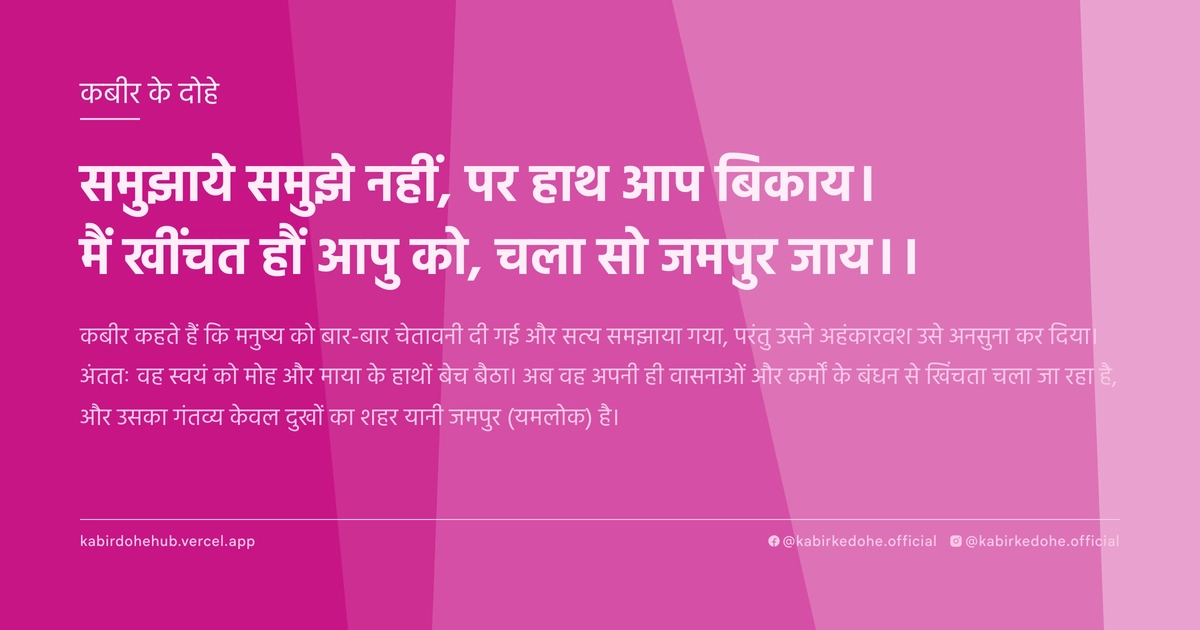
समुझाये समुझे नहीं, पर हाथ आप बिकाय।
मैं खींचत हौं आपु को, चला सो जमपुर जाय।।
Samujhaye samujhe nahi, par hath aap bikay. Main khinchat haun aapu ko, chala so jampur jaaye.
इस पृष्ठ पर इस कबीर दोहे का अर्थ (meaning), हिंदी व्याख्या और अंग्रेज़ी अनुवाद, दार्शनिक विश्लेषण और व्यावहारिक जीवन सीख दी गई है। यह दोहा कर्म (Karma) विषय से जुड़ा है — Kabir doha meaning and explanation in Hindi and English.
अर्थ (Meaning):
कबीर कहते हैं कि मनुष्य को बार-बार चेतावनी दी गई और सत्य समझाया गया, परंतु उसने अहंकारवश उसे अनसुना कर दिया। अंततः वह स्वयं को मोह और माया के हाथों बेच बैठा। अब वह अपनी ही वासनाओं और कर्मों के बंधन से खिंचता चला जा रहा है, और उसका गंतव्य केवल दुखों का शहर यानी जमपुर (यमलोक) है।
Kabir observes that the human soul was repeatedly warned and guided toward the truth, yet in its arrogance, it refused to understand. Consequently, the individual unwittingly sold themselves into the bondage of worldly illusions. Now, driven by their own desires and karmic debts, they are being dragged toward 'Jampur'—the city of death and suffering.
व्याख्या (Interpretation):
इस दोहे का शाब्दिक अर्थ है कि जो व्यक्ति उपदेश नहीं मानता, वह स्वयं अपना विनाश करता है। रूपकात्मक स्तर पर, 'बिकना' यहाँ भौतिक बिक्री नहीं, बल्कि चेतना का पतन है। जब मनुष्य अपनी आत्मा (Atman) को विस्मृत कर इंद्रियों के सुख में लिप्त होता है, तो वह माया के जाल में फंस जाता है। यह निरगुण भक्ति का वह पहलू है जहाँ ईश्वर बाहर नहीं, बल्कि भीतर है, लेकिन अहंकार की परतें उसे ढक लेती हैं। 'जमपुर' केवल मृत्यु के बाद का स्थान नहीं है, बल्कि वह मानसिक अवस्था है जहाँ पश्चाताप और दुख का वास है। यहाँ द्वैत (Duality) का भ्रम ही सबसे बड़ा बंधन है, जो जीव को ब्रह्म से अलग कर उसे संसारी दुखों की ओर खींचता है।
Literally, the verse warns that one who ignores spiritual guidance orchestrates their own downfall. Metaphorically, 'selling oneself' refers to the degradation of consciousness rather than a commercial transaction. When a human forgets the Atman (True Self) and becomes enslaved by sensory pleasures, they fall prey to Maya (Illusion). This reflects the core of Nirgun Bhakti, where the Divine is formless and internal, yet obscured by the thick veil of ego. 'Jampur' is not merely a mythological underworld, but a psychological state of profound suffering and regret. The central paradox is that the very ego which seeks security in the material world is the chain that drags the soul toward spiritual oblivion, reinforcing the non-duality of Atman and Brahman once the illusion is shattered.
दार्शनिक विश्लेषण (Philosophical Analysis):
कबीर का यह दोहा मध्यकालीन भारत के उस सामाजिक परिवेश से उपजा है जहाँ कर्मकांड और बाहरी आडंबरों का बोलबाला था। कबीर ने स्पष्ट किया कि मोक्ष किसी मंदिर, मस्जिद या तीर्थयात्रा से नहीं, बल्कि आत्म-बोध से मिलता है। यहाँ वे अद्वैत वेदांत के उस सिद्धांत को पुष्ट करते हैं कि अज्ञान (Avidya) ही समस्त दुखों का मूल है। जब मनुष्य स्वयं को शरीर मानता है, तो वह मृत्यु के भय और वासनाओं के अधीन हो जाता है।
सूफी मत के 'फना' (अहंकार का विनाश) के सिद्धांत की तरह, कबीर यहाँ चेतावनी दे रहे हैं कि जब तक 'मैं' (Ego) जीवित है, तब तक सत्य का अनुभव असंभव है। वे ritualism का विरोध करते हुए कहते हैं कि माला जपना या व्रत रखना व्यर्थ है यदि हृदय में करुणा और सत्य का अभाव है। यह विश्लेषण दर्शाता है कि आध्यात्मिक पतन अचानक नहीं होता, बल्कि यह निरंतर अज्ञान की अनदेखी का परिणाम है।
मनोवैज्ञानिक स्तर पर, यह दोहा 'संज्ञानात्मक विसंगति' (Cognitive Dissonance) को दर्शाता है, जहाँ व्यक्ति सत्य को जानता है लेकिन अपनी आदतों के कारण उसे स्वीकार नहीं करता। यह आंतरिक संघर्ष अंततः मानसिक तनाव और आध्यात्मिक रिक्तता में बदल जाता है। कबीर का उद्देश्य डराना नहीं, बल्कि जगाना है।
वे इस बात पर जोर देते हैं कि मनुष्य अपनी नियति का स्वयं निर्माता है। 'हाथ आप बिकाय' का अर्थ है कि हमने अपनी स्वतंत्रता को क्षणिक सुखों के बदले गिरवी रख दिया है। यह दासता बाहरी नहीं, बल्कि आंतरिक है।
अंततः, यह दोहा हमें याद दिलाता है कि समय सीमित है। जो व्यक्ति समय रहते अपनी चेतना को जाग्रत नहीं करता, वह कर्मों के उस चक्रव्यूह में फंस जाता है जहाँ से वापसी कठिन है। यह एक कठोर आह्वान है कि हम अपनी पहचान को भौतिकता से हटाकर अनंतता की ओर ले जाएं।
This couplet emerges from the socio-cultural milieu of medieval India, dominated by rigid ritualism and caste hierarchies. Kabir asserts that liberation is not achieved through temples, mosques, or pilgrimages, but through self-realization. He reinforces the Advaita Vedanta principle that Avidya (ignorance) is the root of all suffering. When a human identifies solely with the physical body, they become prisoners of fear and desire.
Mirroring the Sufi concept of 'Fana' (annihilation of the ego), Kabir warns that as long as the 'I' persists, the experience of Truth remains impossible. He rejects ritualism, suggesting that chanting beads or fasting is futile if the heart lacks compassion and truth. This analysis reveals that spiritual decline is not a sudden event but a cumulative result of ignoring the inner voice.
Psychologically, the verse illustrates 'cognitive dissonance,' where an individual recognizes the truth but refuses to act upon it due to ingrained habits. This internal conflict eventually manifests as mental anguish and spiritual void. Kabir's intent is not to instill fear, but to provoke an awakening.
He emphasizes that humans are the architects of their own destiny. 'Selling oneself' implies mortgaging one's spiritual freedom for fleeting sensory pleasures. This bondage is not external or societal, but internal and psychological.
Ultimately, the verse serves as a reminder of the transience of time. Those who fail to awaken their consciousness are trapped in a karmic labyrinth. It is a stern call to shift identity from the finite material self to the infinite universal consciousness.
मूल संदेश (Core Message):
- अहंकार सत्य के मार्ग में सबसे बड़ी बाधा है।
- बाहरी कर्मकांड बिना आंतरिक बोध के व्यर्थ हैं।
- स्वयं को मोह में बेचना ही वास्तविक पतन है।
- चेतना का जागरण ही एकमात्र मोक्ष का मार्ग है।
- अहंकार का विसर्जन ही ब्रह्म से मिलन है।
- Ego is the primary obstacle on the path to Truth.
- External rituals are futile without internal realization.
- Selling oneself to worldly attachment is the true downfall.
- The awakening of consciousness is the only path to liberation.
- The dissolution of the 'I' is the union with the Divine.
व्यावहारिक उदाहरण (Practical Example):
वाराणसी के घाटों पर रहने वाले एक वृद्ध विधवा, जानकी, की कहानी है। जानकी ने अपना पूरा जीवन केवल कठोर नियमों, उपवासों और बाहरी शुद्धता के पालन में बिता दिया। वह मानती थी कि केवल बाहरी अनुशासन ही उसे मोक्ष दिलाएगा। वह दूसरों को उनकी गलतियों पर टोकती थी, लेकिन अपने भीतर के क्रोध और ईर्ष्या को कभी नहीं देखा।
वह अक्सर कहती थी, "मैं शुद्ध हूँ क्योंकि मैं नियमों का पालन करती हूँ।" लेकिन उसके मन में अपने परिवार के प्रति कड़वाहट भरी थी। उसने अपनी पूरी चेतना को 'धर्म' के नाम पर एक बाहरी ढांचे में कैद कर लिया था। वह वास्तव में अपनी आत्मा को उन नियमों के हाथों बेच चुकी थी जो प्रेम से रहित थे।
एक दिन उसकी मुलाकात एक घुमक्कड़ साधु से हुई जिसने उससे पूछा, "तुम्हारी माला के मनके तो चमक रहे हैं, पर क्या तुम्हारा हृदय चमक रहा है?"
जानकी को पहले तो यह बात चुभी, लेकिन फिर उसने गहराई से सोचा। उसे एहसास हुआ कि उसने वर्षों तक केवल 'दिखावे' की पूजा की थी। उसने सत्य को समझा ही नहीं, बल्कि उसे नियमों की पोटली में लपेट दिया था।
उसने महसूस किया कि वह जिस मोक्ष की तलाश में थी, वह उसके अहंकार की भेंट चढ़ चुका था। वह नियमों की गुलामी में इतनी मशगूल थी कि उसने प्रेम और करुणा को पूरी तरह भुला दिया था।
यह उसके लिए 'जमपुर' जैसा अनुभव था—एक ऐसा मानसिक कारागार जहाँ वह खुद को सही मानकर भी अंदर से खाली थी। उसे समझ आया कि वह स्वयं को मोह और अहंकार के हाथों बेच चुकी थी।
तभी उसके भीतर एक 'कबीर ट्विस्ट' आया। उसने तय किया कि अब वह नियमों के लिए नहीं, बल्कि प्रेम के लिए जिएगी। उसने अपनी कठोरता को त्याग कर उन लोगों की मदद करना शुरू किया जिन्हें समाज ने ठुकरा दिया था।
उसने पाया कि जब उसने 'मैं' को छोड़ा, तब उसे असली शांति मिली। उसकी बाहरी शुद्धता अब आंतरिक पवित्रता में बदल गई थी। अब वह किसी के उपदेश की मोहताज नहीं थी, क्योंकि उसने स्वयं को पहचान लिया था।
उसकी जीवन यात्रा अब भय से मुक्त होकर आनंद की ओर मुड़ गई। उसने जान लिया कि असली मुक्ति नियमों के पालन में नहीं, बल्कि अहंकार के विसर्जन में है।
Consider the story of Janaki, an elderly widow living on the ghats of Varanasi. Janaki spent her entire life adhering to rigid rules, fasting, and maintaining external purity. She believed that only strict discipline would grant her salvation. She frequently corrected others' mistakes but never looked at the anger and jealousy within herself.
She often claimed, "I am pure because I follow the rules." However, her heart was filled with bitterness toward her family. She had imprisoned her entire consciousness within an external framework in the name of 'religion.' In essence, she had sold her soul to rules that were devoid of love.
One day, she met a wandering monk who asked her, "Your prayer beads are shining, but is your heart shining?"
Initially, Janaki felt offended, but then she reflected deeply. She realized she had spent years practicing 'performative' worship. She had not understood the truth; instead, she had wrapped it in a bundle of regulations.
She felt that the salvation she sought had been sacrificed to her own ego. She was so preoccupied with the slavery of rules that she had completely forgotten love and compassion.
This was her personal 'Jampur'—a mental prison where, despite believing herself to be right, she was internally hollow. She understood that she had sold herself to the illusions of righteousness and pride.
Then came the 'Kabir Twist.' She decided that from now on, she would live for love, not for rules. She abandoned her rigidity and began helping those marginalized by society.
She discovered that when she let go of the 'I,' she found true peace. Her external purity finally transformed into internal sanctity. She was no longer dependent on external sermons because she had recognized herself.
Her life's journey shifted from fear to bliss. She realized that true liberation lies not in the adherence to laws, but in the dissolution of the ego.
अभ्यास मार्गदर्शन (Practice Guidance):
- प्रतिदिन 20 मिनट मौन रहकर यह विचार करें कि आपके जीवन में कौन सी ऐसी आदतें हैं जो आपको सत्य से दूर ले जा रही हैं।
- एक 'अहंकार डायरी' लिखें: दिन भर में जब भी आपको लगे कि आप दूसरों से श्रेष्ठ हैं या किसी को नीचा दिखा रहे हैं, उसे लिखें और विश्लेषण करें कि वह भावना कहाँ से आई।
- व्यवहार परिवर्तन: किसी ऐसे व्यक्ति की निस्वार्थ सेवा करें जिससे आपके वैचारिक मतभेद हों, ताकि आपका अहंकार टूट सके।
- निदान चेकलिस्ट: क्या मैं नियमों का पालन केवल दिखावे के लिए कर रहा हूँ? क्या मेरी प्रार्थनाओं में प्रेम है या केवल माँग? क्या मैं सत्य सुनने के बाद भी उसे अपने अहंकार के कारण नकारता हूँ?
- Spend 20 minutes in daily silence contemplating which habits are leading you away from the Truth.
- Maintain an 'Ego Journal': Note every instance where you felt superior to others or judged them, then analyze the root of that emotion.
- Behavioral Shift: Perform selfless service for someone with whom you have deep ideological conflicts to break the shell of the ego.
- Diagnostic Checklist: Am I following rituals merely for show? Is there love in my prayers, or only demands? Do I reject the truth even after hearing it because of my pride?
चिंतन प्रश्न (Reflection Questions):
- मेरे जीवन का वह कौन सा 'नियम' या 'विश्वास' है जिसे मैं सत्य से अधिक महत्व देता हूँ?
- क्या मेरी धार्मिक या आध्यात्मिक पहचान वास्तव में मेरी मुक्ति के लिए है, या यह केवल मेरे सामाजिक अहंकार को संतुष्ट करती है?
- मैं किन सूक्ष्म तरीकों से अपनी स्वतंत्रता को सुख-सुविधाओं और दूसरों की प्रशंसा के हाथों बेच रहा हूँ?
- यदि आज मेरा सारा सामाजिक पद और पहचान छीन ली जाए, तो मेरे भीतर क्या बचेगा?
- क्या मैं सत्य को सुनने के लिए तैयार हूँ, या मैं केवल वही सुनना चाहता हूँ जो मेरे मौजूदा विश्वासों की पुष्टि करे?
- Which 'rule' or 'belief' in my life do I value more than the actual Truth?
- Is my religious or spiritual identity truly for my liberation, or does it merely satisfy my social ego?
- In what subtle ways am I selling my freedom for the sake of comforts and the praise of others?
- If all my social status and identity were stripped away today, what would remain within me?
- Am I truly open to hearing the truth, or do I only seek confirmation of my existing biases?