
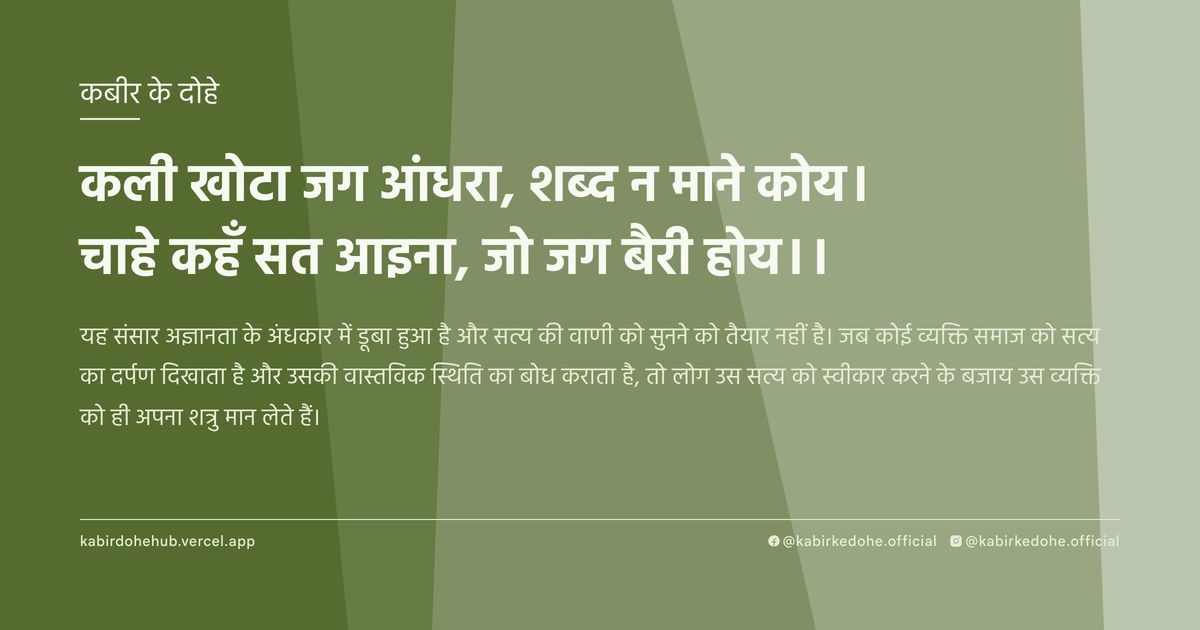
कली खोटा जग आंधरा, शब्द न माने कोय।
चाहे कहँ सत आइना, जो जग बैरी होय।।
Kali khota jag andhara, shabd na maane koy. Chahe kahan sat aaina, jo jag bairi hoye.
इस पृष्ठ पर इस कबीर दोहे का अर्थ (meaning), हिंदी व्याख्या और अंग्रेज़ी अनुवाद, दार्शनिक विश्लेषण और व्यावहारिक जीवन सीख दी गई है। यह दोहा सत्य (Truth) विषय से जुड़ा है — Kabir doha meaning and explanation in Hindi and English.
अर्थ (Meaning):
यह संसार अज्ञानता के अंधकार में डूबा हुआ है और सत्य की वाणी को सुनने को तैयार नहीं है। जब कोई व्यक्ति समाज को सत्य का दर्पण दिखाता है और उसकी वास्तविक स्थिति का बोध कराता है, तो लोग उस सत्य को स्वीकार करने के बजाय उस व्यक्ति को ही अपना शत्रु मान लेते हैं।
The world is blinded by ignorance and refuses to heed the word of truth. Even when someone holds up the mirror of reality to show the world its true face, people do not embrace the truth; instead, they perceive the truth-teller as an enemy.
व्याख्या (Interpretation):
कबीर यहाँ 'अंधा' शब्द का प्रयोग शारीरिक दृष्टि के लिए नहीं, बल्कि आध्यात्मिक विवेक के अभाव के लिए कर रहे हैं। 'कली खोटी' उस विकृत मानसिकता का प्रतीक है जहाँ अहंकार सत्य को स्वीकार नहीं कर पाता। यह दोहा निरगुण भक्ति के उस पहलू को उजागर करता है जहाँ साधक को समाज के विरोध का सामना करना पड़ता है क्योंकि वह माया के भ्रम को तोड़ता है। जब आत्मा (Atman) स्वयं को ब्रह्म (Brahman) के साथ एकाकार देखती है, तो वह बाहरी आडंबरों को व्यर्थ मानती है। यह विरोधाभास है कि जिसे मुक्ति का मार्ग बताया जा रहा है, वही मार्ग बताने वाला व्यक्ति समाज की नजरों में अपराधी या शत्रु बन जाता है क्योंकि वह उनकी सुखद अज्ञानता को चुनौती देता है।
Kabir uses the term 'blind' not to describe physical sight, but the absence of spiritual discernment. 'Kali khoti' symbolizes a distorted consciousness where the ego refuses to acknowledge reality. This verse highlights a core tenet of Nirgun Bhakti: the seeker often faces societal hostility because they dismantle the illusions of Maya. When the Atman realizes its non-duality with Brahman, it views external rituals as empty shells. The central paradox presented is that the one offering the path to liberation is perceived as an adversary because they disrupt the comfortable slumber of ignorance and challenge the social constructs that the ego clings to for identity.
दार्शनिक विश्लेषण (Philosophical Analysis):
कबीर का यह दोहा उनके समय के धार्मिक पाखंड और सामाजिक स्तरीकरण पर एक तीखा प्रहार है। उन्होंने देखा कि कैसे लोग धर्म के नाम पर कर्मकांडों में उलझे थे, जबकि वास्तविक ईश्वर उनके भीतर था। यह दृष्टिकोण अद्वैत वेदांत से मेल खाता है, जहाँ माना जाता है कि अज्ञान (Avidya) ही वह पर्दा है जो हमें सत्य देखने से रोकता है। कबीर का 'शब्द' केवल वाणी नहीं, बल्कि वह नाद या आंतरिक ध्वनि है जो चेतना को जागृत करती है।
सूफी मत के 'फना' (अहंकार का विनाश) के सिद्धांत की तरह, कबीर भी मानते हैं कि जब तक व्यक्ति का 'मैं' जीवित है, वह सत्य को नहीं देख सकता। समाज सत्य को इसलिए नकारता है क्योंकि सत्य अहंकार की मृत्यु की मांग करता है। कबीर ने जाति और धर्म की सीमाओं को तोड़कर एक ऐसे मार्ग का 제시 किया जो केवल अनुभव पर आधारित था, न कि शास्त्रों के रटने पर।
यहाँ 'सत्य का आइना' एक शक्तिशाली रूपक है। दर्पण स्वयं कुछ नहीं बदलता, वह केवल वह दिखाता है जो है। समाज दर्पण से इसलिए घृणा करता है क्योंकि वह अपनी कुरूपता (अज्ञान और अहंकार) को नहीं देखना चाहता। यह मनोवैज्ञानिक सत्य है कि मनुष्य अपनी मान्यताओं के प्रति इतना आसक्त होता है कि वह सत्य को भी शत्रु मान लेता है यदि वह उसकी मान्यताओं को चुनौती दे।
ऐतिहासिक संदर्भ में, कबीर एक बुनकर थे, जिन्होंने समाज के सबसे निचले स्तर से ऊपर उठकर सत्य का साक्षात्कार किया। उनका विरोध केवल ब्राह्मणों या मुल्लाओं से नहीं था, बल्कि उस सामूहिक चेतना से था जो बाहरी प्रतीकों को आंतरिक शुद्धि से अधिक महत्व देती थी।
अंततः, यह विश्लेषण हमें बताता है कि आध्यात्मिक जागृति एक एकाकी यात्रा है। जब आप माया के जाल को पहचान लेते हैं, तो आप दुनिया के लिए 'विदेशी' या 'शत्रु' बन जाते हैं, क्योंकि आप अब उस खेल का हिस्सा नहीं हैं जिसे दुनिया वास्तविकता मानती है।
This couplet is a piercing critique of the religious hypocrisy and social stratification prevalent during Kabir's era. He observed how people were entangled in rituals while the true Divine resided within. This aligns with Advaita Vedanta, which posits that ignorance (Avidya) is the veil preventing the realization of the Absolute. Kabir's 'Shabd' is not merely spoken word, but the primordial sound or internal vibration that awakens consciousness.
Similar to the Sufi concept of 'Fana' (annihilation of the ego), Kabir asserts that as long as the 'I' persists, truth remains invisible. Society rejects the truth because truth demands the death of the ego. Kabir bypassed caste and creed, proposing a path based on direct experience rather than scriptural rote learning.
The 'Mirror of Truth' serves as a potent metaphor. A mirror does not alter reality; it merely reflects it. Society hates the mirror because it reveals the ugliness of its own ignorance and arrogance. Psychologically, humans are so attached to their perceived identities that they perceive truth as an enemy if it threatens their mental constructs.
Historically, as a weaver, Kabir spoke from the margins of society. His opposition was not merely against the priestly class but against a collective consciousness that prioritized external symbols over internal purity.
Ultimately, this analysis reveals that spiritual awakening is often a lonely journey. Once one recognizes the web of Maya, they become an 'outsider' or an 'enemy' to the world, for they no longer participate in the collective delusion that the world mistakes for reality.
मूल संदेश (Core Message):
- अज्ञानता का अंधकार सत्य की रोशनी को शत्रु मानता है।
- सत्य का आइना केवल वही दिखाता है जो वास्तव में है।
- अहंकार की मृत्यु ही वास्तविक आध्यात्मिक जन्म है।
- बाहरी विरोध अक्सर आंतरिक जागृति का संकेत होता है।
- सत्य को स्वीकार करना ही माया के बंधन से मुक्ति है।
- सच्चा मित्र वह है जो आपकी त्रुटियों को स्पष्ट करे।
- The darkness of ignorance perceives the light of truth as an enemy.
- The mirror of truth reflects only that which truly exists.
- The death of the ego is the only authentic spiritual birth.
- External opposition is often a sign of internal awakening.
- Accepting the truth is the only way to break the chains of Maya.
- A true friend is one who clearly exposes your flaws.
व्यावहारिक उदाहरण (Practical Example):
वाराणसी के घाटों पर रहने वाली एक वृद्ध विधवा, जानकी, का जीवन केवल मंदिर की सीढ़ियों और दूसरों की सेवा में बीता था। वह समाज की नजरों में एक 'पवित्र' स्त्री थी क्योंकि वह कठोर नियमों का पालन करती थी।
एक दिन उसकी मुलाकात एक घुमंतू साधु से हुई, जिसने उसे बताया कि उसकी यह बाहरी पवित्रता केवल एक मुखौटा है और उसके भीतर अभी भी क्रोध और दूसरों के प्रति निर्णय लेने की भावना जीवित है।
साधु ने कहा, 'तुम दुनिया को अपनी सादगी दिखाती हो, लेकिन अपने भीतर के अहंकार को नहीं देख पा रही हो।'
जानकी को यह बात चुभी। उसने साधु को पाखंडी कहा और उसे अपने घर से बाहर निकाल दिया। उसने अपने आस-पास के लोगों को बताया कि वह साधु उसे गुमराह कर रहा है।
कई दिनों तक जानकी क्रोधित रही, लेकिन साधु के शब्द उसके मन में एक कांटे की तरह चुभते रहे। उसने महसूस किया कि वह साधु से इसलिए नफरत कर रही थी क्योंकि उसने उसे वह दिखाया जो वह खुद से छिपा रही थी।
उसने महसूस किया कि उसकी 'पवित्रता' वास्तव में एक सामाजिक ढाल थी, जिसके पीछे वह अपनी कड़वाहट छिपाती थी।
यह 'कबीर ट्विस्ट' था—जब उसने यह स्वीकार किया कि साधु उसका शत्रु नहीं, बल्कि उसका सबसे बड़ा मित्र था जिसने उसे सत्य का आइना दिखाया।
जानकी ने बाहरी नियमों का मोह छोड़कर अपने भीतर की करुणा पर काम करना शुरू किया।
अब वह केवल मंदिर नहीं जाती थी, बल्कि उन लोगों की मदद करती थी जिन्हें समाज 'अपवित्र' मानकर त्याग देता था।
उसकी असली मुक्ति तब शुरू हुई जब उसने अपनी छवि (Image) को तोड़कर अपनी वास्तविकता (Reality) को स्वीकार किया।
Janaki, an elderly widow living on the ghats of Varanasi, had spent her life in temple service and strict adherence to social norms. In the eyes of society, she was a 'pure' soul due to her rigorous discipline.
One day, she encountered a wandering ascetic who told her that her external purity was merely a mask and that within her, anger and judgment still thrived.
The ascetic remarked, 'You show the world your simplicity, but you fail to see the arrogance within.'
Janaki felt stung. She branded the ascetic a hypocrite and drove him away from her home, telling everyone that he was trying to mislead her.
For days, Janaki remained enraged, yet the ascetic's words lingered like a thorn in her mind. She realized she hated him not for his words, but because he had revealed what she was hiding from herself.
She recognized that her 'purity' was actually a social shield used to conceal her inner bitterness.
This was the 'Kabir Twist'—the moment she accepted that the ascetic was not her enemy, but her greatest friend for holding up the mirror of truth.
Janaki stopped clinging to external rules and began cultivating genuine inner compassion.
She no longer just visited the temple; she began serving those whom society deemed 'impure' and cast away.
Her true liberation began when she shattered her public image to embrace her internal reality.
अभ्यास मार्गदर्शन (Practice Guidance):
- दैनिक आत्म-निरीक्षण: प्रतिदिन 15 मिनट मौन बैठें और उन क्षणों को याद करें जब आपको किसी की बात सुनकर गुस्सा आया। पूछें, 'क्या वह व्यक्ति मेरा शत्रु है, या वह मेरे किसी छिपे हुए सच को उजागर कर रहा है?'
- जर्नलिंग प्रॉम्प्ट: 'मेरी वह कौन सी छवि है जिसे मैं दुनिया के सामने बनाए रखना चाहता हूँ, और यदि वह टूट जाए तो मुझे कैसा महसूस होगा?'
- व्यवहारिक परिवर्तन: जब कोई आपकी आलोचना करे, तो तुरंत प्रतिक्रिया देने के बजाय 10 सेकंड रुकें और विचार करें कि उस आलोचना में सत्य का कितना अंश है।
- डायग्नोस्टिक चेकलिस्ट: (1) क्या मैं सत्य सुनने पर रक्षात्मक (defensive) हो जाता हूँ? (2) क्या मैं उन लोगों से दूर भागता हूँ जो मुझे चुनौती देते हैं? (3) क्या मेरी शांति केवल बाहरी परिस्थितियों पर निर्भर है?
- Daily Self-Inquiry: Sit in silence for 15 minutes and recall moments when someone's words triggered anger. Ask, 'Is this person truly my enemy, or are they revealing a hidden truth about me?'
- Journaling Prompt: 'What is the specific image of myself that I strive to maintain for the world, and how would I feel if that image were shattered?'
- Behavioral Shift: When criticized, instead of reacting immediately, pause for 10 seconds and analyze how much of the criticism is grounded in truth.
- Diagnostic Checklist: (1) Do I become defensive when confronted with a truth? (2) Do I avoid people who challenge my beliefs? (3) Is my peace dependent solely on external validation?
चिंतन प्रश्न (Reflection Questions):
- आप अपनी डिजिटल पहचान (Social Media) के माध्यम से कौन सा 'झूठा आइना' दुनिया को दिखा रहे हैं?
- क्या आप वास्तव में सत्य की खोज में हैं, या केवल उस सत्य की जो आपकी मान्यताओं की पुष्टि करे?
- आपके जीवन में वह कौन सा व्यक्ति है जिसे आप 'शत्रु' मानते हैं, लेकिन वास्तव में वह आपका सबसे बड़ा शिक्षक हो सकता है?
- यदि आज आपकी सारी सामाजिक प्रतिष्ठा छीन ली जाए, तो आपके भीतर क्या बचेगा?
- आप अपनी कमियों को स्वीकार करने के बजाय उन्हें किन तर्कों के पीछे छिपाते हैं?
- What 'false mirror' are you presenting to the world through your digital identity and social media?
- Are you truly seeking the truth, or are you merely seeking a truth that confirms your existing biases?
- Who in your life do you consider an 'enemy,' but who might actually be your greatest teacher?
- If all your social prestige were stripped away today, what would remain within you?
- Behind what logical arguments do you hide your flaws instead of accepting them?