
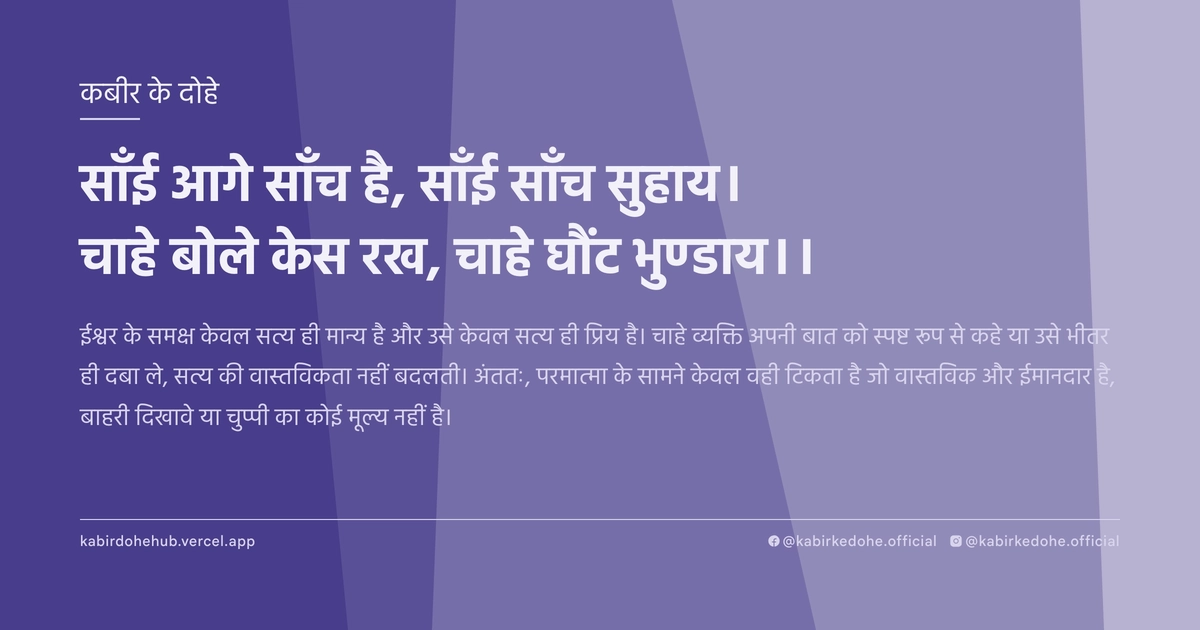
साँई आगे साँच है, साँई साँच सुहाय।
चाहे बोले केस रख, चाहे घौंट भुण्डाय।।
Sai aage saanch hai, sai saanch suhay. Chahe bole kes rakh, chahe ghont bhunday.
इस पृष्ठ पर इस कबीर दोहे का अर्थ (meaning), हिंदी व्याख्या और अंग्रेज़ी अनुवाद, दार्शनिक विश्लेषण और व्यावहारिक जीवन सीख दी गई है। यह दोहा सत्य (Truth) विषय से जुड़ा है — Kabir doha meaning and explanation in Hindi and English.
अर्थ (Meaning):
ईश्वर के समक्ष केवल सत्य ही मान्य है और उसे केवल सत्य ही प्रिय है। चाहे व्यक्ति अपनी बात को स्पष्ट रूप से कहे या उसे भीतर ही दबा ले, सत्य की वास्तविकता नहीं बदलती। अंततः, परमात्मा के सामने केवल वही टिकता है जो वास्तविक और ईमानदार है, बाहरी दिखावे या चुप्पी का कोई मूल्य नहीं है।
Before the Divine, only truth prevails, and only truth is pleasing to the Creator. Whether a person speaks the truth openly or suppresses it within, the fundamental reality of truth remains unchanged. Ultimately, only that which is authentic and honest stands before the Almighty; external pretenses or strategic silences hold no value.
व्याख्या (Interpretation):
यह दोहा सत्य की निरपेक्षता पर जोर देता है। 'साँई' यहाँ उस निराकार ब्रह्म का प्रतीक है जो सर्वव्यापी और सर्वज्ञ है। कबीर कहते हैं कि सत्य केवल एक शब्द नहीं, बल्कि एक अवस्था है। जब हम सत्य को छिपाते हैं ('घौंट भुण्डाय'), तो हम दुनिया को धोखा दे सकते हैं, लेकिन उस चेतना को नहीं जो हमारे भीतर बसी है। यह निर्गुण भक्ति का सार है जहाँ बाहरी कर्मकांडों के बजाय आंतरिक ईमानदारी को प्राथमिकता दी जाती है। यहाँ 'केस' (बाल) या बाहरी पहचान का कोई महत्व नहीं है, क्योंकि आत्मा का मिलन केवल सत्य के माध्यम से संभव है। यह माया के उस पर्दे को हटाने की बात करता है जो हमें झूठ और दिखावे के सहारे जीवित रहने के लिए प्रेरित करता है। अंततः, यह द्वैत को समाप्त कर आत्मा और परमात्मा के बीच सत्य के सेतु को स्थापित करता है।
This couplet emphasizes the absolute nature of truth. 'Sai' here symbolizes the formless Brahman, who is omnipresent and omniscient. Kabir asserts that truth is not merely a word, but a state of being. When we suppress the truth ('ghont bhunday'), we may deceive the world, but we cannot deceive the consciousness residing within us. This is the essence of Nirgun Bhakti, where internal honesty is prioritized over external rituals. The 'kes' (hair) or outward identity holds no significance, as the union of the soul with the Divine is possible only through truth. It speaks of lifting the veil of Maya, which encourages us to survive through lies and pretenses. Ultimately, it seeks to dissolve duality and establish a bridge of truth between the Atman and Brahman.
दार्शनिक विश्लेषण (Philosophical Analysis):
कबीर का यह दर्शन उनके समय के धार्मिक पाखंड और सामाजिक स्तरीकरण के विरुद्ध एक सशक्त प्रहार है। उन्होंने देखा कि लोग तीर्थयात्रा, जटाएं बढ़ाकर या विशेष वस्त्र पहनकर अपनी पवित्रता सिद्ध करने का प्रयास करते थे, जबकि उनके भीतर झूठ और अहंकार भरा होता था। कबीर इस बाहरी आडंबर को नकारते हुए 'सत्य' को एकमात्र आध्यात्मिक मुद्रा मानते हैं।
अद्वैत वेदांत के दृष्टिकोण से, सत्य ही ब्रह्म है ('सत्यं ज्ञानमनंतं ब्रह्म')। जब कबीर कहते हैं कि सत्य ही 'सुहाय' (प्रिय) है, तो वे संकेत दे रहे हैं कि जो व्यक्ति सत्य में स्थित है, वह वास्तव में ब्रह्म में स्थित है। झूठ माया का विस्तार है, जो आत्मा को उसकी वास्तविक प्रकृति से दूर ले जाता है और उसे एक झूठी पहचान (अहंकार) में बांध देता है।
सूफी मत के 'हकीकत' (परम सत्य) के विचार से भी यह मेल खाता है। सूफीवाद में भी बाहरी दिखावे (रिया) को आध्यात्मिक मार्ग की सबसे बड़ी बाधा माना गया है। कबीर का मार्ग 'सहज' मार्ग है, जहाँ सत्य बोलना केवल नैतिक कर्तव्य नहीं, बल्कि एक आध्यात्मिक साधना है।
मनोवैज्ञानिक स्तर पर, झूठ बोलना स्वयं के विरुद्ध एक युद्ध है। जब हम सत्य को दबाते हैं, तो हम अपने भीतर एक आंतरिक संघर्ष पैदा करते हैं जो हमारी मानसिक शांति को नष्ट कर देता है। कबीर सुझाव देते हैं कि सत्य की स्वीकृति, चाहे वह कितनी भी कठिन क्यों न हो, आत्मा को हल्का करती है और उसे परमात्मा के करीब लाती है।
अंततः, यह दोहा हमें सिखाता है कि ईश्वर किसी मंदिर, मस्जिद या बाहरी पहचान में नहीं, बल्कि सत्य की ईमानदारी में बसता है। यह जाति, धर्म और संप्रदाय की सीमाओं को तोड़कर एक सार्वभौमिक नैतिकता की स्थापना करता है, जहाँ केवल 'सत्य' ही एकमात्र मापदंड है।
Kabir's philosophy is a powerful strike against the religious hypocrisy and social stratification of his era. He observed people attempting to prove their sanctity through pilgrimages, growing matted hair, or wearing specific robes, while their interiors were filled with lies and ego. Rejecting this external pomp, Kabir considers 'Truth' as the only spiritual currency.
From the perspective of Advaita Vedanta, Truth is Brahman ('Satyam Jnanam Anantam Brahma'). When Kabir says truth is 'suhay' (pleasing), he indicates that one who is situated in truth is essentially situated in Brahman. Falsehood is an extension of Maya, which distances the soul from its true nature and binds it to a false identity (the ego).
This aligns with the Sufi concept of 'Haqiqat' (Ultimate Truth). In Sufism, external show (Riya) is considered the greatest obstacle on the spiritual path. Kabir's path is the 'Sahaj' path, where speaking the truth is not just a moral duty, but a spiritual discipline.
On a psychological level, lying is a war against oneself. When we suppress the truth, we create an internal conflict that destroys our mental peace. Kabir suggests that the acceptance of truth, however difficult, lightens the soul and brings it closer to the Divine.
Ultimately, this couplet teaches us that God does not reside in temples, mosques, or external identities, but in the honesty of truth. It breaks the boundaries of caste, religion, and sect to establish a universal morality where 'Truth' is the sole criterion.
मूल संदेश (Core Message):
- बाहरी दिखावा ईश्वर को नहीं, केवल मनुष्यों को प्रभावित करता है।
- सत्य की स्वीकृति ही अहंकार के विनाश का एकमात्र मार्ग है।
- झूठ एक मानसिक कारागार है; सत्य उसकी एकमात्र कुंजी है।
- परमात्मा के साथ संबंध की पहली शर्त पूर्ण ईमानदारी है।
- आंतरिक सत्य का बोध ही वास्तविक आध्यात्मिक प्रगति है।
- External pretenses affect humans, not the Divine.
- Acceptance of truth is the only path to the annihilation of ego.
- Falsehood is a mental prison; truth is its only key.
- Absolute honesty is the primary condition for a relationship with the Divine.
- The realization of internal truth is the only real spiritual progress.
व्यावहारिक उदाहरण (Practical Example):
एक समय की बात है, वाराणसी के एक पुराने मोहल्ले में रामदीन नाम का एक बुनकर रहता था। वह अपनी ईमानदारी के लिए जाना जाता था, लेकिन उसके मन में एक गहरा द्वंद्व था। उसने एक बार अपने मालिक की एक महंगी रेशमी साड़ी में गलती से एक छोटा सा छेद कर दिया था।
रामदीन ने उस छेद को बड़ी चतुराई से एक सुंदर कढ़ाई के नीचे छिपा दिया। मालिक ने साड़ी देखी और उसकी प्रशंसा की। रामदीन को पैसे भी मिले और तारीफ भी, लेकिन उसके मन की शांति चली गई।
वह हर रात सोने से पहले सोचता कि उसने दुनिया को तो धोखा दे दिया, लेकिन क्या वह उस 'साँई' को धोखा दे पाया जो उसके भीतर बैठा है? उसे महसूस हुआ कि वह कढ़ाई केवल कपड़े पर नहीं, बल्कि उसकी आत्मा पर एक बोझ बन गई है।
कई दिनों तक वह बेचैनी में रहा। उसे लगा कि उसकी प्रार्थनाएं अब ईश्वर तक नहीं पहुँच रही हैं क्योंकि उसके और परमात्मा के बीच झूठ की एक दीवार खड़ी हो गई है।
एक दिन, कबीर के एक अनुयायी ने उसे वही दोहा सुनाया: 'साँई आगे साँच है'। रामदीन को अचानक बोध हुआ कि वह बाहरी दुनिया की नजरों में तो सफल था, लेकिन अपनी नजरों में गिर चुका था।
उसने तुरंत अपने मालिक के पास जाने का निर्णय लिया। उसने मालिक को पूरी सच्चाई बता दी और साड़ी की कीमत वापस करने की पेशकश की।
मालिक उसकी ईमानदारी से इतना प्रभावित हुआ कि उसने न केवल उसे माफ किया, बल्कि उसे अपने व्यापार में भागीदार बना लिया।
रामदीन ने महसूस किया कि जब उसने सत्य को स्वीकार किया, तो उसके कंधे से एक भारी बोझ उतर गया। अब उसकी नींद गहरी थी और उसका मन शांत।
उसने सीखा कि सत्य बोलना केवल दूसरे के प्रति ईमानदारी नहीं है, बल्कि स्वयं की आत्मा को मुक्त करने की प्रक्रिया है।
यही 'कबीर ट्विस्ट' था—सत्य की कड़वाहट ने उसे उस मानसिक कारागार से मुक्त कर दिया जिसमें वह अपनी ही चतुराई के कारण कैद था।
Once upon a time, in an old neighborhood of Varanasi, lived a weaver named Ramdeen. He was known for his honesty, but a deep conflict brewed within him. He had accidentally made a small hole in an expensive silk saree belonging to his master.
Ramdeen cleverly hid the hole under a beautiful piece of embroidery. The master saw the saree and praised it. Ramdeen received both money and acclaim, but he lost his peace of mind.
Every night before sleeping, he wondered if he had deceived the world, but could he deceive the 'Sai' who resides within him? He felt that the embroidery was not just on the fabric, but had become a burden on his soul.
For many days, he remained restless. He felt that his prayers were no longer reaching God because a wall of lies had been erected between him and the Divine.
One day, a follower of Kabir recited the couplet: 'Sai aage saanch hai'. Ramdeen suddenly realized that while he was successful in the eyes of the world, he had fallen in his own eyes.
He decided to go to his master immediately. He told the master the entire truth and offered to return the cost of the saree.
The master was so impressed by his honesty that he not only forgave him but made him a partner in his business.
Ramdeen felt that when he accepted the truth, a heavy weight was lifted from his shoulders. Now his sleep was deep and his mind was calm.
He learned that speaking the truth is not just honesty toward others, but a process of liberating one's own soul.
This was the 'Kabir Twist'—the bitterness of truth freed him from the mental prison in which he was trapped by his own cleverness.
अभ्यास मार्गदर्शन (Practice Guidance):
- प्रतिदिन 10 मिनट मौन बैठें और विचार करें कि आज आपने कहाँ झूठ बोला या सत्य को छिपाया।
- एक 'सत्य-डायरी' बनाएँ जहाँ आप उन बातों को लिखें जिन्हें आप दुनिया से डरकर नहीं कह पाए, ताकि आप स्वयं के प्रति ईमानदार हो सकें।
- व्यवहार परिवर्तन: किसी भी स्थिति में 'सुविधाजनक झूठ' बोलने के बजाय 'कठोर सत्य' को विनम्रता से कहने का अभ्यास करें।
- डायग्नोस्टिक चेकलिस्ट: क्या आप दूसरों के सामने अपनी छवि बचाने के लिए झूठ बोलते हैं? क्या आपको अपनी सच्चाई बताने के बाद डर लगता है? यदि हाँ, तो आप अभी भी माया के प्रभाव में हैं।
- Sit in silence for 10 minutes daily and reflect on where you lied or suppressed the truth today.
- Maintain a 'Truth-Journal' where you write things you couldn't say to the world out of fear, allowing you to be honest with yourself.
- Behavioral Change: Practice speaking the 'harsh truth' with humility instead of resorting to 'convenient lies' in any situation.
- Diagnostic Checklist: Do you lie to protect your image before others? Do you feel fear after telling the truth? If yes, you are still under the influence of Maya.
चिंतन प्रश्न (Reflection Questions):
- आपकी वह कौन सी 'सत्य' है जिसे आप अपनी सामाजिक प्रतिष्ठा बचाने के लिए दुनिया से छिपा रहे हैं?
- क्या आपका 'धार्मिक' या 'आध्यात्मिक' व्यक्तित्व वास्तव में आपकी आंतरिक वास्तविकता का प्रतिबिंब है, या यह केवल एक मुखौटा है?
- जब आप झूठ बोलते हैं, तो आप वास्तव में किसे धोखा दे रहे होते हैं—सामने वाले को या अपनी स्वयं की चेतना को?
- क्या आप सत्य को केवल तब स्वीकार करते हैं जब वह आपके लाभ में हो, या तब भी जब वह आपको नुकसान पहुँचाए?
- आपके जीवन में 'सत्य' और 'सुविधा' के बीच का संघर्ष कहाँ सबसे अधिक है?
- What is that 'truth' you are hiding from the world to protect your social status?
- Is your 'religious' or 'spiritual' persona truly a reflection of your internal reality, or is it merely a mask?
- When you lie, who are you actually deceiving—the other person or your own consciousness?
- Do you accept the truth only when it benefits you, or even when it causes you loss?
- Where in your life is the conflict between 'truth' and 'convenience' most intense?