
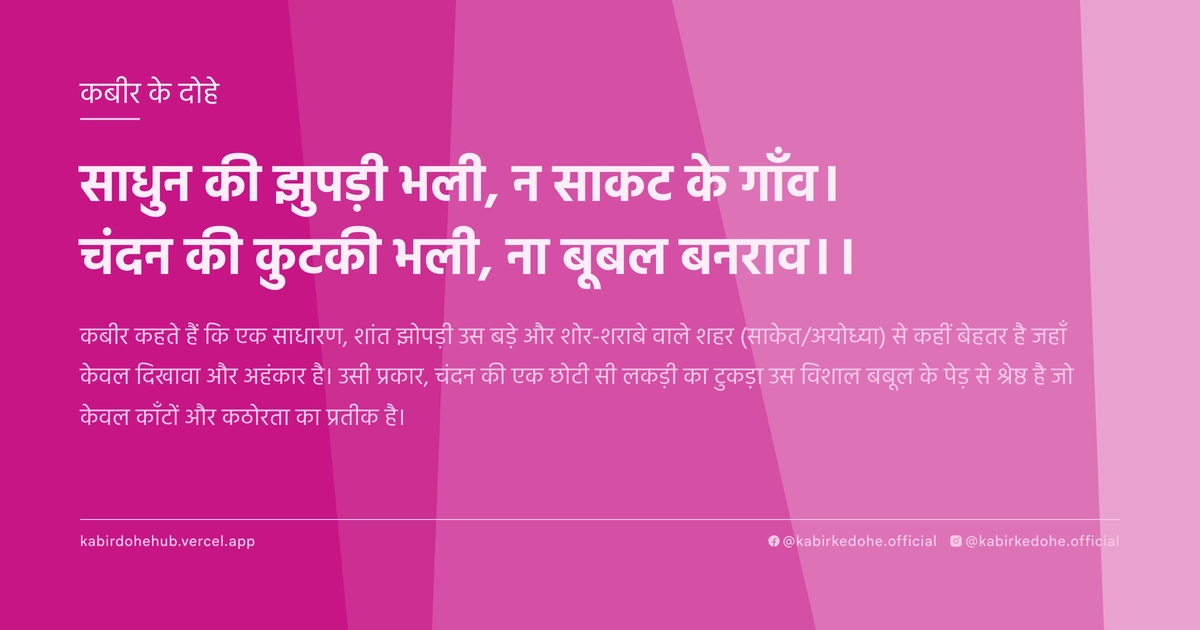
साधुन की झुपड़ी भली, न साकट के गाँव।
चंदन की कुटकी भली, ना बूबल बनराव।।
Sadhun ki jhapdi bhali, na sakat ke gaon. Chandan ki kutki bhali, na bubal banrav.
इस पृष्ठ पर इस कबीर दोहे का अर्थ (meaning), हिंदी व्याख्या और अंग्रेज़ी अनुवाद, दार्शनिक विश्लेषण और व्यावहारिक जीवन सीख दी गई है। यह दोहा संतोष (Contentment) विषय से जुड़ा है — Kabir doha meaning and explanation in Hindi and English.
अर्थ (Meaning):
कबीर कहते हैं कि एक साधारण, शांत झोपड़ी उस बड़े और शोर-शराबे वाले शहर (साकेत/अयोध्या) से कहीं बेहतर है जहाँ केवल दिखावा और अहंकार है। उसी प्रकार, चंदन की एक छोटी सी लकड़ी का टुकड़ा उस विशाल बबूल के पेड़ से श्रेष्ठ है जो केवल काँटों और कठोरता का प्रतीक है।
Kabir asserts that a simple, peaceful hut is far superior to a grand, bustling city filled with vanity and noise. Similarly, a small piece of fragrant sandalwood is more valuable than a massive acacia tree, which offers nothing but thorns and harshness, symbolizing that inner quality outweighs outward scale.
व्याख्या (Interpretation):
इस दोहे का शाब्दिक अर्थ भौतिक सादगी की श्रेष्ठता है, परंतु इसका आध्यात्मिक अर्थ 'गुण' बनाम 'आकार' का है। 'साकट के गाँव' और 'बबूल' माया के उस विस्तार का प्रतीक हैं जो बाहर से भव्य दिखता है लेकिन भीतर से रिक्त या कष्टदायक होता है। 'झोपड़ी' और 'चंदन' उस अंतर्मुखी साधक का प्रतीक हैं जिसने अपनी आत्मा के केंद्र में परमात्मा (निर्गुण ब्रह्म) को पा लिया है। यहाँ कबीर अद्वैत वेदांत के उस सिद्धांत को पुष्ट करते हैं जहाँ आत्मा की शुद्धता किसी बाहरी सामाजिक प्रतिष्ठा या भौतिक विस्तार की मोहताज नहीं होती। यह विरोधाभास है कि जो छोटा और अदृश्य दिखता है, वही वास्तव में अनंत और सुगंधित होता है, जबकि जो विशाल दिखता है, वह अक्सर अहंकार की कड़ियों में जकड़ा होता है।
Literally, this verse praises material simplicity, but spiritually, it addresses the dichotomy of 'Quality' versus 'Quantity'. The 'city' and the 'acacia' represent the expansive nature of Maya—outwardly grand but internally void or painful. The 'hut' and 'sandalwood' symbolize the inward-looking seeker who has discovered the Nirgun Brahman within. Kabir reinforces the Advaita Vedanta principle that spiritual purity is independent of social prestige or physical scale. It presents a profound paradox: that which appears small and inconspicuous is often infinite and fragrant, while that which appears massive is frequently shackled by the constraints of ego and superficiality.
दार्शनिक विश्लेषण (Philosophical Analysis):
कबीर का यह दर्शन उनके युग के सामाजिक और धार्मिक पाखंड के विरुद्ध एक सशक्त प्रहार है। उस समय धर्म को बड़े मंदिरों, भव्य अनुष्ठानों और जातिगत श्रेष्ठता से जोड़ा गया था। कबीर ने 'साकट के गाँव' के माध्यम से उन संस्थागत ढांचों की आलोचना की है जो मनुष्य को उसकी आत्मा से दूर कर बाहरी आडंबरों में उलझा देते हैं। उनका दृष्टिकोण सूफीवाद के 'फना' (अहंकार का विनाश) और भक्ति मार्ग के 'शरणागति' से मेल खाता है, जहाँ साधक अपनी पहचान को मिटाकर शून्य में विलीन होना चाहता है।
दार्शनिक स्तर पर, बबूल का पेड़ उस व्यक्ति का प्रतिनिधित्व करता है जो ज्ञान का दावा तो करता है (विशालता), लेकिन जिसका व्यवहार दूसरों के लिए कष्टदायक (काँटे) है। इसके विपरीत, चंदन अपनी सुगंध से दूसरों को शीतलता प्रदान करता है, चाहे वह छोटा ही क्यों न हो। यह 'अहंकार' के विसर्जन की प्रक्रिया है। जब मनुष्य यह समझ जाता है कि ईश्वर किसी महल या विशेष शहर में नहीं, बल्कि हृदय की सादगी में बसता है, तब वह बाहरी खोज को समाप्त कर आंतरिक यात्रा शुरू करता है।
यह दोहा यह भी स्पष्ट करता है कि आध्यात्मिक प्रगति का पैमाना बाहरी उपलब्धियाँ नहीं, बल्कि आंतरिक रूपांतरण है। कबीर यहाँ यह चेतावनी दे रहे हैं कि हम अक्सर 'विस्तार' को 'विकास' समझ लेते हैं, जबकि वास्तविक विकास संकुचन (contraction) और एकाग्रता में है। जैसे चंदन अपनी सुगंध को संचित रखता है, वैसे ही साधक को अपनी आध्यात्मिक अनुभूति को गुप्त और पवित्र रखना चाहिए।
अद्वैत वेदांत के संदर्भ में, यह 'माया' के आवरण को हटाने की बात है। माया हमें यह विश्वास दिलाती है कि बड़ा होना, शक्तिशाली होना या प्रसिद्ध होना ही सफलता है। कबीर इस भ्रम को तोड़ते हुए कहते हैं कि सत्य 'सूक्ष्म' है, 'स्थूल' नहीं। जो सूक्ष्म को पकड़ लेता है, वह वास्तव में संपूर्ण ब्रह्मांड को पा लेता है।
अंततः, यह कविता हमें यह सिखाती है कि पवित्रता बाहरी वातावरण से नहीं, बल्कि आंतरिक स्वभाव से आती है। एक साधारण झोपड़ी में रहने वाला व्यक्ति यदि आत्म-साक्षात्कार कर चुका है, तो वह उस राजा से कहीं अधिक समृद्ध है जो अपने स्वर्ण महल में भी अशांति और भय से घिरा हुआ है। यह भौतिकता से ऊपर उठकर चेतना के स्तर पर जीने का आह्वान है।
Kabir's philosophy here is a potent strike against the social and religious hypocrisy of his era. During his time, spirituality was often tethered to grand temples, elaborate rituals, and caste-based superiority. Through the metaphor of the 'city', Kabir critiques the institutional structures that distance a human being from their soul, trapping them in external pretenses. His perspective aligns with the Sufi concept of 'Fana' (annihilation of the ego) and the Bhakti path of total surrender, where the seeker aims to dissolve their identity into the Void.
On a philosophical level, the acacia tree represents the individual who claims vast knowledge (scale) but whose behavior is prickly and harmful to others (thorns). In contrast, sandalwood provides coolness and fragrance to all, regardless of its size. This is the process of dismantling the ego. When a person realizes that the Divine does not reside in a palace or a specific holy city, but in the simplicity of the heart, the external search ends and the internal journey begins.
This verse clarifies that the metric of spiritual progress is not external achievement, but internal transformation. Kabir warns us against confusing 'expansion' with 'evolution'; true evolution lies in contraction and concentration. Just as sandalwood retains its fragrance, a seeker should keep their spiritual realizations private and sacred, avoiding the trap of spiritual vanity.
In the context of Advaita Vedanta, this is about piercing the veil of 'Maya'. Maya convinces us that being large, powerful, or famous constitutes success. Kabir shatters this illusion, asserting that Truth is 'subtle' (Sukshma), not 'gross' (Sthula). He who grasps the subtle essence possesses the entire universe.
Ultimately, the poem teaches that purity emanates from internal nature, not external environment. A person living in a humble hut who has achieved self-realization is far wealthier than a king who, despite his golden palace, is surrounded by unrest and fear. It is a call to transcend materiality and live at the level of pure consciousness.
मूल संदेश (Core Message):
- बाहरी भव्यता अक्सर आंतरिक रिक्तता का मुखौटा होती है।
- सत्य विस्तार में नहीं, बल्कि सूक्ष्मता और गहराई में निहित है।
- अहंकार का त्याग ही वास्तविक आध्यात्मिक समृद्धि का द्वार है।
- गुणवत्ता हमेशा मात्रा से अधिक मूल्यवान होती है।
- शांति किसी स्थान में नहीं, बल्कि मन की अवस्था में होती है।
- External grandeur is often a mask for internal emptiness.
- Truth resides not in expansion, but in subtlety and depth.
- The surrender of ego is the only gateway to true spiritual wealth.
- Quality is always more precious than quantity.
- Peace is not a location, but a state of consciousness.
व्यावहारिक उदाहरण (Practical Example):
वाराणसी के एक पुराने घाट पर माधव नाम का एक वृद्ध नाविक रहता था। माधव के पास न तो कोई बड़ा घर था और न ही समाज में कोई ऊंचा पद। वह एक छोटी सी फूस की झोपड़ी में रहता था और दिन भर नाव चलाकर अपना गुजारा करता था। उसी घाट के पास एक समृद्ध व्यापारी, सेठ धनराज का विशाल हवेलीनुमा घर था। धनराज के पास धन की कोई कमी नहीं थी, वह शहर के सबसे बड़े दानदाता माने जाते थे, लेकिन उनका मन हमेशा अशांत रहता था। वे हर समय अपनी संपत्ति की सुरक्षा और सामाजिक प्रतिष्ठा की चिंता में डूबे रहते थे।
धनराज अक्सर माधव को देखते और सोचते कि यह व्यक्ति इतनी गरीबी में भी इतना शांत और प्रसन्न कैसे रह सकता है? माधव की आँखों में एक ऐसी चमक थी जो धनराज के सोने के गहनों में भी नहीं थी। एक दिन, धनराज ने माधव से पूछा, "तुम्हारे पास न सुख-सुविधाएं हैं, न सम्मान, फिर भी तुम इतने संतुष्ट कैसे हो? क्या तुम्हें इस छोटी सी झोपड़ी में घुटन नहीं होती?"
माधव ने मुस्कुराते हुए जवाब दिया, "सेठ जी, आपकी हवेली बहुत बड़ी है, लेकिन क्या उसमें आपके लिए शांति का एक कोना भी है? मेरी झोपड़ी छोटी है, लेकिन यहाँ मैं खुद के साथ रहता हूँ। आपकी हवेली बबूल के पेड़ जैसी है—बाहर से विशाल, लेकिन भीतर काँटों जैसी चिंताएं हैं। मेरी सादगी चंदन की तरह है, जो मुझे और मेरे आस-पास के लोगों को सुकून देती है।"
यह बात धनराज के हृदय पर गहरा प्रहार कर गई। उन्हें एहसास हुआ कि उन्होंने जीवन भर 'विस्तार' को ही 'सफलता' माना, जबकि वे वास्तव में अपनी ही महत्वाकांक्षाओं के पिंजरे में कैद थे। उन्होंने देखा कि माधव की झोपड़ी में वह स्वतंत्रता थी जो उनकी हवेली की दीवारों में दम तोड़ चुकी थी।
अगले कुछ महीनों में, धनराज के व्यवहार में एक बड़ा बदलाव आया। उन्होंने दिखावे के लिए किए जाने वाले बड़े दान बंद कर दिए और वास्तव में जरूरतमंदों की गुप्त रूप से मदद करना शुरू किया। उन्होंने अपनी विलासिता को कम किया और प्रतिदिन कुछ समय मौन में बिताना शुरू किया।
वे अब अपनी प्रतिष्ठा की चिंता नहीं करते थे। उन्होंने महसूस किया कि जब अहंकार का बोझ उतरता है, तब आत्मा हल्की हो जाती है। उन्होंने अपनी हवेली के एक हिस्से को एक साधारण पुस्तकालय और ध्यान केंद्र में बदल दिया, जहाँ कोई भी बिना किसी भेदभाव के आ सकता था।
धनराज ने सीखा कि असली समृद्धि वह नहीं है जो दुनिया देखती है, बल्कि वह है जिसे आत्मा महसूस करती है। उन्होंने माधव की उस 'झोपड़ी' को अपने भीतर बनाना शुरू किया—एक ऐसा स्थान जहाँ केवल शांति और सत्य का वास हो।
अंततः, धनराज की नींद बेहतर हुई और उनके चेहरे पर वही सुकून आया जो माधव के चेहरे पर था। उन्होंने जान लिया कि चंदन की एक छोटी सी लकड़ी पूरे कमरे को महका सकती है, जबकि बबूल का पूरा जंगल केवल चुभन देता है।
On an old ghat in Varanasi lived an elderly boatman named Madhav. Madhav possessed neither a grand house nor a high social standing. He lived in a small thatched hut and earned his living by rowing boats all day. Near his hut stood the massive, mansion-like residence of a wealthy merchant, Seth Dhanraj. Dhanraj lacked for nothing in terms of wealth and was considered the city's greatest philanthropist, yet his mind was perpetually restless. He spent his days consumed by worries over the security of his assets and his social prestige.
Dhanraj often observed Madhav, wondering how a man in such poverty could remain so calm and joyful. There was a radiance in Madhav's eyes that Dhanraj's gold ornaments could not replicate. One day, Dhanraj asked, "You have neither comforts nor honor, yet how are you so content? Do you not feel suffocated in this tiny hut?"
Madhav smiled and replied, "Seth ji, your mansion is vast, but is there a single corner of peace within it for you? My hut is small, but here, I live with myself. Your mansion is like an acacia tree—grand from the outside, but filled with thorns of anxiety within. My simplicity is like sandalwood, providing solace to me and those around me."
These words struck a deep chord in Dhanraj's heart. He realized he had spent his entire life equating 'expansion' with 'success,' while in reality, he was imprisoned in a cage of his own ambitions. He saw that the freedom present in Madhav's hut had perished within the walls of his own mansion.
Over the next few months, a significant shift occurred in Dhanraj's behavior. He stopped making grand, ostentatious donations for show and began helping the needy in secret. He reduced his luxuries and started spending time in daily silence.
He no longer worried about his reputation. He felt that when the burden of ego is lifted, the soul becomes light. He converted a portion of his mansion into a simple library and meditation center, open to everyone regardless of caste or creed.
Dhanraj learned that true prosperity is not what the world sees, but what the soul experiences. He began to build that 'hut' within himself—a sanctuary where only peace and truth resided.
Eventually, Dhanraj's sleep improved, and a serenity settled on his face similar to that of Madhav. He understood that a small piece of sandalwood can fragrance an entire room, while a whole forest of acacia only offers prickliness.
अभ्यास मार्गदर्शन (Practice Guidance):
- दैनिक अभ्यास: प्रतिदिन 20 मिनट 'मौन' का अभ्यास करें। बाहरी शोर को कम कर अपने भीतर की 'झोपड़ी' (शांत केंद्र) में प्रवेश करने का प्रयास करें।
- आत्म-पूछताछ जर्नल: लिखें कि आपके जीवन में 'बबूल' क्या है? वे कौन सी इच्छाएं या प्रतिष्ठाएं हैं जो बाहर से बड़ी दिखती हैं लेकिन भीतर आपको मानसिक कष्ट दे रही हैं?
- व्यवहार परिवर्तन: सप्ताह में एक बार अपनी सुख-सुविधाओं का त्याग करें और अत्यंत साधारण तरीके से जिएं, ताकि आप भौतिकता के प्रति अपनी निर्भरता को पहचान सकें।
- डायग्नोस्टिक चेकलिस्ट: क्या आप अपनी उपलब्धियों का बखान दूसरों के सामने करते हैं? (यदि हाँ, तो आप 'साकट के गाँव' में हैं)। क्या आप अकेलेपन में भी पूर्ण महसूस करते हैं? (यदि हाँ, तो आप 'चंदन' की ओर बढ़ रहे हैं)।
- Daily Practice: Practice 20 minutes of absolute silence daily. Attempt to withdraw from external noise and enter the 'hut' (the quiet center) within yourself.
- Self-Inquiry Journal: Identify the 'acacia' in your life. Which desires or status symbols appear grand externally but cause internal mental distress?
- Behavioral Shift: Once a week, intentionally renounce your comforts and live in extreme simplicity to recognize and detach from your dependence on materiality.
- Diagnostic Checklist: Do you frequently boast about your achievements to others? (If yes, you are in the 'city of Saket'). Do you feel complete even in solitude? (If yes, you are moving toward the 'sandalwood').
चिंतन प्रश्न (Reflection Questions):
- आपकी 'डिजिटल पहचान' (सोशल मीडिया) आपकी वास्तविक आंतरिक स्थिति से कितनी अलग है?
- क्या आप अपनी उपलब्धियों को इसलिए संजोते हैं क्योंकि वे आपको खुशी देती हैं, या इसलिए ताकि दूसरे आपको सराहें?
- यदि आपसे आपकी सारी सामाजिक उपाधियाँ और संपत्ति छीन ली जाए, तो आपके पास 'स्वयं' के रूप में क्या बचेगा?
- आपके जीवन का वह कौन सा हिस्सा 'बबूल' की तरह है—दिखने में प्रभावशाली लेकिन दूसरों के लिए कष्टदायक?
- क्या आप वास्तव में सादगी को अपना सकते हैं, या आप केवल 'सादगी का दिखावा' कर रहे हैं?
- How different is your 'digital identity' (social media) from your actual internal state?
- Do you cherish your achievements because they bring you joy, or because they garner admiration from others?
- If all your social titles and assets were stripped away, what would remain of 'you' as a self?
- Which part of your life is like the 'acacia'—impressive in appearance but painful to others?
- Can you truly embrace simplicity, or are you merely performing a 'charade of simplicity'?