
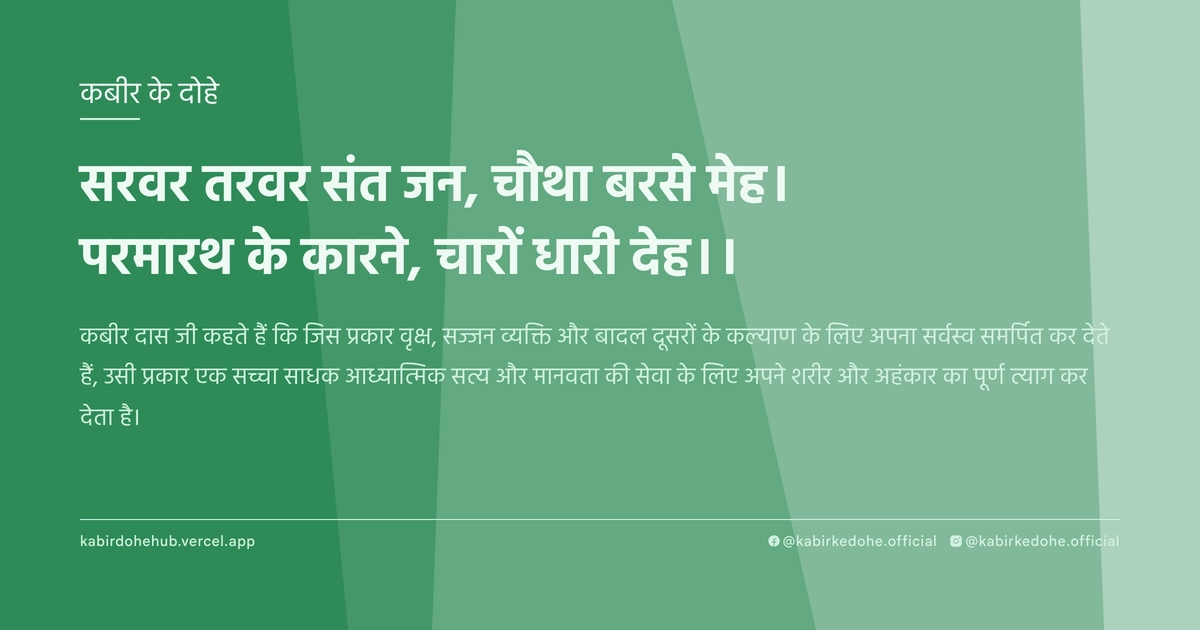
सरवर तरवर संत जन, चौथा बरसे मेह।
परमारथ के कारने, चारों धारी देह।।
Sarvar tarvar sant jan, chautha barse meh. Parmarth ke kaarne, charon dhaari deh.
इस पृष्ठ पर इस कबीर दोहे का अर्थ (meaning), हिंदी व्याख्या और अंग्रेज़ी अनुवाद, दार्शनिक विश्लेषण और व्यावहारिक जीवन सीख दी गई है। यह दोहा करुणा (Compassion) विषय से जुड़ा है — Kabir doha meaning and explanation in Hindi and English.
अर्थ (Meaning):
कबीर दास जी कहते हैं कि जिस प्रकार वृक्ष, सज्जन व्यक्ति और बादल दूसरों के कल्याण के लिए अपना सर्वस्व समर्पित कर देते हैं, उसी प्रकार एक सच्चा साधक आध्यात्मिक सत्य और मानवता की सेवा के लिए अपने शरीर और अहंकार का पूर्ण त्याग कर देता है।
Kabir asserts that just as trees, saints, and rain clouds exist solely to benefit others without expecting anything in return, a true seeker of truth completely dissolves their physical and egoic identity in the service of the ultimate spiritual good and universal welfare.
व्याख्या (Interpretation):
इस दोहे में कबीर ने परोपकार की पराकाष्ठा को दर्शाया है। 'तरवर' (वृक्ष) धूप सहकर छाया देता है, 'सन्त' ज्ञान बाँटते हैं, और 'मेह' (बादल) बिना भेदभाव के वर्षा करते हैं। यहाँ 'चारों धारी देह' का अर्थ केवल शारीरिक मृत्यु नहीं, बल्कि 'अहंकार' की मृत्यु है। यह निर्गुण भक्ति का सार है जहाँ साधक स्वयं को मिटाकर ब्रह्म में विलीन हो जाता है। माया का पर्दा तब हटता है जब व्यक्ति 'मैं' से 'हम' और अंततः 'शून्य' की ओर बढ़ता है। यह अद्वैत वेदांत के उस सिद्धांत को पुष्ट करता है जहाँ स्वयं का विसर्जन ही वास्तविक प्राप्ति है।
In this couplet, Kabir illustrates the pinnacle of altruism. The 'Tarvar' (tree) endures the scorching sun to provide shade, 'Saints' distribute wisdom, and 'Meh' (clouds) rain impartially. The phrase 'chaaro dhaari deh' does not merely signify physical death, but the annihilation of the 'ego'. This is the essence of Nirgun Bhakti, where the seeker dissolves their individual identity to merge with the Formless Brahman. The veil of Maya lifts only when one moves from 'I' to 'We' and ultimately to 'Zero'. It reinforces the Advaita Vedanta principle that the dissolution of the separate self is the only true attainment.
दार्शनिक विश्लेषण (Philosophical Analysis):
कबीर का यह दर्शन उस युग की प्रतिक्रिया था जहाँ धर्म केवल कर्मकांडों और बाहरी दिखावे तक सीमित था। उन्होंने मंदिर-मस्जिद के बजाय 'मानवता' को सर्वोच्च मंदिर माना। यह विचार सूफी मत के 'फना' (स्वयं को मिटाना) और वेदांत के 'अहं ब्रह्मास्मि' के बीच एक सेतु है। कबीर तर्क देते हैं कि जब तक मनुष्य अपनी देह और सामाजिक पहचान (जाति, पद) से चिपका रहता है, वह सत्य को नहीं देख सकता।
यहाँ 'परोपकार' कोई नैतिक कर्तव्य नहीं, बल्कि एक आध्यात्मिक आवश्यकता है। जब हम दूसरों के लिए जीते हैं, तो हम वास्तव में अपनी सीमाओं को तोड़ रहे होते हैं। यह मनोवैज्ञानिक रूपांतरण है जहाँ 'स्व' का संकुचन समाप्त होता है और 'विराट' का उदय होता है।
कबीर ने ritualism का विरोध किया क्योंकि वे जानते थे कि बाहरी अनुष्ठान अहंकार को और बढ़ाते हैं। उनके लिए असली पूजा वह है जो दूसरों के दुखों को हर ले। यह 'सेवा' ही वह अग्नि है जिसमें अहंकार जलकर राख हो जाता है।
ऐतिहासिक रूप से, कबीर ने एक ऐसे समाज को चुनौती दी जहाँ ऊंच-नीच की गहरी खाई थी। उन्होंने यह सिद्ध किया कि पवित्रता जन्म से नहीं, बल्कि आचरण और त्याग से आती है।
अंततः, यह दोहा हमें सिखाता है कि जीवन की सार्थकता संचय में नहीं, बल्कि वितरण में है। जैसे बादल बरसकर हल्का हो जाता है, वैसे ही मनुष्य त्याग कर मुक्त होता है।
Kabir's philosophy was a reaction to an era where religion was confined to rituals and outward displays. He positioned 'humanity' as the supreme temple over mosques and shrines. This thought acts as a bridge between the Sufi concept of 'Fana' (annihilation of the self) and the Vedantic 'Aham Brahmasmi' (I am Brahman).
Kabir argues that as long as a human clings to their physical body and social identity (caste, status), they cannot perceive the Truth. Here, 'altruism' is not a moral duty but a spiritual necessity. By living for others, one is effectively breaking the boundaries of the limited self.
This is a psychological transformation where the contraction of the 'ego' ends and the expansion of the 'Universal' begins. Kabir opposed ritualism because he understood that external ceremonies often inflate the ego rather than diminish it.
For him, true worship is that which alleviates the suffering of others. This 'Seva' (selfless service) is the fire in which the ego is incinerated. Historically, Kabir challenged a society fractured by deep caste hierarchies, proving that purity comes from conduct and sacrifice, not birth.
Ultimately, this couplet teaches that the meaning of life lies not in accumulation, but in distribution. Just as a cloud becomes light by raining, a human becomes free by letting go.
मूल संदेश (Core Message):
- अहंकार का त्याग ही वास्तविक आध्यात्मिक उन्नति है।
- परोपकार केवल नैतिकता नहीं, बल्कि मुक्ति का मार्ग है।
- स्वयं को मिटाकर ही विराट सत्य का अनुभव संभव है।
- बाहरी कर्मकांडों से ऊपर उठकर मानवता की सेवा करें।
- जैसे प्रकृति निस्वार्थ है, मनुष्य को भी वैसा ही होना चाहिए।
- The surrender of ego is the only true spiritual progress.
- Altruism is not just a moral duty, but a path to liberation.
- Only by erasing the self can the Universal Truth be experienced.
- Rise above external rituals to serve the essence of humanity.
- Just as nature is selfless, humans must embody that same essence.
व्यावहारिक उदाहरण (Practical Example):
वाराणसी के एक पुराने घाट पर रामदीन नाम का एक वृद्ध नाविक रहता था। वह जीवन भर केवल अपनी नाव चलाने और पैसे कमाने में लगा रहा।
रामदीन स्वभाव से कठोर था और अपनी छोटी सी संपत्ति को लेकर बहुत सुरक्षात्मक था। वह अन्य नाविकों की मदद नहीं करता था।
एक बार शहर में भीषण बाढ़ आई। घाट के किनारे बनी कई झोपड़ियाँ बह गईं और कई लोग बेघर हो गए।
रामदीन ने देखा कि एक युवा परिवार अपनी सारी जमापूंजी खो चुका है और उनके पास सिर छिपाने की जगह नहीं है।
शुरुआत में रामदीन ने सोचा कि वह उनकी मदद क्यों करे, लेकिन तभी उसे कबीर का वह दोहा याद आया जिसमें बादल और वृक्ष के निस्वार्थ भाव की बात थी।
उसने महसूस किया कि उसकी नाव और उसका छोटा सा घर केवल उसके लिए नहीं, बल्कि दूसरों के काम आने के लिए है।
उसने अपनी नाव को एक अस्थायी आश्रय में बदल दिया और अपनी सारी बचत से उन बेघर लोगों के लिए भोजन और वस्त्र जुटाए।
उसने अपनी 'मलिक' वाली पहचान को त्याग दिया और एक 'सेवक' बन गया। उसने अपनी देह और समय को पूरी तरह इस सेवा में लगा दिया।
धीरे-धीरे रामदीन के भीतर का क्रोध और लालच समाप्त हो गया। उसे एक ऐसी शांति मिली जो उसने कभी धन संचय करके नहीं पाई थी।
जब बाढ़ उतरी, तो रामदीन अब केवल एक नाविक नहीं था, बल्कि पूरे समुदाय के लिए एक मार्गदर्शक बन चुका था। उसने अपनी 'देह' (अहंकार) को मिटाकर सत्य को पा लिया था।
On an ancient ghat in Varanasi lived an elderly boatman named Ramdeen. All his life, he had been focused solely on rowing his boat and accumulating money.
Ramdeen was harsh by nature and extremely protective of his modest assets. He rarely helped other boatmen, believing in strict individualism.
One year, a devastating flood hit the city. Many huts along the riverbanks were swept away, leaving countless people homeless.
Ramdeen noticed a young family who had lost everything and had no place to shelter their children.
Initially, Ramdeen wondered why he should help, but then he recalled Kabir's verse about the selfless nature of clouds and trees.
He realized that his boat and his small home were not meant for his exclusivity, but for the benefit of others in need.
He transformed his boat into a temporary shelter and used all his savings to provide food and clothing for the displaced.
He shed his identity as a 'master' of his craft and became a 'servant' of humanity. He dedicated his physical strength and time entirely to this cause.
Gradually, the anger and greed within Ramdeen vanished. He experienced a profound peace that he had never found through the accumulation of wealth.
When the floodwaters receded, Ramdeen was no longer just a boatman; he had become a guiding light for the entire community. By annihilating his 'body' (ego), he had discovered the Truth.
अभ्यास मार्गदर्शन (Practice Guidance):
- दैनिक अभ्यास: प्रतिदिन 20 मिनट मौन बैठें और विचार करें कि आपके जीवन में कौन सी चीजें केवल 'आपके' लिए हैं और कौन सी दूसरों के काम आ सकती हैं।
- आत्म-पूछताछ जर्नल: लिखें कि दिन भर में आपने कितनी बार 'मैं' या 'मेरा' शब्द का प्रयोग किया और उसे 'हम' या 'परमात्मा' में बदलने का प्रयास करें।
- व्यवहारिक परिवर्तन: सप्ताह में एक बार ऐसा कार्य करें जिसमें आपको कोई श्रेय (credit) न मिले और वह पूरी तरह निस्वार्थ हो।
- निदान चेकलिस्ट: क्या आप किसी की मदद करने के बाद मानसिक रूप से बदले में कुछ उम्मीद करते हैं? यदि हाँ, तो आपका अहंकार अभी जीवित है।
- Daily Practice: Sit in silence for 20 minutes daily and contemplate which aspects of your life are reserved only for 'you' and which can be offered to others.
- Self-Inquiry Journal: Track how many times you used the words 'I' or 'Mine' throughout the day, and consciously try to shift them to 'We' or 'The Divine'.
- Behavioral Change: Once a week, perform an act of service where you receive absolutely no credit or recognition, ensuring it is entirely selfless.
- Diagnostic Checklist: Do you mentally expect something in return after helping someone? If yes, your ego is still active and needs dissolution.
चिंतन प्रश्न (Reflection Questions):
- यदि आपकी सामाजिक पहचान (पद, नाम, जाति) छीन ली जाए, तो आपके पास क्या बचेगा?
- क्या आपका 'परोपकार' वास्तव में निस्वार्थ है, या यह आपकी अपनी छवि को सुधारने का एक तरीका है?
- आप अपनी देह और अहंकार के किन हिस्सों को 'मिटाने' से सबसे ज्यादा डरते हैं?
- क्या आप दूसरों की सफलता में वही खुशी महसूस करते हैं जो अपनी सफलता में करते हैं?
- आपके जीवन का वह कौन सा हिस्सा है जिसे आप अभी भी 'मेरा' कहकर पकड़ कर बैठे हैं?
- If your social identity (status, name, caste) were stripped away, what would actually remain of you?
- Is your 'altruism' truly selfless, or is it a subconscious tool to enhance your own public image?
- Which parts of your physical and egoic identity are you most afraid to 'annihilate'?
- Do you feel the same genuine joy in others' success as you do in your own?
- What is the one thing in your life that you are still clinging to by calling it 'mine'?