
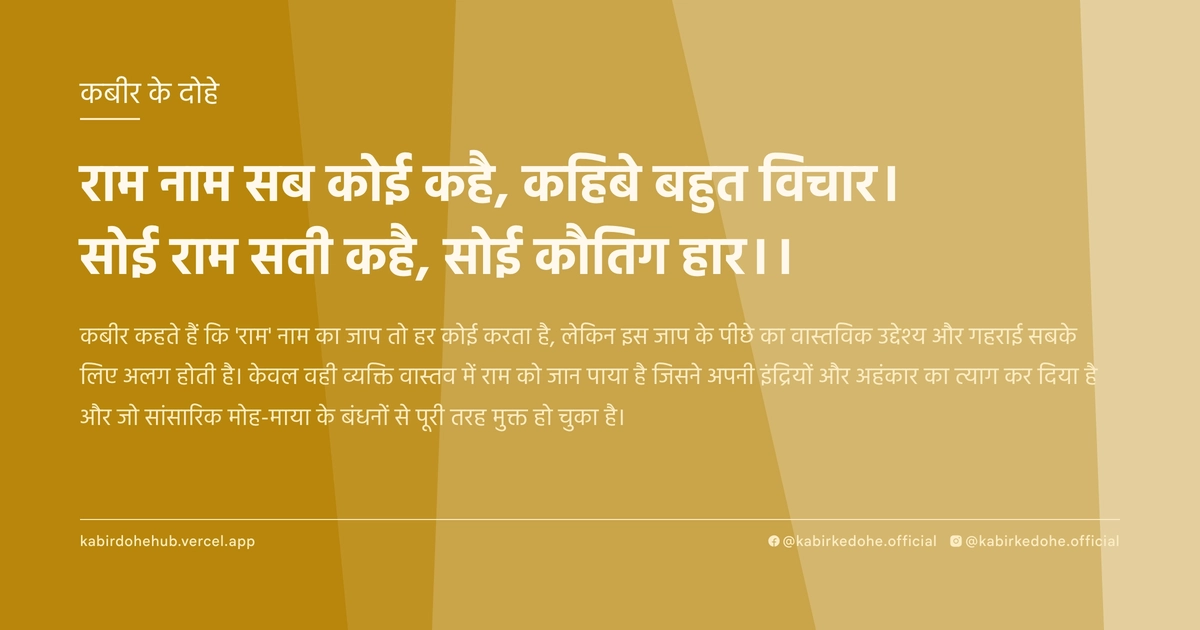
राम नाम सब कोई कहै, कहिबे बहुत विचार।
सोई राम सती कहै, सोई कौतिग हार।।
Ram naam sab koi kahai, kahibe bahut vichaar. Soi Ram sati kahai, soi kautig haar.
इस पृष्ठ पर इस कबीर दोहे का अर्थ (meaning), हिंदी व्याख्या और अंग्रेज़ी अनुवाद, दार्शनिक विश्लेषण और व्यावहारिक जीवन सीख दी गई है। यह दोहा सत्य (Truth) विषय से जुड़ा है — Kabir doha meaning and explanation in Hindi and English.
अर्थ (Meaning):
कबीर कहते हैं कि 'राम' नाम का जाप तो हर कोई करता है, लेकिन इस जाप के पीछे का वास्तविक उद्देश्य और गहराई सबके लिए अलग होती है। केवल वही व्यक्ति वास्तव में राम को जान पाया है जिसने अपनी इंद्रियों और अहंकार का त्याग कर दिया है और जो सांसारिक मोह-माया के बंधनों से पूरी तरह मुक्त हो चुका है।
Kabir observes that while everyone chants the name of 'Ram', the intent and depth behind such recitation vary greatly. Only those who have truly transcended the ego and severed the ties of worldly attachment can be said to have actually realized the Divine essence of Ram.
व्याख्या (Interpretation):
शाब्दिक रूप से यह दोहा नाम-जप की यांत्रिकता पर प्रहार करता है। यहाँ 'राम' शब्द किसी व्यक्ति या पौराणिक राजा का नहीं, बल्कि उस निर्गुण ब्रह्म का प्रतीक है जो कण-कण में व्याप्त है। कबीर स्पष्ट करते हैं कि केवल शब्दों का उच्चारण करना आध्यात्मिक उपलब्धि नहीं है; यह एक मानसिक भ्रम या 'माया' हो सकता है। जब साधक 'सती' (शुद्ध/सत्य) की अवस्था में पहुँचता है, तब वह समझता है कि राम बाहर नहीं, बल्कि भीतर हैं। यह अद्वैत वेदांत के उस सिद्धांत को दर्शाता है जहाँ आत्मा और परमात्मा का भेद मिट जाता है। अंततः, जो व्यक्ति अपनी पहचान को पूरी तरह मिटाकर शून्य हो जाता है, वही इस आध्यात्मिक खेल (कौतिग) का असली विजेता बनता है।
Literally, this couplet attacks the mechanical nature of chanting. Here, 'Ram' does not refer to a historical king or a specific deity, but symbolizes the Nirgun Brahman—the formless absolute pervading every atom. Kabir clarifies that the mere utterance of words is not spiritual attainment; it may simply be a manifestation of 'Maya' or illusion. When the seeker reaches the state of 'Sati' (purity/truth), they realize that Ram is not external but internal. This aligns with Advaita Vedanta, where the distinction between Atman and Brahman dissolves. Ultimately, the one who annihilates their identity and becomes a void is the true winner of this divine play (Kautig).
दार्शनिक विश्लेषण (Philosophical Analysis):
कबीर का यह दोहा उस समय के सामाजिक और धार्मिक पाखंड पर एक तीखा प्रहार है जहाँ धर्म केवल बाहरी कर्मकांडों और माला फेरने तक सीमित हो गया था। कबीर ने देखा कि लोग राम का नाम तो ले रहे थे, लेकिन उनके हृदय में जातिगत श्रेष्ठता, क्रोध और लोभ अभी भी जीवित थे। यह विरोधाभास दर्शाता है कि बाहरी भक्ति अक्सर आंतरिक अहंकार को छिपाने का एक मुखौटा बन जाती है।
दार्शनिक स्तर पर, यह सूफी मत के 'फना' (अहंकार का विनाश) और अद्वैत वेदांत के 'अहं ब्रह्मास्मि' के करीब है। कबीर का 'राम' वह निराकार तत्व है जिसे न मंदिर में पाया जा सकता है न मस्जिद में, बल्कि केवल आत्म-साक्षात्कार के माध्यम से प्राप्त किया जा सकता है। वे तर्क देते हैं कि जब तक 'मैं' (अहंकार) मौजूद है, तब तक 'राम' (परमात्मा) का अनुभव असंभव है क्योंकि दो विपरीत धाराएँ एक साथ नहीं बह सकतीं।
यहाँ 'कौतिग हार' का अर्थ उस आध्यात्मिक खेल से है जहाँ मनुष्य अपनी सीमित पहचान को खोकर अनंत में विलीन हो जाता है। कबीर ritualism (कर्मकांड) का विरोध करते हुए यह समझाते हैं कि सच्ची भक्ति वह है जो मनुष्य के चरित्र को बदल दे, न कि वह जो उसे धार्मिक श्रेष्ठता का अहसास कराए। यह एक मनोवैज्ञानिक रूपांतरण की मांग करता है जहाँ साधक अपनी मान्यताओं को चुनौती दे।
ऐतिहासिक संदर्भ में, कबीर ने एक ऐसे समाज का निर्माण करना चाहा जहाँ ईश्वर तक पहुँचने का मार्ग सरल और आंतरिक हो, न कि पंडितों या मौलवियों के नियंत्रण में। उनका दृष्टिकोण यह था कि यदि नाम-जप से हृदय की शुद्धि नहीं हो रही, तो वह केवल एक शोर है। यह बौद्ध धर्म के शून्यता के सिद्धांत से भी मेल खाता है, जहाँ शून्य होना ही पूर्ण होना है।
अंततः, यह विश्लेषण हमें यह समझने पर मजबूर करता है कि आध्यात्मिक यात्रा शब्दों के संचय की नहीं, बल्कि बोझ को उतारने की प्रक्रिया है। जब हम अपनी पहचान, अपनी उपाधियों और अपने पूर्वाग्रहों को त्याग देते हैं, तब जो शेष बचता है, वही वास्तविक 'राम' है। यह पूर्ण समर्पण की वह अवस्था है जहाँ भक्त और भगवान एक हो जाते हैं।
This couplet is a sharp critique of the social and religious hypocrisy of Kabir's era, where spirituality had been reduced to external rituals and the mechanical counting of beads. Kabir observed that while people chanted 'Ram', their hearts remained riddled with caste superiority, anger, and greed. This paradox highlights how external devotion often becomes a mask to hide an inflating internal ego.
Philosophically, this aligns with the Sufi concept of 'Fana' (annihilation of the self) and the Advaita Vedanta realization of 'Aham Brahmasmi' (I am Brahman). Kabir's 'Ram' is the formless element that cannot be found in temples or mosques, but only through profound self-realization. He argues that as long as the 'I' (ego) exists, the experience of 'Ram' (the Absolute) is impossible, for two opposing currents cannot flow in the same channel.
The term 'Kautig Haar' refers to the divine play where a human sheds their limited identity to merge into the infinite. By rejecting ritualism, Kabir explains that true devotion is that which transforms one's character, rather than that which provides a sense of religious superiority. This requires a psychological transformation where the seeker dares to challenge their own ingrained beliefs.
In a historical context, Kabir sought to establish a path to the Divine that was simple and internal, removing the mediation of priests or clerics. His perspective was that if chanting does not purify the heart, it is merely noise. This resonates with the Buddhist concept of Sunyata (emptiness), where becoming empty is the only way to become full.
Ultimately, this analysis forces us to understand that the spiritual journey is not about the accumulation of words or mantras, but a process of shedding burdens. When we discard our identities, titles, and prejudices, what remains is the true 'Ram'. It is a state of total surrender where the devotee and the Divine merge into one seamless reality.
मूल संदेश (Core Message):
- शब्दों का जाप केवल द्वार है, गंतव्य नहीं।
- अहंकार की उपस्थिति में परमात्मा का अनुभव असंभव है।
- सच्ची भक्ति बाहरी प्रदर्शन में नहीं, आंतरिक रूपांतरण में है।
- जब 'मैं' मिटता है, तभी 'वह' प्रकट होता है।
- ईश्वर को खोजने का अर्थ है स्वयं के भ्रम को मिटाना।
- Chanting words is merely the doorway, not the destination.
- Experience of the Divine is impossible in the presence of ego.
- True devotion lies in internal transformation, not external display.
- Only when the 'I' vanishes does the 'He' appear.
- Searching for God means erasing the illusions of the self.
व्यावहारिक उदाहरण (Practical Example):
वाराणसी के एक पुराने घाट पर माधव नाम का एक वृद्ध नाविक रहता था। माधव का पूरा जीवन नाव चलाने और तीर्थयात्रियों को पार उतारने में बीता था। वह हर समय अपने गले में एक माला रखता था और निरंतर 'राम-राम' का जाप करता रहता था। शहर के लोग उसे बहुत धार्मिक मानते थे क्योंकि वह कभी किसी से झगड़ता नहीं था और हमेशा विनम्र रहता था।
लेकिन माधव के भीतर एक गहरा द्वंद्व था। वह मानता था कि उसकी माला और उसका जाप उसे दूसरों से श्रेष्ठ बनाता है। जब भी वह किसी ऐसे व्यक्ति को देखता जो पूजा-पाठ नहीं करता था, वह मन ही मन उसे 'पापी' समझकर तुच्छ मानता था। उसकी भक्ति बाहरी रूप से शांत थी, लेकिन आंतरिक रूप से वह अपने 'धार्मिक होने के अहंकार' में कैद था।
एक दिन, एक फकीर उसकी नाव पर सवार हुआ। फकीर ने देखा कि माधव जाप तो कर रहा है, लेकिन उसकी आँखों में दूसरों के प्रति सूक्ष्म तिरस्कार है। फकीर ने माधव से पूछा, "तुम राम को पुकार रहे हो, पर क्या तुमने उसे देखा है?" माधव ने गर्व से कहा, "मैं जीवन भर जाप कर रहा हूँ, राम मेरे हृदय में हैं।"
फकीर मुस्कुराया और बोला, "यदि राम तुम्हारे हृदय में हैं, तो वहाँ 'मैं' और 'तू' का भेद कैसे रह गया? यदि तुम खुद को श्रेष्ठ और दूसरों को तुच्छ मानते हो, तो तुम राम का नाम नहीं ले रहे, बल्कि अपने अहंकार को राम के नाम से सजा रहे हो।"
यह बात माधव के हृदय पर बिजली की तरह गिरी। उसे अचानक अहसास हुआ कि उसकी माला केवल एक आभूषण बन गई थी और उसका जाप एक आदत, जिसने उसे वास्तव में ईश्वर के करीब लाने के बजाय उसके अहंकार को और पुख्ता कर दिया था। वह समझ गया कि वह अब तक केवल शब्दों का खेल खेल रहा था।
अगले कुछ महीनों तक माधव ने माला फेरना छोड़ दिया। उसने अपनी ऊर्जा इस बात में लगाई कि वह हर इंसान में उसी 'राम' को देखे जिसे वह अपनी माला में खोज रहा था। उसने उन लोगों की मदद करना शुरू किया जिन्हें वह पहले 'पापी' समझकर अनदेखा करता था।
एक दिन उसने देखा कि एक बीमार भिखारी घाट की सीढ़ियों पर पड़ा है। माधव ने बिना किसी संकोच के उसे अपनी गोद में उठाया और उसकी सेवा की। उस क्षण, जब उसने भिखारी की आँखों में वही करुणा देखी जो वह ईश्वर में खोज रहा था, उसे एक असीम शांति का अनुभव हुआ।
अब माधव का 'राम-राम' केवल होंठों पर नहीं था, बल्कि उसके हर कार्य में झलक रहा था। उसने जान लिया कि असली 'राम' वह नहीं है जिसे पुकारा जाए, बल्कि वह है जिसे हर जीव में महसूस किया जाए। उसका अहंकार पूरी तरह मिट चुका था, और अब वह वास्तव में उस 'कौतिग' का हिस्सा बन गया था।
On an ancient ghat in Varanasi lived an elderly boatman named Madhav. Madhav had spent his entire life rowing boats and ferrying pilgrims across the river. He always wore a prayer bead necklace around his neck and constantly chanted 'Ram-Ram'. The townspeople considered him very religious because he never argued and always remained humble.
However, deep within Madhav, there was a conflict. He believed that his beads and his chanting made him superior to others. Whenever he saw someone who did not engage in ritual worship, he secretly viewed them as 'sinners' and felt a sense of disdain. His devotion was externally calm, but internally, he was imprisoned by the ego of being 'religious'.
One day, a wandering Sufi ascetic boarded his boat. The ascetic noticed that while Madhav was chanting, there was a subtle trace of contempt in his eyes toward others. The ascetic asked, "You call upon Ram, but have you actually seen Him?" Madhav replied with pride, "I have chanted His name all my life; Ram resides in my heart."
The ascetic smiled and said, "If Ram resides in your heart, how can the distinction between 'I' and 'Thou' still exist? If you consider yourself superior and others inferior, you are not calling upon Ram; you are merely decorating your ego with the name of Ram."
These words struck Madhav like a bolt of lightning. He suddenly realized that his beads had become mere ornaments and his chanting a habit, which instead of bringing him closer to God, had fortified his ego. He understood that he had been playing a game of words all along.
For the next few months, Madhav stopped the mechanical counting of beads. He directed his energy toward seeing that same 'Ram' in every human being that he had been searching for in his beads. He began helping those people whom he had previously ignored as 'sinners'.
One day, he saw a sick beggar lying on the steps of the ghat. Without hesitation, Madhav lifted him in his arms and cared for him. In that moment, when he saw the same compassion in the beggar's eyes that he had been seeking in the Divine, he experienced an infinite peace.
Now, Madhav's 'Ram-Ram' was not just on his lips; it resonated in every action. He realized that the true 'Ram' is not someone to be summoned, but someone to be felt in every living being. His ego had completely vanished, and he had finally become a part of that divine play.
अभ्यास मार्गदर्शन (Practice Guidance):
- प्रतिदिन 15 मिनट मौन अभ्यास करें, जहाँ आप शब्दों के बिना केवल अपनी श्वास और आंतरिक उपस्थिति को महसूस करें।
- एक 'अहंकार डायरी' लिखें: दिन भर में उन क्षणों को नोट करें जब आपने खुद को दूसरों से श्रेष्ठ या निम्न महसूस किया, और विश्लेषण करें कि वह भावना कहाँ से आई।
- व्यवहार परिवर्तन: किसी ऐसे व्यक्ति की निस्वार्थ सेवा करें जिसे आप व्यक्तिगत या वैचारिक रूप से नापसंद करते हैं, यह देखते हुए कि वह भी उसी चेतना का हिस्सा है।
- निदान चेकलिस्ट: क्या मेरा आध्यात्मिक अभ्यास मुझे अधिक विनम्र बना रहा है या अधिक निर्णयशील? क्या मैं दूसरों की गलतियों पर उपदेश देता हूँ या उनके दर्द में सहभागी होता हूँ?
- Practice 15 minutes of daily silence, where you feel your breath and internal presence without the use of words or mantras.
- Maintain an 'Ego Diary': Note moments throughout the day when you felt superior or inferior to others, and analyze the root of that emotion.
- Behavioral Shift: Perform selfless service for someone you personally or ideologically dislike, recognizing that they are a manifestation of the same universal consciousness.
- Diagnostic Checklist: Is my spiritual practice making me more humble or more judgmental? Do I preach to others about their mistakes or do I empathize with their pain?
चिंतन प्रश्न (Reflection Questions):
- क्या मेरी धार्मिक पहचान मेरे वास्तविक व्यक्तित्व को निखार रही है या उसे ढक रही है?
- यदि मुझसे मेरी सभी उपाधियाँ और मेरी धार्मिक मान्यताएँ छीन ली जाएँ, तो मेरा अस्तित्व क्या बचेगा?
- मैं दूसरों के प्रति जो करुणा दिखाता हूँ, क्या वह वास्तव में करुणा है या मेरी अपनी 'अच्छाई' का प्रदर्शन?
- मेरे जीवन का कौन सा हिस्सा अभी भी 'दिखावे' की भक्ति पर टिका है?
- क्या मैं सत्य को जानने के लिए तैयार हूँ, या मैं केवल अपनी मान्यताओं की पुष्टि चाहता हूँ?
- Is my religious identity refining my true personality or merely masking it?
- If all my titles and religious beliefs were stripped away, what would remain of my existence?
- Is the compassion I show others true empathy, or is it a performance of my own 'goodness'?
- Which part of my life is still sustained by the 'performance' of devotion?
- Am I truly ready to know the Truth, or am I merely seeking confirmation of my own beliefs?