
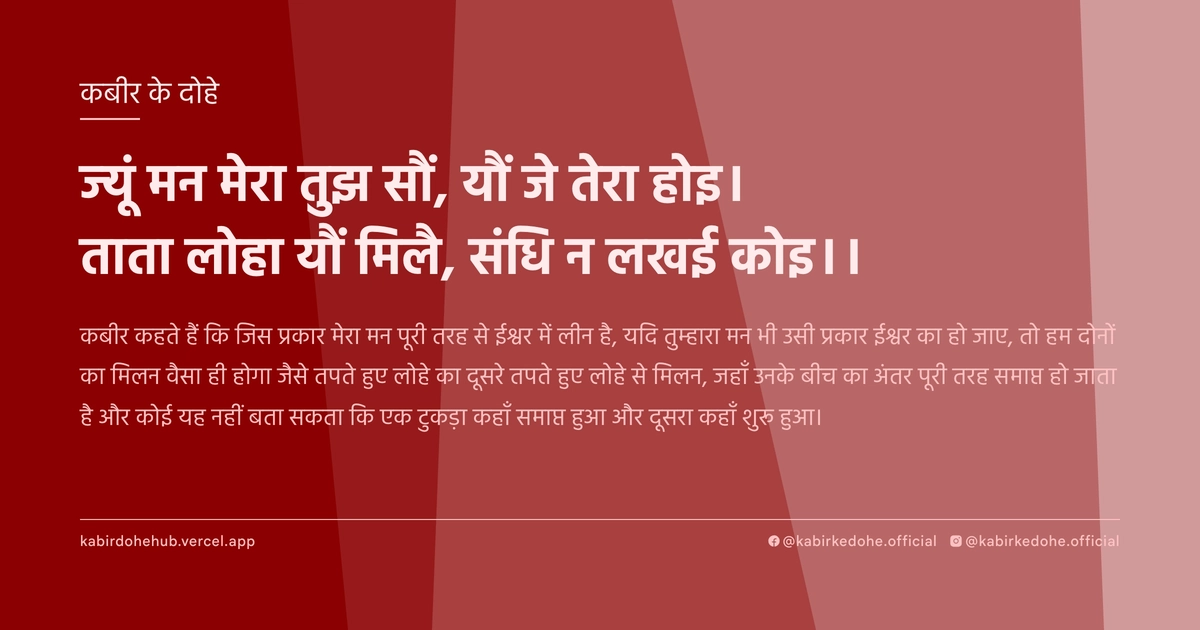
ज्यूं मन मेरा तुझ सौं, यौं जे तेरा होइ।
ताता लोहा यौं मिलै, संधि न लखई कोइ।।
Jyun man mera tujh saun, yaun je tera hoye. Tata loha yaun milai, sandhi na lakhai koi.
इस पृष्ठ पर इस कबीर दोहे का अर्थ (meaning), हिंदी व्याख्या और अंग्रेज़ी अनुवाद, दार्शनिक विश्लेषण और व्यावहारिक जीवन सीख दी गई है। यह दोहा प्रपत्ति (Surrender) विषय से जुड़ा है — Kabir doha meaning and explanation in Hindi and English.
अर्थ (Meaning):
कबीर कहते हैं कि जिस प्रकार मेरा मन पूरी तरह से ईश्वर में लीन है, यदि तुम्हारा मन भी उसी प्रकार ईश्वर का हो जाए, तो हम दोनों का मिलन वैसा ही होगा जैसे तपते हुए लोहे का दूसरे तपते हुए लोहे से मिलन, जहाँ उनके बीच का अंतर पूरी तरह समाप्त हो जाता है और कोई यह नहीं बता सकता कि एक टुकड़ा कहाँ समाप्त हुआ और दूसरा कहाँ शुरू हुआ।
Kabir expresses that just as his mind is utterly absorbed in the Divine, if your mind were to become equally surrendered to the Divine, the union between the seeker and the Sought would be like two pieces of molten iron merging. In such a state of intense heat and fusion, the boundary between the two vanishes completely, leaving no discernible seam or separation.
व्याख्या (Interpretation):
इस दोहे का शाब्दिक अर्थ दो आत्माओं के मिलन से है, लेकिन आध्यात्मिक स्तर पर यह 'अद्वैत' की स्थिति का वर्णन है। 'ताता लोहा' (तप्त लोहा) यहाँ तीव्र आध्यात्मिक तड़प और प्रेम की अग्नि का प्रतीक है, जो अहंकार को पिघला देती है। जब साधक का मन पूरी तरह से परमात्मा में विलीन हो जाता है, तो 'मैं' और 'तू' का द्वैत समाप्त हो जाता है। यह निर्गुण भक्ति का चरम है जहाँ भक्त और भगवान एक ही तत्व बन जाते हैं। माया वह पर्दा है जो हमें अलग दिखाता है, लेकिन प्रेम की अग्नि उस पर्दे को जला देती है। अंततः, यह आत्मा और ब्रह्म की अभिन्नता को दर्शाता है, जहाँ कोई तीसरा साक्षी भी उनके बीच की संधि या जोड़ को नहीं देख सकता।
Literally, the verse speaks of two entities merging, but metaphorically, it describes the state of 'Advaita' or non-duality. The 'molten iron' symbolizes the intense fire of spiritual longing and divine love that incinerates the ego. When the seeker's consciousness is fully absorbed in the Divine, the duality of 'I' and 'Thou' dissolves. This represents the pinnacle of Nirgun Bhakti, where the devotee and the Formless Absolute become one essence. Maya is the illusionary veil that suggests separation, but the heat of devotion burns this veil away. Ultimately, it illustrates the non-duality of Atman and Brahman, where the union is so seamless that no observer can discern where the individual ends and the Universal begins.
दार्शनिक विश्लेषण (Philosophical Analysis):
कबीर का यह दर्शन उनके समय के कर्मकांडीय धर्मों के विरुद्ध एक सशक्त प्रहार था। जहाँ पंडित और मुल्ला बाहरी प्रतीकों और रीति-रिवाजों में उलझे थे, कबीर ने आंतरिक रूपांतरण और 'प्रेम' को एकमात्र मार्ग बताया। यह विचार सीधे तौर पर अद्वैत वेदांत से जुड़ता है, जो कहता है कि जीव और ईश्वर अलग नहीं हैं, बल्कि अज्ञानता के कारण अलग प्रतीत होते हैं।
सूफीवाद के 'फना' (annihilation) के सिद्धांत के साथ इसका गहरा संबंध है, जहाँ प्रेमी अपने अस्तित्व को प्रेमी (ईश्वर) में मिटा देता है। कबीर यहाँ यह स्पष्ट कर रहे हैं कि ईश्वर को पाने के लिए किसी मंदिर या मस्जिद की आवश्यकता नहीं है, बल्कि मन की उस अवस्था की आवश्यकता है जहाँ अहंकार पूरी तरह पिघल जाए।
लोहे का उदाहरण अत्यंत सटीक है क्योंकि लोहा अपनी कठोरता के लिए जाना जाता है, ठीक वैसे ही जैसे मानव अहंकार कठोर होता है। केवल अत्यधिक ताप (साधना और विरह) ही इस कठोरता को समाप्त कर उसे तरल बना सकता है। जब दो तरल तत्व मिलते हैं, तो वे एक हो जाते हैं।
यहाँ कबीर जाति और वर्ग के भेदों को भी नकारते हैं। यदि दो लोग 'तप्त लोहे' की तरह ईश्वर में लीन हैं, तो उनके बीच की सामाजिक पहचान, जाति या धर्म का कोई महत्व नहीं रह जाता। यह एक सार्वभौमिक मानवता का आह्वान है।
अंततः, यह विश्लेषण हमें बताता है कि आध्यात्मिक प्रगति का अर्थ ज्ञान का संचय नहीं, बल्कि स्वयं के 'होने' का विसर्जन है। जब तक 'मैं' मौजूद है, तब तक 'वह' दूर है; जैसे ही 'मैं' पिघलता है, केवल 'वह' ही शेष रहता है।
Kabir's philosophy here serves as a potent critique of the ritualistic religions of his era. While the pundits and mullahs were entangled in external symbols and rites, Kabir emphasized internal transformation and 'Love' as the sole path. This thought aligns directly with Advaita Vedanta, which posits that the individual soul (Jiva) and the Absolute (Brahman) are not distinct but appear separate due to ignorance (Avidya).
There is a profound connection to the Sufi concept of 'Fana' (annihilation), where the lover dissolves their existence into the Beloved. Kabir clarifies that reaching the Divine requires no temple or mosque, but rather a state of mind where the ego is completely melted away.
The metaphor of iron is precise because iron is known for its rigidity, mirroring the stubbornness of the human ego. Only extreme heat—symbolizing intense spiritual practice and the agony of separation (Viraha)—can break this rigidity and make it fluid. When two fluid elements merge, they become indistinguishable.
Furthermore, Kabir rejects the distinctions of caste and class. If two beings are merged in the Divine like molten iron, their social identities, castes, or religions lose all significance. It is a call for a universal humanity based on spiritual essence rather than social construct.
Ultimately, this analysis reveals that spiritual progress is not about the accumulation of knowledge, but the surrender of the 'self'. As long as the 'I' exists, the Divine remains distant; the moment the 'I' melts, only the Divine remains.
मूल संदेश (Core Message):
- अहंकार वह शीतलता है जो हमें अलग करती है।
- प्रेम की अग्नि ही द्वैत को मिटा सकती है।
- पूर्ण समर्पण ही परमात्मा से मिलन का एकमात्र मार्ग है।
- जब 'मैं' मिटता है, तभी 'वह' प्रकट होता है।
- आध्यात्मिक एकता बाहरी नहीं, आंतरिक विलीनीकरण है।
- Ego is the coldness that keeps us separate.
- Only the fire of love can incinerate duality.
- Total surrender is the sole path to Divine union.
- When the 'I' vanishes, the 'Absolute' manifests.
- Spiritual unity is internal fusion, not external association.
व्यावहारिक उदाहरण (Practical Example):
वाराणसी के एक पुराने मोहल्ले में माधव नाम का एक कुम्हार रहता था। वह अपनी कला में निपुण था, लेकिन उसका स्वभाव अत्यंत अहंकारी था। वह मानता था कि उसके द्वारा बनाए गए बर्तन पूरे शहर में सबसे श्रेष्ठ हैं और वह किसी अन्य कुम्हार की सलाह सुनना पसंद नहीं करता था। उसका अहंकार उसके और उसके शिष्यों के बीच एक दीवार बन गया था।
एक दिन, शहर में एक फकीर आया जिसने माधव की मूर्तियों को देखा और मुस्कुराते हुए कहा, "मिट्टी तो सुंदर है, लेकिन इसमें बनाने वाले का अहंकार अभी भी कंकड़ की तरह चुभ रहा है।"
माधव को यह बात चुभ गई। उसने फकीर से पूछा, "आप क्या कहना चाहते हैं?" फकीर ने उसे एक भट्टी के पास ले जाकर दो लोहे के टुकड़ों को तपते हुए दिखाया। जब लोहा लाल होकर पिघलने लगा, तो फकीर ने उन्हें आपस में जोड़ दिया।
फकीर ने कहा, "देखो माधव, जब तक ये लोहे अलग-अलग और ठंडे थे, वे अपनी पहचान में कठोर थे। लेकिन जब वे आग में तपे, तो वे पिघल गए और अब तुम नहीं बता सकते कि कौन सा टुकड़ा पहले कहाँ था।"
माधव को अपनी गलती का अहसास हुआ। उसने महसूस किया कि उसका 'श्रेष्ठ कुम्हार' होने का अहंकार ही वह ठंडा लोहा था जिसने उसे दूसरों से अलग कर रखा था।
उसने तय किया कि वह अब अपनी कला को अपनी श्रेष्ठता सिद्ध करने के लिए नहीं, बल्कि सेवा के लिए उपयोग करेगा। उसने अपने प्रतिस्पर्धियों की मदद करना शुरू किया और अपने शिष्यों को बराबरी का सम्मान दिया।
धीरे-धीरे माधव का स्वभाव बदलने लगा। अब वह केवल बर्तन नहीं बना रहा था, बल्कि वह लोगों के दिलों में प्रेम और विनम्रता के बीज बो रहा था।
उसकी कला में अब एक अलग ही चमक थी, क्योंकि अब उसमें 'मैं' नहीं था, बल्कि एक निस्वार्थ समर्पण था।
गाँव के लोग अब उसे उसकी कला के लिए नहीं, बल्कि उसकी करुणा के लिए पूजने लगे।
माधव ने जान लिया था कि असली मिलन तब होता है जब अहंकार की भट्टी में जलकर व्यक्ति स्वयं को मिटा देता है और केवल प्रेम शेष रहता है।
In an old neighborhood of Varanasi lived a potter named Madhav. He was a master of his craft, but his nature was profoundly arrogant. He believed the vessels he created were the finest in the city and refused to listen to the advice of any other potter. His ego had become a wall between him and his apprentices.
One day, a wandering dervish arrived in the city. After observing Madhav's work, he smiled and said, "The clay is beautiful, but the ego of the maker still pricks like a pebble within the pot."
Stung by this remark, Madhav asked, "What do you mean?" The dervish led him to a forge and showed him two pieces of iron being heated. As the iron turned red and began to soften, the dervish fused them together.
The dervish explained, "Look, Madhav, as long as these pieces of iron were separate and cold, they were rigid in their own identity. But when they were heated in the fire, they melted, and now you cannot tell where one piece ends and the other begins."
Madhav realized his error. He understood that his ego as the 'superior potter' was the cold iron that had kept him isolated and separate from others.
He decided that he would no longer use his art to prove his superiority, but as a means of service. He began helping his competitors and treating his apprentices with equal respect.
Slowly, Madhav's nature transformed. He was no longer just making pots; he was sowing seeds of love and humility in the hearts of people.
There was now a different glow in his art, for it was no longer driven by 'I', but by a selfless surrender.
The townspeople began to revere him not for his skill, but for his compassion.
Madhav had learned that true union occurs only when a person burns away their ego in the furnace of devotion, leaving only love behind.
अभ्यास मार्गदर्शन (Practice Guidance):
- प्रतिदिन 20 मिनट मौन ध्यान करें, जहाँ आप अपने 'मैं' (अहंकार) को एक पिघलते हुए लोहे की तरह कल्पना करें जो धीरे-धीरे ब्रह्मांडीय चेतना में विलीन हो रहा है।
- स्व-अन्वेषण जर्नल लिखें: दिन भर में ऐसे क्षणों को नोट करें जब आपने अपनी श्रेष्ठता सिद्ध करने की कोशिश की। पूछें, "वह कौन था जो श्रेष्ठ दिखना चाहता था?"
- व्यवहारिक परिवर्तन: सप्ताह में एक बार किसी ऐसे व्यक्ति की निस्वार्थ मदद करें जिससे आपके वैचारिक मतभेद हों, बिना यह जताए कि आप उनकी मदद कर रहे हैं।
- निदान चेकलिस्ट: यदि आप दूसरों की आलोचना करते समय संतुष्टि महसूस करते हैं या अपनी उपलब्धियों का श्रेय केवल स्वयं को देते हैं, तो समझें कि आपका 'लोहा' अभी भी ठंडा और कठोर है।
- Practice 20 minutes of silent meditation daily, visualizing your 'I' (ego) as a piece of melting iron slowly merging into the cosmic consciousness.
- Maintain a self-inquiry journal: Note moments during the day when you tried to prove your superiority. Ask, "Who was it that wanted to appear superior?"
- Behavioral Change: Once a week, selflessly help someone with whom you have ideological differences, without letting them feel that you are the benefactor.
- Diagnostic Checklist: If you feel a sense of satisfaction while criticizing others or attribute your achievements solely to yourself, recognize that your 'iron' is still cold and rigid.
चिंतन प्रश्न (Reflection Questions):
- मेरे जीवन में वह कौन सा 'कठोर लोहा' (अहंकार) है जो मुझे दूसरों के साथ गहराई से जुड़ने से रोक रहा है?
- क्या मेरी धार्मिक या आध्यात्मिक पहचान वास्तव में मुझे ईश्वर के करीब ले जा रही है, या यह केवल एक नया सूक्ष्म अहंकार बन गई है?
- यदि आज मेरी सारी सामाजिक उपलब्धियाँ और पहचान छीन ली जाएँ, तो क्या मेरे भीतर कुछ ऐसा बचेगा जो ईश्वर के साथ एक हो सके?
- मैं अपनी श्रेष्ठता सिद्ध करने के लिए किन गुप्त मानसिक खेलों का उपयोग करता हूँ?
- क्या मैं वास्तव में प्रेम करता हूँ, या मैं केवल उस प्रेम की प्रशंसा चाहता हूँ जो लोग मुझे देते हैं?
- What is the 'rigid iron' (ego) in my life that prevents me from connecting deeply with others?
- Is my religious or spiritual identity truly bringing me closer to the Divine, or has it simply become a new, subtle ego?
- If all my social achievements and identities were stripped away today, would there be anything left within me capable of uniting with the Divine?
- What secret mental games do I play to prove my superiority over others?
- Do I truly love, or do I merely crave the admiration that others give me in the name of love?