
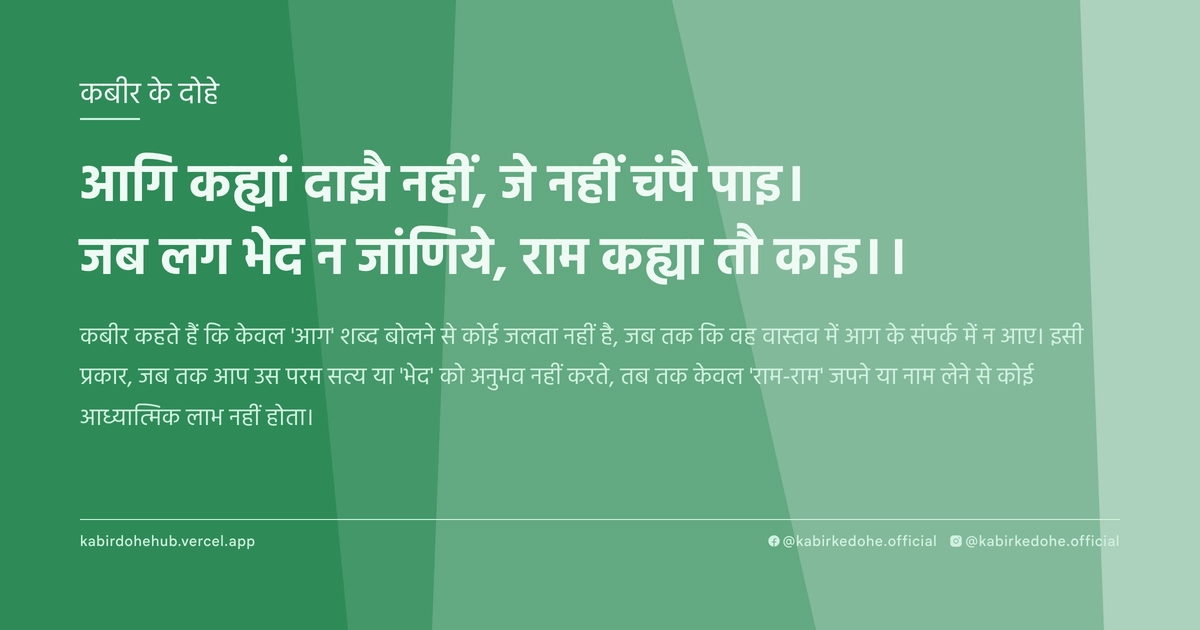
आगि कह्यां दाझै नहीं, जे नहीं चंपै पाइ।
जब लग भेद न जांणिये, राम कह्या तौ काइ।।
Aagi kahyan dajahe nahi, je nahi champai paai. Jab lag bhed na jaaniye, Ram kahya tau kai.
इस पृष्ठ पर इस कबीर दोहे का अर्थ (meaning), हिंदी व्याख्या और अंग्रेज़ी अनुवाद, दार्शनिक विश्लेषण और व्यावहारिक जीवन सीख दी गई है। यह दोहा ध्यान (Meditation) विषय से जुड़ा है — Kabir doha meaning and explanation in Hindi and English.
अर्थ (Meaning):
कबीर कहते हैं कि केवल 'आग' शब्द बोलने से कोई जलता नहीं है, जब तक कि वह वास्तव में आग के संपर्क में न आए। इसी प्रकार, जब तक आप उस परम सत्य या 'भेद' को अनुभव नहीं करते, तब तक केवल 'राम-राम' जपने या नाम लेने से कोई आध्यात्मिक लाभ नहीं होता।
Kabir asserts that merely uttering the word 'fire' does not burn a person unless they actually touch the flame. Similarly, chanting the name of 'Ram' or speaking of the Divine is futile and devoid of spiritual transformation until one realizes the secret 'bhed'—the actual experiential truth of the Absolute.
व्याख्या (Interpretation):
यह दोहा प्रतीकात्मकता और अनुभव के बीच के अंतर को स्पष्ट करता है। 'आग' यहाँ उस तीव्र आध्यात्मिक अनुभव का प्रतीक है जो अज्ञान को जला देता है। कबीर तर्क देते हैं कि धर्म अक्सर केवल शब्दों का खेल बन जाता है, जहाँ व्यक्ति बाहरी अनुष्ठानों और मंत्रों में उलझा रहता है। 'भेद' का अर्थ है वह गुप्त ज्ञान या आत्म-साक्षात्कार जो केवल बौद्धिक चर्चा से नहीं, बल्कि आंतरिक रूपांतरण से आता है। यह निर्गुण भक्ति का सार है, जहाँ ईश्वर किसी बाहरी मूर्ति या नाम में नहीं, बल्कि स्वयं के भीतर स्थित चेतना में पाया जाता है। जब तक साधक माया के पर्दे को हटाकर अपनी वास्तविक प्रकृति (आत्मा) और ब्रह्म की एकता को नहीं पहचानता, तब तक उसकी भक्ति केवल एक यांत्रिक क्रिया है। यह विरोधाभास है कि हम जिसे खोज रहे हैं, वह हमारे भीतर है, फिर भी हम शब्दों के जाल में फंसे हैं।
This couplet elucidates the profound chasm between symbolic representation and direct experience. 'Fire' serves as a metaphor for the searing intensity of spiritual realization that incinerates the ego and ignorance. Kabir argues that religion often devolves into a mere linguistic exercise, where the seeker is trapped in external rituals and rote chanting. The 'bhed' refers to the esoteric secret or the direct realization of the Self, which cannot be attained through intellectual discourse but only through internal alchemy. This is the essence of Nirgun Bhakti, where the Divine is not found in an external idol or a specific name, but in the formless consciousness residing within. Until the seeker pierces the veil of Maya and recognizes the non-duality of Atman and Brahman, the act of chanting 'Ram' remains a mechanical gesture. The central paradox lies in the fact that while the Truth is the most intimate reality, the seeker remains estranged, lost in the superficiality of words.
दार्शनिक विश्लेषण (Philosophical Analysis):
कबीर का यह दोहा उनके युग के धार्मिक पाखंड और कर्मकांडवाद पर एक तीखा प्रहार है। 15वीं शताब्दी में, समाज बाहरी प्रतीकों, जैसे कि माला फेरने, तीर्थयात्रा और विशिष्ट मंत्रों के उच्चारण में डूबा हुआ था। कबीर ने इस 'बाहरी धर्म' को नकारते हुए 'आंतरिक अनुभव' पर जोर दिया। उनका दर्शन अद्वैत वेदांत के करीब है, जहाँ वे मानते हैं कि आत्मा और परमात्मा एक ही हैं, और उनके बीच का अंतर केवल अज्ञान (माया) के कारण है।
सूफी मत के 'फना' (अहंकार का विनाश) के समान, कबीर यहाँ यह समझा रहे हैं कि जब तक 'मैं' का भाव नहीं मिटता, तब तक ईश्वर का नाम केवल एक शब्द है। वे यह स्पष्ट करते हैं कि ज्ञान केवल शास्त्रों को पढ़ने से नहीं आता, बल्कि 'अनुभव' (Experience) से आता है। यदि आग को छूने से जलन होती है, तो सत्य को अनुभव करने से जीवन बदल जाना चाहिए।
कबीर जाति और धर्म की सीमाओं को तोड़ते हैं। उनके लिए 'राम' कोई व्यक्ति या पौराणिक राजा नहीं, बल्कि वह सार्वभौमिक चेतना है जो कण-कण में व्याप्त है। वे चेतावनी देते हैं कि शब्दों का मोह हमें वास्तविकता से दूर ले जाता है। यह मनोवैज्ञानिक रूपांतरण की प्रक्रिया है, जहाँ साधक को अपनी पहचान को सामाजिक और धार्मिक लेबलों से मुक्त करना होता है।
यहाँ 'भेद' शब्द अत्यंत महत्वपूर्ण है। यह उस रहस्य की ओर इशारा करता है जिसे केवल मौन और गहन ध्यान के माध्यम से ही समझा जा सकता है। यह बौद्धिक तर्क का अंत और प्रत्यक्ष अनुभूति की शुरुआत है। कबीर का दृष्टिकोण यह है कि सत्य का मार्ग 'कहने' का नहीं, बल्कि 'होने' का है।
अंततः, यह दोहा हमें सिखाता है कि आध्यात्मिक प्रगति का पैमाना यह नहीं है कि हमने कितनी प्रार्थनाएँ की हैं, बल्कि यह है कि हमारे भीतर कितना परिवर्तन आया है। बिना अनुभव के भक्ति केवल एक मानसिक भ्रम है, जो अहंकार को और अधिक पुष्ट करता है।
Kabir's couplet is a scathing critique of the religious hypocrisy and ritualism prevalent during his era. In the 15th century, society was immersed in external symbols—beading prayer beads, pilgrimages, and the rote recitation of specific mantras. Kabir rejected this 'external religion,' emphasizing instead the 'internal experience.' His philosophy aligns closely with Advaita Vedanta, positing that the Atman and Brahman are identical, and the perceived separation is merely a product of Avidya (ignorance) or Maya.
Parallel to the Sufi concept of 'Fana' (the annihilation of the ego), Kabir explains that until the sense of 'I' is extinguished, the name of God remains a mere word. He asserts that true knowledge does not derive from the study of scriptures but from 'Anubhava' (direct experience). Just as touching fire inevitably causes a burn, experiencing the Truth must inevitably transform one's life.
Kabir transcends the boundaries of caste and creed. For him, 'Ram' is not a historical figure or a mythological king, but the universal consciousness permeating every atom of existence. He warns that an obsession with words distances the seeker from reality. This is a process of psychological transmutation, where the practitioner must strip away their identity from social and religious labels.
The term 'bhed' (the secret/distinction) is pivotal here. It points toward an esoteric realization that can only be accessed through silence and profound meditation. It marks the end of intellectual argumentation and the beginning of direct perception. Kabir's perspective is that the path to Truth is not about 'saying' but about 'becoming.'
Ultimately, this doha teaches that the metric of spiritual progress is not the quantity of prayers offered, but the quality of internal transformation. Devotion without experience is a mere mental illusion that often serves to reinforce the ego rather than dissolve it.
मूल संदेश (Core Message):
- शब्द केवल संकेत हैं, गंतव्य नहीं।
- अनुभव के बिना ज्ञान केवल एक बोझ है।
- अहंकार का विनाश ही वास्तविक भक्ति है।
- सत्य को कहा नहीं, जिया जाता है।
- बाहरी कर्मकांड आंतरिक शून्यता को नहीं भर सकते।
- Words are mere signposts, not the destination.
- Knowledge without experience is but a burden.
- The annihilation of ego is the only true devotion.
- Truth is not spoken; it is lived.
- External rituals cannot fill an internal void.
व्यावहारिक उदाहरण (Practical Example):
वाराणसी के एक पुराने घाट पर माधव नाम का एक वृद्ध व्यक्ति रहता था, जो जीवन भर दूसरों को धर्म की बातें सुनाता रहा। वह घंटों तक राम नाम का जाप करता और लोगों को बताता कि मोक्ष कैसे प्राप्त किया जाए। माधव को अपनी विद्वत्ता पर बहुत गर्व था, लेकिन उसके भीतर शांति नहीं थी।
एक दिन उसकी मुलाकात एक साधारण कुम्हार से हुई, जो मिट्टी के बर्तन बना रहा था। कुम्हार चुप था, लेकिन उसकी आँखों में एक अजीब सी चमक और चेहरे पर गहरी शांति थी। माधव ने उससे पूछा, "तुम दिन भर मिट्टी में सने रहते हो, क्या तुम कभी ईश्वर का नाम लेते हो?"
कुम्हार ने मुस्कुराकर कहा, "बाबा, मैं नाम नहीं लेता, मैं उस नाम को जीता हूँ। जब मैं मिट्टी को आकार देता हूँ, तो मैं भूल जाता हूँ कि मैं कौन हूँ; बस वह सृजन शेष रह जाता है।"
माधव को लगा कि यह तो बहुत साधारण बात है। उसने कुम्हार को उपदेश देना शुरू किया कि कैसे मंत्रों के सही उच्चारण से ही ईश्वर मिलते हैं। कुम्हार ने शांति से कहा, "बाबा, यदि आप प्यासे हैं, तो 'पानी' शब्द को बार-बार दोहराने से आपकी प्यास नहीं बुझेगी। आपको पानी पीना होगा।"
यह बात माधव के दिल पर बिजली की तरह गिरी। उसे एहसास हुआ कि उसने जीवन भर 'पानी' शब्द का अध्ययन किया था, लेकिन कभी पानी पिया नहीं था। उसने महसूस किया कि उसकी भक्ति केवल शब्दों का एक प्रदर्शन थी, जिसमें अहंकार छिपा था।
अगले कुछ महीनों तक, माधव ने बोलना कम कर दिया। उसने अपनी विद्वत्ता का चोगा उतार फेंका और चुपचाप सेवा में लग गया। वह अब केवल राम कहता नहीं था, बल्कि हर दुखी व्यक्ति की मदद में राम को देखने लगा।
उसने पाया कि जब वह बिना किसी फल की इच्छा के किसी की मदद करता, तो उसके भीतर एक ऐसी अग्नि जलती जो उसके क्रोध और अहंकार को भस्म कर देती। यह वह 'आग' थी जिसका जिक्र कबीर ने किया था।
अब माधव के चेहरे पर वही शांति थी जो उस कुम्हार की थी। उसने जान लिया था कि 'भेद' शब्दों में नहीं, बल्कि उस मौन में है जहाँ 'मैं' मिट जाता है और केवल 'वह' रह जाता है।
On an ancient ghat in Varanasi lived an elderly man named Madhav, who had spent his entire life preaching religion to others. He would chant the name of Ram for hours and instruct people on how to attain Moksha. Madhav took great pride in his scholarship, yet he lacked inner peace.
One day, he encountered a simple potter shaping clay. The potter was silent, but his eyes held a strange radiance and his face reflected a profound serenity. Madhav asked him, "You spend your days covered in mud; do you ever utter the name of God?"
The potter smiled and replied, "Baba, I do not utter the name; I live the name. When I shape the clay, I forget who I am; only the act of creation remains."
Madhav felt this was too simplistic. He began lecturing the potter on how the correct pronunciation of mantras is the only way to reach the Divine. The potter calmly responded, "Baba, if you are thirsty, repeating the word 'water' will not quench your thirst. You must actually drink the water."
These words struck Madhav like a bolt of lightning. He realized that he had spent his life studying the word 'water' but had never actually tasted it. He understood that his devotion was merely a performance of words, masking a deep-seated ego.
For the next few months, Madhav spoke less. He cast off the cloak of his scholarship and immersed himself in silent service. He no longer just said 'Ram'; he began to see 'Ram' in every suffering soul he helped.
He discovered that when he helped others without desire for reward, a fire ignited within him that consumed his anger and pride. This was the 'fire' Kabir spoke of—the fire of direct experience.
Now, Madhav's face mirrored the peace of the potter. He had learned that the 'bhed' (the secret) does not reside in words, but in that silence where the 'I' vanishes and only the 'Absolute' remains.
अभ्यास मार्गदर्शन (Practice Guidance):
- दैनिक मौन अभ्यास: प्रतिदिन 30 मिनट पूर्ण मौन रहें। शब्दों के बिना केवल अपनी श्वास और वर्तमान क्षण के प्रति जागरूक रहें।
- आत्म-पूछताछ जर्नल: लिखें कि आप किन धार्मिक या सामाजिक पहचानों (जैसे 'मैं एक अच्छा व्यक्ति हूँ' या 'मैं भक्त हूँ') से चिपके हुए हैं और वे आपके अहंकार को कैसे बढ़ा रहे हैं।
- कर्म-योग प्रयोग: किसी ऐसे व्यक्ति की निस्वार्थ सेवा करें जिससे आप घृणा करते हैं, और देखें कि क्या आपका आंतरिक प्रतिरोध (अहंकार) पिघल रहा है।
- निदान चेकलिस्ट: क्या मेरी प्रार्थनाएं केवल शब्दों का दोहराव हैं? क्या मैं दूसरों को उपदेश देने में अधिक रुचि रखता हूँ बजाय खुद को बदलने के? क्या मैं सत्य को केवल बौद्धिक रूप से जानता हूँ या अनुभव करता हूँ?
- Daily Silence Practice: Spend 30 minutes in absolute silence daily. Be aware of your breath and the present moment without the interference of words.
- Self-Inquiry Journaling: Document the religious or social identities you cling to (e.g., 'I am a good person' or 'I am a devotee') and analyze how they reinforce your ego.
- Karma Yoga Experiment: Perform selfless service for someone you dislike and observe whether your internal resistance (ego) begins to dissolve.
- Diagnostic Checklist: Are my prayers merely repetitions of words? Am I more interested in preaching to others than in transforming myself? Do I know the Truth only intellectually or do I experience it?
चिंतन प्रश्न (Reflection Questions):
- क्या मेरी आध्यात्मिक पहचान वास्तव में मेरी मुक्ति है, या यह मेरे अहंकार का एक नया और सूक्ष्म रूप है?
- यदि मुझसे मेरे सभी धार्मिक शब्द और लेबल छीन लिए जाएं, तो मेरे भीतर क्या बचेगा?
- मैं कितनी बार सत्य को 'जानने' का दावा करता हूँ जबकि मैं उसे 'जी' नहीं रहा होता?
- क्या मेरी भक्ति दूसरों को प्रभावित करने के लिए है या स्वयं को मिटाने के लिए?
- मेरे जीवन में वह कौन सी 'आग' है जो मेरे पुराने ढर्रों को जलाकर राख कर सकती है?
- Is my spiritual identity truly my liberation, or is it merely a new, more subtle form of my ego?
- If all my religious words and labels were stripped away, what would remain within me?
- How often do I claim to 'know' the Truth while failing to actually 'live' it?
- Is my devotion intended to impress others or to dissolve myself?
- What is the 'fire' in my life capable of incinerating my old patterns and delusions?