
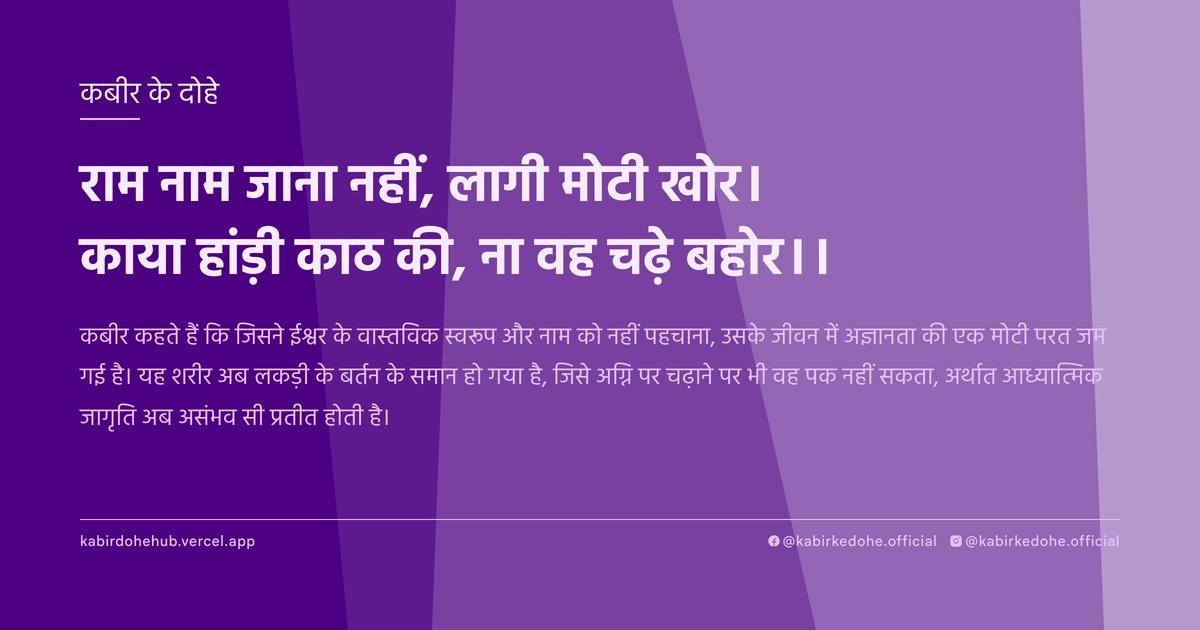
राम नाम जाना नहीं, लागी मोटी खोर।
काया हांड़ी काठ की, ना वह चढ़े बहोर।।
Ram naam jaana nahi, laagi moti khor. Kaya haandi kaath ki, na vah chadhe bahor.
इस पृष्ठ पर इस कबीर दोहे का अर्थ (meaning), हिंदी व्याख्या और अंग्रेज़ी अनुवाद, दार्शनिक विश्लेषण और व्यावहारिक जीवन सीख दी गई है। यह दोहा मृतुक्यता (Mortality) विषय से जुड़ा है — Kabir doha meaning and explanation in Hindi and English.
अर्थ (Meaning):
कबीर कहते हैं कि जिसने ईश्वर के वास्तविक स्वरूप और नाम को नहीं पहचाना, उसके जीवन में अज्ञानता की एक मोटी परत जम गई है। यह शरीर अब लकड़ी के बर्तन के समान हो गया है, जिसे अग्नि पर चढ़ाने पर भी वह पक नहीं सकता, अर्थात आध्यात्मिक जागृति अब असंभव सी प्रतीत होती है।
Kabir asserts that one who fails to recognize the true essence of the Divine Name accumulates a thick crust of ignorance. The physical body becomes like a pot made of wood; though placed upon the fire of life, it cannot be cooked or transformed, symbolizing a soul stunted by spiritual blindness.
व्याख्या (Interpretation):
यहाँ 'राम' शब्द किसी व्यक्ति विशेष के लिए नहीं, बल्कि उस सर्वव्यापी चेतना (Nirgun Brahman) के लिए है जो कण-कण में व्याप्त है। 'मोटी खोर' अज्ञान और अहंकार की उस परत को दर्शाता है जो आत्मा और परमात्मा के बीच एक दीवार बन जाती है। शरीर की तुलना 'काठ की हांड़ी' से करना एक गहरा विरोधाभास है; मिट्टी का बर्तन आग में तपकर मजबूत होता है, लेकिन लकड़ी का बर्तन आग में केवल जलता है, पकता नहीं। यह इस बात का संकेत है कि जब तक अहंकार जीवित है, साधना की अग्नि केवल कष्ट देगी, रूपांतरण नहीं। यह माया के उस जाल को दर्शाता है जहाँ मनुष्य बाहरी कर्मकांडों में उलझा रहता है जबकि आंतरिक तत्व मृतप्राय रहता है। अंततः, यह दोहा आत्मा और ब्रह्म की अद्वैत स्थिति की प्राप्ति के लिए अहंकार के विसर्जन की अनिवार्यता पर बल देता है।
Here, 'Ram' does not refer to a mythological figure but to the omnipresent consciousness (Nirgun Brahman) pervading every atom. The 'thick crust' (moti khor) symbolizes the layers of ego and ignorance that create a barrier between the Atman and the Absolute. Comparing the body to a 'wooden pot' is a profound paradox; while a clay pot is tempered and strengthened by fire, a wooden pot merely burns without ever becoming a vessel for nourishment. This suggests that without the realization of the True Name, spiritual practices (Sadhana) only bring superficial agitation rather than internal alchemy. It highlights the tragedy of Maya, where the seeker mistakes the ritual for the realization. The central paradox lies in the human condition: seeking liberation while clinging to the very identity (the wooden pot) that prevents such liberation, emphasizing the necessity of ego-annihilation for non-dual union.
दार्शनिक विश्लेषण (Philosophical Analysis):
कबीर का यह दोहा मध्यकालीन भारत के उस दौर का है जब धर्म केवल बाहरी आडंबरों, जातिगत श्रेष्ठता और कठोर कर्मकांडों तक सीमित हो गया था। कबीर ने 'राम नाम' को एक मंत्र के रूप में नहीं, बल्कि एक अनुभव के रूप में प्रस्तुत किया है। वे यहाँ स्पष्ट करते हैं कि बिना आंतरिक बोध के, किसी भी प्रकार की पूजा या तीर्थयात्रा व्यर्थ है। यह दृष्टिकोण सीधे तौर पर अद्वैत वेदांत से जुड़ता है, जहाँ जीव और ईश्वर की एकता की बात कही गई है, लेकिन यह एकता तभी संभव है जब 'मैं' (अहंकार) का लोप हो जाए।
सूफी मत के 'फना' (अहंकार का विनाश) के सिद्धांत के समान, कबीर यहाँ शरीर को एक माध्यम मानते हैं, लेकिन चेतावनी देते हैं कि यदि यह माध्यम जड़ (काठ जैसा) हो गया है, तो यह परमात्मा के प्रेम को ग्रहण नहीं कर पाएगा। वे उन लोगों पर प्रहार करते हैं जो स्वयं को धार्मिक मानते हैं लेकिन जिनके हृदय में करुणा और सत्य का अभाव है। उनके लिए धर्म कोई बाहरी पोशाक नहीं, बल्कि आंतरिक शुद्धि है।
मनोवैज्ञानिक स्तर पर, 'मोटी खोर' हमारे उन मानसिक पूर्वाग्रहों और कंडीशनिंग को दर्शाती है जो हमें सत्य को देखने से रोकते हैं। जब हम अपनी पहचान को केवल शरीर या सामाजिक पद से जोड़ लेते हैं, तो हम उस 'काठ की हांड़ी' में बदल जाते हैं जो परिवर्तन के प्रति प्रतिरोधी होती है। कबीर का तर्क है कि आध्यात्मिक विकास के लिए पहले इस जड़ता को तोड़ना आवश्यक है।
यह दोहा यह भी स्पष्ट करता है कि केवल ज्ञान का संचय करना पर्याप्त नहीं है। यदि ज्ञान हृदय में नहीं उतरा, तो वह केवल बौद्धिक विलासिता है। जिस प्रकार लकड़ी का बर्तन आग में पककर भोजन नहीं बना सकता, उसी प्रकार केवल शास्त्रों का पाठ करने वाला व्यक्ति यदि अहंकार से भरा है, तो वह मोक्ष का पात्र नहीं बन सकता।
अंततः, कबीर हमें यह समझाते हैं कि वास्तविक भक्ति 'निर्गुण' है—वह जो रूप, रंग और सीमाओं से परे है। जब साधक यह जान लेता है कि वह स्वयं वह अनंत चेतना है, तब वह 'काठ' से 'मिट्टी' (लचीला और समर्पित) बनता है और अंततः अग्नि में तपकर स्वर्ण बन जाता है। यह रूपांतरण ही जीवन का वास्तविक उद्देश्य है।
This couplet emerges from the socio-religious landscape of medieval India, a period where spirituality had largely devolved into rigid ritualism, caste hierarchies, and external displays of piety. Kabir redefines 'Ram Naam' not as a repetitive chant or a theological label, but as a direct experiential realization of the Absolute. He posits that without this internal awakening, all external religious activities are futile. This aligns seamlessly with Advaita Vedanta, which asserts the fundamental unity of the Atman and Brahman, suggesting that this unity is obscured only by the veil of Avidya (ignorance).
Drawing parallels with the Sufi concept of 'Fana' (the annihilation of the self), Kabir views the body as a vessel. However, he warns that if the vessel is 'wooden'—meaning rigid, ego-driven, and devoid of surrender—it cannot contain the fluid grace of the Divine. He critiques the religious elite of his time who prioritized the form of worship over the essence of devotion, arguing that true religion is an internal purification process rather than a social performance.
Psychologically, the 'thick crust' represents the cognitive biases, social conditioning, and emotional armor we build around ourselves. When an individual identifies solely with their ego or social status, they become the 'wooden pot'—resistant to the transformative fire of truth. Kabir suggests that spiritual evolution requires the breaking of this psychological rigidity to allow the light of consciousness to penetrate.
Furthermore, the poem emphasizes that intellectual accumulation is not spiritual growth. Knowledge that remains in the head without descending into the heart is merely intellectual vanity. Just as a wooden pot cannot be used to cook food regardless of the heat, a scholar burdened by pride cannot achieve liberation regardless of their scriptural knowledge.
Ultimately, Kabir advocates for 'Nirgun Bhakti'—devotion to the formless. He suggests that the journey is one of transmutation: moving from the rigidity of the ego (wood) to the humility of surrender (clay), and finally to the purity of realization (gold). The 'fire' is the intensity of longing and self-inquiry, which, when applied to a surrendered heart, leads to the dissolution of the separate self into the Universal Truth.
मूल संदेश (Core Message):
- अहंकार सत्य और आत्मा के बीच की सबसे बड़ी बाधा है।
- बाहरी कर्मकांड बिना आंतरिक रूपांतरण के व्यर्थ हैं।
- विनम्रता ही वह माध्यम है जिससे आध्यात्मिक अग्नि हमें पकाती है।
- ईश्वर का नाम केवल शब्द नहीं, बल्कि अहंकार का विसर्जन है।
- जब तक 'मैं' है, तब तक 'वह' (परमात्मा) नहीं मिल सकता।
- Ego is the primary obstacle between the seeker and the Truth.
- External rituals are futile without internal transformation.
- Humility is the only medium through which the spiritual fire refines us.
- The Divine Name is not a word, but the dissolution of the ego.
- As long as the 'I' persists, the 'Absolute' remains hidden.
व्यावहारिक उदाहरण (Practical Example):
वाराणसी के एक पुराने मोहल्ले में रामदीन नाम का एक कुम्हार रहता था। वह शहर का सबसे कुशल कारीगर था, लेकिन उसका अहंकार उसकी कला से भी बड़ा था। वह मानता था कि उसके जैसा बर्तन कोई और नहीं बना सकता और वह अक्सर अन्य कुम्हारों का उपहास करता था। वह प्रतिदिन मंदिर जाता, घंटों पूजा करता और दान देता, लेकिन उसके मन में दूसरों के प्रति घृणा और श्रेष्ठता का भाव था।
एक दिन एक फकीर उसके पास आया और उसने रामदीन से एक छोटा सा मिट्टी का प्याला माँगा। रामदीन ने उसे झिड़कते हुए कहा, 'मेरे पास समय नहीं है, जाओ कहीं और से ले लो।' फकीर मुस्कुराया और उसने रामदीन को एक लकड़ी का टुकड़ा दिया और कहा, 'इसे आग पर चढ़ाओ और इसमें पानी उबालकर मुझे पिलाओ।'
रामदीन को यह मूर्खता लगी, लेकिन उसने चुनौती स्वीकार की। उसने लकड़ी के टुकड़े को आग पर रखा। जैसे ही आग तेज हुई, लकड़ी जलने लगी, उसमें से धुआँ निकला और वह काला पड़ गया, लेकिन वह कभी बर्तन नहीं बना और न ही उसमें पानी उबल सका। वह केवल राख में बदल गया।
फकीर ने उसकी आँखों में देखते हुए कहा, 'रामदीन, तुम्हारा जीवन भी इसी लकड़ी के टुकड़े जैसा है। तुम पूजा करते हो, दान देते हो, लेकिन तुम्हारा अहंकार उस मोटी खोर की तरह है जिसने तुम्हें भीतर से जड़ बना दिया है। तुम आग (साधना) में तो हो, लेकिन पक नहीं रहे, क्योंकि तुम मिट्टी की तरह विनम्र नहीं हो, तुम लकड़ी की तरह कठोर हो।'
यह बात रामदीन के हृदय पर गहरी चोट कर गई। उसने महसूस किया कि उसकी सारी धार्मिकता केवल एक बाहरी दिखावा थी। उसने पहली बार अपनी श्रेष्ठता के भ्रम को देखा और उसे अपनी 'काठ की हांड़ी' जैसी प्रकृति का अहसास हुआ।
अगले कुछ महीनों तक, रामदीन ने अपनी कला का उपयोग दूसरों की सेवा के लिए करना शुरू किया। उसने गरीब बच्चों को मुफ्त में मिट्टी के बर्तन बनाना सिखाया और अपने प्रतिस्पर्धियों की मदद की। उसने पूजा करना नहीं छोड़ा, लेकिन अब उसकी पूजा में 'मैं' नहीं, बल्कि 'हम' था।
उसने पाया कि जैसे ही उसका अहंकार कम हुआ, उसे वह शांति मिलने लगी जिसकी तलाश वह वर्षों से मंदिर की घंटियों में कर रहा था। उसकी कला में अब एक नई गहराई थी, क्योंकि वह अब केवल मिट्टी को नहीं, बल्कि अपनी आत्मा को गढ़ रहा था।
अंततः, रामदीन ने समझा कि ईश्वर मंदिर की मूर्तियों में नहीं, बल्कि उस विनम्रता में है जो एक इंसान को दूसरे इंसान से जोड़ती है। वह अब 'काठ' नहीं रहा था; वह उस मिट्टी की तरह बन गया था जिसे ईश्वर अपनी इच्छा के अनुसार आकार दे सकता था।
In an ancient alley of Varanasi lived a potter named Ramdin. He was the most skilled artisan in the city, but his arrogance was even greater than his craft. He believed no one could match his skill and frequently mocked other potters. Every day, he visited the temple, spent hours in prayer, and gave alms, yet his heart remained filled with contempt and a sense of superiority.
One day, a wandering Sufi ascetic approached him and asked for a small clay cup. Ramdin brushed him off rudely, saying, 'I have no time for you; go find someone else.' The ascetic smiled and handed Ramdin a piece of dry wood, saying, 'Place this upon the fire and boil water in it for me.'
Ramdin found the request absurd, but he accepted the challenge. He placed the wood on the fire. As the flames grew intense, the wood began to char, smoke billowed, and it turned black, but it never became a vessel, nor did it boil any water. It simply crumbled into ash.
Looking deep into Ramdin's eyes, the ascetic said, 'Ramdin, your life is exactly like this piece of wood. You pray, you give charity, but your ego is like a thick crust that has made you rigid within. You are in the fire of spiritual practice, but you are not being transformed because you are not humble like clay; you are stubborn like wood.'
These words struck Ramdin's heart with profound force. He realized that all his religiosity was merely an external facade. For the first time, he saw the illusion of his superiority and recognized the 'wooden pot' nature of his own existence.
Over the next few months, Ramdin began using his craft to serve others. He taught underprivileged children how to mold clay for free and helped his competitors improve their techniques. He did not stop praying, but his prayers no longer contained 'I'; they were filled with 'We'.
He discovered that as his ego diminished, he began to experience the peace he had spent years searching for in the ringing bells of the temple. There was now a new depth to his art, for he was no longer just molding clay, but molding his own soul.
Ultimately, Ramdin understood that the Divine does not reside in temple idols, but in the humility that connects one human being to another. He was no longer 'wood'; he had become like the clay, ready to be shaped by the Divine Will.
अभ्यास मार्गदर्शन (Practice Guidance):
- दैनिक आत्म-निरीक्षण: प्रतिदिन 15 मिनट मौन बैठें और विचार करें कि आज दिन भर में कितनी बार 'मैं' (अहंकार) ने सत्य को ढक लिया।
- सेवा का अभ्यास: सप्ताह में एक बार किसी ऐसे व्यक्ति की निस्वार्थ मदद करें जिससे आप वैचारिक रूप से असहमत हों, ताकि आपके भीतर की 'कठोरता' कम हो।
- जर्नलिंग प्रॉम्प्ट: 'मेरे जीवन में वह कौन सी मान्यता या विश्वास है जो मुझे दूसरों से श्रेष्ठ बनाता है और मुझे बदलने से रोक रहा है?'
- डायग्नोस्टिक चेकलिस्ट: क्या मैं आलोचना सुनकर क्रोधित होता हूँ? क्या मैं अपनी उपलब्धियों का श्रेय केवल स्वयं को देता हूँ? क्या मैं दूसरों की भक्ति को अपनी तुलना में कमतर आंकता हूँ? (यदि हाँ, तो 'मोटी खोर' अभी मौजूद है)।
- Daily Self-Inquiry: Spend 15 minutes in silence daily, observing how many times the 'I' (ego) obscured the truth during the day's interactions.
- Practice of Service: Once a week, perform a selfless act of service for someone with whom you fundamentally disagree, to soften the 'rigidity' within.
- Journaling Prompt: 'What belief or conviction in my life makes me feel superior to others and prevents me from evolving?'
- Diagnostic Checklist: Do I react with anger to criticism? Do I attribute all my successes solely to myself? Do I judge others' spiritual paths as inferior to mine? (If yes, the 'thick crust' is still present).
चिंतन प्रश्न (Reflection Questions):
- क्या मेरी धार्मिक पहचान वास्तव में मुझे विनम्र बना रही है, या यह मेरे अहंकार को एक नया 'पवित्र' रूप दे रही है?
- मेरे व्यक्तित्व का वह कौन सा हिस्सा है जिसे मैं 'पवित्र' मानता हूँ, लेकिन वास्तव में वह केवल एक सामाजिक मुखौटा है?
- यदि आज मेरी सारी उपलब्धियाँ और पद छीन लिए जाएँ, तो क्या मेरे भीतर कुछ ऐसा बचेगा जिसे मैं 'सत्य' कह सकूँ?
- मैं दूसरों में जो कमियाँ देखता हूँ, क्या वे वास्तव में मेरी अपनी आंतरिक परतों (खोर) का प्रतिबिंब हैं?
- क्या मैं सत्य को खोजने का प्रयास कर रहा हूँ, या मैं केवल यह सिद्ध करना चाहता हूँ कि मैं सही हूँ?
- Does my religious identity truly make me humble, or is it merely giving my ego a 'sacred' new form?
- Which part of my personality do I consider 'pure,' but is actually just a socially constructed mask?
- If all my achievements and titles were stripped away today, would anything remain within me that I could call 'Truth'?
- Are the flaws I perceive in others actually reflections of the 'thick crusts' within my own being?
- Am I genuinely seeking the Truth, or am I merely trying to prove that I am right?