
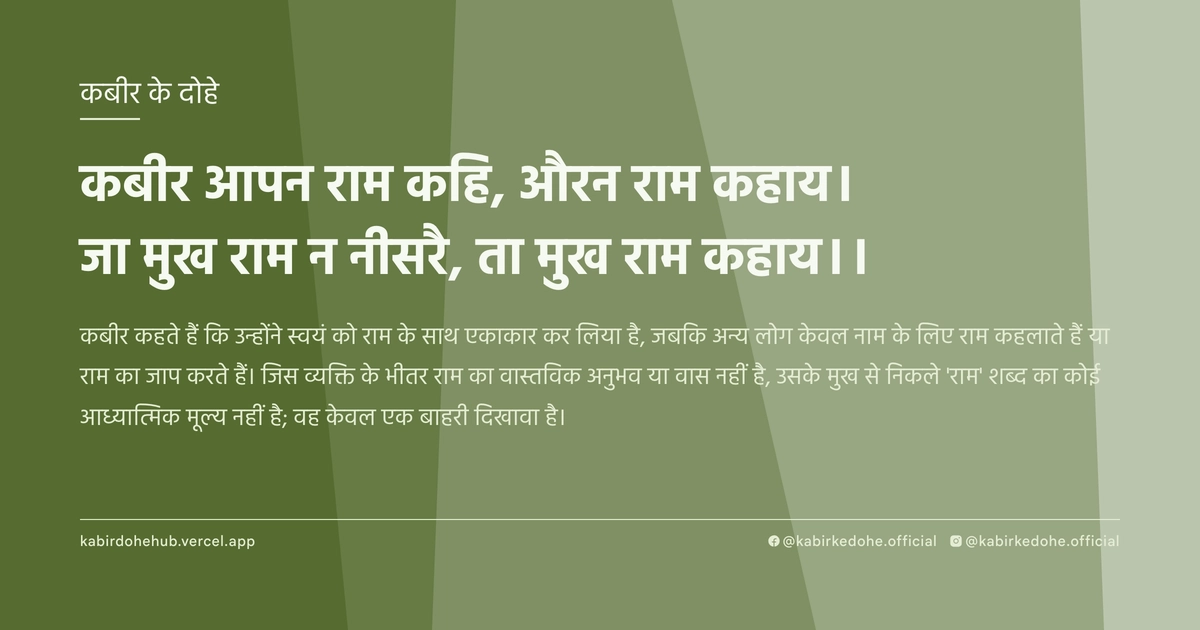
कबीर आपन राम कहि, औरन राम कहाय।
जा मुख राम न नीसरै, ता मुख राम कहाय।।
Kabir aapan Ram kahi, auran Ram kahay. Ja mukh Ram na neesarai, ta mukh Ram kahay.
इस पृष्ठ पर इस कबीर दोहे का अर्थ (meaning), हिंदी व्याख्या और अंग्रेज़ी अनुवाद, दार्शनिक विश्लेषण और व्यावहारिक जीवन सीख दी गई है। यह दोहा आत्मनिरीक्षण (Self-introspection) विषय से जुड़ा है — Kabir doha meaning and explanation in Hindi and English.
अर्थ (Meaning):
कबीर कहते हैं कि उन्होंने स्वयं को राम के साथ एकाकार कर लिया है, जबकि अन्य लोग केवल नाम के लिए राम कहलाते हैं या राम का जाप करते हैं। जिस व्यक्ति के भीतर राम का वास्तविक अनुभव या वास नहीं है, उसके मुख से निकले 'राम' शब्द का कोई आध्यात्मिक मूल्य नहीं है; वह केवल एक बाहरी दिखावा है।
Kabir asserts that he has identified his own essence with the Divine (Ram), whereas others merely claim the name or call themselves devotees. He emphasizes that for those who do not possess the living presence of the Divine within their own being, the utterance of 'Ram' from their lips is a hollow ritual devoid of spiritual truth.
व्याख्या (Interpretation):
शाब्दिक अर्थ यह है कि केवल नाम जपने से ईश्वर नहीं मिलते। गहराई में, यह दोहा 'साधना' और 'पाखंड' के बीच के अंतर को स्पष्ट करता है। यहाँ 'राम' किसी व्यक्ति विशेष नहीं, बल्कि उस निराकार ब्रह्म (Nirgun Brahman) का प्रतीक है जो कण-कण में व्याप्त है। कबीर अद्वैत वेदांत के उस सत्य की ओर इशारा कर रहे हैं जहाँ आत्मा और परमात्मा का भेद मिट जाता है। जब तक अहंकार (Maya) जीवित है, तब तक 'राम' केवल एक बाहरी शब्द है। जब अहंकार का विसर्जन होता है, तब साधक स्वयं 'राम' बन जाता है, अर्थात वह उस सार्वभौमिक चेतना के साथ एकाकार हो जाता है। यह विरोधाभास है कि जिसे हम बाहर खोज रहे हैं, वह वास्तव में हमारे भीतर का ही शुद्धतम स्वरूप है।
Literally, the verse distinguishes between the mere recitation of a name and the actual realization of the Divine. Metaphorically, it addresses the gap between ritualistic piety and authentic spiritual awakening. 'Ram' here does not refer to a mythological figure but to the formless, omnipresent consciousness (Nirgun Bhakti). Drawing from Advaita Vedanta, Kabir suggests that the seeker and the sought are one; the duality is an illusion created by Maya. The central paradox is that as long as the 'I' (ego) exists, the Divine remains an external object of worship. Only when the ego is annihilated does the seeker realize they are the very essence they were searching for, transforming the word 'Ram' from a label into a state of being.
दार्शनिक विश्लेषण (Philosophical Analysis):
कबीर का यह दोहा मध्यकालीन भारत के उस दौर की उपज है जब धर्म कर्मकांडों, जातिगत भेदभाव और बाहरी आडंबरों में जकड़ा हुआ था। कबीर ने पुरोहितवाद और मजारों-मंदिरों की भीड़ पर प्रहार किया, यह तर्क देते हुए कि ईश्वर किसी विशेष स्थान या भाषा का मोहताज नहीं है। उनका दर्शन सूफीवाद के 'फना' (अहंकार का विनाश) और वेदांत के 'अहं ब्रह्मास्मि' का एक अनूठा संगम है।
वे इस बात पर जोर देते हैं कि भक्ति का अर्थ केवल माला फेरना या तीर्थयात्रा करना नहीं है, बल्कि आंतरिक शुद्धिकरण है। यदि हृदय में करुणा, सत्य और प्रेम नहीं है, तो धार्मिक शब्दावली केवल एक मुखौटा है। यह मनोवैज्ञानिक रूपांतरण की प्रक्रिया है जहाँ व्यक्ति 'कर्ता' होने के भ्रम को त्यागकर 'साक्षी' बन जाता है।
कबीर का विरोध केवल बाहरी धर्म से नहीं, बल्कि उस मानसिक जड़ता से था जो मनुष्य को उसकी अपनी दिव्यता देखने से रोकती है। वे कहते हैं कि जब तक आप स्वयं को शरीर या सामाजिक पहचान (जाति, पद) मानते रहेंगे, आप राम को कभी नहीं पा सकेंगे क्योंकि आप स्वयं ही बाधा बन जाएंगे।
यहाँ 'राम' शब्द का प्रयोग एक कोड के रूप में किया गया है ताकि वे आम जनता से जुड़ सकें, लेकिन उनका संदेश पूरी तरह से निराकार (Nirgun) है। वे सिखाते हैं कि सत्य का अनुभव शब्दों में नहीं, बल्कि मौन और आत्म-साक्षात्कार में है।
अंततः, यह विश्लेषण हमें यह समझने पर मजबूर करता है कि आध्यात्मिक प्रगति का पैमाना यह नहीं है कि हम कितनी प्रार्थनाएँ करते हैं, बल्कि यह है कि हमारे व्यवहार में कितनी दिव्यता उतरी है। जब व्यक्ति का अस्तित्व ही राममय हो जाता है, तब शब्दों की आवश्यकता समाप्त हो जाती है।
This Doha emerges from a historical epoch in medieval India where spirituality was heavily obscured by rigid ritualism, caste hierarchies, and performative piety. Kabir’s philosophy serves as a radical critique of the priestly class and the institutionalized religion of his time, arguing that the Divine is not confined to temples, mosques, or specific linguistic formulas.
His approach is a sophisticated synthesis of Sufi 'Fana' (the annihilation of the self) and the Advaita Vedanta concept of 'Aham Brahmasmi' (I am Brahman). He posits that true devotion is not found in the mechanical repetition of a mantra, but in the profound internal alchemy of the soul. To Kabir, religious terminology without internal realization is merely a psychological defense mechanism to hide one's spiritual emptiness.
From a psychological perspective, Kabir advocates for the dissolution of the 'ego-self.' He suggests that the belief in a separate, personal identity is the primary veil (Maya) that prevents the realization of the universal consciousness. The struggle is not against an external enemy, but against the internal illusion of separation.
By using the word 'Ram,' Kabir strategically employs a familiar cultural symbol to introduce a complex, non-dualistic philosophy. He shifts the focus from 'worshipping' God to 'becoming' the Divine essence. This is a transition from dualistic prayer to non-dualistic existence.
Ultimately, Kabir challenges the literalist misconception that spirituality is about adherence to a set of rules. He asserts that the only valid evidence of spiritual attainment is the transformation of one's character and the erasure of the boundary between the self and the other. The goal is not to reach a destination, but to realize that the destination is the very nature of the traveler.
मूल संदेश (Core Message):
- शब्द केवल संकेत हैं, गंतव्य नहीं।
- अहंकार की उपस्थिति में भक्ति केवल एक नाटक है।
- ईश्वर को पुकारने से बेहतर है ईश्वर बन जाना।
- सच्ची आध्यात्मिकता बाहरी प्रदर्शन में नहीं, आंतरिक रूपांतरण में है।
- जब 'मैं' मिटता है, तभी 'राम' प्रकट होते हैं।
- प्रेम ही एकमात्र वास्तविक प्रार्थना है।
- Words are mere signposts, not the destination.
- Devotion in the presence of ego is merely a performance.
- It is superior to embody the Divine than to invoke it.
- True spirituality lies in internal transformation, not external display.
- Only when the 'I' vanishes does the Divine emerge.
- Love is the only authentic prayer.
व्यावहारिक उदाहरण (Practical Example):
वाराणसी के घाटों पर रहने वाला एक वृद्ध विधवा, जिसे लोग 'माई' कहते थे, दिन भर गंगा किनारे बैठकर राम-राम जपती थी। वह शहर की सबसे बड़ी भक्त मानी जाती थी, और लोग उसके पास आशीर्वाद लेने आते थे। लेकिन माई के मन में एक गहरा अहंकार था कि वह दूसरों से अधिक पवित्र है। वह अक्सर उन लोगों को तिरस्कार की दृष्टि से देखती थी जो शास्त्रों का पालन नहीं करते थे या जिनके जीवन में संघर्ष था।
उसी घाट के पास एक बूढ़ा मल्लाह (नाव चलाने वाला) रहता था, जो अनपढ़ था और कभी मंदिर नहीं गया था। वह बस अपनी नाव चलाता और हर डूबते हुए व्यक्ति की मदद करता, चाहे वह किसी भी जाति या धर्म का हो। वह कभी जोर से राम का नाम नहीं लेता था, लेकिन उसके चेहरे पर एक असीम शांति और आँखों में करुणा थी।
एक दिन, माई ने मल्लाह को देखा जो एक बीमार भिखारी की सेवा कर रहा था, जबकि वह खुद भूखा था। माई ने उसे टोकते हुए कहा, 'तू इतना समय इन गंदे लोगों में क्यों बर्बाद करता है? राम का नाम ले, तभी मोक्ष मिलेगा।'
मल्लाह ने मुस्कुराकर जवाब दिया, 'माई, मैं जब इस दुखी इंसान के घावों को धोता हूँ, तो मुझे लगता है कि मैं राम के ही पैर धो रहा हूँ। मेरे लिए राम कोई शब्द नहीं, बल्कि यह सेवा ही राम है।'
यह सुनकर माई स्तब्ध रह गई। उसे अचानक अहसास हुआ कि वह वर्षों से जिस 'राम' को शब्दों में खोज रही थी, वह वास्तव में मल्लाह के कर्मों में जीवित था। उसकी सारी मालाएँ और मंत्र उसके अहंकार की दीवारें बन चुके थे।
उस क्षण माई का अहंकार टूट गया। उसने महसूस किया कि जिसे वह 'पवित्रता' समझ रही थी, वह केवल एक सामाजिक मुखौटा था। उसने पहली बार अपनी आंतरिक रिक्तता को देखा और समझा कि शब्दों का जाप तब तक व्यर्थ है जब तक हृदय में प्रेम न हो।
इसके बाद माई का जीवन पूरी तरह बदल गया। उसने अपनी श्रेष्ठता का भाव त्याग दिया और चुपचाप दूसरों की सेवा में लग गई। अब वह राम-राम कम जपती थी, लेकिन उसके हर कार्य में राम झलकने लगे थे।
उसने सीखा कि ईश्वर को पुकारने से बेहतर है ईश्वर की तरह बन जाना। उसकी भक्ति अब प्रदर्शन नहीं, बल्कि एक मौन अनुभव बन गई थी।
In the ancient alleys of Varanasi, there lived an elderly widow known as 'Mai,' who spent her days chanting 'Ram-Ram' by the banks of the Ganges. She was revered as the city's most devout soul, and people flocked to her for blessings. However, beneath this veneer of piety, Mai harbored a deep-seated ego, believing herself to be spiritually superior to others. She often looked down upon those who did not follow strict scriptures or those whose lives were messy and fragmented.
Nearby lived an old boatman, an illiterate man who had never stepped inside a temple. He spent his days rowing passengers across the river and helping anyone in distress, regardless of their caste or creed. He never loudly proclaimed his faith, yet his face radiated an inexplicable peace and his eyes were filled with genuine compassion.
One afternoon, Mai observed the boatman tending to a sick beggar, offering him his own meager portion of food while he remained hungry. Mai admonished him, saying, 'Why do you waste your time on these wretched souls? Chant the name of Ram, for only then will you attain liberation.'
The boatman smiled gently and replied, 'Mai, when I wash the wounds of this suffering man, I feel as though I am washing the feet of Ram Himself. For me, Ram is not a word to be spoken, but a service to be performed.'
These words struck Mai like a bolt of lightning. She suddenly realized that the 'Ram' she had been chasing through endless repetitions of a word was living and breathing in the selfless actions of the boatman. Her beads and mantras had become walls of ego, separating her from the very truth she sought.
In that moment of profound clarity, Mai's spiritual pride collapsed. She recognized that her perceived 'purity' was merely a social mask. She confronted her own internal emptiness and understood that chanting is futile if the heart remains closed to love.
Following this epiphany, Mai's life underwent a radical transformation. She abandoned her sense of superiority and began quietly serving the marginalized. She chanted the name of Ram less frequently, but Ram began to manifest in every gesture of her hands.
She learned that it is far more potent to embody the Divine than to simply invoke it. Her devotion shifted from a public performance to a silent, lived experience.
अभ्यास मार्गदर्शन (Practice Guidance):
- दैनिक मौन अभ्यास: प्रतिदिन 20 मिनट पूर्ण मौन में बैठें। शब्दों को त्यागकर केवल अपनी सांसों और आंतरिक उपस्थिति को महसूस करें। यह देखें कि क्या आप बिना किसी नाम के भी 'दिव्यता' का अनुभव कर सकते हैं।
- आत्म-पूछताछ जर्नल: हर रात लिखें कि आज आपने कितनी बार अपनी धार्मिक या नैतिक श्रेष्ठता का उपयोग दूसरों को छोटा महसूस कराने के लिए किया। क्या आपका 'राम' आपके अहंकार को पोषण दे रहा है?
- व्यवहार परिवर्तन: किसी ऐसे व्यक्ति की निस्वार्थ सेवा करें जिसे आप नापसंद करते हैं। यह प्रयास करें कि सेवा के दौरान आपके मन में 'मैं मदद कर रहा हूँ' का भाव न आए, बल्कि यह महसूस हो कि आप स्वयं की ही सेवा कर रहे हैं।
- डायग्नोस्टिक चेकलिस्ट: (1) क्या मैं दूसरों की आध्यात्मिक स्थिति पर टिप्पणी करता हूँ? (2) क्या मेरी प्रार्थनाएँ मुझे शांत करती हैं या मुझे दूसरों से बेहतर महसूस कराती हैं? (3) क्या मैं शब्दों के बिना भी प्रेम महसूस कर सकता हूँ? यदि उत्तर 'हाँ' है, तो आप अभी भी अहंकार के प्रभाव में हैं।
- Daily Silence Practice: Spend 20 minutes in absolute silence. Abandon all words and mantras; simply feel your breath and internal presence. Observe if you can experience 'Divinity' without the mediation of a name.
- Self-Inquiry Journaling: Every night, record instances where you used your religious or moral standing to feel superior to others. Ask yourself: Is your 'Ram' nourishing your ego or dissolving it?
- Behavioral Shift: Perform a selfless act of service for someone you genuinely dislike. Strive to remove the thought 'I am helping' and instead feel that you are serving the same universal consciousness in another form.
- Diagnostic Checklist: (1) Do I judge others' spiritual progress? (2) Do my prayers bring me peace or a sense of superiority? (3) Can I feel love without the need for a label? If you answer 'Yes' to the first two, you are still operating within the ego's illusion.
चिंतन प्रश्न (Reflection Questions):
- क्या मेरा धर्म मेरी करुणा को बढ़ा रहा है, या यह मेरे भीतर एक अदृश्य दीवार खड़ी कर रहा है?
- यदि मुझसे मेरे सभी धार्मिक लेबल (नाम, जाति, संप्रदाय) छीन लिए जाएं, तो मेरी आध्यात्मिक पहचान क्या होगी?
- मैं अपनी डिजिटल पहचान (सोशल मीडिया) पर जिस 'आदर्श' व्यक्तित्व को दिखाता हूँ, क्या वह मेरे वास्तविक आंतरिक संघर्षों को छिपाने का एक तरीका है?
- क्या मैं वास्तव में ईश्वर से प्रेम करता हूँ, या मैं केवल उस 'छवि' से प्रेम करता हूँ जो मैं ईश्वर के बारे में सोचता हूँ?
- मेरे जीवन का वह कौन सा हिस्सा है जहाँ मैं अभी भी 'सही' होने की जिद में सत्य को खो रहा हूँ?
- क्या मेरी शांति बाहरी परिस्थितियों पर निर्भर है, या यह मेरे भीतर के 'राम' का स्थायी स्वभाव है?
- Is my religion expanding my compassion, or is it building an invisible wall between me and others?
- If all my religious labels (name, caste, sect) were stripped away, what would remain of my spiritual identity?
- Is the 'ideal' persona I project on social media a mask to hide my internal spiritual conflicts?
- Do I truly love the Divine, or am I merely in love with the 'image' of the Divine that I have constructed?
- In which area of my life am I losing the Truth because of my stubborn insistence on being 'right'?
- Is my peace dependent on external circumstances, or is it the permanent nature of the 'Ram' within me?