
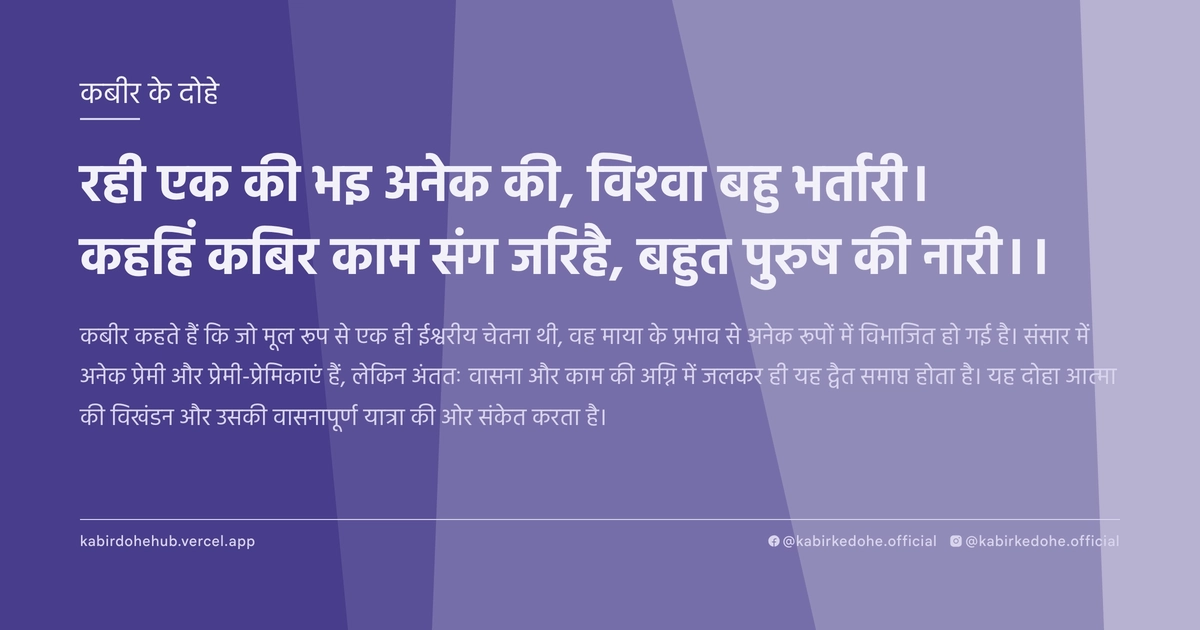
रही एक की भइ अनेक की, विश्वा बहु भर्तारी।
कहहिं कबिर काम संग जरिहै, बहुत पुरुष की नारी।।
Rahi ek ki bhai anek ki, vishwa bahu bhartari. Kahahin Kabir kaam sang jarihai, bahut purush ki naari.
इस पृष्ठ पर इस कबीर दोहे का अर्थ (meaning), हिंदी व्याख्या और अंग्रेज़ी अनुवाद, दार्शनिक विश्लेषण और व्यावहारिक जीवन सीख दी गई है। यह दोहा काम (Lust) विषय से जुड़ा है — Kabir doha meaning and explanation in Hindi and English.
अर्थ (Meaning):
कबीर कहते हैं कि जो मूल रूप से एक ही ईश्वरीय चेतना थी, वह माया के प्रभाव से अनेक रूपों में विभाजित हो गई है। संसार में अनेक प्रेमी और प्रेमी-प्रेमिकाएं हैं, लेकिन अंततः वासना और काम की अग्नि में जलकर ही यह द्वैत समाप्त होता है। यह दोहा आत्मा की विखंडन और उसकी वासनापूर्ण यात्रा की ओर संकेत करता है।
Kabir observes that the singular, primordial consciousness has fragmented into a multitude of forms through the illusion of Maya. While the world is filled with countless lovers and attachments, Kabir warns that those bound by lust and worldly desires will eventually be consumed by the very fire of passion they pursued, highlighting the transient and destructive nature of fragmented desire.
व्याख्या (Interpretation):
यहाँ 'एक' का अर्थ परब्रह्म या निर्गुण निराकार ईश्वर है, और 'अनेक' का अर्थ इस भौतिक जगत की विविधता है। कबीर इस विरोधाभास को दर्शाते हैं कि कैसे अद्वैत सत्य माया के आवरण में ढंककर द्वैत बन गया। 'भर्तारी' शब्द यहाँ केवल पति के लिए नहीं, बल्कि उस आसक्ति के लिए है जो आत्मा को बांधती है। जब आत्मा स्वयं को शरीर और लिंग के दायरे में सीमित मानकर काम-वासना में लिप्त होती है, तो वह उस अग्नि में जलती है जो उसे सत्य से दूर ले जाती है। यह निर्गुण भक्ति का मार्ग है जहाँ साधक को यह समझना होता है कि बाहरी संबंधों की बहुलता वास्तव में आंतरिक शून्यता का परिणाम है। आत्मा-ब्रह्म की एकता ही एकमात्र सत्य है, बाकी सब भ्रम है।
The 'One' refers to the Parabrahman or the Formless Absolute, while the 'Many' signifies the fragmented reality of the material world. Kabir explores the paradox of Advaita (non-duality) collapsing into duality through the lens of Maya. The term 'Bhartari' (husband/lover) symbolizes the attachments that tether the soul to the earthly plane. When the Atman identifies with the physical body and succumbs to Kama (lust), it enters a cycle of burning desire that obscures the realization of the Self. This aligns with Nirgun Bhakti, where the seeker is urged to transcend gender and social roles to recognize that the perceived multiplicity of the universe is but a reflection of a single, undivided consciousness. The 'fire' is the psychological agony of longing for something external that can never provide permanent satisfaction.
दार्शनिक विश्लेषण (Philosophical Analysis):
कबीर का यह दोहा उनके समय के सामाजिक और धार्मिक पाखंड पर एक गहरा प्रहार है। उन्होंने देखा कि लोग कैसे बाहरी कर्मकांडों और शारीरिक संबंधों में उलझकर ईश्वर को खोज रहे थे। उनका दर्शन सूफीवाद के 'वहदत-अल-वजूद' (अस्तित्व की एकता) और वेदांत के अद्वैतवाद का संगम है। वे तर्क देते हैं कि जब तक मनुष्य स्वयं को 'अनेक' के रूप में देखता है, वह अलगाव और दुख का अनुभव करता रहेगा।
यहाँ काम (lust) को एक विनाशकारी अग्नि के रूप में चित्रित किया गया है। यह केवल यौन इच्छा नहीं है, बल्कि किसी भी ऐसी इच्छा का प्रतीक है जो आत्मा को उसकी मूल एकता से अलग करती है। कबीर का मानना था कि जाति, धर्म और लिंग के भेद कृत्रिम हैं, क्योंकि ये सभी उसी 'एक' की अभिव्यक्ति हैं।
ऐतिहासिक संदर्भ में, कबीर ने उस समय के समाज को चुनौती दी जहाँ पुरुष प्रधानता और महिलाओं के प्रति दृष्टिकोण केवल उपभोग तक सीमित था। वे चेतावनी देते हैं कि जो व्यक्ति केवल शारीरिक आकर्षण को ही प्रेम समझता है, वह अंततः उसी वासना की अग्नि में भस्म हो जाएगा।
मनोवैज्ञानिक स्तर पर, यह दोहा 'अहंकार' के विखंडन की बात करता है। जब हम कहते हैं 'मैं यह हूँ' या 'वह मेरा है', तो हम एक कृत्रिम सीमा खींचते हैं। यह सीमा ही दुख का कारण है। कबीर इस सीमा को मिटाने और पुनः उस 'एक' में विलीन होने का आह्वान करते हैं।
अंततः, यह शिक्षण हमें सिखाता है कि मुक्ति बाहरी दुनिया में संबंधों की खोज करने से नहीं, बल्कि आंतरिक मौन में उस एक सत्य को पहचानने से मिलती है। यह ritualism के विरुद्ध एक सशक्त घोषणा है, जो हृदय की शुद्धता और आत्म-साक्षात्कार को सर्वोपरि मानती है।
This Doha is a profound critique of the socio-religious hypocrisy of Kabir's era. He observed how individuals sought the Divine while remaining entangled in superficial rituals and physical attachments. His philosophy represents a synthesis of the Sufi concept of 'Wahdat-al-Wujud' (Unity of Existence) and the Advaita Vedanta principle of non-duality. He argues that as long as humans perceive themselves as 'many'—separate entities—they will inevitably experience alienation and suffering.
Kama (lust) is depicted here as a consuming fire. This is not merely a reference to sexual desire, but a metaphor for any craving that separates the soul from its primordial unity. In the historical context of the 15th century, Kabir challenged the rigid caste hierarchies and gender roles, asserting that such distinctions are artificial constructs of Maya, masking the singular essence of the Divine.
He warns against the delusion of treating the physical body as the ultimate destination of love. By doing so, the seeker replaces spiritual longing (Viraha) with worldly passion, which leads to psychological fragmentation rather than wholeness. The 'burning' refers to the existential crisis that arises when the temporary nature of physical beauty and pleasure is revealed.
Psychologically, the poem addresses the annihilation of the ego. The act of claiming ownership over another person or identity creates a boundary. This boundary is the root of all suffering. Kabir calls for the dissolution of this 'I' and 'Mine' to return to the state of oneness.
Ultimately, this teaching suggests that liberation is not found in the multiplication of external relationships but in the realization of the internal singularity. It is a powerful rejection of ritualism, emphasizing that only through the purity of heart and the recognition of the Formless (Nirgun) can one escape the cycle of desire and rebirth.
मूल संदेश (Core Message):
- माया का भ्रम हमें एकता से अलग कर अनेकता में उलझाता है।
- वासना और मोह की अग्नि अंततः विनाश और दुख का कारण बनती है।
- सच्चा प्रेम नियंत्रण नहीं, बल्कि आत्मा की स्वतंत्रता का उत्सव है।
- अहंकार का विसर्जन ही अद्वैत सत्य तक पहुँचने का एकमात्र मार्ग है।
- बाहरी विविधता के पीछे छिपे एक ही ईश्वरीय तत्व को पहचानें।
- The illusion of Maya distracts us from unity and entangles us in multiplicity.
- The fire of lust and attachment inevitably leads to destruction and suffering.
- True love is not control, but a celebration of the soul's freedom.
- The dissolution of the ego is the only path to the truth of non-duality.
- Recognize the single Divine element hidden behind all external diversity.
व्यावहारिक उदाहरण (Practical Example):
वाराणसी के घाटों पर रहने वाले एक वृद्ध बुनकर थे, जिनका नाम माधव था। माधव अपनी कला में निपुण थे, लेकिन उनका मन हमेशा इस बात से अशांत रहता था कि उनके बेटे और पोते उनके नियंत्रण में नहीं हैं। वे चाहते थे कि पूरा परिवार उनकी इच्छा के अनुसार चले। वे अपनी संपत्ति और रिश्तों को अपनी 'जीत' मानते थे और हर सदस्य को अपनी संपत्ति की तरह देखते थे।
एक दिन उन्होंने कबीर के इस दोहे को सुना। उन्हें एहसास हुआ कि वे जिसे 'अपना परिवार' कह रहे थे, वास्तव में वे केवल अपनी इच्छाओं और अहंकार की संतुष्टि कर रहे थे। वे रिश्तों को प्रेम नहीं, बल्कि स्वामित्व मान रहे थे।
माधव ने देखा कि उनकी यह 'पकड़' उनके परिवार में केवल तनाव और कड़वाहट पैदा कर रही थी। वे जितना अधिक उन्हें बांधने की कोशिश करते, उनके बच्चे उतना ही दूर चले जाते। यह ठीक वैसा ही था जैसे वासना की अग्नि धीरे-धीरे रिश्तों को जला देती है।
उन्होंने अपनी सोच बदली। उन्होंने यह स्वीकार किया कि उनका बेटा या पोता उनकी संपत्ति नहीं, बल्कि स्वतंत्र आत्माएं हैं, जो उसी एक परमात्मा का अंश हैं। उन्होंने नियंत्रण की इच्छा को त्याग दिया और केवल प्रेम देना शुरू किया।
शुरुआत में यह कठिन था। उनका अहंकार उन्हें बार-बार याद दिलाता था कि वे 'मुखिया' हैं। लेकिन उन्होंने हर बार स्वयं से पूछा, "क्या मैं एक आत्मा से प्रेम कर रहा हूँ या अपनी सत्ता की भूख को मिटा रहा हूँ?"
धीरे-धीरे, उनके घर का वातावरण बदलने लगा। जब बच्चों ने महसूस किया कि अब उन पर दबाव नहीं है, तो वे स्वयं माधव के पास आने लगे। रिश्तों में जो दूरी थी, वह मिट गई क्योंकि माधव ने 'अनेक' की चाहत छोड़कर 'एक' प्रेम को अपनाया।
माधव ने पाया कि जब उन्होंने दूसरों को मुक्त किया, तो वे स्वयं सबसे अधिक मुक्त महसूस करने लगे। उनकी आंतरिक शांति अब बाहरी परिस्थितियों पर निर्भर नहीं थी।
अंत में, माधव ने अपनी सारी संपत्ति एक सामुदायिक केंद्र के लिए दान कर दी। उन्होंने महसूस किया कि असली संपत्ति वह शांति है जो तब मिलती है जब हम यह जान लेते हैं कि हम और पूरा ब्रह्मांड एक ही चेतना के विभिन्न रूप हैं।
In the ancient ghats of Varanasi lived an elderly weaver named Madhav. Madhav was a master of his craft, but his mind was perpetually troubled by the fact that his sons and grandsons did not obey his every whim. He viewed his family not as individuals, but as extensions of his own will and prestige. He believed that controlling them was a sign of his authority and love.
One day, while resting under a banyan tree, he heard a wandering monk recite this specific Doha of Kabir. The words struck a chord in him. He realized that his desire to control his family was not love, but a form of spiritual lust—a craving for power and validation through others.
Madhav observed that his grip on his children was creating a void of resentment and bitterness. The more he tried to bind them to his expectations, the further they drifted away. He saw that he was burning his own relationships in the fire of his ego, just as Kabir warned about the fire of Kama.
He decided to undergo a transformation. He began to view his children not as possessions, but as independent souls, each a spark of the same Divine Light. He consciously decided to stop being the 'master' and started being a 'witness'.
This transition was agonizing. His ego frequently whispered that he was losing his status as the patriarch. However, whenever he felt the urge to dominate, he would ask himself, "Am I loving a soul, or am I feeding my hunger for control?"
Slowly, the atmosphere in his home shifted. When the children felt the pressure of expectation lift, they began to return to him out of genuine affection rather than obligation. The distance between them vanished because Madhav had replaced the 'many' demands of his ego with the 'one' essence of unconditional love.
Madhav discovered a profound truth: by liberating others, he had liberated himself. His inner peace was no longer hostage to the behavior of his family members.
In his final years, Madhav donated his wealth to a community school. He realized that the only true possession is the peace that comes from knowing that we and the entire universe are but different expressions of a single, undivided consciousness.
अभ्यास मार्गदर्शन (Practice Guidance):
- दैनिक आत्म-निरीक्षण: प्रतिदिन 15 मिनट मौन बैठें और विचार करें कि दिन भर में आपने कितनी बार 'मेरा', 'मेरा अधिकार' या 'मेरी इच्छा' जैसे शब्दों का प्रयोग किया।
- अद्वैत चिंतन: जब भी किसी व्यक्ति के प्रति क्रोध या मोह महसूस हो, तो आँखें बंद करें और कल्पना करें कि उस व्यक्ति की आत्मा और आपकी आत्मा एक ही प्रकाश स्रोत से निकली हैं।
- जर्नलिंग प्रॉम्प्ट: "मेरे जीवन में वे कौन से रिश्ते हैं जिन्हें मैं प्रेम नहीं बल्कि नियंत्रण के रूप में देखता हूँ? यदि मैं नियंत्रण छोड़ दूँ, तो क्या बचेगा?"
- डायग्नोस्टिक चेकलिस्ट: यदि आप दूसरों के व्यवहार से अत्यधिक विचलित होते हैं, तो यह संकेत है कि आप अभी भी 'अनेक' (द्वैत) में फंसे हैं। यदि आप दूसरों की खुशी में अपनी खुशी देखते हैं, तो आप 'एक' (अद्वैत) की ओर बढ़ रहे हैं।
- Daily Self-Observation: Spend 15 minutes in silence daily, noting how many times you used words like "mine," "my right," or "my desire" during the day.
- Non-Dual Contemplation: Whenever you feel anger or possessiveness toward someone, close your eyes and visualize that their soul and yours originate from the same singular source of light.
- Journaling Prompt: "Which relationships in my life am I treating as possessions rather than as free souls? What would remain if I completely let go of the need to control?"
- Diagnostic Checklist: If you are easily disturbed by others' behavior, it is a sign you are still trapped in 'Many' (Duality). If you find your own joy in the liberation of others, you are moving toward the 'One' (Non-duality).
चिंतन प्रश्न (Reflection Questions):
- क्या मेरा 'प्रेम' वास्तव में दूसरे की भलाई के लिए है, या यह मेरी अपनी भावनात्मक जरूरतों को पूरा करने का एक तरीका है?
- मैं अपनी पहचान (नाम, पद, जाति) के बिना खुद को कैसे परिभाषित करूँगा?
- मेरे जीवन का वह कौन सा 'अनेक' (लगाव) है जो मुझे 'एक' (शांति) से दूर रख रहा है?
- क्या मैं डिजिटल युग के दिखावे और सामाजिक छवि के मोह में अपनी वास्तविक आत्मा को खो रहा हूँ?
- यदि संसार की सारी विविधता अचानक समाप्त हो जाए, तो क्या मैं उस शून्य में स्वयं को पा सकूँगा?
- Is my "love" truly for the well-being of the other, or is it a mechanism to satisfy my own emotional voids?
- How would I define myself if I were stripped of my name, title, and social identity?
- Which specific "multiplicity" (attachment) in my life is keeping me away from the "One" (inner peace)?
- Am I losing my authentic soul in the pursuit of a curated digital image and social validation?
- If all the diversity of the world suddenly vanished, would I be able to find myself in that absolute void?