
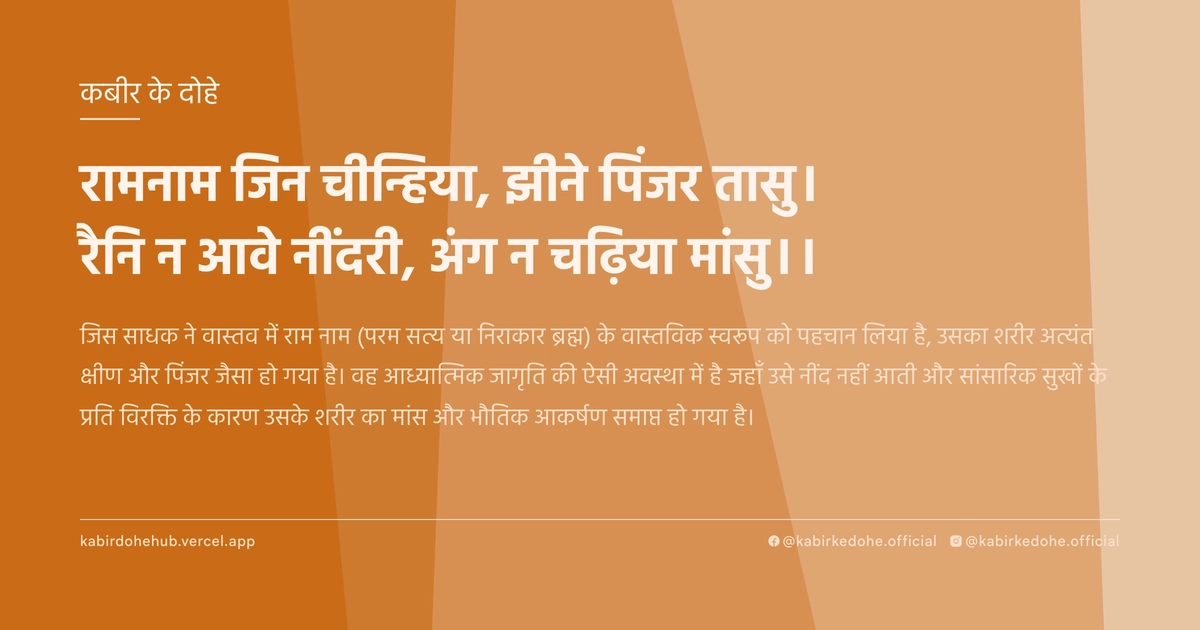
रामनाम जिन चीन्हिया, झीने पिंजर तासु।
रैनि न आवे नींदरी, अंग न चढ़िया मांसु।।
Ramnam jin cheenhiya, jheene pinjar tasu. Raini na aave neendari, ang na chadhiya maansu.
इस पृष्ठ पर इस कबीर दोहे का अर्थ (meaning), हिंदी व्याख्या और अंग्रेज़ी अनुवाद, दार्शनिक विश्लेषण और व्यावहारिक जीवन सीख दी गई है। यह दोहा भक्ति (Bhakti) विषय से जुड़ा है — Kabir doha meaning and explanation in Hindi and English.
अर्थ (Meaning):
जिस साधक ने वास्तव में राम नाम (परम सत्य या निराकार ब्रह्म) के वास्तविक स्वरूप को पहचान लिया है, उसका शरीर अत्यंत क्षीण और पिंजर जैसा हो गया है। वह आध्यात्मिक जागृति की ऐसी अवस्था में है जहाँ उसे नींद नहीं आती और सांसारिक सुखों के प्रति विरक्ति के कारण उसके शरीर का मांस और भौतिक आकर्षण समाप्त हो गया है।
The seeker who has truly recognized the essence of the Divine Name (the formless Absolute) finds their physical frame reduced to a mere skeletal cage. In the intensity of this spiritual awakening, sleep vanishes, and the body sheds its fleshy attachments, reflecting a total transcendence of material desires and bodily cravings.
व्याख्या (Interpretation):
यह दोहा शारीरिक क्षीणता का नहीं, बल्कि अहंकार के विसर्जन का प्रतीक है। 'राम' यहाँ किसी व्यक्ति विशेष नहीं, बल्कि निर्गुण ब्रह्म हैं। 'झीने पिंजर' का अर्थ है कि जब आत्मा परमात्मा में लीन होती है, तो माया का प्रभाव समाप्त हो जाता है और शरीर केवल एक माध्यम रह जाता है। नींद का न आना अज्ञान की निद्रा से जागने का संकेत है। यह अद्वैत वेदांत की उस स्थिति को दर्शाता है जहाँ साधक यह जान लेता है कि वह शरीर नहीं, बल्कि शुद्ध चेतना है। यहाँ मांस का न चढ़ना भौतिक उपवास नहीं, बल्कि काम, क्रोध और लोभ जैसी मानसिक वासनाओं के पूर्ण विनाश का रूपक है।
This couplet does not describe physical starvation, but the dissolution of the ego. 'Ram' here refers not to a deity, but to the Nirgun Brahman—the formless Absolute. The 'slender cage' symbolizes the state where the soul, merged with the Divine, views the body as a mere vessel, stripped of its illusory importance. The absence of sleep signifies the awakening from the slumber of ignorance (Maya). It aligns with Advaita Vedanta, where the seeker realizes they are not the body, but pure consciousness. The lack of 'flesh' is a metaphor for the eradication of sensory cravings and the annihilation of the lower self, marking the transition from the gross to the subtle plane of existence.
दार्शनिक विश्लेषण (Philosophical Analysis):
कबीर का यह दृष्टिकोण मध्यकालीन भारत के उस दौर का है जब धर्म केवल कर्मकांडों और बाहरी दिखावे तक सीमित था। कबीर ने 'रामनाम' को एक मंत्र के रूप में नहीं, बल्कि एक अनुभव के रूप में प्रस्तुत किया है। यह सूफी मत के 'फना' (अहंकार का विनाश) और वेदांत के 'अद्वैत' (एकत्व) का संगम है। वे तर्क देते हैं कि जब तक मनुष्य अपनी शारीरिक पहचान और सामाजिक अहंकार से चिपका रहता है, वह सत्य को नहीं देख सकता।
यहाँ 'पिंजर' शब्द शरीर की नश्वरता को दर्शाता है। कबीर ritualism का विरोध करते हुए कहते हैं कि असली भक्ति शरीर को सजाने में नहीं, बल्कि उसे पारदर्शी बनाने में है ताकि भीतर का प्रकाश बाहर आ सके। यह मनोवैज्ञानिक रूपांतरण की प्रक्रिया है जहाँ साधक अपनी पहचान को 'मैं' से हटाकर 'वह' (ब्रह्म) पर केंद्रित करता है।
इस दोहे में एक गहरा विरोधाभास है: शरीर का कमजोर होना वास्तव में आत्मा की सर्वोच्च शक्ति का उदय है। यह उस स्थिति का वर्णन है जहाँ भौतिक आवश्यकताएं इतनी गौण हो जाती हैं कि वे चेतना के मार्ग में बाधा नहीं बनतीं। कबीर यहाँ यह स्पष्ट करते हैं कि आध्यात्मिक उपलब्धि बाहरी तपस्या से नहीं, बल्कि आंतरिक विरक्ति से आती है।
सांस्कृतिक रूप से, यह संदेश जाति और वर्ग के भेदों को मिटाता है, क्योंकि 'पिंजर' (हड्डियों का ढांचा) सबके लिए एक समान होता है। जब अहंकार मिटता है, तो केवल सत्य बचता है। यह मार्ग कठिन है क्योंकि यह हमें हमारी सबसे प्रिय वस्तु—हमारी अपनी पहचान—को छोड़ने की चुनौती देता है।
अंततः, यह दोहा हमें सिखाता है कि सत्य की खोज में विलासिता और मोह का त्याग अनिवार्य है। यह 'शून्य' की अवस्था है, जहाँ पहुँचकर साधक यह अनुभव करता है कि वह और उसका आराध्य अलग नहीं हैं, बल्कि एक ही अखंड सत्ता के दो छोर हैं।
Kabir's perspective emerges from a medieval Indian era where religion was often reduced to empty rituals and outward displays. He presents 'Ramnaam' not as a repetitive mantra, but as a direct experiential realization. This is a confluence of the Sufi concept of 'Fana' (annihilation of the self) and the Vedantic principle of 'Advaita' (non-duality). He argues that as long as a human clings to physical identity and social ego, the Truth remains obscured.
The term 'Pinjar' (cage) highlights the transience of the body. Opposing ritualism, Kabir suggests that true devotion lies not in adorning the body, but in making it transparent so the inner light can radiate. This is a process of psychological transformation where the seeker shifts their identity from the 'I' to the 'Absolute'.
There is a profound paradox here: the weakening of the physical frame is actually the ascent of the soul's supreme power. It describes a state where material needs become so secondary that they no longer obstruct the path of consciousness. Kabir clarifies that spiritual attainment comes not from external asceticism, but from internal detachment.
Culturally, this message erases caste and class distinctions, for the 'skeleton' is the same for all. When the ego vanishes, only Truth remains. This path is arduous because it challenges us to relinquish our most cherished possession—our own perceived identity.
Ultimately, this doha teaches that the renunciation of luxury and attachment is essential in the pursuit of Truth. It is the state of 'Shunya' (Void), where the seeker realizes that they and the Divine are not separate entities, but two ends of the same indivisible Reality.
मूल संदेश (Core Message):
- अहंकार का विसर्जन ही वास्तविक आध्यात्मिक जागृति है।
- शरीर एक अस्थायी पिंजर है, आत्मा अनंत सत्य है।
- सांसारिक वासनाओं का त्याग ही आंतरिक शांति का मार्ग है।
- सत्य की पहचान के बाद भौतिक सुख तुच्छ हो जाते हैं।
- जागृति का अर्थ है अज्ञान की गहरी नींद से मुक्त होना।
- The dissolution of ego is the only true spiritual awakening.
- The body is a temporary cage; the soul is the eternal Truth.
- Renouncing worldly cravings is the sole path to inner peace.
- Once Truth is realized, material pleasures become insignificant.
- Awakening means liberation from the deep slumber of ignorance.
व्यावहारिक उदाहरण (Practical Example):
वाराणसी के एक पुराने घाट पर माधव नाम का एक वृद्ध बुनकर रहता था। माधव अपनी कला में निपुण था, लेकिन उसका मन हमेशा इस बात से परेशान रहता था कि लोग उसे केवल एक गरीब बुनकर के रूप में देखते हैं। वह अपनी सामाजिक प्रतिष्ठा और धन की इच्छा में दिन-रात डूबा रहता था, जिससे उसकी नींद उड़ गई थी और वह मानसिक तनाव से घिरा रहता था।
एक दिन उसने एक फकीर को देखा जो फटे कपड़ों में था, लेकिन उसके चेहरे पर एक ऐसी शांति थी जो माधव ने कभी नहीं देखी थी। माधव ने उससे पूछा, "आप इतने अभाव में भी इतने प्रसन्न कैसे हैं?"
फकीर ने मुस्कुराते हुए कहा, "मैं अभाव में नहीं हूँ, मैं तो उस पूर्णता में हूँ जहाँ 'मेरा' और 'तेरा' शब्द ही समाप्त हो गए हैं। जब तक तुम खुद को इस शरीर और इस नाम से पहचानोगे, तुम तड़पते रहोगे। जिस दिन तुम जान जाओगे कि तुम यह शरीर नहीं, बल्कि वह अनंत प्रकाश हो, उस दिन तुम्हारी सारी चिंताएं इस पिंजर की तरह हल्की हो जाएंगी।"
माधव को यह बात गहराई से लगी। उसने महसूस किया कि उसकी बेचैनी उसकी भौतिक इच्छाओं और अहंकार के कारण थी। उसने धीरे-धीरे अपनी पहचान को अपने काम और धन से अलग करना शुरू किया। उसने यह अभ्यास किया कि वह जो भी कपड़ा बुने, उसे ईश्वर की सेवा मानकर करे, न कि धन कमाने का साधन।
समय बीतने के साथ, माधव की बाहरी दुनिया नहीं बदली, लेकिन उसकी आंतरिक दुनिया बदल गई। वह अब अपनी गरीबी का शोक नहीं मनाता था। उसका शरीर उम्र के साथ कमजोर होता गया, लेकिन उसकी आत्मा अधिक शक्तिशाली और प्रफुल्लित हो गई।
वह अब रात भर जागकर ध्यान करता था, लेकिन यह अनिद्रा तनाव वाली नहीं, बल्कि आनंदमयी थी। उसे अब नींद की आवश्यकता नहीं थी क्योंकि वह जागृति के उस स्तर पर पहुँच गया था जहाँ वह हर पल परमात्मा का अनुभव करता था।
उसके पड़ोसी देखते कि माधव अब बहुत कम खाता है और उसका शरीर सूख गया है, लेकिन उसकी आँखों में एक अद्भुत चमक है। लोग उसे 'पागल' कहने लगे, लेकिन माधव के लिए यह पागलपन ही असली समझदारी थी।
एक दिन एक अमीर व्यापारी उसके पास आया और उसने माधव को बहुत सारा धन देने का प्रस्ताव रखा ताकि वह उसके लिए विशेष वस्त्र बुने। माधव ने शांति से मना कर दिया और कहा, "मैंने वह धन पा लिया है जिसे दुनिया नहीं देख सकती। अब इस शरीर के मांस और हड्डियों का कोई मोह नहीं रहा।"
व्यापारी हैरान था। उसने देखा कि माधव के पास कुछ नहीं था, फिर भी वह दुनिया का सबसे अमीर व्यक्ति लग रहा था। यह 'कबीर ट्विस्ट' था—माधव ने भौतिक अभाव को आध्यात्मिक प्रचुरता में बदल दिया था।
अंत में, माधव ने अपनी पूरी जिंदगी उस 'रामनाम' (परम सत्य) को पहचानने में बिता दी। जब वह इस दुनिया से गया, तो वह एक खाली पिंजर की तरह हल्का था, लेकिन उसकी चेतना ब्रह्मांड की विशालता में विलीन हो चुकी थी।
On an ancient ghat in Varanasi lived an elderly weaver named Madhav. Madhav was skilled in his craft, but his mind was perpetually troubled by the fact that people saw him only as a poor weaver. He was consumed by desires for social prestige and wealth, which robbed him of sleep and left him engulfed in mental stress.
One day, he encountered a dervish dressed in rags, yet possessing a serenity Madhav had never witnessed. Madhav asked, "How can you be so content in such deprivation?"
The dervish smiled and replied, "I am not in deprivation; I am in that fullness where the words 'mine' and 'thine' have ceased to exist. As long as you identify yourself with this body and this name, you will suffer. The day you realize you are not this body, but that infinite light, all your anxieties will become as light as this skeletal cage."
These words struck a chord deep within Madhav. He realized that his restlessness stemmed from his material desires and ego. He began the practice of detaching his identity from his work and wealth. He started weaving every cloth as an offering to the Divine, rather than a means to earn money.
As time passed, Madhav's external world remained unchanged, but his internal world shifted. He no longer grieved over his poverty. While his body weakened with age, his soul grew more powerful and exuberant.
He began spending his nights in meditation, but this sleeplessness was not born of stress, but of bliss. He no longer needed sleep because he had reached a level of awakening where he experienced the Divine in every moment.
His neighbors noticed that Madhav ate very little and his body had grown frail, yet there was a magnificent glow in his eyes. People began calling him 'mad,' but for Madhav, this madness was the only true sanity.
One day, a wealthy merchant approached him and offered a vast sum of money for special garments. Madhav calmly declined, saying, "I have found a wealth that the world cannot see. I no longer have any attachment to the flesh and bones of this body."
The merchant was astonished. He saw that although Madhav possessed nothing, he appeared to be the richest man in the world. This was the 'Kabir Twist'—Madhav had transformed material scarcity into spiritual abundance.
In the end, Madhav spent his life recognizing that 'Ramnaam' (the Absolute Truth). When he departed from this world, he was as light as an empty cage, but his consciousness had merged into the vastness of the universe.
अभ्यास मार्गदर्शन (Practice Guidance):
- प्रतिदिन 20 मिनट मौन ध्यान करें, जहाँ आप अपने शरीर को केवल एक 'पिंजर' या माध्यम के रूप में देखें, न कि अपनी वास्तविक पहचान के रूप में।
- एक डायरी लिखें जिसमें आप उन तीन चीजों की पहचान करें जिन्हें आप 'मेरा' कहते हैं (जैसे पद, संपत्ति, संबंध) और विश्लेषण करें कि यदि ये छिन जाएं, तो आपके भीतर क्या बचेगा।
- व्यवहार परिवर्तन: दिन में कम से कम एक बार किसी ऐसे व्यक्ति की मदद करें जिससे आपको कोई लाभ न हो, ताकि आप अपने अहंकार के 'मांस' को कम कर सकें।
- निदानात्मक चेकलिस्ट: क्या आप अभी भी दूसरों की प्रशंसा से उत्साहित और आलोचना से दुखी होते हैं? यदि हाँ, तो आप अभी भी शरीर और अहंकार के मोह में हैं। क्या आप अकेलेपन में भी पूर्ण महसूस करते हैं? यदि हाँ, तो आप जागृति की ओर बढ़ रहे हैं।
- Practice 20 minutes of silent meditation daily, visualizing your body as a mere 'cage' or vessel, rather than your true identity.
- Maintain a journal to identify three things you call 'mine' (e.g., status, wealth, relationships) and analyze what remains of you if these were stripped away.
- Behavioral Shift: Help someone daily from whom you expect nothing in return, as a way to prune the 'flesh' of your ego.
- Diagnostic Checklist: Do you still feel elated by praise and crushed by criticism? If yes, you are still clinging to the ego. Do you feel complete even in solitude? If yes, you are moving toward awakening.
चिंतन प्रश्न (Reflection Questions):
- यदि आज आपकी सामाजिक पहचान और उपलब्धियां आपसे छीन ली जाएं, तो आपके पास 'स्वयं' के नाम पर क्या बचेगा?
- आपकी 'डिजिटल पहचान' (सोशल मीडिया इमेज) आपके वास्तविक स्वरूप को कितना ढक रही है?
- क्या आपकी आध्यात्मिक खोज वास्तव में सत्य की प्यास है, या केवल मानसिक तनाव से बचने का एक तरीका?
- आप किन गुप्त पूर्वाग्रहों को अभी भी अपने भीतर पाल रहे हैं जो आपको दूसरों से अलग और श्रेष्ठ महसूस कराते हैं?
- क्या आप वास्तव में जाग रहे हैं, या आप केवल एक भ्रम से दूसरे भ्रम की ओर बढ़ रहे हैं?
- If your social identity and achievements were stripped away today, what would remain of 'you'?
- To what extent does your 'digital identity' (social media image) obscure your authentic self?
- Is your spiritual quest a genuine thirst for Truth, or merely a mechanism to escape mental stress?
- What hidden biases do you still harbor that make you feel separate from or superior to others?
- Are you truly awakening, or are you simply moving from one illusion to another?