
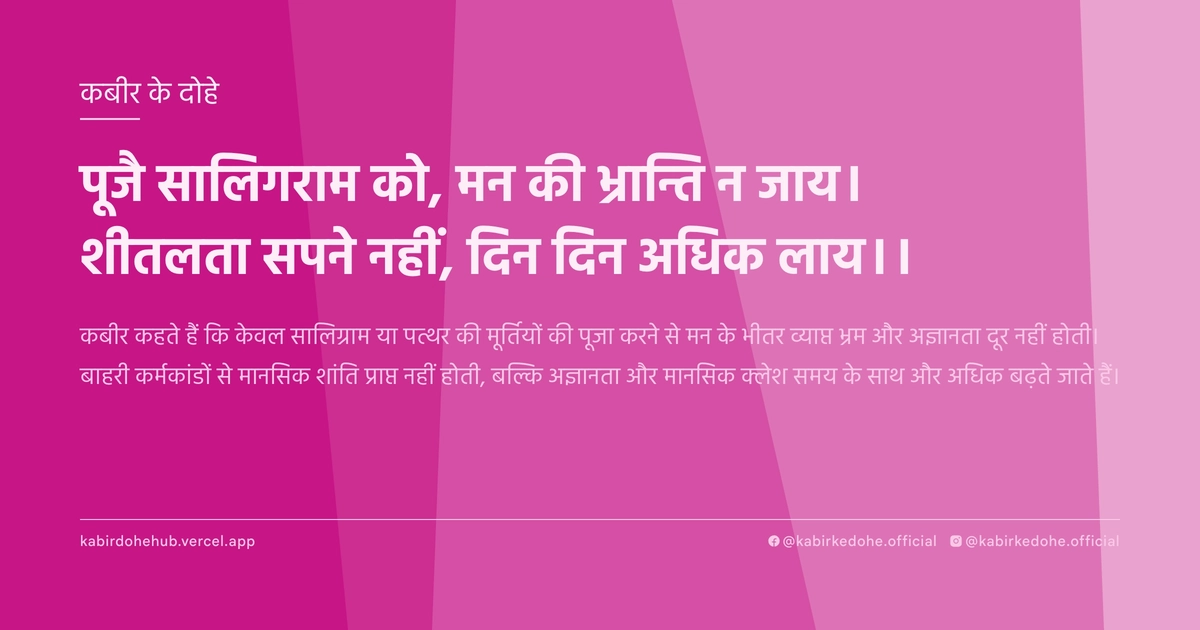
पूजै सालिगराम को, मन की भ्रान्ति न जाय।
शीतलता सपने नहीं, दिन दिन अधिक लाय।।
Poojai saligram ko, man ki bhranti na jaaye. Sheetalta sapne nahi, din din adhik laay.
इस पृष्ठ पर इस कबीर दोहे का अर्थ (meaning), हिंदी व्याख्या और अंग्रेज़ी अनुवाद, दार्शनिक विश्लेषण और व्यावहारिक जीवन सीख दी गई है। यह दोहा मूर्ति पूजा विरोध (Condemnation of Idolatry) विषय से जुड़ा है — Kabir doha meaning and explanation in Hindi and English.
अर्थ (Meaning):
कबीर कहते हैं कि केवल सालिग्राम या पत्थर की मूर्तियों की पूजा करने से मन के भीतर व्याप्त भ्रम और अज्ञानता दूर नहीं होती। बाहरी कर्मकांडों से मानसिक शांति प्राप्त नहीं होती, बल्कि अज्ञानता और मानसिक क्लेश समय के साथ और अधिक बढ़ते जाते हैं।
Kabir asserts that the mere ritualistic worship of the Saligram or stone idols does not eradicate the delusions and ignorance residing within the mind. External ceremonies fail to provide true mental peace; instead, spiritual blindness and inner turmoil only intensify as time passes.
व्याख्या (Interpretation):
सालिग्राम की पूजा यहाँ केवल एक प्रतीक है, जो बाहरी धार्मिकता और कर्मकांडों का प्रतिनिधित्व करता है। कबीर का तर्क है कि जब तक साधक अपने भीतर के 'अहंकार' और 'भ्रम' (माया) को नहीं पहचानता, तब तक बाहरी पूजा केवल एक मानसिक विलास है। यह दोहा निर्गुण भक्ति की ओर संकेत करता है, जहाँ ईश्वर को किसी आकार में नहीं, बल्कि चेतना के रूप में अनुभव किया जाता है। जब हम सत्य को बाहर खोजते हैं, तो हम वास्तव में अपनी आंतरिक शून्यता से दूर भाग रहे होते हैं। यह विरोधाभास है कि जिसे हम शांति पाने का साधन मानते हैं, वही हमारी आध्यात्मिक प्रगति में बाधा बन जाता है क्योंकि यह हमें यह विश्वास दिलाता है कि हम 'पूजा' कर रहे हैं, जबकि हम वास्तव में सो रहे हैं।
The worship of the Saligram serves as a metaphor for external religiosity and the adherence to ritualistic forms. Kabir argues that as long as the seeker does not recognize the 'ego' and 'delusion' (Maya) within, external worship remains a mere psychological distraction. This verse points toward Nirgun Bhakti, where the Divine is experienced not as a form, but as pure consciousness. When we seek Truth externally, we are essentially fleeing from our own internal void. The central paradox is that the very rituals we believe are vehicles for peace become obstacles to spiritual progress, as they foster a false sense of achievement while the soul remains dormant in ignorance.
दार्शनिक विश्लेषण (Philosophical Analysis):
कबीर का यह दोहा मध्यकालीन भारत के उस सामाजिक-धार्मिक परिवेश की प्रतिक्रिया है जहाँ कर्मकांडों और मूर्तिपूजा को मोक्ष का एकमात्र मार्ग माना जाता था। कबीर ने स्पष्ट रूप से 'साकार' (Sakar) की तुलना में 'निराकार' (Nirakar) की प्रधानता पर जोर दिया है। उनका दृष्टिकोण अद्वैत वेदांत से मेल खाता है, जहाँ आत्मा और ब्रह्म की एकता ही अंतिम सत्य है। उनके अनुसार, पत्थर की पूजा करना वास्तव में अपनी चेतना को सीमित करना है।
सूफी मत के 'फना' (अहंकार का विनाश) के सिद्धांत की तरह, कबीर यहाँ यह समझा रहे हैं कि जब तक 'मैं' (अहंकार) मौजूद है, तब तक कोई भी बाहरी क्रिया फलदायी नहीं हो सकती। वे जाति और संप्रदाय की दीवारों को ढहाते हुए कहते हैं कि ईश्वर किसी मंदिर या मूर्ति में कैद नहीं है, बल्कि वह 'घट-घट' (प्रत्येक हृदय) में व्याप्त है।
मनोवैज्ञानिक स्तर पर, यह दोहा 'पुष्टि' (Confirmation Bias) की बात करता है। जब व्यक्ति केवल कर्मकांड करता है, तो वह अपनी आंतरिक समस्याओं को हल करने के बजाय उन्हें धार्मिक आवरण में छिपाने की कोशिश करता है। इससे मानसिक तनाव कम नहीं होता, बल्कि 'दिन दिन अधिक लाय'—अर्थात समय के साथ यह मानसिक बोझ बढ़ता जाता है क्योंकि वास्तविकता और विश्वास के बीच की खाई चौड़ी होती जाती है।
कबीर का विरोध मूर्तिपूजा से अधिक उस 'भ्रम' से है जो यह दावा करता है कि बाहरी क्रियाएं आंतरिक परिवर्तन ला सकती हैं। वे एक ऐसी क्रांति की बात करते हैं जो मंदिर से शुरू होकर हृदय के शून्य तक पहुँचती है। यह मार्ग कठिन है क्योंकि इसमें किसी सहारे (मूर्ति) के बजाय स्वयं के आत्म-साक्षात्कार की आवश्यकता होती है।
अंततः, यह विश्लेषण हमें यह सिखाता है कि भक्ति का अर्थ समर्पण है, न कि प्रदर्शन। जब तक भक्ति में 'स्व' का विसर्जन नहीं होता, तब तक वह केवल एक सामाजिक नाटक है। वास्तविक शीतलता (शांति) केवल तभी आती है जब मन की भ्रांतियाँ मिट जाती हैं और साधक स्वयं को उस अनंत निराकार ब्रह्म के साथ एकाकार कर लेता है।
This couplet is a direct response to the socio-religious climate of medieval India, where rituals and idol worship were touted as the sole paths to salvation. Kabir emphasizes the primacy of the 'Nirakar' (Formless) over the 'Sakar' (Form). His perspective aligns closely with Advaita Vedanta, asserting that the non-duality of Atman and Brahman is the ultimate truth. To him, clinging to a stone idol is an act of limiting one's own consciousness.
Mirroring the Sufi concept of 'Fana' (the annihilation of the ego), Kabir explains that as long as the 'I' persists, no external act can be spiritually fruitful. He dismantles the walls of caste and sect, proclaiming that the Divine is not imprisoned in a temple or an idol but permeates every single heart ('Ghat-Ghat').
On a psychological level, this verse addresses 'Confirmation Bias.' When an individual relies solely on rituals, they attempt to mask their internal conflicts with a religious veneer rather than resolving them. Consequently, mental distress does not diminish; instead, it grows ('din din adhik laay') as the gap between their lived reality and their blind faith widens.
Kabir's opposition is not merely against the idol, but against the 'delusion' that external actions can trigger internal transformation. He advocates for a revolution that moves from the temple to the void of the heart. This path is arduous because it requires self-realization rather than the crutch of a physical object.
Ultimately, this analysis teaches us that devotion is about surrender, not performance. Until the 'self' is dissolved in devotion, the practice remains a social drama. True 'coolness' (peace) arrives only when delusions vanish and the seeker merges with the infinite, formless Brahman.
मूल संदेश (Core Message):
- बाहरी कर्मकांड केवल मानसिक आवरण हैं, सत्य नहीं।
- शांति पत्थर में नहीं, बल्कि भ्रम के अंत में है।
- अहंकार की उपस्थिति में कोई भी पूजा व्यर्थ है।
- निराकार ब्रह्म का अनुभव ही वास्तविक शीतलता है।
- आंतरिक शुद्धि के बिना बाहरी शुद्धि एक छलावा है।
- External rituals are mere mental veils, not the Truth.
- Peace resides not in the stone, but in the end of delusion.
- Any worship is futile in the presence of the ego.
- Experiencing the Formless Brahman is the only true coolness.
- External purity is a facade without internal purification.
व्यावहारिक उदाहरण (Practical Example):
वाराणसी के एक पुराने घाट पर माधव नाम का एक वृद्ध व्यक्ति रहता था। वह शहर का सबसे प्रतिष्ठित मूर्तिकार था, जिसने जीवन भर हजारों सालिग्राम और देवी-देवताओं की प्रतिमाएं बनाई थीं। माधव का मानना था कि वह जितना अधिक सुंदर और सटीक पत्थर को तराशेगा, वह उतना ही ईश्वर के करीब होगा। वह हर सुबह घंटों तक अपनी बनाई मूर्तियों की पूजा करता, महंगे इत्र चढ़ाता और कठिन मंत्रों का जाप करता।
बाहर से माधव एक महान भक्त दिखता था, लेकिन उसके भीतर एक गहरा असंतोष था। वह छोटी-छोटी बातों पर क्रोधित हो जाता, अपने शिष्यों पर चिल्लाता और रात भर अनिद्रा और बेचैनी से जूझता। उसे लगता था कि शायद उसकी पूजा में कोई कमी है, इसलिए वह और अधिक कठिन उपवास करने लगा और और अधिक मूर्तियों का संग्रह करने लगा।
एक दिन, एक फकीर उसके पास आया। फकीर ने माधव की भव्य मूर्तियों को देखा और फिर उसकी थकी हुई, तनावग्रस्त आँखों को। फकीर ने मुस्कुराते हुए पूछा, "माधव, क्या तुमने कभी उस पत्थर को पूजा है जो तुम्हारे सीने के भीतर धड़कता है?"
माधव हैरान था। उसने कहा, "मैं तो सालिग्राम की पूजा करता हूँ, जो साक्षात विष्णु हैं!" फकीर ने जवाब दिया, "तुम पत्थर को तो पूज रहे हो, लेकिन उस भ्रम को नहीं पूज रहे जिसने तुम्हें यह विश्वास दिलाया कि शांति पत्थर में है। तुम्हारी मूर्तियों की चमक बढ़ रही है, लेकिन तुम्हारे मन का अंधेरा और गहरा होता जा रहा है।"
यह बात माधव के हृदय पर बिजली की तरह गिरी। उसे अहसास हुआ कि वह अपनी पूरी जिंदगी 'पूजा के प्रदर्शन' में बिता चुका था, लेकिन उसने कभी अपने क्रोध, अपने अहंकार और अपनी ईर्ष्या का सामना नहीं किया था। वह मूर्तियों को शीतलता देने के लिए जल चढ़ाता था, जबकि उसका अपना मन क्रोध की अग्नि में जल रहा था।
अगले कुछ महीनों तक, माधव ने मूर्तियों की पूजा बंद नहीं की, लेकिन उसने अपना ध्यान बदल दिया। अब जब वह मूर्ति के सामने बैठता, तो वह यह नहीं कहता कि "हे भगवान मुझे शांति दो," बल्कि वह अपने भीतर झांकता और पूछता, "मेरे भीतर वह कौन सा भ्रम है जो मुझे अशांत कर रहा है?"
उसने पाया कि उसका अहंकार इस बात में था कि वह 'सबसे बड़ा मूर्तिकार' है। जैसे ही उसने इस पहचान को छोड़ा, उसे वह शीतलता महसूस हुई जो उसे हजारों सालिग्रामों में नहीं मिली थी।
उसकी कला अब बदल गई थी। अब उसकी बनाई मूर्तियां केवल सुंदर नहीं थीं, बल्कि उनमें एक अजीब सी शांति थी। उसने सीखा कि बाहरी पूजा केवल एक इशारा है; असली मंदिर तो वह चेतना है जहाँ कोई पत्थर नहीं, केवल प्रेम और सत्य है।
On an ancient ghat in Varanasi lived an elderly man named Madhav. He was the city's most prestigious sculptor, having spent his life carving thousands of Saligrams and deities. Madhav believed that the more perfectly he carved the stone, the closer he would get to God. Every morning, he spent hours worshipping his creations, offering expensive perfumes and chanting complex mantras.
Outwardly, Madhav appeared to be a great devotee, but internally, he harbored a profound dissatisfaction. He would snap at the smallest things, scream at his disciples, and battle insomnia and restlessness every night. He believed his rituals were lacking, so he began stricter fasts and collected even more idols.
One day, a wandering fakir arrived. The fakir looked at Madhav's magnificent idols and then at his exhausted, stressed eyes. Smiling, the fakir asked, "Madhav, have you ever worshipped the stone that beats within your own chest?"
Madhav was bewildered. "I worship the Saligram, who is Lord Vishnu himself!" he replied. The fakir answered, "You worship the stone, but you do not worship the delusion that convinced you peace resides in stone. The luster of your idols increases, but the darkness of your mind deepens."
These words struck Madhav like lightning. He realized he had spent his entire life in the 'performance of worship' without ever confronting his own anger, ego, or jealousy. He had been pouring water on stones to cool them, while his own mind burned in the fire of rage.
For the next few months, Madhav did not stop his rituals, but he shifted his focus. Now, when he sat before the idol, he stopped praying, "O Lord, give me peace," and instead looked inward, asking, "What is the delusion within me that keeps me restless?"
He discovered that his ego was tied to the identity of being the 'greatest sculptor.' The moment he let go of this identity, he felt a coolness that thousands of Saligrams had never provided.
His art transformed. His sculptures were no longer just beautiful; they radiated a strange, profound peace. He learned that external worship is merely a signpost; the real temple is the consciousness where there is no stone, only love and truth.
अभ्यास मार्गदर्शन (Practice Guidance):
- प्रतिदिन 20 मिनट मौन अभ्यास करें, जहाँ आप किसी भी बाहरी देवता या रूप के बजाय केवल अपनी आती-जाती सांसों और मन के विचारों का अवलोकन करें।
- एक 'भ्रम पत्रिका' (Delusion Journal) बनाएँ। हर दिन लिखें कि किस समय आपने बाहरी दिखावे या रस्मों को आंतरिक शांति का विकल्प मान लिया।
- जब भी आप किसी धार्मिक अनुष्ठान में शामिल हों, स्वयं से पूछें: 'क्या यह क्रिया मेरे अहंकार को बढ़ा रही है या उसे मिटा रही है?'
- निदान चेकलिस्ट: यदि आप पूजा के बाद भी क्रोधित महसूस करते हैं, या दूसरों को 'कम धार्मिक' मानकर तुच्छ समझते हैं, तो समझ लें कि आप अभी भी 'भ्रांति' के स्तर पर हैं।
- Practice 20 minutes of daily silence, observing your breath and the flow of thoughts rather than focusing on any external deity or form.
- Maintain a 'Delusion Journal.' Each day, record instances where you substituted external appearances or rituals for genuine internal peace.
- Whenever engaging in a religious ritual, ask yourself: 'Is this action inflating my ego or dissolving it?'
- Diagnostic Checklist: If you still feel anger after worship, or if you look down upon others as 'less religious,' recognize that you are still operating within the realm of 'delusion'.
चिंतन प्रश्न (Reflection Questions):
- मेरे जीवन में वे कौन सी 'सालिग्राम' (बाहरी प्रतीक) हैं जिन्हें मैं अपनी आंतरिक रिक्तता को भरने के लिए पकड़ कर बैठा हूँ?
- क्या मेरी धार्मिक पहचान मुझे दूसरों से श्रेष्ठ महसूस कराती है? यदि हाँ, तो क्या यह भक्ति है या अहंकार?
- यदि मुझसे मेरे सभी धार्मिक प्रतीक छीन लिए जाएँ, तो क्या मेरे भीतर कोई शांति शेष रहेगी?
- मैं अपनी मानसिक अशांति को शांत करने के लिए किन 'रस्मों' का सहारा लेता हूँ, और वे वास्तव में काम क्यों नहीं करतीं?
- क्या मैं सत्य की खोज कर रहा हूँ, या केवल इस बात की पुष्टि कि मैं एक 'अच्छा इंसान' या 'भक्त' हूँ?
- What are the 'Saligrams' (external symbols) in my life that I cling to in order to fill my internal void?
- Does my religious identity make me feel superior to others? If so, is this devotion or ego?
- If all my religious symbols were stripped away, would any peace remain within me?
- Which 'rituals' do I use to soothe my mental unrest, and why do they actually fail to work?
- Am I seeking the Truth, or merely seeking confirmation that I am a 'good person' or a 'devotee'?