
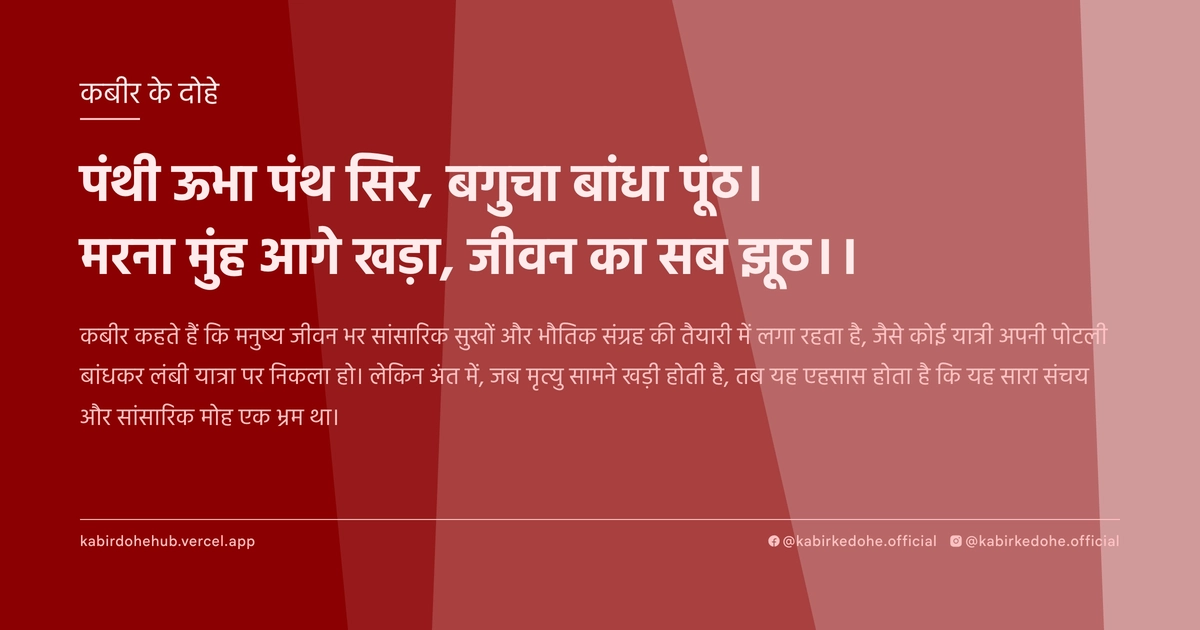
पंथी ऊभा पंथ सिर, बगुचा बांधा पूंठ।
मरना मुंह आगे खड़ा, जीवन का सब झूठ।।
Panthi ubha panth sir, bagucha bandha poonth. Marna munh aage khada, jeevan ka sab jhooth.
इस पृष्ठ पर इस कबीर दोहे का अर्थ (meaning), हिंदी व्याख्या और अंग्रेज़ी अनुवाद, दार्शनिक विश्लेषण और व्यावहारिक जीवन सीख दी गई है। यह दोहा मृतुक्यता (Mortality) विषय से जुड़ा है — Kabir doha meaning and explanation in Hindi and English.
अर्थ (Meaning):
कबीर कहते हैं कि मनुष्य जीवन भर सांसारिक सुखों और भौतिक संग्रह की तैयारी में लगा रहता है, जैसे कोई यात्री अपनी पोटली बांधकर लंबी यात्रा पर निकला हो। लेकिन अंत में, जब मृत्यु सामने खड़ी होती है, तब यह एहसास होता है कि यह सारा संचय और सांसारिक मोह एक भ्रम था।
Kabir observes that humans spend their entire lives preparing for worldly pleasures and accumulating material wealth, much like a traveler tying a bundle for a long journey. However, when death stands directly before them, they realize that all this accumulation and worldly attachment was merely an illusion.
व्याख्या (Interpretation):
शाब्दिक अर्थ में, यह दोहा एक यात्री की छवि प्रस्तुत करता है जो अपनी पोटली (बगुचा) बांधकर रास्ते पर खड़ा है। रूपकात्मक रूप से, 'पोटली' हमारी इच्छाओं, अहंकार और संचित कर्मों का प्रतीक है। यह निरगुण भक्ति के उस सिद्धांत को दर्शाता है जहाँ संसार को 'माया' कहा गया है—एक ऐसा पर्दा जो सत्य को छुपाता है। आत्मा स्वयं को शरीर और संपत्ति से जोड़ लेती है, जबकि अद्वैत वेदांत के अनुसार, केवल शुद्ध चेतना ही शाश्वत है। यहाँ विरोधाभास यह है कि मनुष्य उस यात्रा की तैयारी करता है जहाँ वह कुछ भी साथ नहीं ले जा सकता। मृत्यु यहाँ डराने के लिए नहीं, बल्कि एक जागृति (Awakening) के रूप में आई है, जो यह बताती है कि जीवन का वास्तविक सत्य भौतिकता में नहीं, बल्कि आत्म-साक्षात्कार में है।
Literally, the couplet presents the image of a traveler standing on a path with a tied bundle. Metaphorically, the 'bundle' (bagucha) symbolizes our desires, ego, and accumulated karmas. This aligns with the principle of Nirgun Bhakti, where the world is termed 'Maya'—a veil obscuring the ultimate truth. The soul mistakenly identifies itself with the body and possessions, whereas Advaita Vedanta posits that only pure consciousness is eternal. The central paradox lies in the human tendency to prepare for a journey where nothing material can be carried. Death here is not a figure of terror, but a catalyst for awakening, revealing that the reality of life resides not in materiality, but in the realization of the Self.
दार्शनिक विश्लेषण (Philosophical Analysis):
कबीर का यह दोहा उस युग की सामाजिक और धार्मिक जड़ता पर प्रहार करता है जहाँ लोग कर्मकांडों और बाहरी दिखावे को मोक्ष का मार्ग मानते थे। कबीर ने स्पष्ट किया कि चाहे कोई पंडित हो या मुल्ला, मृत्यु सबके लिए समान है और भौतिक संचय किसी की रक्षा नहीं कर सकता। यह विचार सूफी मत के 'फना' (अहंकार का विलीनीकरण) और अद्वैत वेदांत के 'माया' सिद्धांत का संगम है।
दार्शनिक स्तर पर, 'बगुचा' केवल धन नहीं, बल्कि हमारी पहचान, पद और सामाजिक प्रतिष्ठा है। हम जीवन भर एक ऐसी पहचान बुनते हैं जिसे हम 'मैं' कहते हैं, लेकिन यह 'मैं' वास्तव में एक मानसिक रचना है। जब मृत्यु आती है, तो यह कृत्रिम पहचान ढह जाती है, और केवल वह बचता है जो हमने आंतरिक रूप से विकसित किया है।
कबीर यहाँ ritualism (कर्मकांड) का विरोध करते हैं। वे कहते हैं कि तीर्थयात्राएं या बाहरी पूजा उस पोटली को बांधने जैसा है, जो अंततः व्यर्थ है। वास्तविक भक्ति वह है जो अहंकार को मिटा दे। जब तक 'मैं' जीवित है, तब तक सत्य अदृश्य है।
मनोवैज्ञानिक रूप से, यह दोहा 'मृत्यु-चेतना' (Memento Mori) को विकसित करने का आह्वान है। जब मनुष्य अपनी नश्वरता को स्वीकार करता है, तभी वह वर्तमान क्षण में जीना सीखता है। यह भय से मुक्ति का मार्ग है, क्योंकि जो जानता है कि सब कुछ झूठ है, वह मोह के बंधन से मुक्त हो जाता है।
अंततः, कबीर यह समझाते हैं कि जीवन का 'झूठ' होना इस बात पर निर्भर नहीं है कि अनुभव शून्य हैं, बल्कि इस पर है कि हम उन्हें स्थायी मान लेते हैं। सत्य वह है जो समय और मृत्यु से परे है—वह निरगुण ब्रह्म, जो न जन्म लेता है और न मरता है।
This couplet strikes at the social and religious rigidity of Kabir's era, where people viewed rituals and outward displays as the path to salvation. Kabir clarifies that whether one is a priest or a cleric, death is the great equalizer, and material accumulation offers no sanctuary. This thought is a confluence of the Sufi concept of 'Fana' (annihilation of the ego) and the Advaita Vedanta doctrine of 'Maya'.
Philosophically, the 'bundle' represents not just wealth, but our identity, status, and social prestige. We spend our lives weaving an identity we call 'I', but this 'I' is merely a mental construct. At the moment of death, this artificial identity collapses, leaving behind only that which has been cultivated internally.
Kabir rejects ritualism here. He suggests that pilgrimages or external worship are akin to tying a bundle that will ultimately be useless. True devotion is that which erases the ego. As long as the 'I' persists, the Truth remains hidden.
Psychologically, the couplet is a call to develop 'death-consciousness' (Memento Mori). Only when a human accepts their mortality do they learn to live truly in the present moment. This is the path to liberation from fear; one who knows that the material world is a fleeting illusion is freed from the bonds of attachment.
Ultimately, Kabir explains that the 'lie' of life does not mean experiences are void, but that we mistakenly perceive them as permanent. Truth is that which transcends time and death—the Nirgun Brahman, which neither is born nor dies.
मूल संदेश (Core Message):
- सांसारिक संचय एक मानसिक कारागार है।
- मृत्यु अंत नहीं, बल्कि भ्रम का अंत है।
- अहंकार की पोटली को समय रहते खोल दें।
- सत्य वह है जो मृत्यु के बाद भी शेष रहे।
- आत्मा का कोई बंडल नहीं होता, वह मुक्त है।
- बाहरी पहचान को त्यागकर आंतरिक शून्य को खोजें।
- Worldly accumulation is a mental prison.
- Death is not the end, but the end of illusion.
- Untie the bundle of ego before time runs out.
- Truth is that which remains after death.
- The soul carries no bundle; it is inherently free.
- Discard external identity to discover the internal void.
व्यावहारिक उदाहरण (Practical Example):
वाराणसी के घाटों पर रहने वाले एक वृद्ध बुनकर, माधव, की कहानी है। माधव ने अपना पूरा जीवन बेहतरीन रेशमी साड़ियाँ बुनने में बिताया। वह अपनी कला में इतना मग्न था कि उसने अपनी पूरी जमापूंजी एक विशाल हवेली बनाने में लगा दी, यह सोचकर कि उसका नाम अमर हो जाएगा। वह हमेशा अपनी संपत्ति और अपनी श्रेष्ठता का बखान करता था।
एक दिन माधव गंभीर रूप से बीमार पड़ा। वह अपनी उस हवेली के बिस्तर पर लेटा था जिसे उसने अपनी पूरी जिंदगी की कमाई से बनाया था। उसके चारों ओर उसके महंगे कपड़े और सोने के गहने रखे थे, जिन्हें उसने 'अपनी पोटली' मानकर संजोया था।
तभी उसकी मुलाकात एक फकीर से हुई, जिसने माधव की आंखों में देखा और बस इतना कहा, 'माधव, तूने घर तो बहुत बड़ा बनाया, पर क्या तूने उस घर में रहने वाले को पहचाना?'
माधव को अचानक महसूस हुआ कि उसकी हवेली, उसके रेशमी धागे और उसका अहंकार सब उस बिस्तर के साथ ही सिमट रहे हैं। उसे याद आया कि कैसे उसने अपने गरीब पड़ोसियों को अपनी अमीरी का अहसास कराया था और उनके दुख को अनदेखा किया था।
उसे लगा कि वह जिस 'बगुचे' को बांधकर जीवन भर चला, वह वास्तव में एक भारी बोझ था जिसने उसे उसकी अपनी आत्मा से दूर रखा। उसे अपनी पूरी उपलब्धि एक झूठ लगने लगी।
उस रात, माधव ने अपनी सारी संपत्ति का विवरण एक कागज पर लिखा और उसे स्थानीय अनाथालय के नाम कर दिया। उसने महसूस किया कि संचय करना ही सबसे बड़ा भ्रम था।
जब उसने अपनी अंतिम सांसें लीं, तो उसके चेहरे पर एक ऐसी शांति थी जो उसने अपनी सबसे महंगी साड़ी बुनते समय भी महसूस नहीं की थी।
उसका अहंकार मिट चुका था। अब वह कोई 'मशहूर बुनकर' नहीं था, बल्कि केवल एक शुद्ध चेतना था जो उस अनंत में विलीन हो रहा था।
माधव की कहानी यह सिखाती है कि जब हम बाहरी पहचान को छोड़ देते हैं, तभी हम वास्तविक स्वतंत्रता का अनुभव करते हैं।
यह 'कबीर ट्विस्ट' था—मृत्यु के करीब आकर जीवन के असली अर्थ को पहचानना और मोह के बंडल को खोल देना।
This is the story of Madhav, an elderly weaver living on the ghats of Varanasi. Madhav spent his entire life weaving the finest silk sarees. He was so absorbed in his craft that he invested all his savings into building a massive mansion, believing it would make his name immortal. He always boasted of his wealth and superiority.
One day, Madhav fell gravely ill. He lay in the bed of that very mansion he had built with his life's earnings. Around him were his expensive clothes and gold ornaments, which he had cherished as his 'bundle'.
Then he met a wandering dervish, who looked into Madhav's eyes and simply asked, 'Madhav, you built a very large house, but did you ever recognize the one who lives within it?'
Suddenly, Madhav realized that his mansion, his silk threads, and his ego were all shrinking along with that bed. He remembered how he had flaunted his wealth before his poor neighbors and ignored their suffering.
He felt that the 'bundle' he had carried throughout his life was actually a heavy burden that had kept him distant from his own soul. His entire achievement began to feel like a lie.
That night, Madhav wrote down the details of all his assets on a piece of paper and donated them to a local orphanage. He realized that accumulation was the greatest illusion.
As he took his final breaths, there was a peace on his face that he had never felt even while weaving his most expensive saree.
His ego had vanished. He was no longer a 'famous weaver,' but merely a pure consciousness merging into the infinite.
Madhav's story teaches us that only when we let go of external identities do we experience true freedom.
This was the 'Kabir Twist'—recognizing the true meaning of life by standing at the threshold of death and untying the bundle of attachment.
अभ्यास मार्गदर्शन (Practice Guidance):
- प्रतिदिन 20 मिनट 'शून्य ध्यान' का अभ्यास करें, जहाँ आप अपनी सभी सामाजिक पहचानों (नाम, पद, रिश्ता) को मानसिक रूप से उतार कर रख दें।
- एक 'नश्वरता जर्नल' (Mortality Journal) लिखें: हर सप्ताह एक ऐसी चीज़ लिखें जिससे आप बहुत अधिक जुड़े हैं और विचार करें कि यदि वह कल गायब हो जाए, तो आपके भीतर क्या बचेगा।
- व्यवहार परिवर्तन: महीने में एक बार अपनी किसी प्रिय वस्तु का दान करें, यह अनुभव करते हुए कि आप उस वस्तु के स्वामी नहीं, बल्कि केवल उसके संरक्षक हैं।
- डायग्नोस्टिक चेकलिस्ट: क्या आप अपनी उपलब्धियों के खोने के विचार से डरते हैं? क्या आप दूसरों की तुलना में खुद को श्रेष्ठ महसूस करते हैं? यदि हाँ, तो आपका 'बगुचा' अभी भी भारी है।
- Practice 20 minutes of 'Zero Meditation' daily, where you mentally strip away all social identities (name, rank, relationships).
- Maintain a 'Mortality Journal': Each week, write about one thing you are deeply attached to and contemplate what would remain within you if it vanished tomorrow.
- Behavioral Change: Once a month, donate a cherished possession, experiencing the feeling that you are not the owner of the object, but merely its temporary custodian.
- Diagnostic Checklist: Do you fear the thought of losing your achievements? Do you feel superior to others based on your status? If yes, your 'bundle' is still too heavy.
चिंतन प्रश्न (Reflection Questions):
- यदि आज आपकी मृत्यु हो जाए, तो आपकी कौन सी 'उपलब्धि' आपके साथ जाएगी?
- आपकी वह कौन सी गुप्त पहचान है जिसे आप दुनिया से छुपाते हैं क्योंकि वह आपके 'आदर्श' बगुचे में फिट नहीं बैठती?
- क्या आपका डिजिटल व्यक्तित्व (Social Media Ego) आपकी वास्तविक आत्मा से बड़ा हो गया है?
- आप किस डर से अपनी भौतिक वस्तुओं को पकड़े हुए हैं?
- क्या आप वास्तव में स्वतंत्र हैं, या आप अपनी इच्छाओं की पोटली के गुलाम हैं?
- यदि आप अपना नाम और पेशा भूल जाएं, तो आप कौन होंगे?
- If you were to die today, which of your 'achievements' would accompany you?
- What is that secret identity you hide from the world because it doesn't fit into your 'ideal' bundle?
- Has your digital persona (Social Media Ego) become larger than your actual soul?
- What fear drives you to cling so tightly to your material possessions?
- Are you truly free, or are you a slave to the bundle of your desires?
- If you forgot your name and profession, who would you be?