
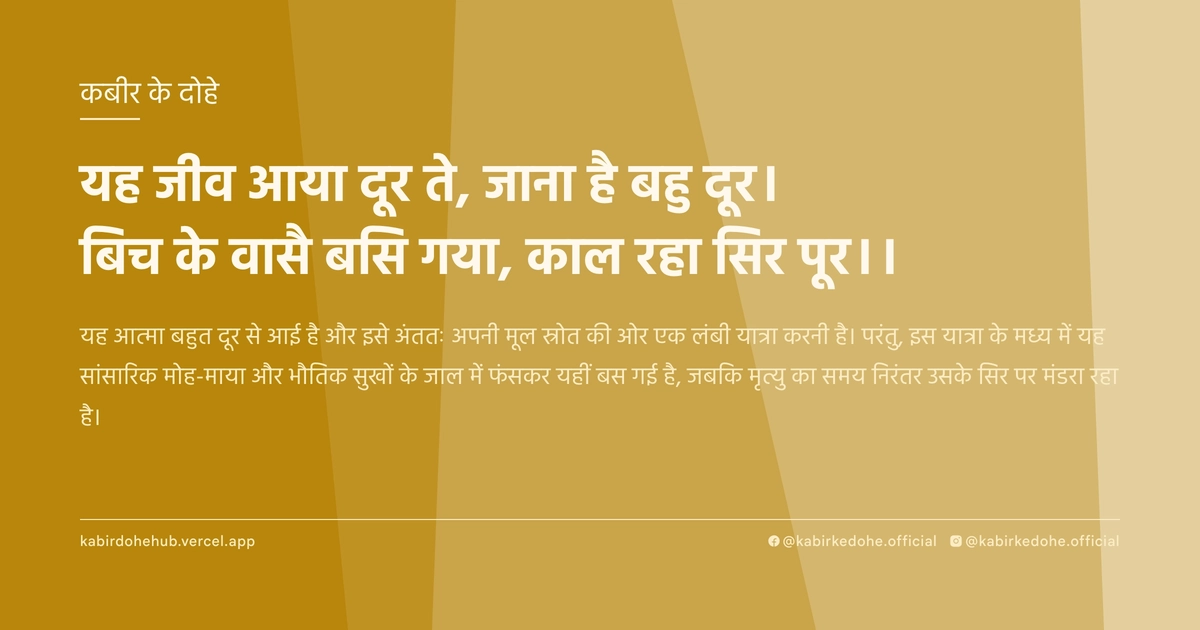
यह जीव आया दूर ते, जाना है बहु दूर।
बिच के वासै बसि गया, काल रहा सिर पूर।।
Yeh jeev aaya door te, jaana hai bahu door. Bich ke vaasai basi gaya, kaal raha sir poor.
इस पृष्ठ पर इस कबीर दोहे का अर्थ (meaning), हिंदी व्याख्या और अंग्रेज़ी अनुवाद, दार्शनिक विश्लेषण और व्यावहारिक जीवन सीख दी गई है। यह दोहा मृतुक्यता (Mortality) विषय से जुड़ा है — Kabir doha meaning and explanation in Hindi and English.
अर्थ (Meaning):
यह आत्मा बहुत दूर से आई है और इसे अंततः अपनी मूल स्रोत की ओर एक लंबी यात्रा करनी है। परंतु, इस यात्रा के मध्य में यह सांसारिक मोह-माया और भौतिक सुखों के जाल में फंसकर यहीं बस गई है, जबकि मृत्यु का समय निरंतर उसके सिर पर मंडरा रहा है।
The soul has journeyed from a far-off celestial origin and must eventually return to that distant source. However, in the midst of this transit, it has become ensnared by worldly attachments and the illusions of existence, forgetting its destination while the inevitable shadow of time and death looms constantly overhead.
व्याख्या (Interpretation):
शाब्दिक रूप से, कबीर आत्मा की लंबी यात्रा का वर्णन कर रहे हैं। आध्यात्मिक स्तर पर, 'दूर' शब्द परमात्मा या शून्य की उस अवस्था को दर्शाता है जहाँ द्वैत नहीं है। 'बिच के वासै' का अर्थ है माया का वह मायाजाल जिसमें जीव अपनी वास्तविक पहचान भूलकर शरीर और अहंकार को ही सत्य मान लेता है। यह निर्गुण भक्ति का सार है, जहाँ यह बताया गया है कि आत्मा वास्तव में इस भौतिक जगत की निवासी नहीं है, बल्कि एक यात्री है। अद्वैत वेदांत के अनुसार, यह विस्मृति ही बंधन का कारण है। काल का सिर पर होना इस बात की चेतावनी है कि समय सीमित है और जागरण अनिवार्य है। यह विरोधाभास है कि हम उस घर को खोज रहे हैं जहाँ से हम कभी अलग हुए ही नहीं थे।
Literally, Kabir describes the soul's vast odyssey. Spiritually, 'far' signifies the state of Shunya or the Absolute, where duality ceases to exist. 'Bich ke vaasai' refers to the intricate web of Maya, where the soul forgets its divine essence and mistakes the transient body and ego for the ultimate reality. This aligns with Nirgun Bhakti, emphasizing that the soul is not a native of this material realm but a transient traveler. According to Advaita Vedanta, this cosmic amnesia is the root of all bondage. The mention of 'Kaal' (Time/Death) looming overhead serves as a stark reminder that the window for awakening is narrow. It presents the central paradox: the soul spends lifetimes searching for a home from which it never truly departed.
दार्शनिक विश्लेषण (Philosophical Analysis):
कबीर का यह दोहा उस कालखंड की उपज है जब समाज कर्मकांडों और बाहरी आडंबरों में उलझा था। कबीर ने यहाँ 'तीर्थ' या 'मक्का-काशी' की यात्रा के बजाय 'आंतरिक यात्रा' पर बल दिया है। वे स्पष्ट करते हैं कि मोक्ष किसी भौगोलिक स्थान पर जाने से नहीं, बल्कि इस बोध से मिलता है कि हम यहाँ केवल मेहमान हैं।
यह विचार सूफी मत के 'इश्क-ए-हकीकी' (ईश्वरीय प्रेम) से मिलता-जुलता है, जहाँ आत्मा को अपने मूल स्रोत (वतन) की याद आती है। कबीर यहाँ शरीर को एक सराय या अस्थायी पड़ाव मानते हैं। जब मनुष्य इस अस्थायी घर को स्थायी समझने लगता है, तो वह आध्यात्मिक प्रगति में बाधा डालता है।
अद्वैत वेदांत के परिप्रेक्ष्य में, यह 'अविद्या' की स्थिति है। जीव स्वयं को ब्रह्म मानकर भी अपनी सीमित पहचान (अहंकार) से चिपका रहता है। कबीर इस अहंकार के विसर्जन की बात करते हैं। वे कहते हैं कि जब तक 'मैं' का भाव है, तब तक 'वह' (परमात्मा) दूर प्रतीत होगा।
सामाजिक रूप से, कबीर जाति और धर्म के भेदों को निरर्थक बताते हैं क्योंकि मृत्यु (काल) सबके लिए समान है। यदि काल सबके सिर पर है, तो फिर ऊंच-नीच का अहंकार कैसा? यह विश्लेषण हमें सिखाता है कि जीवन का वास्तविक उद्देश्य संचय नहीं, बल्कि विसर्जन है।
अंततः, यह दोहा मनोवैज्ञानिक रूपांतरण की मांग करता है। यह हमें 'होने' (Being) और 'दिखने' (Appearing) के बीच के अंतर को समझने के लिए प्रेरित करता है। जब जीव यह जान लेता है कि वह केवल एक यात्री है, तो उसकी आसक्ति समाप्त हो जाती है और वह सहजता से अपने मूल स्रोत में विलीन हो जाता है।
Kabir’s couplet emerges from an era dominated by rigid ritualism and external piety. He pivots the focus from geographical pilgrimages to the 'internal odyssey.' He asserts that liberation is not found in visiting sacred cities but in the realization that our presence in this material world is purely transient.
This philosophy resonates deeply with the Sufi concept of 'Ishq-e-Haqiqi' (Divine Love), where the soul yearns for its original homeland (Watan). Kabir views the physical body as a temporary inn or a roadside shelter. When a human mistakes this temporary lodging for a permanent residence, they create the primary obstacle to spiritual evolution.
From the lens of Advaita Vedanta, this state is described as 'Avidya' (ignorance). The soul, though essentially identical to Brahman, remains clung to a limited identity of the ego. Kabir advocates for the annihilation of this ego. He suggests that as long as the 'I' persists, the Divine will seem distant.
Socially, Kabir renders caste and religious hierarchies obsolete by highlighting the universality of death (Kaal). If the shadow of time looms equally over the king and the beggar, the arrogance of social status becomes a farce. This analysis shifts the focus from accumulation to dissolution.
Ultimately, the verse demands a psychological transformation. It forces a distinction between 'Being' and 'Appearing.' Once the soul accepts its status as a traveler, attachment dissolves, allowing it to merge effortlessly back into the formless source from which it originated.
मूल संदेश (Core Message):
- सांसारिक पहचान एक मुखौटा है, इसे सत्य न मानें।
- जीवन एक पड़ाव है, अंतिम गंतव्य नहीं।
- मोह का बंधन ही आत्मा की वास्तविक यात्रा में बाधा है।
- मृत्यु का भय केवल तब तक है जब तक अहंकार जीवित है।
- स्वयं को यात्री मानें, मालिक नहीं।
- Worldly identity is a mask; do not mistake it for the Truth.
- Life is a transit point, not the final destination.
- Attachment is the only chain hindering the soul's return.
- The fear of death exists only as long as the ego persists.
- Identify as a traveler, never as the owner.
व्यावहारिक उदाहरण (Practical Example):
एक समय की बात है, वाराणसी के घाटों पर रहने वाले एक वृद्ध बुनकर थे, जिनका नाम माधव था। माधव ने अपना पूरा जीवन बेहतरीन रेशमी वस्त्र बनाने में बिता दिया। उनका मानना था कि उनके द्वारा बनाए गए वस्त्रों की बारीकी ही उनकी पहचान है। वे अपनी कला और अपनी संपत्ति पर बहुत गर्व करते थे।
माधव का एक बेटा था, जो बहुत बीमार रहता था। माधव ने अपनी सारी जमापूंजी बेहतरीन वैद्यों और दवाओं पर खर्च कर दी, लेकिन बेटे की हालत नहीं सुधरी। माधव को लगा कि वह अपनी संपत्ति और प्रभाव से मृत्यु को जीत लेंगे।
एक दिन, माधव की मुलाकात एक फकीर से हुई जिसने उन्हें कबीर का यह दोहा सुनाया। फकीर ने कहा, 'माधव, तुम इस रेशमी कपड़े को अपना घर समझ रहे हो, जबकि तुम स्वयं एक ऐसे कपड़े की तरह हो जिसे समय की कैंची कभी भी काट सकती है।'
माधव को पहले तो गुस्सा आया, लेकिन फिर उन्होंने अपने जीवन की समीक्षा की। उन्होंने महसूस किया कि उन्होंने अपना पूरा जीवन 'संग्रह' करने में बिताया, लेकिन 'स्वयं' को जानने में कुछ समय नहीं दिया।
उन्होंने देखा कि उनके पास आलीशान घर था, लेकिन उनके भीतर एक गहरा खालीपन था। वे जिसे अपनी उपलब्धि मान रहे थे, वह वास्तव में उन्हें उनके मूल स्रोत से दूर ले जा रही थी।
एक रात, जब उनके बेटे ने अंतिम सांस ली, माधव टूट गए। लेकिन इस बार वे विलाप नहीं कर रहे थे। उन्हें याद आया कि आत्मा 'दूर से आई है और दूर जानी है'।
उन्होंने महसूस किया कि उनका बेटा केवल एक यात्री था जिसने अपनी यात्रा पूरी कर ली। इस बोध ने माधव के भीतर के अहंकार को पूरी तरह समाप्त कर दिया।
अगले दिन से, माधव ने अपने वस्त्रों को बेचना शुरू किया और उस धन से गरीबों की सेवा करने लगे। उन्होंने अब अपनी पहचान 'बुनकर' के रूप में नहीं, बल्कि 'सेवा' के रूप में गढ़ी।
उनकी कला अब अहंकार का साधन नहीं, बल्कि ईश्वर के प्रति समर्पण का माध्यम बन गई। वे अब शांति से जीते थे, क्योंकि उन्होंने जान लिया था कि वे यहाँ केवल मेहमान हैं।
माधव की यह यात्रा भौतिक संपत्ति से आध्यात्मिक स्वतंत्रता की ओर थी, जहाँ उन्होंने अंततः उस 'दूर' गंतव्य की ओर बढ़ना शुरू किया।
Once, in the ghats of Varanasi, lived an elderly weaver named Madhav. Madhav spent his entire life crafting the finest silk garments. He believed that the intricacy of his weaves defined his identity and took immense pride in his wealth and skill.
Madhav had a son who was chronically ill. Madhav spent his entire life's savings on the most renowned physicians and rare medicines, believing that his wealth and influence could conquer death itself.
One day, Madhav encountered a wandering dervish who recited this specific Doha to him. The dervish remarked, 'Madhav, you treat this silk cloth as your permanent home, forgetting that you yourself are like a fabric that the scissors of Time can cut at any moment.'
Initially, Madhav was offended, but he soon began to reflect on his life. He realized he had spent decades 'accumulating' but had spent not a single moment 'becoming' or knowing himself.
He looked at his opulent house and realized it was merely a gilded cage that had distanced him from his true spiritual origin. The achievements he cherished were actually anchors keeping him trapped in Maya.
One night, when his son took his final breath, Madhav was devastated. However, this time, he did not wail in denial. He remembered that the soul 'comes from afar and must return afar.'
He realized that his son was merely a traveler who had completed his journey. This profound realization shattered the last remnants of Madhav's ego.
From the next day, Madhav began selling his luxury silks and used the proceeds to serve the destitute. He no longer identified as a 'Master Weaver' but as a 'Servant of the Divine.'
His art ceased to be a tool for vanity and became a medium of surrender. He lived in a state of profound peace, accepting his status as a guest in this material world.
Madhav's journey shifted from the pursuit of material perfection to the attainment of spiritual liberation, finally setting his sights on that distant, eternal destination.
अभ्यास मार्गदर्शन (Practice Guidance):
- दैनिक चिंतन: प्रतिदिन 15 मिनट शांत बैठें और विचार करें कि आपके शरीर, नाम और पद के अलावा आपकी वास्तविक पहचान क्या है।
- लेखन अभ्यास: एक डायरी लिखें जिसमें उन चीजों की सूची हो जिनसे आप अत्यधिक चिपके हुए हैं, और फिर विश्लेषण करें कि यदि वे कल गायब हो जाएं, तो क्या आप अभी भी 'अस्तित्व' में रहेंगे?
- व्यवहार परिवर्तन: दिन में कम से कम एक बार किसी ऐसी वस्तु या स्थिति का त्याग करें जिससे आपका अहंकार जुड़ा हो, यह याद दिलाते हुए कि आप यहाँ केवल एक यात्री हैं।
- निदान चेकलिस्ट: क्या आप छोटी सी हानि पर अत्यधिक विलाप करते हैं? क्या आप अपनी उपलब्धियों को अपनी स्थायी पहचान मानते हैं? यदि हाँ, तो आप 'बिच के वासै' (माया के जाल) में फंसे हैं।
- Daily Contemplation: Spend 15 minutes in silence daily, questioning what remains of your identity once your body, name, and social titles are stripped away.
- Journaling Prompt: List the things you are most attached to. Then, analyze whether your sense of 'Self' would survive if these external markers vanished tomorrow.
- Behavioral Shift: Once a day, consciously let go of a desire or a grudge that feeds your ego, reminding yourself that you are merely a transient guest in this realm.
- Diagnostic Checklist: Do you experience extreme distress over minor losses? Do you equate your achievements with your permanent identity? If yes, you are currently ensnared in 'Bich ke vaasai' (the mid-way illusion).
चिंतन प्रश्न (Reflection Questions):
- यदि आपका सामाजिक पद और डिजिटल पहचान (Social Media Profile) छीन ली जाए, तो आपके पास बचेगा क्या?
- आप किन ऐसी चीजों को 'अपना' कहते हैं, जो वास्तव में समय के साथ आपसे छिन जाएंगी?
- क्या आपकी वर्तमान प्राथमिकताएं आपको आपके मूल स्रोत के करीब ले जा रही हैं या आपसे दूर?
- मृत्यु का विचार आपको डराता है या आपको जगाता है?
- वह कौन सा 'अदृश्य बोझ' है जिसे आप इस यात्रा में ढो रहे हैं और जिसे छोड़ना आवश्यक है?
- If your social status and digital identity were erased, what would remain of 'You'?
- What things do you claim as 'mine' that are actually temporary loans from Time?
- Are your current priorities drawing you closer to your source or further away into the illusion?
- Does the thought of death evoke fear in you, or does it serve as a wake-up call?
- What is the 'invisible burden' you are carrying on this journey that must be dropped to move forward?