
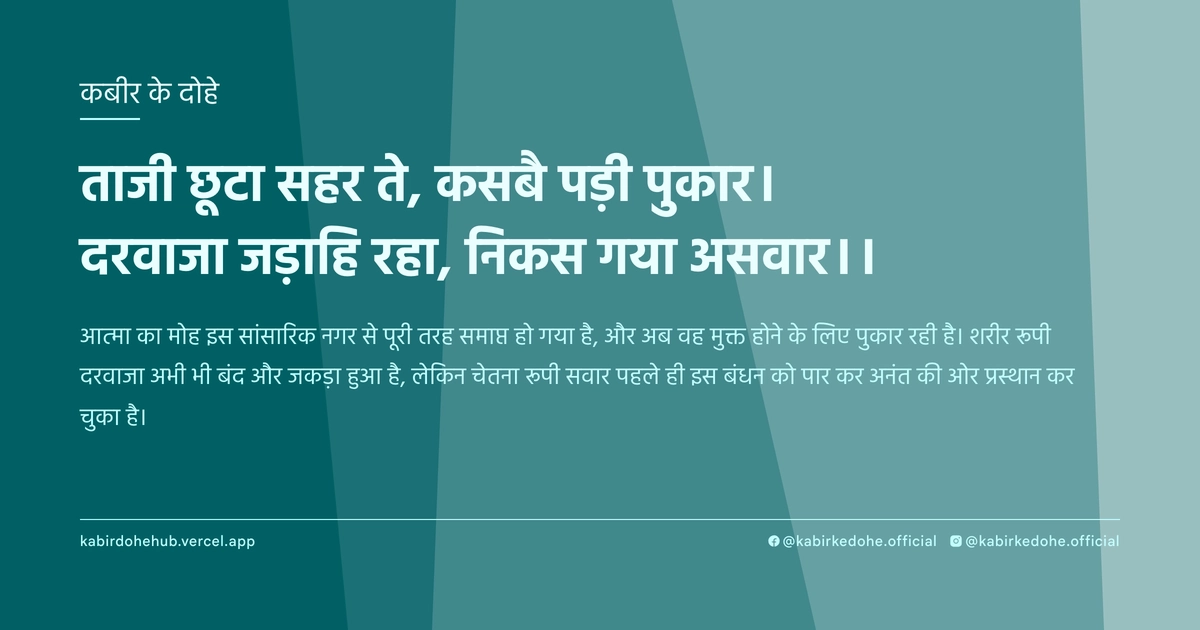
ताजी छूटा सहर ते, कसबै पड़ी पुकार।
दरवाजा जड़ाहि रहा, निकस गया असवार।।
Taji chhuta sahar te, kasbai padi pukar. Darwaza jadahi raha, nikas gaya aswar.
इस पृष्ठ पर इस कबीर दोहे का अर्थ (meaning), हिंदी व्याख्या और अंग्रेज़ी अनुवाद, दार्शनिक विश्लेषण और व्यावहारिक जीवन सीख दी गई है। यह दोहा मृतुक्यता (Mortality) विषय से जुड़ा है — Kabir doha meaning and explanation in Hindi and English.
अर्थ (Meaning):
आत्मा का मोह इस सांसारिक नगर से पूरी तरह समाप्त हो गया है, और अब वह मुक्त होने के लिए पुकार रही है। शरीर रूपी दरवाजा अभी भी बंद और जकड़ा हुआ है, लेकिन चेतना रूपी सवार पहले ही इस बंधन को पार कर अनंत की ओर प्रस्थान कर चुका है।
The soul's attachment to the city of worldly existence has completely dissolved, and it now cries out for liberation. While the door of the physical body remains locked and rigid, the rider—the conscious spirit—has already transcended these boundaries and departed toward the infinite.
व्याख्या (Interpretation):
यह दोहा भौतिक शरीर और शाश्वत आत्मा के बीच के विरोधाभास को दर्शाता है। 'सहर' (नगर) माया और सामाजिक बंधनों का प्रतीक है, जिससे आत्मा का मोह भंग हो चुका है। 'दरवाजा' शारीरिक अस्तित्व और अहंकार की सीमाओं को दर्शाता है जो अभी भी जड़ है। 'अस्वार' वह जागृत चेतना है जिसने द्वैत को मिटा दिया है। यह निर्गुण भक्ति का चरम है जहाँ साधक यह अनुभव करता है कि वह शरीर नहीं, बल्कि वह शुद्ध चैतन्य है जो शरीर के नष्ट होने से पहले ही मुक्त हो गया है। यह अद्वैत वेदांत के उस सत्य को उजागर करता है जहाँ आत्मा और ब्रह्म एक हो जाते हैं, और संसार केवल एक स्वप्न की भाँति प्रतीत होता है।
This couplet illustrates the profound paradox between the physical vessel and the eternal soul. The 'city' symbolizes Maya and the intricate web of social attachments from which the soul has finally detached. The 'door' represents the rigid boundaries of the physical body and the ego, which remain locked in materiality. The 'rider' is the awakened consciousness that has dissolved the illusion of duality. This represents the pinnacle of Nirgun Bhakti, where the seeker realizes they are not the body, but the pure consciousness that achieves liberation even before the physical death. It highlights the Advaita Vedanta truth where the Atman merges with Brahman, rendering the material world a mere fleeting dream.
दार्शनिक विश्लेषण (Philosophical Analysis):
कबीर का यह कथन उनके समय के कर्मकांडीय और बाहरी आडंबरों पर एक गहरा प्रहार है। उन्होंने सिखाया कि मुक्ति किसी तीर्थ या मंदिर के दरवाजे खोलने से नहीं, बल्कि आंतरिक जागरण से मिलती है। यहाँ 'सहर' केवल एक स्थान नहीं, बल्कि वह मानसिक अवस्था है जहाँ मनुष्य अपनी पहचान को पद, प्रतिष्ठा और रिश्तों से जोड़ता है। कबीर इस सामाजिक संरचना को पूरी तरह नकारते हैं, क्योंकि यह आत्मा को सीमित करती है।
दार्शनिक स्तर पर, यह सूफी मत के 'फना' (अहंकार का विनाश) और वेदांत के 'मोक्ष' का संगम है। जब साधक यह जान लेता है कि वह 'अस्वार' है, तो शरीर का बंधन उसके लिए अर्थहीन हो जाता है। यह मनोवैज्ञानिक रूपांतरण की वह स्थिति है जहाँ भय समाप्त हो जाता है क्योंकि मृत्यु केवल एक द्वार है, अंत नहीं।
कबीर यहाँ यह स्पष्ट करते हैं कि अधिकांश लोग केवल 'दरवाजे' (शरीर और रीति-रिवाजों) की मरम्मत में लगे रहते हैं, जबकि वास्तविक लक्ष्य 'सवार' (चेतना) को मुक्त करना है। यह एक चेतावनी है कि बाहरी धार्मिकता अक्सर आंतरिक शून्यता को छिपाने का पर्दा होती है।
इस दोहे में 'पुकार' वह तीव्र तड़प है जिसे सूफी 'इश्क' कहते हैं। यह तड़प ही वह अग्नि है जो माया के बंधनों को जला देती है। जब तक व्यक्ति संसार को अपना घर मानता है, वह बंदी है; जिस क्षण वह इसे एक सराय मानता है, वह मुक्त हो जाता है।
अंततः, यह विश्लेषण हमें बताता है कि मुक्ति कोई भविष्य की घटना नहीं है, बल्कि वर्तमान की एक अनुभूति है। जब अहंकार का विसर्जन होता है, तो व्यक्ति जीवित रहते हुए भी 'जीवन्मुक्त' हो जाता है, ठीक उसी तरह जैसे सवार दरवाजे के बंद होने से पहले ही निकल गया।
Kabir's statement is a profound critique of the ritualistic and external pomposity of his era. He taught that liberation is not achieved by opening the doors of pilgrimages or temples, but through internal awakening. Here, the 'city' is not merely a location, but a mental state where a human ties their identity to status, prestige, and relationships. Kabir rejects this social construct entirely, as it limits the soul's expansion.
On a philosophical level, this is a convergence of the Sufi concept of 'Fana' (annihilation of the ego) and the Vedantic 'Moksha'. When the seeker realizes they are the 'rider', the bondage of the body becomes meaningless. This is a state of psychological transformation where fear vanishes because death is seen as a mere doorway, not an end.
Kabir clarifies that most people spend their lives repairing the 'door' (the body and rituals), while the true goal is to liberate the 'rider' (consciousness). This serves as a warning that external religiosity is often a veil used to hide internal emptiness.
The 'cry' mentioned in the verse is the intense longing that Sufis call 'Ishq'. This longing is the fire that burns away the shackles of Maya. As long as a person considers the world their home, they are prisoners; the moment they view it as a temporary inn, they are free.
Ultimately, this analysis reveals that liberation is not a future event but a present realization. When the ego is dissolved, the individual becomes 'Jivanmukta' (liberated while alive), just as the rider departed before the door could be shut.
मूल संदेश (Core Message):
- संसार एक अस्थायी पड़ाव है, इसे अपना स्थायी घर न मानें।
- शरीर एक सीमित खोल है, जबकि आत्मा अनंत आकाश है।
- अहंकार का त्याग ही वास्तविक मुक्ति का एकमात्र द्वार है।
- बाहरी अनुष्ठानों से ऊपर उठकर आंतरिक सत्य को खोजें।
- मृत्यु शरीर का अंत है, चेतना का नहीं; यह केवल एक यात्रा है।
- स्वयं को जानने का अर्थ है समस्त ब्रह्मांड को जान लेना।
- The world is a temporary stop; do not mistake it for a permanent home.
- The body is a limited shell, while the soul is the infinite sky.
- The surrender of ego is the only true gateway to liberation.
- Rise above external rituals to discover the internal truth.
- Death is the end of the body, not consciousness; it is merely a journey.
- To know oneself is to know the entire universe.
व्यावहारिक उदाहरण (Practical Example):
वाराणसी के घाटों पर रहने वाले एक वृद्ध विधवा, जानकी, का जीवन अत्यंत सरल था। वह अपना पूरा समय मंदिर की सफाई और भजनों में बिताती थी, लेकिन उसके मन में हमेशा एक अधूरापन रहता था। वह मानती थी कि मोक्ष केवल मृत्यु के बाद मिलता है और उसके लिए कठोर तपस्या अनिवार्य है।
एक दिन उसकी मुलाकात एक घुमंतू साधु से हुई जिसने उसे कबीर का यह दोहा सुनाया। साधु ने उससे पूछा, 'यदि तुम जानती हो कि तुम यह शरीर नहीं हो, तो तुम इस दरवाजे के बंद होने का इंतजार क्यों कर रही हो?'
जानकी ने पहले तो इसे नहीं समझा, लेकिन फिर उसने ध्यान लगाना शुरू किया। उसने महसूस किया कि उसकी सारी पीड़ा इस बात से थी कि वह खुद को केवल एक 'विधवा' और 'असहाय' महिला के रूप में देख रही थी।
वह 'सहर' (नगर) उसके दुखों और सामाजिक पहचान का था। उसने धीरे-धीरे अपनी पहचान को इन लेबल्स से अलग करना शुरू किया। उसने पाया कि उसकी असली पहचान वह शांति है जो उसके भीतर हमेशा मौजूद थी।
एक समय ऐसा आया जब जानकी ने मंदिर की सफाई करना बंद नहीं किया, लेकिन अब वह इसे एक कर्तव्य नहीं, बल्कि एक उत्सव की तरह करने लगी। उसके चेहरे पर एक ऐसी मुस्कान थी जो किसी बाहरी सुख से नहीं आई थी।
उसके आस-पास के लोग हैरान थे कि जो महिला पहले केवल मृत्यु की कामना करती थी, वह अब जीवन के हर क्षण को इतनी गहराई से जी रही थी।
उसने महसूस किया कि उसका 'अस्वार' (चेतना) अब मुक्त हो चुका है। वह अब भी उसी पुराने घर में रहती थी, उसी पुराने शरीर में थी, लेकिन वह अब उस शरीर की सीमाओं से बंधी नहीं थी।
जब वह अंततः शांत भाव से इस दुनिया से विदा हुई, तो उसके चेहरे पर कोई डर नहीं था। उसने दरवाजे के बंद होने का इंतजार नहीं किया; वह तो पहले ही निकल चुकी थी।
यह 'कबीर ट्विस्ट' था—मोक्ष को मृत्यु के बाद की घटना मानने के बजाय, उसे वर्तमान जीवन में चेतना के विस्तार के रूप में अनुभव करना।
जानकी का जीवन यह प्रमाण बन गया कि मुक्ति बाहरी परिस्थितियों के बदलने से नहीं, बल्कि आंतरिक दृष्टि के बदलने से आती है।
Janaki, an elderly widow living on the ghats of Varanasi, led a very simple life. She spent all her time cleaning temples and chanting hymns, yet a sense of incompleteness always lingered in her heart. She believed that salvation occurred only after death and required rigorous penance.
One day, she met a wandering monk who recited this specific Doha of Kabir to her. The monk asked, 'If you know you are not this body, why are you waiting for the door to close?'
Janaki did not understand at first, but she began to practice deep meditation. She realized that all her suffering stemmed from identifying herself solely as a 'widow' and a 'helpless' woman.
That 'city' was the realm of her sorrows and social labels. Slowly, she began to detach her identity from these definitions. She discovered that her true identity was the silence and peace that had always existed within her.
Eventually, Janaki did not stop cleaning the temple, but she no longer did it as a chore; she did it as a celebration. A smile graced her face—a smile born not of external pleasure, but of internal liberation.
People around her were astonished that the woman who once prayed only for death was now living every moment with such profound intensity.
She felt that her 'rider' (consciousness) had already been liberated. She still lived in the same old house, in the same old body, but she was no longer bound by the limitations of that body.
When she finally departed from this world in total serenity, there was no fear on her face. She hadn't waited for the door to close; she had already departed.
This was the 'Kabir Twist'—instead of viewing salvation as a post-death event, she experienced it as an expansion of consciousness in the present life.
Janaki's life became a testament that liberation does not come from changing external circumstances, but from shifting the internal gaze.
अभ्यास मार्गदर्शन (Practice Guidance):
- दैनिक साक्षी भाव: दिन में तीन बार 10 मिनट के लिए बैठें और स्वयं को एक 'द्रष्टा' के रूप में देखें। यह महसूस करें कि आप अपने विचारों, भावनाओं और शरीर से अलग एक शुद्ध चेतना हैं।
- पहचान का विसर्जन (Journaling): एक सूची बनाएं कि आप दुनिया के लिए कौन हैं (जैसे: पिता, कर्मचारी, नागरिक)। फिर प्रत्येक के आगे लिखें, 'मैं यह भी हूँ, लेकिन मैं इससे परे भी हूँ।'
- मौन का अभ्यास: प्रतिदिन एक घंटा पूर्ण मौन रहें। बाहरी शोर के बीच अपने आंतरिक 'सवार' की पुकार को सुनने का प्रयास करें।
- निदान चेकलिस्ट: क्या आप अभी भी अपनी खुशी को बाहरी उपलब्धियों (नगर के द्वारों) से जोड़ रहे हैं? क्या आप मृत्यु के विचार से डरते हैं या उसे एक बदलाव के रूप में देखते हैं? यदि डर हावी है, तो आप अभी भी 'दरवाजे' में फंसे हैं।
- Daily Witness Consciousness: Sit for 10 minutes three times a day and observe yourself as a 'witness'. Feel that you are pure consciousness, distinct from your thoughts, emotions, and body.
- Dissolution of Identity (Journaling): List who you are to the world (e.g., parent, employee, citizen). Then, next to each, write: 'I am this, but I am also beyond this.'
- Practice of Silence: Maintain complete silence for one hour daily. Amidst the external noise, attempt to hear the call of the internal 'rider'.
- Diagnostic Checklist: Are you still linking your happiness to external achievements (the city gates)? Do you fear the thought of death or see it as a transition? If fear dominates, you are still trapped within the 'door'.
चिंतन प्रश्न (Reflection Questions):
- यदि आपकी सभी सामाजिक पहचानें (नाम, पद, रिश्ता) छीन ली जाएं, तो आपके भीतर क्या बचेगा?
- आप अपने जीवन के 'दरवाजे' को सजाने में कितना समय बिता रहे हैं, और 'सवार' को जगाने में कितना?
- क्या आपकी आध्यात्मिक खोज वास्तव में मुक्ति के लिए है, या यह केवल आपके अहंकार को एक 'आध्यात्मिक' पहचान देने का तरीका है?
- वह कौन सा डर है जो आपको इस 'नगर' (माया) को छोड़ने से रोकता है, जबकि आप जानते हैं कि यह क्षणभंगुर है?
- क्या आप जीवित रहते हुए भी मुक्त होने का साहस रखते हैं, या आप केवल मृत्यु के बाद के पुरस्कार की प्रतीक्षा कर रहे हैं?
- If all your social identities (name, title, relationship) were stripped away, what would remain within you?
- How much time are you spending decorating the 'door' of your life, and how much on awakening the 'rider'?
- Is your spiritual quest truly for liberation, or is it merely a way to give your ego a 'spiritual' identity?
- What is the specific fear that prevents you from leaving this 'city' (Maya), even though you know it is ephemeral?
- Do you have the courage to be free while still alive, or are you merely waiting for a post-death reward?