
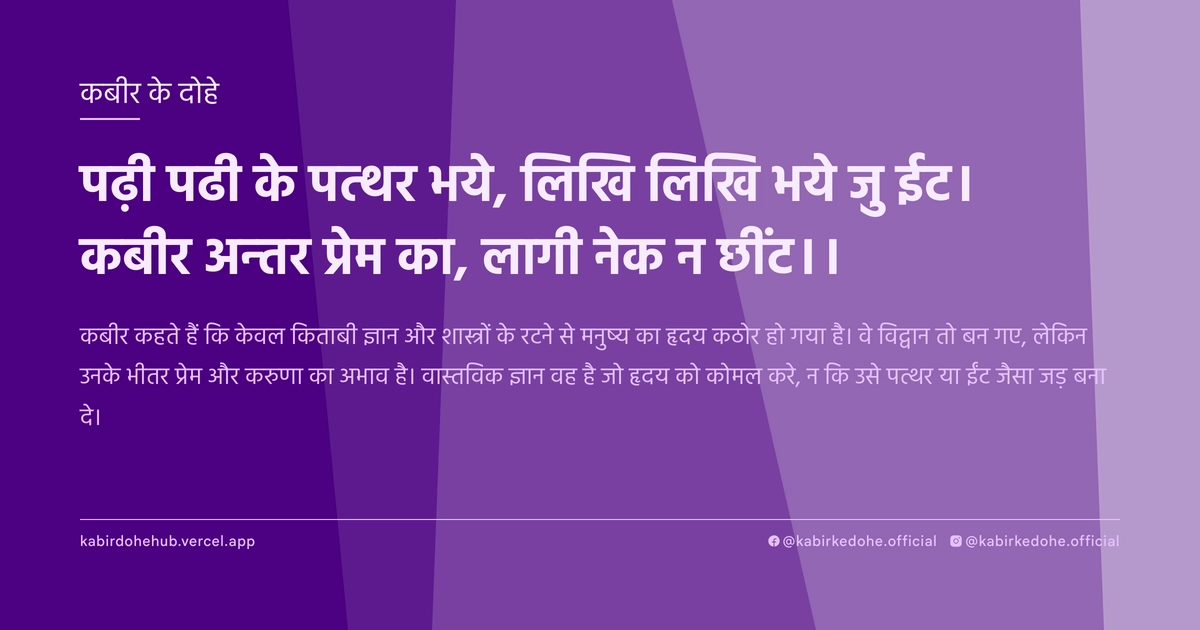
पढ़ी पढी के पत्थर भये, लिखि लिखि भये जु ईट।
कबीर अन्तर प्रेम का, लागी नेक न छींट।।
Padhi padhi ke patthar bhaye, likhi likhi bhaye ju eet. Kabir antar prem ka, laagi nek na chheent.
इस पृष्ठ पर इस कबीर दोहे का अर्थ (meaning), हिंदी व्याख्या और अंग्रेज़ी अनुवाद, दार्शनिक विश्लेषण और व्यावहारिक जीवन सीख दी गई है। यह दोहा प्रेम भक्ति (Divine Love) विषय से जुड़ा है — Kabir doha meaning and explanation in Hindi and English.
अर्थ (Meaning):
कबीर कहते हैं कि केवल किताबी ज्ञान और शास्त्रों के रटने से मनुष्य का हृदय कठोर हो गया है। वे विद्वान तो बन गए, लेकिन उनके भीतर प्रेम और करुणा का अभाव है। वास्तविक ज्ञान वह है जो हृदय को कोमल करे, न कि उसे पत्थर या ईंट जैसा जड़ बना दे।
Kabir asserts that the mere accumulation of bookish knowledge and the rote memorization of scriptures have turned humans into stones. While they may have become scholars, they lack love and compassion. True wisdom is that which softens the heart, rather than rendering it as rigid and lifeless as a stone or a brick.
व्याख्या (Interpretation):
यहाँ 'पत्थर' और 'ईंट' बौद्धिक अहंकार के प्रतीक हैं। जब ज्ञान केवल मस्तिष्क तक सीमित रहता है और हृदय तक नहीं पहुँचता, तो वह व्यक्ति को विनम्र बनाने के बजाय अभिमानी बना देता है। यह निर्गुण भक्ति का मूल है जहाँ बाहरी कर्मकांडों और पांडित्य के ऊपर आंतरिक प्रेम को प्राथमिकता दी गई है। माया यहाँ वह भ्रम है जो हमें विश्वास दिलाता है कि शब्दों का संग्रह ही सत्य का साक्षात्कार है। आत्मा और ब्रह्म की एकता केवल प्रेम के माध्यम से संभव है, न कि तर्क के माध्यम से। कबीर इस विरोधाभास को उजागर करते हैं कि जो स्वयं को सबसे अधिक ज्ञानी मानता है, वह वास्तव में आध्यात्मिक रूप से सबसे अधिक रिक्त है।
Here, 'stone' and 'brick' serve as metaphors for intellectual arrogance. When knowledge remains confined to the intellect and fails to permeate the heart, it fosters pride rather than humility. This is the essence of Nirgun Bhakti, where internal love is prioritized over external rituals and scholarship. Maya, in this context, is the illusion that leads one to believe that the accumulation of words is equivalent to the realization of Truth. The non-duality of Atman and Brahman is attainable only through love, not through logic. Kabir highlights the paradox that the one who considers themselves the most learned is often the most spiritually vacant.
दार्शनिक विश्लेषण (Philosophical Analysis):
कबीर का यह दोहा मध्यकालीन भारत के उस दौर की प्रतिक्रिया है जब धर्म केवल संस्कृत ग्रंथों के रटने और ब्राह्मणवादी वर्चस्व तक सीमित था। वे इस बात पर प्रहार करते हैं कि कैसे शास्त्र ज्ञान अक्सर एक ढाल बन जाता है जिसके पीछे मनुष्य अपनी संवेदनहीनता को छिपाता है। यह दृष्टिकोण अद्वैत वेदांत के उस सिद्धांत से मिलता है जहाँ 'अहंकार' (Ego) को ज्ञान के मार्ग में सबसे बड़ी बाधा माना गया है। कबीर का 'प्रेम' केवल मानवीय अनुराग नहीं, बल्कि सूफीवाद के 'इश्क-ए-हकीकी' (ईश्वरीय प्रेम) के समान है, जो आत्मा को शुद्ध करता है।
वे तर्क देते हैं कि जब ज्ञान केवल सूचना बन जाता है, तो वह हृदय को कठोर कर देता है। यह मानसिक जड़ता व्यक्ति को दूसरों से अलग करती है, जबकि वास्तविक आध्यात्मिकता सबको जोड़ने का कार्य करती है। कबीर के अनुसार, एक अनपढ़ व्यक्ति जो प्रेम में लीन है, वह उस विद्वान से कहीं अधिक श्रेष्ठ है जिसने हज़ारों ग्रंथ पढ़े हैं लेकिन जिसके भीतर करुणा नहीं है।
यह विश्लेषण हमें बताता है कि ज्ञान का उद्देश्य 'पांडित्य' नहीं बल्कि 'परिवर्तन' होना चाहिए। यदि अध्ययन के बाद भी व्यक्ति में क्रोध, घृंड और अहंकार बना रहता है, तो वह अध्ययन व्यर्थ है। कबीर यहाँ बौद्धिक शुष्कता और आध्यात्मिक तरलता के बीच के अंतर को स्पष्ट कर रहे हैं।
सूफी परंपरा की तरह, कबीर भी मानते हैं कि ईश्वर को तर्क से नहीं, बल्कि समर्पण से पाया जा सकता है। जब तक 'मैं' (अहंकार) जीवित है, तब तक सत्य का अनुभव असंभव है। किताबी ज्ञान अक्सर इस 'मैं' को और अधिक पुष्ट करता है, जिससे सत्य और दूर हो जाता है।
अंततः, यह दोहा हमें याद दिलाता है कि करुणा ही वास्तविक बुद्धिमत्ता है। बिना प्रेम के ज्ञान एक बोझ है, एक ऐसी ईंट जो केवल दीवारें खड़ी करती है, पुल नहीं। कबीर का आह्वान है कि हम शब्दों के जाल से निकलकर अनुभव की सरलता की ओर बढ़ें।
This couplet is a reaction to the medieval Indian era where religion was confined to the rote memorization of Sanskrit texts and Brahmanical hegemony. Kabir attacks the notion that scriptural knowledge often becomes a shield behind which humans hide their insensitivity. This perspective aligns with Advaita Vedanta's principle that 'Ahankara' (Ego) is the primary obstacle on the path to enlightenment.
Kabir's 'Love' is not merely human affection but is akin to the Sufi concept of 'Ishq-e-Haqiqi' (Divine Love), which purifies the soul. He argues that when knowledge becomes mere information, it hardens the heart. This mental rigidity separates the individual from others, whereas true spirituality serves as a bridge.
According to Kabir, an illiterate person immersed in love is far superior to a scholar who has read thousands of texts but lacks compassion. This analysis reveals that the purpose of knowledge should be 'transformation,' not 'scholarship.' If anger, hatred, and pride persist after study, the study is futile.
Like the Sufi tradition, Kabir believes that the Divine cannot be reached through logic but through surrender. As long as the 'I' (Ego) exists, the experience of Truth is impossible. Bookish knowledge often reinforces this 'I,' pushing the Truth further away.
Ultimately, this doha reminds us that compassion is the only true intelligence. Knowledge without love is a burden—a brick that builds walls instead of bridges. Kabir calls us to move beyond the web of words toward the simplicity of direct experience.
मूल संदेश (Core Message):
- बौद्धिक अहंकार सत्य के मार्ग में सबसे बड़ी बाधा है।
- शास्त्रों का ज्ञान तब तक व्यर्थ है जब तक वह हृदय को कोमल न करे।
- प्रेम ही वह एकमात्र सेतु है जो आत्मा को परमात्मा से जोड़ता है।
- सच्चा विद्वान वह है जो अपनी विद्वत्ता को विस्मृत कर करुणा अपना ले।
- सूचना एकत्र करना ज्ञान नहीं है; रूपांतरण ही वास्तविक ज्ञान है।
- Intellectual arrogance is the greatest obstacle on the path to Truth.
- Scriptural knowledge is futile unless it softens the heart.
- Love is the only bridge that connects the soul to the Divine.
- A true scholar is one who forgets their scholarship to embrace compassion.
- Collecting information is not knowledge; transformation is true wisdom.
व्यावहारिक उदाहरण (Practical Example):
वाराणसी के एक पुराने मोहल्ले में पंडित शिवदत्त रहते थे। उन्हें शहर के सबसे बड़े विद्वान के रूप में जाना जाता था। उन्होंने वेदों, पुराणों और उपनिषदों का गहन अध्ययन किया था और उनकी स्मृति अद्भुत थी। वे हर चर्चा में अपनी श्रेष्ठता सिद्ध करते और उन लोगों का उपहास उड़ाते जो शास्त्रों के श्लोक नहीं जानते थे। उनका जीवन नियमों और अनुष्ठानों की एक कठोर दीवार बन गया था।
उसी गली में एक साधारण मोची, रामू, रहता था। रामू को पढ़ना-लिखना नहीं आता था, लेकिन वह हर किसी की मदद के लिए तत्पर रहता था। वह अक्सर बीमारों की सेवा करता और भूखों को अपना भोजन खिला देता था। शिवदत्त उसे 'अज्ञानी' कहकर पुकारते थे और उसकी सरलता को मूर्खता मानते थे।
एक बार शहर में भीषण बाढ़ आई। शिवदत्त अपने कीमती ग्रंथों और पांडुलिपियों को बचाने में लगे रहे। वे इस बात पर बहस कर रहे थे कि कौन सा ग्रंथ पहले बचाया जाए और किस विधि से उन्हें सुरक्षित रखा जाए। उनके लिए उनकी किताबें उनके अस्तित्व से अधिक महत्वपूर्ण थीं।
तभी उन्होंने देखा कि रामू, जो खुद मुश्किल में था, अपने घर से निकलकर उन लोगों को बचा रहा था जो तैरना नहीं जानते थे। रामू ने एक छोटे बच्चे को डूबने से बचाया और एक वृद्ध महिला को सुरक्षित स्थान पर पहुँचाया। रामू के चेहरे पर कोई अहंकार नहीं था, केवल दूसरों के प्रति गहरी चिंता थी।
जब पानी उतरा, शिवदत्त ने देखा कि उनके कई दुर्लभ ग्रंथ पानी में भीगकर नष्ट हो गए थे। वे शोक में डूबे थे। तभी रामू उनके पास आया और बड़े प्रेम से बोला, 'महाराज, आपके ग्रंथ तो चले गए, पर ईश्वर तो आपके भीतर हैं, वे कहाँ गए?'
शिवदत्त को अचानक महसूस हुआ कि उन्होंने जीवन भर शब्दों को इकट्ठा किया, लेकिन प्रेम को नहीं। उनकी सारी पढ़ाई ने उन्हें एक 'पत्थर' बना दिया था—कठोर, अभिमानी और संवेदनहीन। रामू की एक छोटी सी बात ने उनके भीतर के अहंकार की ईंट को तोड़ दिया।
उस दिन शिवदत्त ने पहली बार महसूस किया कि असली ज्ञान वह नहीं है जो पन्नों पर लिखा है, बल्कि वह है जो व्यवहार में झलकता है। उन्होंने अपनी श्रेष्ठता का दावा छोड़ दिया और रामू की निस्वार्थ सेवा से सीखना शुरू किया।
शिवदत्त का जीवन बदल गया। अब वे केवल शास्त्रों की व्याख्या नहीं करते थे, बल्कि उन सिद्धांतों को प्रेम और सेवा के माध्यम से जीने लगे थे। उन्होंने जान लिया था कि बिना प्रेम के ज्ञान केवल एक बोझ है।
In an old neighborhood of Varanasi lived Pandit Shivdutt, known as the city's greatest scholar. He had deeply studied the Vedas, Puranas, and Upanishads, possessing a formidable memory. He dominated every discussion, often mocking those who could not recite scriptural verses. His life had become a rigid wall of rules and rituals.
In the same lane lived Ramu, a simple cobbler. Ramu was illiterate, but he was always ready to help others. He cared for the sick and shared his food with the hungry. Shivdutt called him 'ignorant' and viewed his simplicity as foolishness.
Once, a severe flood hit the city. Shivdutt was preoccupied with saving his precious texts and manuscripts. He spent his time debating which book to save first and the correct method to preserve them. To him, the books were more important than his own existence.
Meanwhile, he saw Ramu, despite being in danger himself, rescuing people who could not swim. Ramu saved a small child from drowning and carried an elderly woman to safety. There was no ego on Ramu's face, only a deep concern for others.
When the waters receded, Shivdutt found that many of his rare texts had been destroyed by water. He was drowned in grief. Ramu approached him and said with great love, 'Maharaj, your books are gone, but the Divine is within you; where has He gone?'
Suddenly, Shivdutt realized that he had spent his entire life collecting words, but not love. All his studies had turned him into a 'stone'—hard, arrogant, and insensitive. Ramu's simple words shattered the brick of his ego.
That day, Shivdutt realized that true knowledge is not what is written on pages, but what is reflected in behavior. He abandoned his claims of superiority and began learning from Ramu's selfless service.
Shivdutt's life transformed. He no longer just interpreted scriptures; he began living those principles through love and service. He understood that knowledge without love is merely a burden.
अभ्यास मार्गदर्शन (Practice Guidance):
- प्रतिदिन 15 मिनट मौन बैठें और विचार करें कि क्या आपका ज्ञान आपको दूसरों से ऊपर महसूस कराता है या उनके करीब लाता है।
- एक 'करुणा डायरी' लिखें: प्रतिदिन एक ऐसी घटना दर्ज करें जहाँ आपने तर्क के बजाय प्रेम को चुना।
- किसी ऐसे व्यक्ति की निस्वार्थ सेवा करें जिसे आप 'अज्ञानी' या 'निम्न' समझते हैं, और उनके भीतर की दिव्यता को खोजने का प्रयास करें।
- निदानात्मक चेकलिस्ट: यदि आप किसी की गलती पर तुरंत सुधार करने की इच्छा रखते हैं, तो समझें कि आपका 'बौद्धिक अहंकार' सक्रिय है। यदि आप सुनने और समझने की क्षमता रखते हैं, तो आप प्रेम के मार्ग पर हैं।
- Sit in silence for 15 minutes daily and contemplate whether your knowledge makes you feel superior to others or brings you closer to them.
- Keep a 'Compassion Journal': Record one daily instance where you chose love over logic or correction.
- Perform selfless service for someone you perceive as 'ignorant' or 'inferior,' and strive to find the divinity within them.
- Diagnostic Checklist: If you feel an immediate urge to correct someone's mistake, recognize that your 'intellectual ego' is active. If you possess the capacity to listen and understand, you are on the path of love.
चिंतन प्रश्न (Reflection Questions):
- क्या मेरी डिग्री या ज्ञान मेरे और दूसरों के बीच एक दीवार बन गया है?
- जब मैं किसी को 'गलत' साबित करता हूँ, तो क्या मैं सत्य की खोज कर रहा होता हूँ या अपनी श्रेष्ठता की?
- मेरे जीवन का कौन सा हिस्सा केवल 'दिखावे के ज्ञान' से संचालित है?
- क्या मैं उन लोगों का सम्मान कर पाता हूँ जिनके पास कोई औपचारिक शिक्षा नहीं है, लेकिन जिनके पास गहरा जीवन अनुभव है?
- यदि आज मेरी सारी उपलब्धियाँ और ज्ञान छीन लिया जाए, तो क्या मेरे भीतर कोई प्रेम शेष बचेगा?
- Has my degree or knowledge become a wall between me and others?
- When I prove someone 'wrong,' am I seeking the Truth or merely my own superiority?
- Which part of my life is driven solely by 'performative knowledge'?
- Can I truly respect those who lack formal education but possess deep life experience?
- If all my achievements and knowledge were stripped away today, would any love remain within me?