
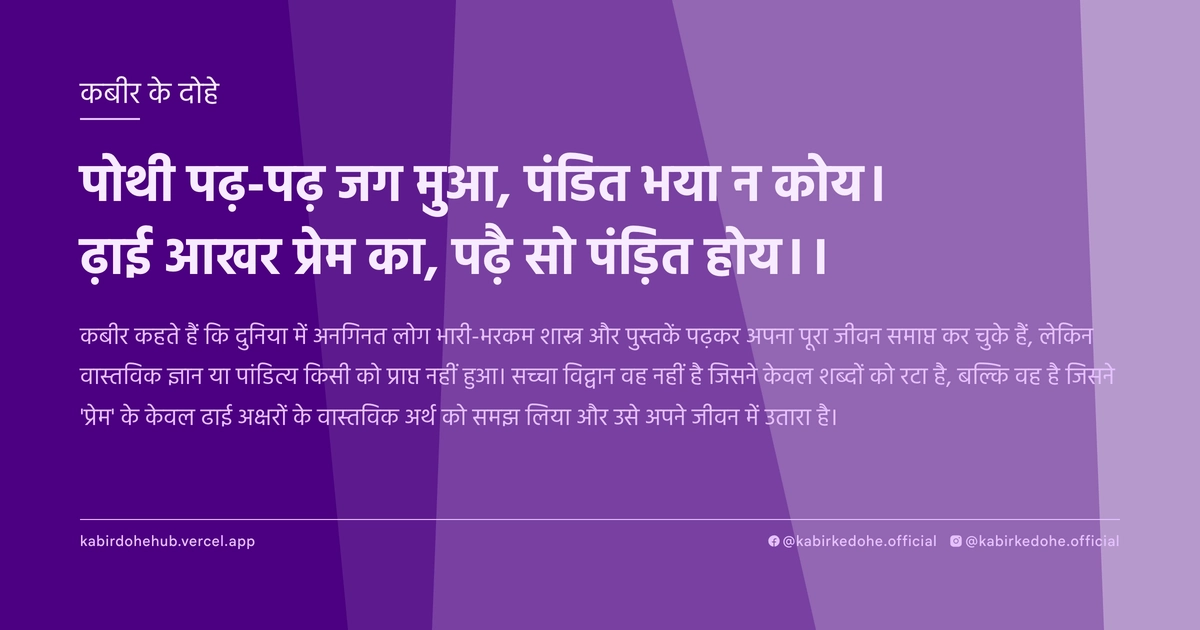
पोथी पढ़-पढ़ जग मुआ, पंडित भया न कोय।
ढ़ाई आखर प्रेम का, पढ़ै सो पंड़ित होय।।
Pothi padh-padh jag mua, pandit bhaya na koy. Dhai akhar prem ka, padhai so pandit hoye.
इस पृष्ठ पर इस कबीर दोहे का अर्थ (meaning), हिंदी व्याख्या और अंग्रेज़ी अनुवाद, दार्शनिक विश्लेषण और व्यावहारिक जीवन सीख दी गई है। यह दोहा भक्ति (Bhakti) विषय से जुड़ा है — Kabir doha meaning and explanation in Hindi and English.
अर्थ (Meaning):
कबीर कहते हैं कि दुनिया में अनगिनत लोग भारी-भरकम शास्त्र और पुस्तकें पढ़कर अपना पूरा जीवन समाप्त कर चुके हैं, लेकिन वास्तविक ज्ञान या पांडित्य किसी को प्राप्त नहीं हुआ। सच्चा विद्वान वह नहीं है जिसने केवल शब्दों को रटा है, बल्कि वह है जिसने 'प्रेम' के केवल ढाई अक्षरों के वास्तविक अर्थ को समझ लिया और उसे अपने जीवन में उतारा है।
Kabir asserts that countless souls have spent their entire lives immersed in the study of voluminous scriptures and academic texts, yet true wisdom remains elusive to them. He posits that genuine scholarship is not found in the rote memorization of texts, but in the realization and practice of the two-and-a-half letters of 'Love' (Prem), which unlocks the ultimate truth of existence.
व्याख्या (Interpretation):
यहाँ 'पोथी' केवल पुस्तकों का प्रतीक नहीं है, बल्कि उस बौद्धिक अहंकार का प्रतीक है जो मनुष्य को सत्य से दूर करता है। कबीर एक गहरे विरोधाभास को प्रस्तुत करते हैं: ज्ञान का संचय (Information) और वास्तविक बोध (Realization) दो अलग चीजें हैं। 'ढाई आखर प्रेम' का अर्थ केवल मानवीय अनुराग नहीं, बल्कि वह ब्रह्मांडीय प्रेम है जो आत्मा को परमात्मा से जोड़ता है। यह निर्गुण भक्ति का सार है, जहाँ ईश्वर किसी मंदिर या शास्त्र में नहीं, बल्कि हृदय की करुणा में निवास करता है। जब अहंकार मिटता है, तब द्वैत समाप्त होता है और साधक यह अनुभव करता है कि वह और उसका आराध्य एक ही हैं। यह अद्वैत वेदांत की उस स्थिति की ओर संकेत है जहाँ ज्ञान, प्रेम में रूपांतरित हो जाता है। अंततः, प्रेम ही वह एकमात्र कुंजी है जो माया के पर्दे को हटाकर आत्मा का साक्षात्कार कराती है।
In this verse, 'Pothi' (scriptures) symbolizes not just books, but the intellectual ego that creates a barrier between the seeker and the Truth. Kabir presents a profound paradox: the accumulation of information is fundamentally different from spiritual realization. The 'two-and-a-half letters of Love' do not refer merely to romantic or human affection, but to the cosmic, unconditional love that bridges the gap between the Atman (individual soul) and Brahman (universal consciousness). This is the essence of Nirgun Bhakti, where the Divine is found not in rituals or texts, but in the purity of the heart. When the ego dissolves, duality vanishes, and the seeker realizes the non-dual nature of existence. This aligns with Advaita Vedanta, where knowledge transcends the intellect and transforms into direct experience. Ultimately, love is the only catalyst capable of piercing the veil of Maya to reveal the inherent divinity within.
दार्शनिक विश्लेषण (Philosophical Analysis):
कबीर का यह दोहा उस युग की प्रतिक्रिया है जहाँ धर्म केवल कर्मकांडों और संस्कृत के कठिन ग्रंथों तक सीमित था। उन्होंने देखा कि पंडित और मौलवी बाहरी आडंबरों में उलझे थे, जबकि आंतरिक रूपांतरण शून्य था। कबीर ने जाति और धर्म की सीमाओं को तोड़कर एक ऐसे मार्ग का प्रस्ताव रखा जो सार्वभौमिक था। उनका दर्शन सूफीवाद के 'इश्क-ए-हकीकी' (ईश्वरीय प्रेम) और भारतीय भक्ति परंपरा के मिलन बिंदु पर स्थित है।
दार्शनिक स्तर पर, कबीर यहाँ 'ज्ञान मार्ग' बनाम 'प्रेम मार्ग' की चर्चा कर रहे हैं। ज्ञान मार्ग अक्सर अहंकार को बढ़ाता है क्योंकि व्यक्ति स्वयं को दूसरों से श्रेष्ठ समझने लगता है। इसके विपरीत, प्रेम मार्ग अहंकार का विसर्जन करता है। जब हम किसी से या ईश्वर से प्रेम करते हैं, तो 'मैं' और 'तू' का भेद मिट जाता है। यही वह बिंदु है जहाँ अद्वैत की स्थिति प्राप्त होती है।
कबीर का विरोध केवल पुस्तकों से नहीं, बल्कि उस यांत्रिक अध्ययन से है जो जीवन से कटा हुआ है। वे तर्क देते हैं कि यदि ज्ञान आपको विनम्र नहीं बनाता और आपके भीतर करुणा पैदा नहीं करता, तो वह ज्ञान केवल एक बोझ है। यह मनोवैज्ञानिक रूपांतरण की प्रक्रिया है, जहाँ व्यक्ति अपनी बौद्धिक पहचान को त्यागकर अपनी सहज मानवीय पहचान को अपनाता है।
सूफी संतों की तरह, कबीर मानते हैं कि हृदय ही वह वास्तविक मंदिर है जहाँ ईश्वर का वास है। बाहरी तीर्थयात्राएं और कठिन तपस्याएं व्यर्थ हैं यदि हृदय में प्रेम का अभाव है। यह विचार उस समय के रूढ़िवादी समाज के लिए एक क्रांतिकारी प्रहार था, जिसने ज्ञान को केवल कुछ विशेषाधिकार प्राप्त वर्गों तक सीमित कर रखा था।
अंततः, यह दोहा हमें सिखाता है कि सत्य कोई ऐसी वस्तु नहीं है जिसे पढ़कर प्राप्त किया जा सके, बल्कि यह एक अनुभव है जिसे जिया जाना चाहिए। प्रेम यहाँ एक क्रिया है, एक साधना है, जो साधक को उसकी सीमित पहचान से मुक्त कर अनंत के साथ एकाकार कर देती है।
This couplet is a visceral reaction to an era where religion was confined to rigid rituals and the esoteric study of Sanskrit texts. Kabir observed that the priestly classes were entangled in external formalities while internal transformation remained nonexistent. By dismantling the barriers of caste and creed, he proposed a universal path accessible to all, regardless of social standing.
Philosophically, Kabir contrasts the 'Path of Knowledge' (Jnana Marga) with the 'Path of Love' (Bhakti Marga). The path of intellectual knowledge often inflates the ego, as the seeker begins to perceive themselves as superior to others. In contrast, the path of love demands the annihilation of the ego. In the state of true love, the distinction between the 'I' and the 'Other' dissolves, leading to the realization of non-duality (Advaita).
Kabir's critique is not directed at literacy or books per se, but at the mechanical acquisition of knowledge that is detached from lived experience. He argues that knowledge which does not cultivate humility or compassion is merely a psychological burden. This is a call for a psychological shift from an identity based on intellectual achievement to one based on existential authenticity.
Mirroring the Sufi concept of 'Ishq-e-Haqiqi' (Divine Love), Kabir posits that the heart is the only true sanctuary of the Divine. External pilgrimages and ascetic rigors are futile if the heart remains barren of love. This was a revolutionary strike against the orthodoxies of his time, which had monopolized spiritual truth within a privileged few.
Ultimately, the doha teaches that Truth is not an object to be studied, but an experience to be lived. Love is presented here as a spiritual discipline—a practice of surrender—that liberates the seeker from the confines of the limited self and merges them with the Infinite.
मूल संदेश (Core Message):
- बौद्धिक अहंकार सत्य के मार्ग में सबसे बड़ी बाधा है।
- वास्तविक ज्ञान सूचनाओं का संग्रह नहीं, बल्कि हृदय का विस्तार है।
- प्रेम वह सेतु है जो आत्मा को परमात्मा से जोड़ता है।
- करुणा के बिना कोई भी शिक्षा व्यर्थ और मृत है।
- अद्वैत की प्राप्ति केवल प्रेम के पूर्ण समर्पण से संभव है।
- Intellectual arrogance is the greatest obstacle on the path to Truth.
- True wisdom is not the accumulation of data, but the expansion of the heart.
- Love is the only bridge that connects the individual soul to the Universal.
- Any education devoid of compassion is sterile and meaningless.
- The realization of non-duality is possible only through the total surrender of love.
व्यावहारिक उदाहरण (Practical Example):
वाराणसी के एक पुराने घाट पर, माधव नाम का एक वृद्ध व्यक्ति रहता था। माधव ने अपना पूरा जीवन वेदों और शास्त्रों के गहन अध्ययन में बिताया था। वह शहर का सबसे बड़ा विद्वान माना जाता था, और लोग दूर-दूर से उसकी व्याख्याएं सुनने आते थे। माधव को अपनी विद्वत्ता पर गर्व था और वह अक्सर उन लोगों को तुच्छ समझता था जो पढ़े-लिखे नहीं थे।
एक दिन, माधव ने देखा कि एक साधारण सा मल्लाह, जिसका नाम रामू था, घाट की सीढ़ियों पर बैठकर एक घायल कुत्ते की सेवा कर रहा था। रामू के पास कोई शास्त्र नहीं था, वह पढ़ना-लिखना नहीं जानता था, लेकिन उसकी आँखों में एक ऐसी शांति और करुणा थी जो माधव ने अपनी तमाम पुस्तकों में नहीं पढ़ी थी।
माधव ने रामू से पूछा, 'तुम इस तुच्छ प्राणी पर इतना समय क्यों व्यर्थ कर रहे हो? क्या तुम्हें पता है कि शास्त्रों में जीव मात्र की सेवा का क्या महत्व है?' रामू ने सरलता से मुस्कुराते हुए उत्तर दिया, 'बाबा, मुझे नहीं पता कि शास्त्र क्या कहते हैं, लेकिन जब इस बेजुबान की आँखों में दर्द दिखता है, तो मेरा दिल तड़प उठता है। मैं बस उसे प्यार करना चाहता हूँ।'
यह सरल उत्तर माधव के हृदय पर बिजली की तरह गिरा। उसे अचानक अहसास हुआ कि उसने हज़ारों पन्ने पढ़े थे, लेकिन वह एक छोटे से घायल कुत्ते के दर्द को महसूस नहीं कर पाया। उसकी सारी विद्वत्ता उसके और दुनिया के बीच एक दीवार बन गई थी।
माधव ने महसूस किया कि वह 'पंडित' तो बन गया था, लेकिन 'मनुष्य' बनना भूल गया था। उसने अपनी पोथियों को एक तरफ रखा और रामू के साथ बैठकर उस कुत्ते की सेवा करने लगा।
धीरे-धीरे माधव का व्यवहार बदलने लगा। उसने उपदेश देना छोड़ दिया और दूसरों की मदद करना शुरू किया। उसने पाया कि जब वह प्रेम से किसी की सेवा करता है, तो उसे वह शांति मिलती है जो उसे कठिन से कठिन श्लोकों के विश्लेषण से कभी नहीं मिली थी।
उसका अहंकार, जो उसकी शिक्षाओं के पीछे छिपा था, धीरे-धीरे पिघलने लगा। वह अब केवल शब्दों का ज्ञाता नहीं, बल्कि प्रेम का अनुभवकर्ता बन गया था।
माधव की इस नई पहचान ने उसके आसपास के लोगों को भी प्रभावित किया। अब लोग उसकी बातों को इसलिए नहीं सुनते थे क्योंकि वह विद्वान था, बल्कि इसलिए क्योंकि उसके शब्दों में अब करुणा और प्रेम था।
इस प्रकार, एक महान विद्वान ने 'प्रेम के ढाई अक्षरों' को पढ़कर वास्तविक पांडित्य प्राप्त किया।
On an ancient ghat in Varanasi lived an elderly man named Madhav. Madhav had spent his entire life in the rigorous study of the Vedas and Shastras. He was regarded as the city's greatest scholar, and people traveled from afar to hear his interpretations. Madhav took immense pride in his erudition, often looking down upon those who were illiterate.
One day, Madhav noticed a simple boatman named Ramu sitting on the steps of the ghat, tenderly nursing a wounded dog. Ramu possessed no scriptures and could not read or write, yet there was a serenity and compassion in his eyes that Madhav had never encountered in all his books.
Madhav asked Ramu, 'Why do you waste your time on this insignificant creature? Do you not know the scriptural significance of serving all living beings?' Ramu smiled simply and replied, 'Baba, I do not know what the scriptures say, but when I see the pain in this voiceless animal's eyes, my heart aches. I only wish to love it.'
This simple answer struck Madhav like a bolt of lightning. He suddenly realized that while he had read thousands of pages, he had failed to feel the pain of a small, wounded dog. His scholarship had become a wall between him and the world.
Madhav realized that while he had become a 'Pandit' (scholar), he had forgotten how to be a 'Human'. He set aside his heavy volumes and sat beside Ramu to help care for the dog.
Gradually, Madhav's behavior transformed. He stopped delivering lectures and started practicing selfless service. He discovered that when he served others with love, he found a peace that the most complex shlokas had never provided.
His ego, which had been hidden behind his academic achievements, began to melt away. He was no longer just a knower of words, but an experiencer of love.
This new identity influenced everyone around him. People no longer listened to him because he was a scholar, but because his words were now infused with genuine compassion.
Thus, a great intellectual attained true wisdom by finally reading the 'two-and-a-half letters of love'.
अभ्यास मार्गदर्शन (Practice Guidance):
- दैनिक चिंतन: प्रतिदिन 15 मिनट मौन बैठें और विचार करें कि क्या आपका ज्ञान आपको दूसरों के प्रति अधिक विनम्र बना रहा है या अधिक अहंकारी।
- करुणा का अभ्यास: दिन में कम से कम एक ऐसा कार्य करें जिसमें कोई व्यक्तिगत लाभ न हो, केवल निस्वार्थ प्रेम और सेवा की भावना हो।
- आत्म-पूछताछ जर्नल: लिखें कि आपके जीवन में कौन सी ऐसी 'पोथियाँ' (मान्यताएं, डिग्रियां, सामाजिक प्रतिष्ठा) हैं जो आपको वास्तव में लोगों से जुड़ने से रोक रही हैं।
- निदान चेकलिस्ट: यदि आप किसी की गलती पर तुरंत निर्णय लेते हैं, तो आप 'पोथी' के प्रभाव में हैं। यदि आप उस व्यक्ति के दर्द को महसूस कर पाते हैं, तो आप 'प्रेम' के मार्ग पर हैं।
- Daily Contemplation: Spend 15 minutes in silence daily, reflecting on whether your knowledge is making you more humble or more arrogant toward others.
- Practice of Compassion: Perform at least one act of service daily that offers no personal gain, driven solely by selfless love and empathy.
- Self-Inquiry Journaling: Document the 'scriptures' in your life—degrees, social status, or rigid beliefs—that act as barriers preventing you from genuinely connecting with others.
- Diagnostic Checklist: If your immediate reaction to another's mistake is judgment, you are operating from the 'Pothi' (egoic knowledge). If your reaction is empathy for their struggle, you are aligning with 'Prem' (Love).
चिंतन प्रश्न (Reflection Questions):
- क्या मेरी शैक्षणिक या व्यावसायिक उपलब्धियां मुझे दूसरों से श्रेष्ठ महसूस कराती हैं?
- जब मैं किसी की मदद करता हूँ, तो क्या मैं वास्तव में उस व्यक्ति को देख रहा हूँ, या मैं अपनी 'परोपकारी' छवि को देख रहा हूँ?
- मेरे जीवन में ऐसा कौन सा रिश्ता है जहाँ मेरा अहंकार मेरे प्रेम पर हावी है?
- यदि मेरी सारी डिग्रियां और ज्ञान छीन लिए जाएं, तो मेरी मानवीय पहचान में क्या बचेगा?
- क्या मैं सत्य को खोजने के लिए केवल मस्तिष्क का उपयोग कर रहा हूँ, या मैं अपने हृदय को भी खोलने के लिए तैयार हूँ?
- Do my academic or professional achievements make me feel inherently superior to others?
- When I help someone, am I truly seeing the other person, or am I admiring my own image as a 'benefactor'?
- In which relationship in my life does my ego consistently override my capacity to love?
- If all my degrees and intellectual accolades were stripped away, what would remain of my human identity?
- Am I attempting to find Truth using only the intellect, or am I willing to open my heart to the vulnerability of love?