
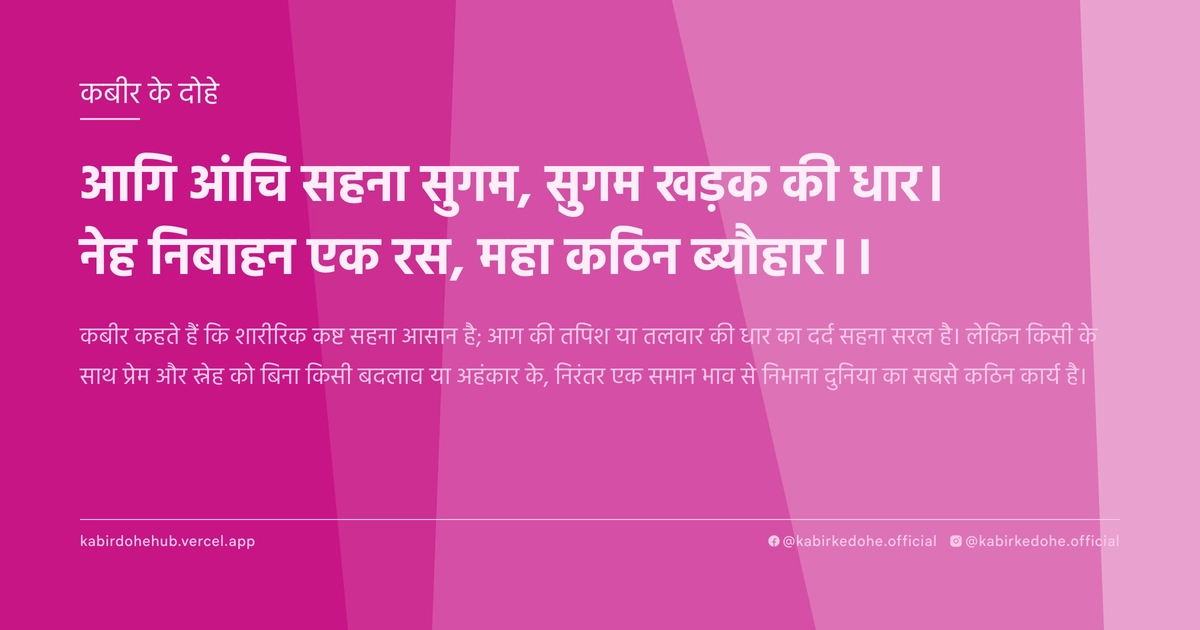
आगि आंचि सहना सुगम, सुगम खड़क की धार।
नेह निबाहन एक रस, महा कठिन ब्यौहार।।
Aagi aanchi sahna sugam, sugam khadak ki dhaar. Neh nibahan ek ras, maha kathin byauhaar.
इस पृष्ठ पर इस कबीर दोहे का अर्थ (meaning), हिंदी व्याख्या और अंग्रेज़ी अनुवाद, दार्शनिक विश्लेषण और व्यावहारिक जीवन सीख दी गई है। यह दोहा प्रेम भक्ति (Divine Love) विषय से जुड़ा है — Kabir doha meaning and explanation in Hindi and English.
अर्थ (Meaning):
कबीर कहते हैं कि शारीरिक कष्ट सहना आसान है; आग की तपिश या तलवार की धार का दर्द सहना सरल है। लेकिन किसी के साथ प्रेम और स्नेह को बिना किसी बदलाव या अहंकार के, निरंतर एक समान भाव से निभाना दुनिया का सबसे कठिन कार्य है।
Kabir asserts that enduring physical agony is relatively simple; bearing the heat of fire or the edge of a sword is manageable. However, maintaining a constant, unwavering stream of love and affection toward another without ego or fluctuation is the most challenging endeavor in human existence.
व्याख्या (Interpretation):
इस दोहे का शाब्दिक अर्थ है कि बाहरी शारीरिक पीड़ा क्षणिक और प्रत्यक्ष होती है, जिसे धैर्य से सहा जा सकता है। लेकिन 'नेह निबाहन' का अर्थ है प्रेम की निरंतरता। यहाँ कबीर प्रेम को एक साधना के रूप में देखते हैं। यह निरगुण भक्ति का संकेत है जहाँ प्रेम केवल व्यक्ति विशेष के लिए नहीं, बल्कि आत्मा के परमात्मा में विलीनीकरण की प्रक्रिया है। माया हमें द्वैत में फँसाती है, जिससे प्रेम में ईर्ष्या और अपेक्षाएँ जन्म लेती हैं। जब तक 'मैं' (अहंकार) जीवित है, प्रेम 'एक रस' (स्थिर) नहीं रह सकता। यह दोहा आत्मा और ब्रह्म की अद्वैत स्थिति की ओर इशारा करता है, जहाँ प्रेमी और प्रियतम एक हो जाते हैं और द्वंद्व समाप्त हो जाता है।
Literally, the verse suggests that external physical pain is transient and direct, making it bearable through sheer endurance. However, 'Neh Nibahan' refers to the continuity of love. Kabir views love not as an emotion, but as a spiritual discipline (Sadhana). This aligns with Nirgun Bhakti, where love is not merely for a person but a process of the Atman merging into the formless Brahman. Maya traps the soul in duality, birthing jealousy and expectation. As long as the 'I' (ego) persists, love cannot remain 'Ek Ras' (constant/uniform). The verse points toward the Advaita state of non-duality, where the lover and the beloved merge, and all contradictions vanish, revealing the paradox that the softest emotion is the hardest to sustain.
दार्शनिक विश्लेषण (Philosophical Analysis):
कबीर का यह विचार उनके युग के सामाजिक और धार्मिक पाखंड के विरुद्ध एक गहरा प्रहार है। उस समय धर्म का अर्थ केवल कर्मकांड, तीर्थयात्रा और कठोर तपस्या था। कबीर ने स्पष्ट किया कि शरीर को कष्ट देना (जैसे भूखा रहना या आग पर चलना) वास्तविक आध्यात्मिकता नहीं है। यह 'बाह्य आडंबर' है। वास्तविक तपस्या तो मन के भीतर है, जहाँ अहंकार का विसर्जन होता है।
दार्शनिक रूप से, यह दोहा अद्वैत वेदांत के करीब है। जब तक व्यक्ति खुद को दूसरे से अलग मानता है, उसका प्रेम शर्त-आधारित होता है। 'एक रस' का अर्थ है वह प्रेम जो परिस्थिति, समय या व्यवहार के बदलने पर भी न बदले। यह सूफीवाद के 'इश्क-ए-हकीकी' (ईश्वरीय प्रेम) के समान है, जहाँ प्रेमी अपने अस्तित्व को मिटाकर केवल प्रियतम में लीन हो जाता है।
कबीर यहाँ यह समझा रहे हैं कि तलवार की धार शरीर को काटती है, लेकिन अहंकार और द्वेष आत्मा को काटते हैं। शारीरिक पीड़ा का अंत मृत्यु के साथ हो जाता है, लेकिन प्रेम में विफलता और अहंकार का बोझ जन्म-जन्मांतर तक आत्मा को भारी करता है। यह मनोवैज्ञानिक रूपांतरण की मांग करता है—एक ऐसी स्थिति जहाँ 'देने' का भाव 'पाने' की इच्छा से ऊपर उठ जाए।
ritualism (कर्मकांड) का विरोध करते हुए कबीर कहते हैं कि ईश्वर मंदिर या मस्जिद में नहीं, बल्कि उस हृदय में है जो बिना किसी भेदभाव के प्रेम करना जानता है। जाति और धर्म की दीवारें प्रेम के 'एक रस' प्रवाह में सबसे बड़ी बाधाएँ हैं। जो व्यक्ति इन दीवारों को गिरा देता है, वही वास्तव में 'सहज' अवस्था को प्राप्त करता है।
अंततः, यह दोहा हमें सिखाता है कि प्रेम कोई भावना नहीं, बल्कि एक कठिन तपस्या है। यह अहंकार की पूर्ण आहुति माँगता है। जब तक 'मैं' है, तब तक 'तू' है; जब 'मैं' मिट जाता है, तब केवल प्रेम शेष रहता है। यही वह 'महा-कठिन व्यवहार' है जिसे केवल एक जागृत आत्मा ही सिद्ध कर सकती है।
Kabir's insight is a profound critique of the social and religious hypocrisy of his era. At that time, spirituality was often reduced to ritualism, pilgrimages, and severe physical austerities. Kabir clarifies that inflicting pain on the body—such as fasting excessively or walking on fire—is not true spirituality; it is merely 'external ostentation.' True austerity resides within the mind, where the ego is systematically dismantled.
Philosophically, this verse resonates with Advaita Vedanta. As long as an individual perceives themselves as separate from another, their love remains conditional. 'Ek Ras' implies a love that remains constant regardless of circumstances, time, or the other's behavior. This mirrors the Sufi concept of 'Ishq-e-Haqiqi' (Divine Love), where the lover annihilates their own existence to merge entirely with the Beloved.
Kabir argues that while a sword's edge cuts the flesh, ego and malice sever the soul. Physical pain ends with death, but the burden of failed love and persistent ego weighs down the soul across lifetimes. This necessitates a psychological transformation—a shift where the impulse to give transcends the desire to receive.
By rejecting ritualism, Kabir posits that the Divine is not found in temples or mosques, but in the heart that loves without discrimination. The walls of caste and creed are the primary obstacles to the 'uniform flow' of love. Only those who tear down these walls can achieve the state of 'Sahaja' (spontaneous enlightenment).
Ultimately, the verse teaches that love is not a mere emotion but a rigorous spiritual discipline. It demands the total sacrifice of the ego. As long as there is an 'I', there is a 'Thou'; when the 'I' vanishes, only Love remains. This is the 'maha-kathin' (greatly difficult) conduct that only an awakened soul can master.
मूल संदेश (Core Message):
- शारीरिक तपस्या सरल है, मानसिक रूपांतरण कठिन।
- सच्चा प्रेम वह है जो परिस्थिति से अप्रभावित रहे।
- अहंकार का विसर्जन ही प्रेम की पहली शर्त है।
- बाहरी अनुष्ठानों से ऊपर उठकर आंतरिक करुणा को अपनाएं।
- अद्वैत की अनुभूति ही प्रेम को 'एक रस' बनाती है।
- Physical austerity is simple; mental transformation is arduous.
- True love is that which remains unaffected by external circumstances.
- The dissolution of ego is the primary prerequisite for love.
- Rise above external rituals to embrace internal compassion.
- The realization of non-duality makes love a uniform flow.
व्यावहारिक उदाहरण (Practical Example):
एक समय की बात है, वाराणसी के घाटों पर माधव नाम का एक वृद्ध बुनकर रहता था। माधव अपने काम में निपुण था, लेकिन उसका स्वभाव अत्यंत क्रोधी था। वह अपने परिवार और पड़ोसियों के साथ छोटी-छोटी बातों पर झगड़ता था। उसे लगता था कि वह बहुत धार्मिक है क्योंकि वह रोज़ घंटों पूजा करता था और कठिन उपवास रखता था।
एक दिन माधव की मुलाकात एक घुमक्कड़ संत से हुई। माधव ने गर्व से कहा, "महाराज, मैं धर्म के कठिन से कठिन नियम मानता हूँ, शरीर को कष्ट देता हूँ, फिर भी मुझे शांति क्यों नहीं मिलती?"
संत ने मुस्कुराते हुए माधव के घर के सामने एक छोटा सा पौधा लगाया और कहा, "माधव, इस पौधे को रोज़ पानी देना, लेकिन शर्त यह है कि चाहे तुम्हारा पड़ोसी तुमसे झगड़ा करे या तुम्हारी पत्नी तुम पर चिल्लाए, तुम्हें इस पौधे को देखते समय अपने मन में उनके प्रति केवल प्रेम रखना है।"
शुरुआत में माधव के लिए यह आसान था। लेकिन जैसे-जैसे दिन बीते, उसके पड़ोसी ने उसकी बाड़ तोड़ दी और उसकी पत्नी ने पुराने झगड़े उखाड़े। माधव का खून खौलने लगा। उसने सोचा, "यह तो बहुत आसान है, बस पानी देना है।"
परंतु, जैसे ही वह पानी डालने जाता, उसके मन में क्रोध की लहर उठती। वह महसूस करता कि उपवास करना या घंटों बैठना आसान था, लेकिन उस व्यक्ति को क्षमा करना जिसने उसे चोट पहुँचाई हो, वह सबसे कठिन था।
एक शाम, जब उसका पड़ोसी उसे गालियाँ दे रहा था, माधव ने अचानक महसूस किया कि उसका क्रोध वास्तव में उसके अपने अहंकार की रक्षा कर रहा था। उसने पहली बार महसूस किया कि वह 'प्रेम' को एक लेन-देन समझ रहा था—"मैं अच्छा हूँ, इसलिए तुम अच्छे रहो।"
उसने अपनी आँखें बंद कीं और उस 'एक रस' प्रेम को याद किया जिसकी बात संत ने की थी। उसने पड़ोसी के पैर छुए और शांत स्वर में कहा, "भाई, मेरी बाड़ टूट गई तो क्या हुआ, हमारा रिश्ता न टूटे।"
पड़ोसी स्तब्ध रह गया। माधव के चेहरे पर एक ऐसी शांति थी जो उसने अपने कठिन उपवासों में कभी नहीं पाई थी।
माधव समझ गया कि शरीर की आग सहना सरल है, लेकिन हृदय में प्रेम की निरंतरता बनाए रखना ही वास्तविक मोक्ष है। उस दिन के बाद, माधव का घर केवल कपड़ों की बुनाई का केंद्र नहीं, बल्कि प्रेम की पाठशाला बन गया।
Once, on the ghats of Varanasi, lived an elderly weaver named Madhav. Madhav was skilled in his craft, but his temperament was volatile. He quarreled with his family and neighbors over trivial matters. He believed himself to be deeply religious because he spent hours in prayer and observed rigorous fasts.
One day, Madhav met a wandering saint. Madhav asked with pride, "Maharaj, I follow the strictest rules of religion and subject my body to great hardship, yet why do I find no peace?"
The saint smiled, planted a small sapling in front of Madhav's house, and said, "Madhav, water this plant daily. But the condition is that regardless of whether your neighbor fights with you or your wife screams at you, you must maintain a feeling of pure love in your heart while looking at this plant."
Initially, Madhav found this easy. But as days passed, his neighbor broke his fence and his wife brought up old grievances. Madhav's blood boiled. He thought, "This is simple, just watering a plant."
However, every time he went to water it, a wave of anger surged. He realized that fasting or sitting in meditation for hours was easy, but forgiving someone who had intentionally hurt him was the hardest task of all.
One evening, while his neighbor was hurling insults at him, Madhav suddenly realized that his anger was merely a defense mechanism for his own ego. He felt for the first time that he had treated love as a transaction—"I am good, therefore you must be good to me."
He closed his eyes and recalled the 'Ek Ras' (uniform) love the saint had mentioned. He touched his neighbor's feet and said in a calm voice, "Brother, so what if the fence is broken? Let us ensure our relationship does not break."
The neighbor was stunned. There was a serenity on Madhav's face that he had never experienced during his harshest fasts.
Madhav understood that enduring the fire of the body is simple, but maintaining the continuity of love in the heart is true liberation. From that day on, Madhav's home became not just a center for weaving cloth, but a school for love.
His transformation was complete; he stopped seeking validation through rituals and started finding God in the selfless service of others.
अभ्यास मार्गदर्शन (Practice Guidance):
- दैनिक अभ्यास: दिन में तीन बार किसी ऐसे व्यक्ति का स्मरण करें जिससे आपका वैचारिक मतभेद है, और मानसिक रूप से उन्हें बिना शर्त क्षमा करें।
- आत्म-पूछताछ जर्नल: लिखें कि 'मेरा प्रेम कब शर्त-आधारित हो जाता है?' और उन ट्रिगर्स को पहचानें जो आपके प्रेम को 'एक रस' से हटाकर क्रोध में बदल देते हैं।
- व्यवहारिक परिवर्तन: जब भी कोई आपको उकसाए, प्रतिक्रिया देने से पहले 10 सेकंड का मौन रखें और स्वयं से पूछें, "क्या मेरा अहंकार बोल रहा है या मेरी आत्मा?"
- डायग्नोस्टिक चेकलिस्ट: क्या मैं केवल उन लोगों से प्रेम करता हूँ जो मुझसे सहमत हैं? क्या मैं अपनी अच्छाई का उपयोग दूसरों को नियंत्रित करने के लिए करता हूँ? यदि हाँ, तो आप अभी भी 'कठिन व्यवहार' के मार्ग पर नहीं हैं।
- Daily Practice: Three times a day, recall someone with whom you have a conceptual conflict and mentally grant them unconditional forgiveness.
- Self-Inquiry Journal: Write about 'When does my love become conditional?' and identify the triggers that shift your love from 'Ek Ras' to anger.
- Behavioral Change: Whenever provoked, maintain 10 seconds of silence before reacting and ask yourself, "Is it my ego speaking or my soul?"
- Diagnostic Checklist: Do I only love those who agree with me? Do I use my kindness to control others? If yes, you have not yet entered the path of 'Maha-Kathin Vyavhar'.
चिंतन प्रश्न (Reflection Questions):
- क्या मेरा 'प्रेम' वास्तव में प्रेम है, या केवल एक अपेक्षा है कि दूसरा वैसा ही व्यवहार करे जैसा मैं चाहता हूँ?
- मैं अपनी धार्मिक या नैतिक श्रेष्ठता का उपयोग दूसरों को नीचा दिखाने के लिए किस तरह करता हूँ?
- मेरे जीवन में वह कौन सा 'अदृश्य घाव' है जिसे मैं प्रेम के माध्यम से भरने के बजाय क्रोध से ढंकता हूँ?
- यदि मेरा सामाजिक सम्मान (Digital/Social Ego) छीन लिया जाए, तो क्या मेरा व्यवहार दूसरों के प्रति वैसा ही रहेगा?
- क्या मैं वास्तव में किसी ऐसे व्यक्ति को प्रेम कर सकता हूँ जो मेरे अस्तित्व के लिए खतरा हो?
- Is my 'love' truly love, or merely an expectation that others behave exactly as I desire?
- How do I use my religious or moral superiority to subtly belittle others?
- What is that 'invisible wound' in my life that I cover with anger instead of healing through love?
- If my social status (Digital/Social Ego) were stripped away, would my behavior toward others remain the same?
- Can I truly love someone who poses a threat to my perceived existence or identity?