
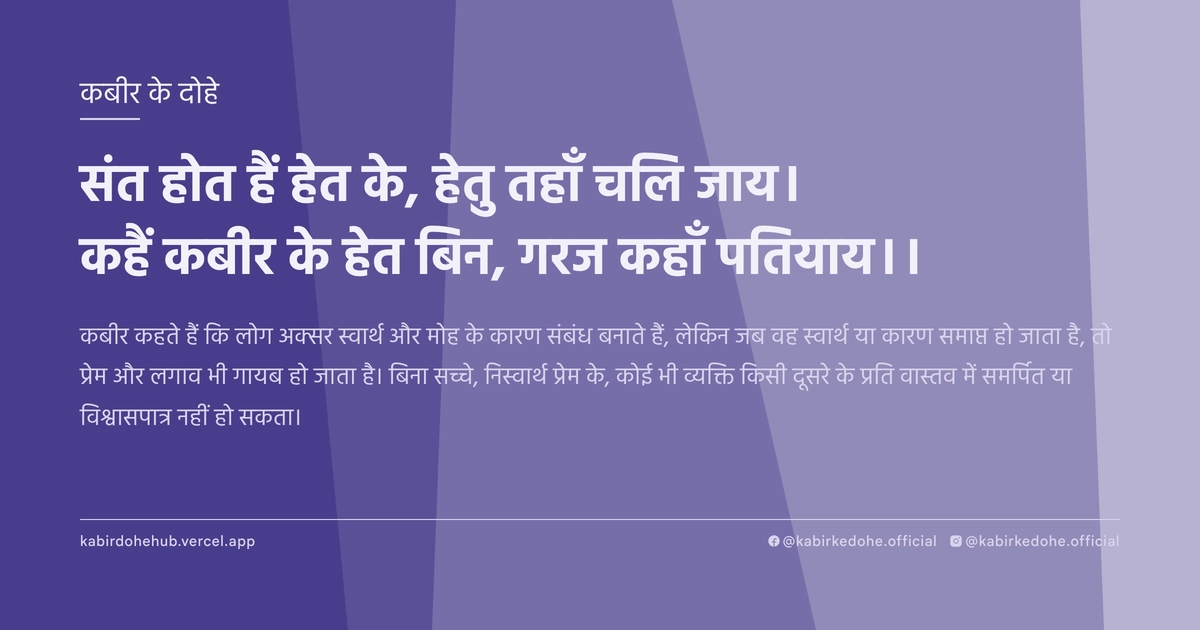
संत होत हैं हेत के, हेतु तहाँ चलि जाय।
कहैं कबीर के हेत बिन, गरज कहाँ पतियाय।।
Sant hot hain het ke, het tahan chali jaaye. Kahen kabir ke het bin, garaj kahan patiyaay.
इस पृष्ठ पर इस कबीर दोहे का अर्थ (meaning), हिंदी व्याख्या और अंग्रेज़ी अनुवाद, दार्शनिक विश्लेषण और व्यावहारिक जीवन सीख दी गई है। यह दोहा प्रेम भक्ति (Divine Love) विषय से जुड़ा है — Kabir doha meaning and explanation in Hindi and English.
अर्थ (Meaning):
कबीर कहते हैं कि लोग अक्सर स्वार्थ और मोह के कारण संबंध बनाते हैं, लेकिन जब वह स्वार्थ या कारण समाप्त हो जाता है, तो प्रेम और लगाव भी गायब हो जाता है। बिना सच्चे, निस्वार्थ प्रेम के, कोई भी व्यक्ति किसी दूसरे के प्रति वास्तव में समर्पित या विश्वासपात्र नहीं हो सकता।
Kabir observes that people often form attachments based on selfish motives or transactional needs; however, once the motive is fulfilled or disappears, the affection vanishes. He asserts that without genuine, selfless love, there is no foundation for true trust or lasting devotion in any relationship.
व्याख्या (Interpretation):
इस दोहे का शाब्दिक अर्थ है कि सांसारिक प्रेम 'हेतु' यानी कारण पर आधारित होता है। कबीर यहाँ 'हेत' (प्रेम) और 'हेतु' (कारण/स्वार्थ) के बीच के सूक्ष्म अंतर को स्पष्ट कर रहे हैं। आध्यात्मिक स्तर पर, यह माया के प्रभाव को दर्शाता है जहाँ मनुष्य ईश्वर या अन्य मनुष्यों से केवल अपनी इच्छाओं की पूर्ति के लिए जुड़ता है। यह निर्गुण भक्ति का आह्वान है, जहाँ प्रेम का कोई बाहरी कारण नहीं होना चाहिए। जब तक अहंकार (I-ness) मौजूद है, प्रेम केवल एक सौदा है। वास्तविक प्रेम वह है जो बिना किसी अपेक्षा के हो, जो आत्मा का परमात्मा से मिलन हो, जहाँ द्वैत समाप्त हो जाता है और केवल शुद्ध चेतना शेष रहती है।
Literally, the verse addresses how worldly love is predicated on 'hetu' or a specific motive. Kabir distinguishes between 'het' (affection) and 'hetu' (cause/selfishness), revealing the fragility of transactional bonds. Metaphorically, this reflects the grip of Maya, where humans connect with the Divine or others merely to satisfy personal desires. It is a call toward Nirgun Bhakti, where devotion must be causeless and unconditional. As long as the ego persists, love remains a trade. True love is the dissolution of the 'I', transitioning from the duality of giver and receiver to the non-dual state of Atman-Brahman, where love is the very nature of existence, not a reaction to a benefit.
दार्शनिक विश्लेषण (Philosophical Analysis):
कबीर का यह दोहा उनके युग के सामाजिक और धार्मिक पाखंड पर एक गहरा प्रहार है। उस समय धर्म के नाम पर लोग केवल मोक्ष या स्वर्ग की लालसा में पूजा-पाठ करते थे, जो वास्तव में एक आध्यात्मिक सौदा था। कबीर इस 'सौदागर भक्ति' को नकारते हैं और निस्वार्थ प्रेम की वकालत करते हैं।
अद्वैत वेदांत के परिप्रेक्ष्य में, जब हम किसी से 'कारण' के साथ प्रेम करते हैं, तो हम वास्तव में दूसरे व्यक्ति को एक वस्तु के रूप में देख रहे होते हैं। यह अलगाव की भावना को बढ़ाता है। कबीर सिखाते हैं कि जब 'हेतु' (स्वार्थ) मिट जाता है, तब केवल 'सत्य' बचता है। यह सूफी मत के 'इश्क-ए-हकीकी' (ईश्वरीय प्रेम) के समान है, जहाँ प्रेमी अपने अस्तित्व को पूरी तरह मिटा देता है ताकि केवल प्रिय (परमात्मा) शेष रहे।
मनोवैज्ञानिक रूप से, कबीर यहाँ 'प्रोजेक्शन' की बात कर रहे हैं। हम अक्सर दूसरों में अपनी जरूरतों का प्रतिबिंब ढूंढते हैं और उसे प्रेम का नाम देते हैं। यह प्रेम नहीं, बल्कि आत्म-मोह है। जब वह जरूरत पूरी हो जाती है, तो प्रतिबिंब टूट जाता है और हम जिसे प्रेम समझ रहे थे, वह केवल एक भ्रम था।
कबीर का विरोध केवल बाहरी कर्मकांडों से नहीं था, बल्कि आंतरिक लालच से था। वे कहते हैं कि यदि आपका प्रेम किसी लाभ पर टिका है, तो वह बंधन है, मुक्ति नहीं। मुक्ति तब होती है जब प्रेम का कोई 'क्यों' नहीं बचता, केवल 'होना' बचता है।
अंततः, यह दोहा हमें अहंकार के विसर्जन की ओर ले जाता है। जब तक 'मैं' और 'मेरा लाभ' मौजूद है, तब तक हम सत्य से दूर हैं। निस्वार्थता ही वह एकमात्र सेतु है जो मनुष्य को उसकी अपनी सीमित पहचान से ऊपर उठाकर सार्वभौमिक चेतना से जोड़ता है।
This couplet is a profound critique of the social and religious hypocrisy of Kabir's era. During his time, many practiced religion solely for the sake of salvation or heavenly rewards—essentially treating spirituality as a transactional contract. Kabir rejects this 'mercenary devotion' and advocates for unconditional love.
From the lens of Advaita Vedanta, loving someone for a 'reason' means perceiving the other as an object to be used, which reinforces the illusion of separation. Kabir teaches that when the 'hetu' (motive) is eliminated, only the 'Satya' (Truth) remains. This aligns closely with the Sufi concept of 'Ishq-e-Haqiqi' (Divine Love), where the lover annihilates their own existence (Fana) so that only the Beloved remains.
Psychologically, Kabir addresses the concept of projection. We often seek reflections of our own needs in others and mislabel this as love. This is not love, but a form of self-absorption. Once the need is met, the projection shatters, revealing that the perceived affection was merely a mirage.
Kabir's opposition was not just to external rituals, but to the internal greed that fuels them. He argues that love based on gain is a shackle, not liberation. Liberation occurs when the 'why' of love vanishes, leaving only the pure state of 'being'.
Ultimately, the verse guides us toward the dissolution of the ego. As long as 'I' and 'my profit' exist, we remain distant from the Truth. Selflessness is the only bridge that elevates a human from their limited identity to the universal consciousness.
मूल संदेश (Core Message):
- स्वार्थ पर आधारित संबंध रेत के घर की तरह होते हैं।
- सच्चा प्रेम वह है जिसमें कोई 'क्यों' नहीं होता।
- अहंकार को मिटाना ही वास्तविक भक्ति की पहली सीढ़ी है।
- लेन-देन का भाव प्रेम को व्यापार बना देता है।
- आत्मा का मिलन केवल निस्वार्थता के माध्यम से संभव है।
- Relationships built on motives are like houses made of sand.
- True love is that which possesses no 'why'.
- Annihilating the ego is the first step toward genuine devotion.
- The spirit of transaction turns love into a business deal.
- Union of the soul is possible only through absolute selflessness.
व्यावहारिक उदाहरण (Practical Example):
एक समय की बात है, वाराणसी के एक पुराने घाट पर माधव नाम का एक बुनकर रहता था। माधव अपनी कला में निपुण था, लेकिन उसका स्वभाव अत्यंत अहंकारी था। वह केवल उन्हीं लोगों की मदद करता था जिनसे उसे भविष्य में कोई लाभ मिलने की संभावना होती थी।
एक दिन, एक वृद्ध सन्यासी उसके पास आए। सन्यासी के पास न धन था, न कोई पद। उन्होंने माधव से एक साधारण सा सूती वस्त्र माँगा। माधव ने उन्हें अनदेखा कर दिया क्योंकि उसे लगा कि इस निर्धन सन्यासी से उसे कुछ हासिल नहीं होगा।
कुछ दिनों बाद, शहर के एक बड़े सेठ ने माधव को अपने यहाँ बुलाकर बहुत बड़ा ऑर्डर दिया और ढेर सारा स्वर्ण दिया। माधव बहुत खुश हुआ और सेठ को अपना सबसे करीबी मित्र मानने लगा। वह सेठ की हर बात मानता, उसकी चापलूसी करता और उसके लिए दिन-रात काम करता।
लेकिन समय बदला। सेठ का व्यापार डूब गया और वह कंगाल हो गया। अब उसके पास माधव को देने के लिए न स्वर्ण था और न ही कोई बड़ा ऑर्डर। धीरे-धीरे सेठ ने माधव को बुलाना बंद कर दिया और माधव ने भी सेठ की उपेक्षा करना शुरू कर दिया।
एक शाम, माधव घाट पर बैठा था, तभी उसे वही वृद्ध सन्यासी दोबारा दिखे। सन्यासी ने मुस्कुराते हुए माधव से पूछा, 'बेटा, वह मित्र कहाँ गया जिसके लिए तुम अपनी नींदें कुर्बान करते थे?'
माधव चुप रहा। सन्यासी ने आगे कहा, 'तुम्हारा प्रेम उस स्वर्ण की तरह था जो चमक तो रहा था, लेकिन उसमें आत्मा नहीं थी। तुम सेठ से नहीं, बल्कि सेठ के धन से प्रेम करते थे। जब हेतु चला गया, तो तुम्हारा हेत भी चला गया।'
यह बात माधव के हृदय में तीर की तरह लगी। उसे अहसास हुआ कि उसने कभी किसी से सच्चा प्रेम नहीं किया, बल्कि केवल अपने स्वार्थों का व्यापार किया।
उस रात माधव सो नहीं सका। उसने तय किया कि वह अब से बिना किसी कारण के दूसरों की सेवा करेगा। उसने अपने जीवन का सबसे सुंदर वस्त्र बिना किसी शुल्क के उस सन्यासी को भेंट किया।
उस दिन माधव ने पहली बार महसूस किया कि जब देने के पीछे कोई लालच नहीं होता, तो मन में एक ऐसी शांति आती है जो दुनिया के किसी भी स्वर्ण से बड़ी है।
माधव का जीवन बदल गया। अब वह केवल एक बुनकर नहीं था, बल्कि एक ऐसा इंसान बन गया था जिसने 'हेतु' को मारकर 'हेत' को जीवित किया था।
Once, in the ancient ghats of Varanasi, lived a weaver named Madhav. Madhav was a master of his craft, but his nature was deeply arrogant. He only helped those from whom he expected a future benefit.
One day, an elderly sanyasi (monk) approached him. The monk had neither wealth nor status. He asked Madhav for a simple cotton cloth. Madhav ignored him, believing that this impoverished monk could offer him nothing in return.
Shortly after, a wealthy merchant in the city summoned Madhav, gave him a massive order, and paid him in gold. Madhav was overjoyed and began to consider the merchant his closest friend. He obeyed the merchant's every whim, flattered him, and worked day and night for him.
However, time changed. The merchant's business collapsed, and he became a pauper. He no longer had gold or grand orders to offer Madhav. Gradually, the merchant stopped calling him, and Madhav began to ignore the merchant.
One evening, while sitting by the ghat, Madhav saw the same elderly sanyasi. The monk smiled and asked, 'Son, where is that friend for whom you sacrificed your sleep?'
Madhav remained silent. The sanyasi continued, 'Your love was like that gold—it sparkled, but it had no soul. You did not love the merchant; you loved the merchant's wealth. When the motive vanished, your affection vanished too.'
These words pierced Madhav's heart like an arrow. He realized he had never truly loved anyone; he had only traded his interests.
Madhav could not sleep that night. He decided that from then on, he would serve others without any expectation of return. He gifted his most beautiful piece of fabric to the sanyasi, free of charge.
In that moment, Madhav felt a peace that surpassed any worldly gold—a peace that only comes when giving is devoid of greed.
Madhav's life was transformed. He was no longer just a weaver, but a man who had killed the 'motive' to revive true 'love'.
अभ्यास मार्गदर्शन (Practice Guidance):
- दैनिक आत्म-निरीक्षण: दिन के अंत में अपनी सूची बनाएँ कि आपने आज किन लोगों से बात की और क्या उन बातचीत के पीछे कोई गुप्त स्वार्थ था।
- निस्वार्थ सेवा अभ्यास: सप्ताह में एक बार किसी ऐसे व्यक्ति की मदद करें जिससे आपको पता हो कि वह आपके लिए कभी कुछ नहीं कर पाएगा।
- साक्षी भाव ध्यान: ध्यान के दौरान अपने भीतर उठने वाली 'अपेक्षाओं' को देखें। जब आप किसी के लिए कुछ अच्छा सोचें, तो पूछें—'क्या मैं यह अपनी छवि सुधारने के लिए कर रहा हूँ?'
- डायग्नोस्टिक चेकलिस्ट: यदि आप किसी व्यक्ति के व्यवहार में बदलाव आने पर अचानक उनसे नफरत करने लगते हैं, तो समझें कि आपका प्रेम 'हेतु' (कारण) पर आधारित था, 'हेत' (आत्मा) पर नहीं।
- Daily Self-Audit: At the end of the day, list the people you interacted with and honestly analyze if there was a hidden motive behind those interactions.
- Altruism Practice: Once a week, help someone from whom you know for a certainty that you will receive nothing in return.
- Witness Meditation: During meditation, observe the 'expectations' arising within. When you feel a desire to do good, ask—'Am I doing this to improve my own image?'
- Diagnostic Checklist: If you suddenly feel resentment toward someone because their behavior changed or they can no longer benefit you, recognize that your love was based on 'hetu' (motive), not 'het' (soul).
चिंतन प्रश्न (Reflection Questions):
- मेरे जीवन में ऐसे कितने लोग हैं जिन्हें मैं केवल इसलिए पसंद करता हूँ क्योंकि वे मेरे काम आते हैं?
- यदि मेरी सारी सामाजिक प्रतिष्ठा और संपत्ति आज चली जाए, तो मेरे पास कौन बचेगा और क्यों?
- क्या मेरा धर्म और मेरी प्रार्थनाएँ ईश्वर के प्रति प्रेम हैं, या केवल अपनी इच्छाओं की पूर्ति का एक साधन?
- जब मैं दूसरों की मदद करता हूँ, तो क्या मैं वास्तव में उनकी मदद कर रहा हूँ या अपनी 'अच्छे इंसान' होने की छवि को पुष्ट कर रहा हूँ?
- मेरे भीतर का वह कौन सा डर है जो मुझे बिना किसी अपेक्षा के प्रेम करने से रोकता है?
- How many people in my life do I like solely because they are useful to me?
- If all my social status and wealth vanished today, who would remain by my side and why?
- Is my religion and prayer an act of love for the Divine, or merely a tool to fulfill my own desires?
- When I help others, am I truly helping them, or am I reinforcing my own image of being a 'good person'?
- What is the fear within me that prevents me from loving without any expectation?