
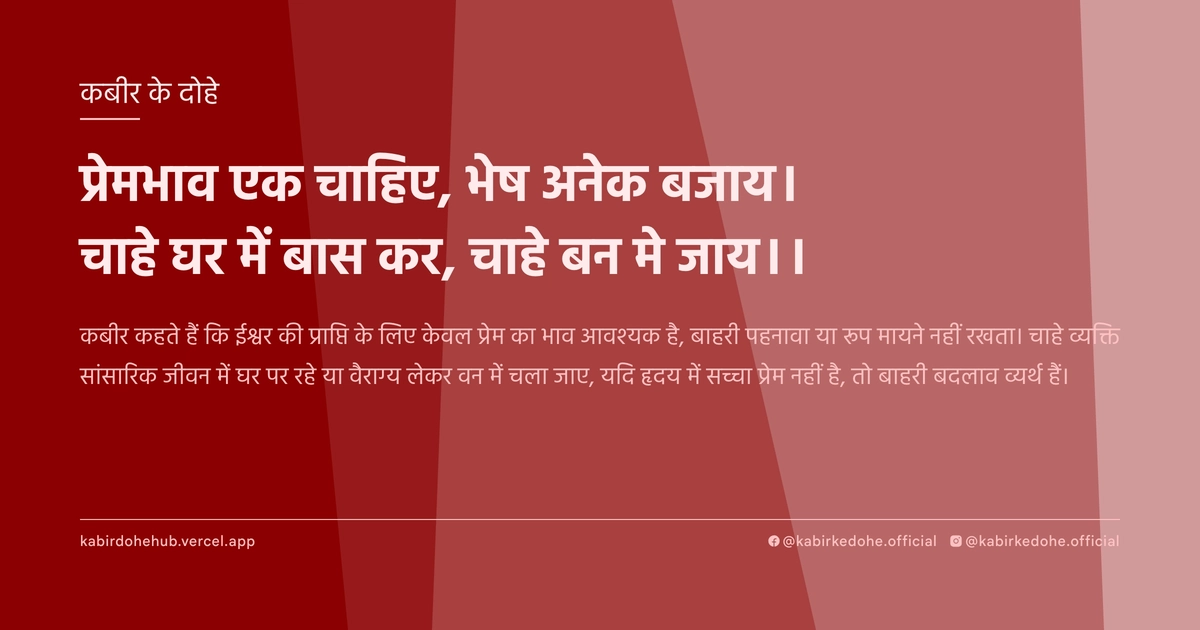
प्रेमभाव एक चाहिए, भेष अनेक बजाय।
चाहे घर में बास कर, चाहे बन मे जाय।।
Prembhav ek chahiye, bhesh anek bajay. Chahe ghar me baas kar, chahe ban me jaaye.
इस पृष्ठ पर इस कबीर दोहे का अर्थ (meaning), हिंदी व्याख्या और अंग्रेज़ी अनुवाद, दार्शनिक विश्लेषण और व्यावहारिक जीवन सीख दी गई है। यह दोहा भक्ति (Bhakti) विषय से जुड़ा है — Kabir doha meaning and explanation in Hindi and English.
अर्थ (Meaning):
कबीर कहते हैं कि ईश्वर की प्राप्ति के लिए केवल प्रेम का भाव आवश्यक है, बाहरी पहनावा या रूप मायने नहीं रखता। चाहे व्यक्ति सांसारिक जीवन में घर पर रहे या वैराग्य लेकर वन में चला जाए, यदि हृदय में सच्चा प्रेम नहीं है, तो बाहरी बदलाव व्यर्थ हैं।
Kabir asserts that the only essential requirement for spiritual realization is the essence of love. External appearances, rituals, or outward identities are irrelevant. Whether one resides within the domesticity of a home or retreats into the solitude of a forest, the location is secondary to the internal state of devotion.
व्याख्या (Interpretation):
इस दोहे का शाब्दिक अर्थ है कि प्रेम की भावना एक ही होती है, भले ही उसे व्यक्त करने वाले लोग अलग-अलग वेशभूषा में हों। आध्यात्मिक स्तर पर, यह 'निर्गुण भक्ति' का समर्थन करता है, जहाँ ईश्वर किसी विशेष आकार या स्थान में नहीं, बल्कि प्रेम की शुद्धता में बसता है। यहाँ 'घर' और 'वन' केवल स्थान नहीं, बल्कि मानसिक अवस्थाएँ हैं—एक मोह का प्रतीक है और दूसरा वैराग्य का। कबीर समझाते हैं कि माया का भ्रम बाहरी त्याग में नहीं, बल्कि आंतरिक आसक्ति में है। जब आत्मा (Atman) और परमात्मा (Brahman) के बीच केवल प्रेम का सेतु बचता है, तब द्वैत समाप्त हो जाता है। यह विरोधाभास है कि जिसे हम बाहर ढूँढते हैं, वह हमारे भीतर के प्रेम में ही निहित है।
Literally, the verse suggests that while outward forms vary, the essence of love remains singular. Metaphorically, this is a profound endorsement of Nirgun Bhakti, where the Divine is not confined to an image or a specific geography but resides in the purity of love. 'Home' and 'Forest' represent the psychological poles of attachment and renunciation. Kabir argues that Maya (illusion) is not found in the presence of family or possessions, but in the attachment to them. When the bridge between the Atman (individual soul) and Brahman (universal consciousness) is built solely with love, duality dissolves. The central paradox is that the liberation sought through external flight is actually achieved through internal alignment.
दार्शनिक विश्लेषण (Philosophical Analysis):
कबीर का यह विचार उनके युग के कट्टरपंथी धार्मिक ढांचे पर एक प्रहार था, जहाँ धर्म को केवल बाहरी प्रतीकों—जैसे तिलक, माला, या गेरुए वस्त्रों—से पहचाना जाता था। उन्होंने स्पष्ट किया कि आध्यात्मिकता का पैमाना 'वेश' (पहनावा) नहीं, बल्कि 'भाव' (अंतःकरण की स्थिति) है। यह दृष्टिकोण अद्वैत वेदांत के करीब है, जो मानता है कि सत्य एक है, भले ही उसे पाने के मार्ग अलग दिखें।
सूफी मत के 'इश्क-ए-हकीकी' (ईश्वरीय प्रेम) का प्रभाव यहाँ स्पष्ट है, जहाँ प्रेमी और प्रियतम का भेद मिट जाता है। कबीर का तर्क है कि यदि हृदय में प्रेम नहीं है, तो वन में जाना केवल एक शारीरिक विस्थापन है, आध्यात्मिक रूपांतरण नहीं। वे कर्मकांडों की निरर्थकता को उजागर करते हैं, यह बताते हुए कि ईश्वर किसी विशेष 'यूनिफॉर्म' का मोहताज नहीं है।
मनोवैज्ञानिक स्तर पर, यह दोहा 'पहचान के संकट' को संबोधित करता है। मनुष्य अक्सर अपनी बाहरी पहचान (जाति, धर्म, पद) को ही अपनी वास्तविकता मान लेता है। कबीर इस अहंकार (Ego) को नष्ट करने की बात करते हैं, क्योंकि अहंकार ही वह पर्दा है जो हमें प्रेम के सार्वभौमिक सत्य से अलग करता है।
यह शिक्षण हमें सिखाता है कि वास्तविक वैराग्य 'बाहरी त्याग' नहीं, बल्कि 'आंतरिक अनासक्ति' है। एक गृहस्थ भी उतना ही पवित्र हो सकता है जितना कि एक संन्यासी, यदि उसका हर कार्य प्रेम से प्रेरित हो। यहाँ प्रेम केवल एक भावना नहीं, बल्कि एक आध्यात्मिक अनुशासन है जो व्यक्ति को स्वयं से ऊपर उठाकर संपूर्णता में विलीन कर देता है।
अंततः, कबीर यह स्थापित करते हैं कि सत्य सार्वभौमिक है। जब हम भेदों को मिटाकर केवल प्रेम को देखते हैं, तब हम उस बिंदु पर पहुँचते हैं जहाँ धर्म, संप्रदाय और स्थान अपनी प्रासंगिकता खो देते हैं और केवल शुद्ध चेतना शेष रह जाती है।
Kabir’s assertion is a direct critique of the rigid religious structures of his era, where spirituality was often reduced to external markers—beads, tilaks, or saffron robes. He posits that the metric of spiritual progress is not 'Vesh' (outward attire) but 'Bhav' (the internal state of being). This aligns closely with Advaita Vedanta, which suggests that while paths may appear diverse, the ultimate Truth is singular and non-dual.
The influence of Sufism’s 'Ishq-e-Haqiqi' (Divine Love) is evident here, where the boundary between the lover and the Beloved vanishes. Kabir argues that without love, retreating to a forest is merely a physical relocation, not a spiritual transformation. He exposes the futility of ritualism, suggesting that the Divine is not captivated by a specific 'uniform' of holiness.
Psychologically, this verse addresses the crisis of identity. Humans often mistake their social masks—caste, creed, or status—for their true essence. Kabir advocates for the annihilation of the ego, as the ego is the primary veil separating the individual from the universal truth of love.
He teaches that true renunciation is not 'external abandonment' but 'internal detachment.' A householder can be as liberated as a forest-dwelling ascetic if every action is rooted in love. Here, love is not a mere emotion but a spiritual discipline that elevates the individual beyond the self into the totality of existence.
Ultimately, Kabir establishes that Truth is universal. When we strip away the distinctions and perceive only love, religions, sects, and geographies lose their relevance, leaving behind only pure, unadulterated consciousness.
मूल संदेश (Core Message):
- बाहरी दिखावा आध्यात्मिक प्रगति का प्रमाण नहीं है।
- प्रेम ही वह एकमात्र कुंजी है जो परमात्मा का द्वार खोलती है।
- सच्चा वैराग्य मन के भीतर होता है, स्थान बदलने से नहीं।
- ईश्वर किसी विशेष पोशाक या धर्म का मोहताज नहीं है।
- आंतरिक भाव की शुद्धता ही वास्तविक पूजा है।
- अहंकार का त्याग ही प्रेम की पहली शर्त है।
- Outward appearance is not a metric of spiritual evolution.
- Love is the sole key that unlocks the gateway to the Divine.
- True renunciation occurs within the mind, not through geography.
- The Divine is not bound by specific attire or religious labels.
- The purity of internal intent is the only authentic worship.
- The dissolution of ego is the primary prerequisite for love.
व्यावहारिक उदाहरण (Practical Example):
वाराणसी के एक पुराने घाट पर माधव नाम का एक वृद्ध बुनकर रहता था। माधव का जीवन सादगी से भरा था, लेकिन वह अपने भीतर एक गहरी बेचैनी महसूस करता था। उसने देखा कि उसके शहर में कई साधु-संत थे जो भस्म लगाते थे और घने जंगलों में तपस्या करने का दावा करते थे, जबकि कुछ लोग केवल मंदिर की सीढ़ियों पर बैठकर उपदेश देते थे। माधव को लगा कि शायद वह कभी ईश्वर को नहीं पा सकेगा क्योंकि वह एक साधारण बुनकर है और उसके पास न तो संन्यास का साहस है और न ही कोई विशेष धार्मिक ज्ञान।
एक दिन, माधव ने देखा कि एक अत्यंत वृद्ध महिला, जो शहर की सबसे गरीब विधवा मानी जाती थी, अपने हिस्से की एक रोटी एक भूखे कुत्ते को खिला रही थी। उसके चेहरे पर एक ऐसी शांति और चमक थी जो माधव ने बड़े-बड़े विद्वानों के चेहरे पर भी नहीं देखी थी। वह महिला किसी मंदिर नहीं जाती थी, न ही उसने कोई विशेष वस्त्र पहने थे; वह बस अपने छोटे से कमरे में रहती थी और सबके प्रति करुणा रखती थी।
माधव ने उस महिला से पूछा, 'माँ, आप इतनी शांति कैसे पा लेती हैं? क्या आपने कोई कठिन तपस्या की है या किसी दूर के वन में जाकर ज्ञान प्राप्त किया है?' उस महिला ने मुस्कुराकर जवाब दिया, 'बेटा, मैंने कभी वन नहीं देखा। मेरा यह छोटा सा कमरा ही मेरा मंदिर है और हर जीव में मुझे मेरा ईश्वर दिखता है। मैंने बस प्रेम करना सीखा है, बाकी सब तो केवल कपड़े बदलने जैसा है।'
यह सुनकर माधव के भीतर कुछ टूट गया। उसे समझ आया कि वह अब तक 'वेश' की तलाश कर रहा था—कि कैसे दिखना चाहिए या कहाँ होना चाहिए। उसने महसूस किया कि उसकी करघे की खट-खट भी एक प्रार्थना बन सकती है यदि वह हर धागे को प्रेम से पिरोए।
अगले दिन से माधव ने अपना जीवन बदल दिया। उसने संन्यास नहीं लिया, बल्कि अपने काम को ही अपनी साधना बना लिया। वह अब केवल कपड़े नहीं बुनता था, बल्कि अपने पड़ोसियों की मदद करता, दुखी लोगों को सहारा देता और अपने काम में पूरी ईमानदारी और प्रेम डालता।
धीरे-धीरे, लोग माधव के पास आने लगे। वे उसकी बातों में वह गहराई महसूस करते थे जो उन्हें बड़े-बड़े प्रवचनों में नहीं मिलती थी। माधव अब भी वही साधारण बुनकर था, उसी पुराने घर में रहता था, लेकिन उसका आंतरिक रूपांतरण उसे एक जीवित संत बना चुका था।
उसने जान लिया था कि ईश्वर किसी विशेष स्थान या पोशाक में नहीं, बल्कि उस निस्वार्थ प्रेम में है जो एक इंसान को दूसरे इंसान से, और आत्मा को परमात्मा से जोड़ता है।
माधव की कहानी यह सिद्ध करती है कि जब प्रेम का भाव जागता है, तो साधारण गृहस्थी भी एक पवित्र तीर्थ बन जाती है।
In the ancient ghats of Varanasi lived an elderly weaver named Madhav. His life was simple, yet he carried a deep inner restlessness. He observed the city filled with ascetics smeared in ash and scholars who claimed to have found truth in distant forests or through rigorous rituals. Madhav felt he would never reach the Divine because he was merely a weaver, lacking the courage for renunciation or the pedigree of religious scholarship.
One day, Madhav noticed an elderly widow, regarded as one of the poorest in the city, feeding her only piece of bread to a stray dog. Her face radiated a serenity and luminosity that Madhav had never seen even in the most learned pundits. This woman did not frequent temples, nor did she wear any special attire; she lived in a tiny, dilapidated room and treated everyone with profound compassion.
Curious, Madhav asked her, 'Mother, how do you possess such peace? Have you performed severe penance or traveled to some distant forest for enlightenment?' The woman smiled and replied, 'Son, I have never seen a forest. This small room is my temple, and I see the Divine in every living being. I have simply learned to love; everything else is just a change of clothes.'
These words shattered Madhav's misconceptions. He realized he had been searching for the 'Vesh'—the outward form—believing that spirituality required a specific look or location. He understood that the rhythmic clatter of his loom could become a prayer if every thread was woven with love.
From that day, Madhav transformed his life. He did not renounce his home; instead, he turned his daily labor into a spiritual practice. He no longer just wove cloth; he wove kindness into his community, supporting the grieving and working with absolute integrity and love.
Gradually, people began to gravitate toward Madhav. They found a depth in his presence that was missing from formal sermons. Madhav remained the same simple weaver in the same old house, but his internal alchemy had turned him into a living saint.
He had discovered that God does not reside in a specific costume or geography, but in the selfless love that connects one human to another, and the soul to the Infinite.
Madhav's story proves that when the essence of love awakens, the most ordinary domestic life becomes a sacred pilgrimage.
अभ्यास मार्गदर्शन (Practice Guidance):
- दैनिक चिंतन: प्रतिदिन 15 मिनट मौन बैठें और विचार करें कि क्या आपके कार्य बाहरी दिखावे से प्रेरित हैं या आंतरिक प्रेम से।
- आत्म-पूछताछ जर्नल: लिखें कि आप किन लोगों को उनके 'वेश' या सामाजिक स्थिति के कारण कम या ज्यादा आंकते हैं, और फिर उस पूर्वाग्रह को प्रेम में बदलने का प्रयास करें।
- व्यवहारिक परिवर्तन: दिन में कम से कम एक ऐसा कार्य करें जिसमें कोई बाहरी प्रशंसा न हो, केवल दूसरे की भलाई का भाव हो।
- नैदानिक चेकलिस्ट: क्या मैं अपनी आध्यात्मिक पहचान को दूसरों से श्रेष्ठ दिखाने की कोशिश कर रहा हूँ? क्या मेरा व्यवहार घर के बाहर और भीतर अलग है? यदि हाँ, तो आप अभी भी 'वेश' में फंसे हैं।
- Daily Contemplation: Spend 15 minutes in silence, questioning whether your actions are driven by outward appearances or an internal essence of love.
- Self-Inquiry Journaling: Document instances where you judged others based on their 'Vesh' (social status or attire), and consciously work to replace that bias with empathy.
- Behavioral Shift: Perform at least one act of kindness daily that offers no social reward or visibility, focusing solely on the act of loving.
- Diagnostic Checklist: Do I attempt to project my spiritual identity as superior to others? Is my behavior inconsistent between my public and private life? If yes, you are still clinging to the 'costume' of spirituality.
चिंतन प्रश्न (Reflection Questions):
- यदि आपसे आपकी सारी सामाजिक पहचान (पद, धर्म, जाति) छीन ली जाए, तो आपके भीतर क्या बचेगा?
- क्या आप वास्तव में दूसरों से प्रेम करते हैं, या आप उस 'छवि' से प्रेम करते हैं जो आप दूसरों के सामने पेश करते हैं?
- आपकी 'आध्यात्मिक पोशाक' (जैसे आपकी नैतिकता या ज्ञान का प्रदर्शन) आपके वास्तविक स्वभाव को छिपाने का साधन तो नहीं बन गई है?
- क्या आप शांति की तलाश में 'वन' (पलायन) की ओर भाग रहे हैं, जबकि समाधान आपके 'घर' (वर्तमान क्षण) में है?
- आपके जीवन का कौन सा हिस्सा केवल दूसरों को दिखाने के लिए है और कौन सा वास्तव में आपके हृदय के करीब है?
- If all your social identities—status, religion, caste—were stripped away, what would remain of you?
- Do you truly love others, or are you in love with the 'image' of yourself as a loving person?
- Has your 'spiritual attire'—your display of morality or knowledge—become a mask to hide your true nature?
- Are you fleeing toward a 'forest' (escapism) in search of peace, while the solution lies within your 'home' (the present moment)?
- Which part of your life is performed solely for an audience, and which part is genuinely close to your heart?