
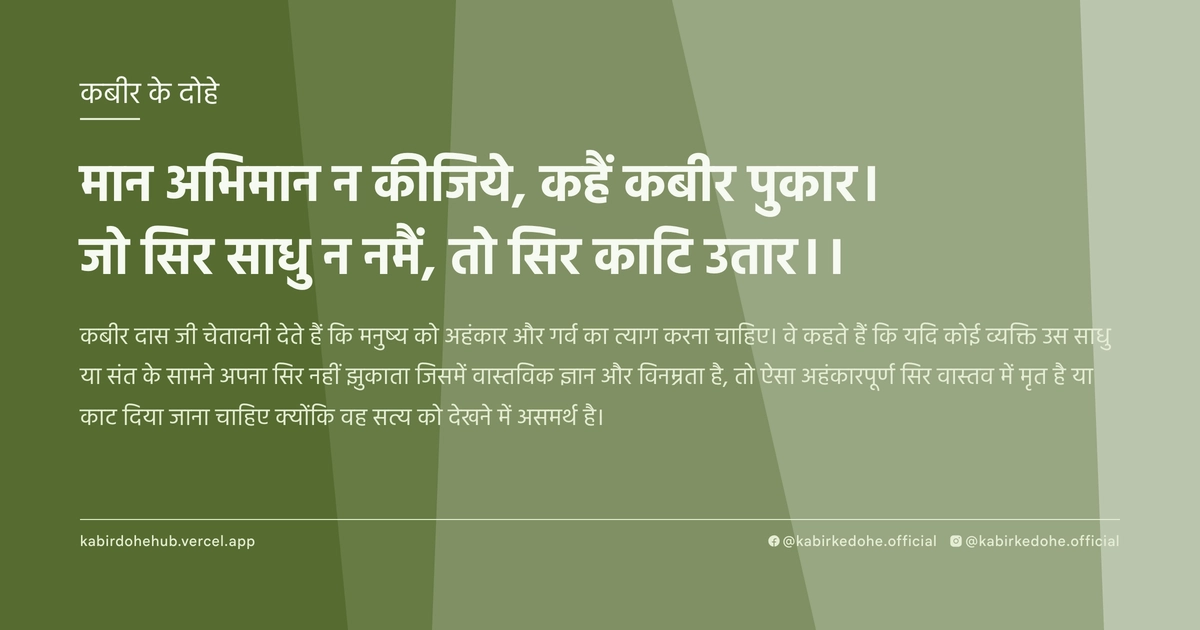
मान अभिमान न कीजिये, कहैं कबीर पुकार।
जो सिर साधु न नमैं, तो सिर काटि उतार।।
Maan abhiman na kariye, kahain kabir pukaar. Jo sir sadhu na namai, to sir kaati utaar.
इस पृष्ठ पर इस कबीर दोहे का अर्थ (meaning), हिंदी व्याख्या और अंग्रेज़ी अनुवाद, दार्शनिक विश्लेषण और व्यावहारिक जीवन सीख दी गई है। यह दोहा विनम्रता (Humility) विषय से जुड़ा है — Kabir doha meaning and explanation in Hindi and English.
अर्थ (Meaning):
कबीर दास जी चेतावनी देते हैं कि मनुष्य को अहंकार और गर्व का त्याग करना चाहिए। वे कहते हैं कि यदि कोई व्यक्ति उस साधु या संत के सामने अपना सिर नहीं झुकाता जिसमें वास्तविक ज्ञान और विनम्रता है, तो ऐसा अहंकारपूर्ण सिर वास्तव में मृत है या काट दिया जाना चाहिए क्योंकि वह सत्य को देखने में असमर्थ है।
Kabir warns against the perils of pride and arrogance. He asserts that one must renounce the ego. If a person refuses to bow their head before a true saint—one who embodies wisdom and humility—then that head is effectively useless or deserves to be severed, as it is blinded by ego and incapable of perceiving the Divine Truth.
व्याख्या (Interpretation):
शाब्दिक अर्थ में यह दोहा विनम्रता का आह्वान करता है, लेकिन आध्यात्मिक स्तर पर यह 'अहंकार' के विनाश की बात करता है। यहाँ 'साधु' केवल एक व्यक्ति नहीं, बल्कि उस जागृत चेतना का प्रतीक है जो माया के पार देख चुकी है। 'सिर काटना' शारीरिक हिंसा नहीं, बल्कि मानसिक रूपांतरण है; यह उस झूठे 'मैं' (अहंकार) की मृत्यु है जो हमें ब्रह्म से अलग करता है। यह निर्गुण भक्ति का सार है जहाँ साधक को यह समझना होता है कि जब तक 'मैं' है, तब तक 'वह' (ईश्वर) नहीं मिल सकता। यह अद्वैत वेदांत के उस सिद्धांत को दर्शाता है जहाँ व्यक्तिगत पहचान का विलीनीकरण सार्वभौमिक चेतना में होता है। अंततः, यह दोहा इस विरोधाभास को उजागर करता है कि वास्तविक सम्मान केवल उसी को मिलता है जो स्वयं को पूरी तरह शून्य कर देता है।
Literally, this couplet calls for humility, but spiritually, it demands the annihilation of the 'Ahamkara' (ego). The 'Sadhu' here is not merely a person but a symbol of awakened consciousness that has transcended Maya. The phrase 'severing the head' does not imply physical violence, but rather a psychological metamorphosis; it represents the death of the false identity that separates the Atman from Brahman. This aligns with Nirgun Bhakti, where the seeker realizes that as long as the 'I' exists, the Divine cannot be realized. It mirrors the Advaita Vedanta principle of non-duality, where the individual ego must dissolve into the universal consciousness. Ultimately, it highlights the paradox that true honor is attained only by those who render themselves completely void of pride.
दार्शनिक विश्लेषण (Philosophical Analysis):
कबीर का यह दोहा उस सामाजिक और धार्मिक परिवेश में लिखा गया था जहाँ जातिगत श्रेष्ठता और बाहरी कर्मकांडों का बोलबाला था। कबीर ने देखा कि लोग मंदिर-मस्जिद में तो झुकते हैं, लेकिन वास्तव में उनके भीतर अहंकार की दीवारें खड़ी हैं। वे ritualism का विरोध करते हुए कहते हैं कि बाहरी झुकना व्यर्थ है यदि आंतरिक अहंकार जीवित है।
दार्शनिक रूप से, यह सूफी मत के 'फना' (स्वयं को मिटा देना) और वेदांत के 'अहं ब्रह्मास्मि' के बीच का सेतु है। जब तक मनुष्य अपनी सामाजिक स्थिति, ज्ञान या संपत्ति के अभिमान में रहता है, वह सत्य के मार्ग पर चलने के योग्य नहीं होता। कबीर के लिए, साधु वह है जिसने अपनी वासनाओं और अहंकार पर विजय प्राप्त कर ली है।
अहंकार को 'सिर' के रूप में चित्रित करना अत्यंत सटीक है क्योंकि मस्तिष्क ही तर्क और पहचान का केंद्र है। जब यह तर्क 'मैं श्रेष्ठ हूँ' में बदल जाता है, तो यह आध्यात्मिक अंधापन पैदा करता है। कबीर यहाँ एक कठोर भाषा का प्रयोग कर रहे हैं ताकि साधक की गहरी नींद (अज्ञान) टूटे।
यह विश्लेषण स्पष्ट करता है कि विनम्रता कोई कमजोरी नहीं, बल्कि उच्चतम आध्यात्मिक शक्ति है। जो व्यक्ति झुकना जानता है, वही वास्तव में ऊपर उठने की क्षमता रखता है। यह अहंकार का विसर्जन ही वह द्वार है जिससे होकर आत्मा परमात्मा में विलीन होती है।
अंततः, कबीर यह संदेश देते हैं कि सत्य किसी शास्त्र या पद में नहीं, बल्कि उस सरलता में है जो अहंकार रहित होती है। यह दोहा हमें सिखाता है कि ज्ञान का असली प्रमाण विनम्रता है, न कि पांडित्य।
This couplet was composed in a socio-religious era dominated by caste hierarchies and rigid ritualism. Kabir observed that while people bowed in temples and mosques, they maintained towering walls of arrogance within. He rejects ritualism, asserting that external prostration is futile if the internal ego remains intact.
Philosophically, this is a bridge between the Sufi concept of 'Fana' (annihilation of the self) and the Vedantic realization of non-duality. As long as a human clings to the pride of social status, knowledge, or wealth, they remain unfit for the path of Truth. For Kabir, a 'Sadhu' is one who has conquered their desires and ego.
Depicting the ego as the 'head' is precise, as the mind is the center of logic and identity. When logic transforms into the belief 'I am superior,' it creates spiritual blindness. Kabir employs harsh language here as a shock tactic to awaken the seeker from the deep slumber of ignorance.
This analysis clarifies that humility is not a weakness but the highest spiritual power. Only the one who knows how to bow possesses the capacity to truly rise. The dissolution of the ego is the only gateway through which the Atman merges with the Brahman.
Ultimately, Kabir conveys that Truth resides not in scriptures or titles, but in the simplicity that is devoid of pride. This couplet teaches us that the true evidence of wisdom is humility, not scholarship.
मूल संदेश (Core Message):
- अहंकार वह पर्दा है जो ईश्वर और जीव के बीच खड़ा है।
- सच्ची श्रेष्ठता केवल पूर्ण समर्पण और विनम्रता में निहित है।
- ज्ञान का अंतिम लक्ष्य अहंकार का विनाश होना चाहिए।
- बाहरी आडंबरों से अधिक आंतरिक शून्यता का महत्व है।
- जब 'मैं' मिटता है, तभी 'सत्य' का उदय होता है।
- Ego is the veil that stands between the Divine and the individual.
- True superiority resides only in total surrender and humility.
- The ultimate goal of knowledge must be the annihilation of the ego.
- Internal emptiness is far more valuable than external rituals.
- Only when the 'I' vanishes does the 'Truth' emerge.
व्यावहारिक उदाहरण (Practical Example):
वाराणसी के एक पुराने मोहल्ले में रामदीन नाम का एक अत्यंत कुशल बुनकर रहता था। उसकी बनाई साड़ियाँ पूरे शहर में प्रसिद्ध थीं। अपनी कला के कारण रामदीन में भारी अहंकार आ गया था। वह मानता था कि उसके जैसा कोई दूसरा कलाकार नहीं है और वह अपने से छोटे बुनकरों को तुच्छ समझता था।
एक दिन, उसके मोहल्ले में एक फटे-पुराने कपड़ों में एक वृद्ध साधु आए। वे बहुत शांत थे और उनकी आँखों में एक अजब सी चमक थी। रामदीन ने उन्हें देखा, लेकिन उनके साधारण पहनावे के कारण उन्हें सम्मान नहीं दिया और उल्टा उनका उपहास किया।
साधु ने मुस्कुराते हुए रामदीन से कहा, 'बेटा, धागे तो तुम बहुत सुंदर जोड़ते हो, लेकिन क्या तुमने अपने अहंकार के धागे को तोड़ना सीखा?' रामदीन को यह बात चुभी और उसने क्रोध में कहा कि वह शहर का सबसे बड़ा कलाकार है, उसे किसी उपदेश की ज़रूरत नहीं।
अगले दिन, रामदीन ने एक बहुत ही विशेष शाही पोशाक तैयार की। लेकिन जैसे ही उसने अंतिम धागा पिरोया, उसका हाथ काँपा और पूरी मेहनत से बनी वह पोशाक फट गई। वह हताश होकर बैठ गया। उसे महसूस हुआ कि उसकी सारी कुशलता उसके नियंत्रण में नहीं थी।
उसी समय उसे साधु की बात याद आई। उसे समझ आया कि उसकी कला उसकी नहीं, बल्कि उस परमात्मा की देन थी। वह जिसे अपनी उपलब्धि मान रहा था, वह वास्तव में एक उपहार था।
रामदीन दौड़कर उस साधु के पास गया और उनके चरणों में गिर पड़ा। उसने पहली बार महसूस किया कि उसका 'सिर' (अहंकार) वास्तव में उसे सत्य देखने से रोक रहा था।
उसने साधु से क्षमा मांगी और अपनी कला को सेवा के रूप में देखना शुरू किया। अब वह अन्य बुनकरों को सिखाने लगा और उनके साथ सम्मानपूर्वक व्यवहार करने लगा।
रामदीन के जीवन में यह बदलाव केवल व्यवहारिक नहीं था, बल्कि आध्यात्मिक था। उसका काम अब और भी सुंदर हो गया था क्योंकि अब उसमें 'मैं' नहीं, बल्कि 'समर्पण' था।
In an old neighborhood of Varanasi lived Ramdeen, an exceptionally skilled weaver. His sarees were famous throughout the city. Due to his artistry, Ramdeen developed a massive ego. He believed no other artist matched his skill and looked down upon junior weavers as insignificant.
One day, an elderly monk dressed in tattered clothes arrived in his neighborhood. The monk was profoundly calm, with a strange brilliance in his eyes. Ramdeen saw him, but because of his simple attire, he offered no respect and instead mocked him.
The monk smiled and said, 'Son, you weave threads beautifully, but have you learned to break the threads of your arrogance?' Ramdeen felt stung and replied angrily that he was the city's greatest artist and needed no preaching.
The next day, Ramdeen prepared a special royal garment. However, as he threaded the final stitch, his hand trembled, and the entire masterpiece tore apart. He sat in utter despair, realizing that his skill was not entirely under his control.
At that moment, the monk's words echoed in his mind. He realized that his art was not his own, but a gift from the Divine. What he had claimed as his achievement was, in reality, a grace.
Ramdeen rushed to the monk and fell at his feet. For the first time, he felt that his 'head' (ego) had been preventing him from seeing the Truth.
He sought forgiveness and began to view his art as a form of service. He started teaching other weavers and treating them with genuine respect.
This transformation in Ramdeen's life was not merely behavioral but spiritual. His work became even more beautiful because it was no longer driven by 'I', but by 'surrender'.
अभ्यास मार्गदर्शन (Practice Guidance):
- दैनिक अभ्यास: प्रतिदिन 15 मिनट मौन बैठें और विचार करें कि आपकी कौन सी उपलब्धियाँ आपको दूसरों से श्रेष्ठ महसूस कराती हैं। उन्हें एक कागज पर लिखें और फिर उस कागज को जला दें, यह प्रतीक मानते हुए कि आपका अहंकार भस्म हो रहा है।
- आत्म-पूछताछ: जब भी आप किसी पर क्रोध करें या किसी को छोटा समझें, तो स्वयं से पूछें—'यह कौन है जो क्रोध कर रहा है? क्या यह मेरी आत्मा है या मेरा सामाजिक मुखौटा?'
- व्यवहार परिवर्तन: दिन में कम से कम एक बार किसी ऐसे व्यक्ति की मदद करें या उनसे कुछ सीखें जिन्हें समाज 'निम्न' मानता है, ताकि आपके भीतर की श्रेष्ठता की भावना समाप्त हो सके।
- निदान चेकलिस्ट: यदि आप किसी की आलोचना सुनकर विचलित होते हैं, या अपनी प्रशंसा सुनकर अत्यधिक उत्साहित होते हैं, तो समझ लें कि आपका अहंकार अभी भी जीवित है और आपको विनम्रता के अभ्यास की आवश्यकता है।
- Daily Practice: Sit in silence for 15 minutes daily and identify which achievements make you feel superior to others. Write them on a piece of paper and burn it, symbolizing the cremation of your ego.
- Self-Inquiry: Whenever you feel anger toward someone or perceive them as inferior, ask yourself—'Who is it that is feeling this anger? Is it my soul, or my social mask?'
- Behavioral Change: At least once a day, help or learn something from someone whom society deems 'lowly,' to dismantle the internal sense of superiority.
- Diagnostic Checklist: If you feel disturbed by criticism or overly elated by praise, recognize that your ego is still active and you require deeper practice in humility.
चिंतन प्रश्न (Reflection Questions):
- आपकी वह कौन सी पहचान (पद, डिग्री, संपत्ति) है जिसे खोने के विचार मात्र से आप भयभीत हो जाते हैं?
- क्या आप वास्तव में दूसरों का सम्मान करते हैं, या आप केवल उस सम्मान को चाहते हैं जो आपको दूसरों से मिलता है?
- डिजिटल युग में, आपकी सोशल मीडिया प्रोफाइल आपके असली व्यक्तित्व को कितना ढक लेती है?
- क्या आपकी विनम्रता एक रणनीति है दूसरों को प्रभावित करने की, या यह आपके भीतर का वास्तविक स्वभाव है?
- यदि आपसे आपकी सारी उपलब्धियाँ छीन ली जाएँ, तो आपके पास क्या बचेगा?
- आप किन लोगों को 'साधु' या 'गुरु' मानने से इनकार करते हैं क्योंकि वे आपकी अपेक्षाओं के अनुरूप नहीं हैं?
- Which identity (title, degree, wealth) do you cling to so tightly that the mere thought of losing it terrifies you?
- Do you truly respect others, or do you merely crave the respect that others give to you?
- In the digital age, how much does your social media profile mask your authentic self?
- Is your humility a strategy to influence others, or is it a genuine internal state?
- If all your achievements were stripped away, what would remain of you?
- Which people do you refuse to acknowledge as 'saints' or 'teachers' simply because they do not fit your preconceived expectations?