
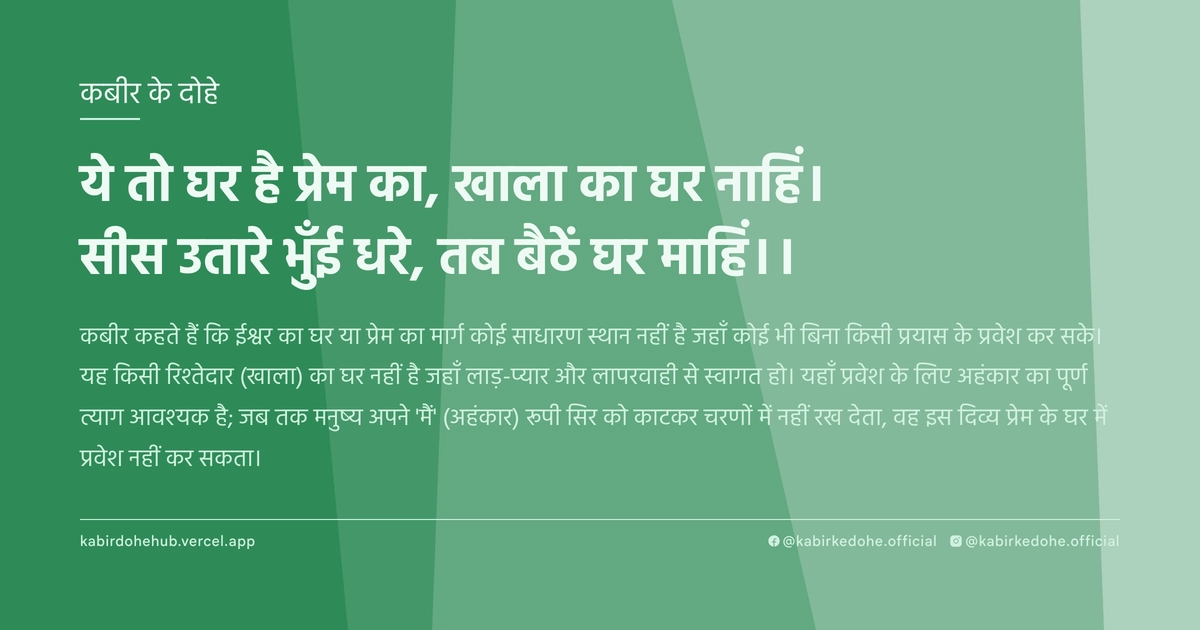
ये तो घर है प्रेम का, खाला का घर नाहिं।
सीस उतारे भुँई धरे, तब बैठें घर माहिं।।
Ye to ghar hai prem ka, khala ka ghar nahin. Sees utare bhunyi dhare, tab baithen ghar mahin.
इस पृष्ठ पर इस कबीर दोहे का अर्थ (meaning), हिंदी व्याख्या और अंग्रेज़ी अनुवाद, दार्शनिक विश्लेषण और व्यावहारिक जीवन सीख दी गई है। यह दोहा प्रपत्ति (Surrender) विषय से जुड़ा है — Kabir doha meaning and explanation in Hindi and English.
अर्थ (Meaning):
कबीर कहते हैं कि ईश्वर का घर या प्रेम का मार्ग कोई साधारण स्थान नहीं है जहाँ कोई भी बिना किसी प्रयास के प्रवेश कर सके। यह किसी रिश्तेदार (खाला) का घर नहीं है जहाँ लाड़-प्यार और लापरवाही से स्वागत हो। यहाँ प्रवेश के लिए अहंकार का पूर्ण त्याग आवश्यक है; जब तक मनुष्य अपने 'मैं' (अहंकार) रूपी सिर को काटकर चरणों में नहीं रख देता, वह इस दिव्य प्रेम के घर में प्रवेश नहीं कर सकता।
Kabir asserts that the abode of Divine Love is not a place of casual entry or familial indulgence. It is not the house of a maternal aunt (khala) where one is welcomed with blind affection and effortless ease. To enter this sacred space, one must undergo a radical transformation: the total surrender of the ego. Only when the 'head'—symbolizing the pride and intellectual arrogance of the self—is severed and placed at the threshold of humility can the seeker truly dwell within the house of Love.
व्याख्या (Interpretation):
यह दोहा प्रतीकात्मक रूप से 'अहंकार' और 'समर्पण' के द्वंद्व को दर्शाता है। 'खाला का घर' उस सांसारिक सुख और मोह का प्रतीक है जहाँ व्यक्ति अपनी इच्छाओं के अनुसार व्यवहार करता है। इसके विपरीत, 'प्रेम का घर' निर्गुण भक्ति का वह शिखर है जहाँ द्वैत समाप्त हो जाता है। 'सीस उतारना' शारीरिक मृत्यु नहीं, बल्कि मानसिक और आध्यात्मिक मृत्यु है—अर्थात उस 'अहंकार' का अंत जो आत्मा को परमात्मा से अलग मानता है। जब तक 'मैं' जीवित है, तब तक 'वह' (ईश्वर) प्रकट नहीं हो सकता। यह अद्वैत वेदांत के उस सिद्धांत की पुष्टि करता है जहाँ जीव और ब्रह्म के बीच का एकमात्र पर्दा अहंकार है। इस विरोधाभास के माध्यम से कबीर समझाते हैं कि पूर्ण प्राप्ति के लिए पूर्ण विलोपन आवश्यक है।
This couplet symbolically portrays the conflict between 'Ego' and 'Surrender.' The 'aunt's house' represents the worldly realm of attachment and indulgence, where the self is pampered and desires are catered to without challenge. In contrast, the 'House of Love' signifies the pinnacle of Nirgun Bhakti, where duality dissolves. 'Severing the head' is not a literal act of violence but a metaphor for spiritual death—the annihilation of the 'I-consciousness' that separates the Atman from Brahman. In the philosophy of non-duality, the ego is the only veil obscuring the Truth. Kabir highlights a central paradox: to gain everything (the Divine), one must first become nothing. The 'head' represents the intellect and pride; only by sacrificing this perceived identity can the seeker experience the formless reality.
दार्शनिक विश्लेषण (Philosophical Analysis):
कबीर का यह संदेश उस समय के सामाजिक और धार्मिक परिवेश में एक क्रांतिकारी प्रहार था, जहाँ कर्मकांडों और बाहरी दिखावे को मोक्ष का मार्ग माना जाता था। वे स्पष्ट करते हैं कि तीर्थयात्रा, माला जपना या विशेष वस्त्र धारण करना 'प्रेम के घर' में प्रवेश का टिकट नहीं हैं। उनका दृष्टिकोण सूफी मत के 'फना' (स्वयं को मिटा देना) और अद्वैत वेदांत के 'अहं ब्रह्मास्मि' के बीच का एक सेतु है। सूफीवाद में जैसे प्रेमी अपने अस्तित्व को खुदा में विलीन कर देता है, वैसे ही कबीर यहाँ पूर्ण समर्पण की बात कर रहे हैं।
ऐतिहासिक रूप से, कबीर ने जाति और धर्म के ऊंच-नीच के भेदभाव को नकारते हुए यह बताया कि ईश्वर तक पहुँचने का मार्ग केवल आंतरिक शुद्धि और अहंकार के विसर्जन से होकर जाता है। वे ritualism (कर्मकांड) का विरोध करते हैं क्योंकि कर्मकांड अक्सर अहंकार को पुष्ट करते हैं ('मैं पूजा करता हूँ', 'मैं दान देता हूँ')।
मनोवैज्ञानिक स्तर पर, 'सीस उतारना' संज्ञानात्मक पुनर्गठन (cognitive restructuring) है। जब व्यक्ति अपनी पहचान को अपनी उपलब्धियों, पद या ज्ञान से जोड़ना बंद कर देता है, तब वह वास्तविक शांति का अनुभव करता है। यह अहंकार का विलोपन ही वह बिंदु है जहाँ से वास्तविक भक्ति शुरू होती है।
कबीर यहाँ 'प्रेम' को एक अनुशासन के रूप में प्रस्तुत करते हैं। प्रेम यहाँ केवल भावना नहीं, बल्कि एक अग्नि है जो अशुद्धियों को जला देती है। यह मार्ग कठिन है क्योंकि यह मनुष्य से उसकी सबसे प्रिय वस्तु—उसकी अपनी पहचान—मांगता है।
अंततः, यह दोहा हमें सिखाता है कि आध्यात्मिक प्रगति का मापदंड यह नहीं है कि हमने कितना ज्ञान अर्जित किया, बल्कि यह है कि हमने अपने अहंकार को कितना कम किया। ज्ञान यदि अहंकार को बढ़ाता है, तो वह बंधन है; यदि वह विनम्रता लाता है, तो वह मुक्ति है।
Kabir’s message was a revolutionary strike against the socio-religious climate of his era, where rituals and outward displays of piety were mistaken for the path to liberation. He clarifies that pilgrimages, chanting beads, or wearing specific robes are not tickets into the 'House of Love.' His perspective serves as a bridge between the Sufi concept of 'Fana' (annihilation of the self) and the Advaita Vedanta realization of 'Aham Brahmasmi.' Just as a Sufi lover dissolves their existence into the Divine, Kabir demands total surrender.
Historically, by rejecting caste and religious hierarchies, Kabir emphasized that the path to the Divine is paved solely with inner purification and the dissolution of the ego. He vehemently opposed ritualism because rituals often reinforce the ego—creating a sense of 'I am the one who prays' or 'I am the one who gives.'
On a psychological level, 'severing the head' represents a profound cognitive restructuring. When an individual ceases to define their identity through achievements, status, or intellectual superiority, they encounter true peace. This annihilation of the ego is the precise point where authentic devotion begins.
Kabir presents 'Love' not as a mere emotion, but as a rigorous spiritual discipline. Love here is a transformative fire that incinerates impurities. This path is arduous because it demands the sacrifice of the thing humans cherish most: their own perceived identity.
Ultimately, this couplet teaches that the metric of spiritual progress is not the accumulation of knowledge, but the reduction of the ego. Knowledge that inflates the self is a shackle; knowledge that fosters humility is liberation. The 'House of Love' is therefore an open door, but the entrance is too narrow for the ego to pass through.
मूल संदेश (Core Message):
- अहंकार वह दीवार है जो आत्मा को परमात्मा से अलग करती है।
- प्रेम का मार्ग समर्पण से शुरू होता है, अधिकार से नहीं।
- बौद्धिक श्रेष्ठता अक्सर आध्यात्मिक प्रगति में सबसे बड़ी बाधा बनती है।
- पूर्ण विलोपन ही पूर्ण प्राप्ति का एकमात्र द्वार है।
- विनम्रता कोई कमजोरी नहीं, बल्कि सर्वोच्च शक्ति का लक्षण है।
- The ego is the wall that separates the soul from the Divine.
- The path of Love begins with surrender, not with entitlement.
- Intellectual superiority is often the greatest obstacle to spiritual growth.
- Total annihilation of the self is the only gateway to total realization.
- Humility is not a weakness, but the hallmark of supreme strength.
व्यावहारिक उदाहरण (Practical Example):
वाराणसी के घाटों पर रहने वाले एक वृद्ध बुनकर, माधव, की कहानी है। माधव अपने काम में निपुण थे और पूरे शहर में उनकी साड़ियों की मांग थी। उनकी इस कुशलता ने उनके भीतर एक गहरा अहंकार पैदा कर दिया था। वे मानते थे कि उनके जैसा कलाकार पूरे बनारस में कोई नहीं है। वे अन्य बुनकरों को तुच्छ समझते थे और खुद को 'कला का स्वामी' कहते थे।
एक दिन उनके गाँव में एक फकीर आया, जिसने माधव की प्रशंसा सुनकर उनसे मिलने की इच्छा जताई। फकीर ने माधव की सबसे महंगी साड़ी देखी और सहजता से कहा, 'यह कपड़ा सुंदर है, लेकिन इसे बनाने वाले का अहंकार इस कपड़े की चमक को धुंधला कर रहा है।' माधव को यह बात चुभी। उन्होंने क्रोध में कहा, 'आप मेरी कला को नहीं जानते, मैं इस कला का शिखर हूँ!'
फकीर मुस्कुराया और बोला, 'शिखर पर पहुँचने के लिए पहले नीचे गिरना पड़ता है। तुम अपनी कला के घर में तो हो, लेकिन प्रेम के घर के द्वार पर खड़े हो और तुम्हारा सिर इतना ऊंचा है कि तुम दरवाजे से अंदर नहीं जा पा रहे।'
माधव को पहले तो यह बात समझ नहीं आई, लेकिन उस रात उन्हें नींद नहीं आई। उन्होंने महसूस किया कि उनकी कला अब उनकी सेवा नहीं, बल्कि उनका बोझ बन गई थी। वे अब दूसरों की मदद करने के बजाय अपनी प्रशंसा सुनने के भूखे थे।
अगले दिन, माधव ने अपनी सबसे कीमती साड़ियों का एक बड़ा हिस्सा उन गरीब बुनकरों को दान कर दिया जिन्हें वे अब तक नीचा दिखाते थे। उन्होंने अपनी कार्यशाला के बाहर एक छोटा सा बोर्ड लगाया जिस पर लिखा था—'मैं केवल एक माध्यम हूँ, कलाकार तो वह परमात्मा है।'
जैसे ही उन्होंने यह स्वीकार किया कि वे कुछ भी नहीं हैं, उनके मन का भारीपन गायब हो गया। उन्हें महसूस हुआ कि अब तक वे अपनी कला के पिंजरे में कैद थे।
उन्होंने देखा कि जब वे विनम्र हुए, तो अन्य बुनकर उनके पास सीखने आने लगे और माधव को उनके भीतर एक नई खुशी मिली जो प्रशंसा से कहीं अधिक गहरी थी।
यह 'कबीर ट्विस्ट' था—जब माधव ने अपने 'कलाकार' होने के अहंकार (सिर) को उतारा, तब जाकर वे वास्तव में प्रेम और संतोष के घर में प्रवेश कर पाए। उनकी कला अब व्यवसाय नहीं, बल्कि प्रार्थना बन गई थी।
Consider the story of Madhav, an elderly weaver living on the ghats of Varanasi. Madhav was a master of his craft, and his sarees were coveted throughout the city. However, this mastery birthed a profound ego. He believed no other artist in Banaras could match his skill, viewing other weavers as inferior and calling himself the 'Lord of Art.'
One day, a wandering fakir arrived in the village, drawn by the fame of Madhav's work. After observing Madhav's most expensive saree, the fakir remarked casually, 'The fabric is beautiful, but the weaver's ego is blurring the luster of the cloth.' Stung by this, Madhav retorted angrily, 'You do not understand my art; I am the pinnacle of this craft!'
The fakir smiled and replied, 'To reach the pinnacle, one must first learn to fall. You are in the house of your art, but you stand at the door of the House of Love, and your head is held so high that you cannot fit through the entrance.'
Madhav didn't understand at first, but he spent a sleepless night reflecting. He realized that his art had ceased to be a service and had become a burden. He was no longer hungry for creation, but for praise.
The next morning, Madhav donated a significant portion of his finest sarees to the impoverished weavers he had previously looked down upon. He placed a small sign outside his workshop: 'I am but a medium; the true Artist is the Divine.'
As he accepted his own insignificance, the heaviness in his heart vanished. He felt that he had been imprisoned by his own identity as a 'master.'
He noticed that as he became humble, other weavers flocked to him not out of fear or envy, but for genuine learning. Madhav found a joy deeper than any praise he had ever received.
This was the 'Kabir Twist'—when Madhav severed the head of his professional arrogance, he finally entered the House of Love. His art was no longer a business; it became a prayer.
अभ्यास मार्गदर्शन (Practice Guidance):
- दैनिक आत्म-निरीक्षण: प्रतिदिन 15 मिनट मौन बैठें और विचार करें कि आज दिन भर में कितनी बार 'मैं' (अहंकार) ने मेरी प्रतिक्रियाओं को नियंत्रित किया।
- सेवा का अभ्यास: किसी ऐसे व्यक्ति की निस्वार्थ मदद करें जिससे आप मानसिक रूप से खुद को श्रेष्ठ समझते हैं, बिना उन्हें यह बताए कि आप उनकी मदद कर रहे हैं।
- जर्नलिंग प्रॉम्प्ट: 'यदि मेरी सारी उपलब्धियाँ, पद और पहचान छीन ली जाएँ, तो मेरा वास्तविक अस्तित्व क्या बचेगा?' इस पर गहराई से लिखें।
- डायग्नोस्टिक चेकलिस्ट: क्या मैं दूसरों की आलोचना सुनकर विचलित होता हूँ? क्या मैं अपनी प्रशंसा की उम्मीद करता हूँ? क्या मैं खुद को दूसरों से अधिक आध्यात्मिक या ज्ञानी मानता हूँ? (यदि हाँ, तो अहंकार अभी जीवित है)।
- Daily Self-Observation: Spend 15 minutes in silence daily, observing how many times the 'I' (ego) dictated your reactions throughout the day.
- Practice of Service: Perform a selfless act of service for someone you subconsciously perceive as 'inferior' to yourself, ensuring they never know you were the benefactor.
- Journaling Prompt: 'If all my achievements, titles, and social identities were stripped away, what would remain of my true essence?' Write extensively on this.
- Diagnostic Checklist: Do I feel disturbed by criticism? Do I crave validation? Do I believe I am more spiritual or knowledgeable than others? (If yes, the ego is still active).
चिंतन प्रश्न (Reflection Questions):
- मेरा वह कौन सा 'मुखौटा' है जिसे मैं दुनिया के सामने सबसे गर्व से पहनता हूँ, और उसके पीछे मैं क्या छिपा रहा हूँ?
- क्या मेरी भक्ति या आध्यात्मिकता वास्तव में मुझे विनम्र बना रही है, या यह मेरे अहंकार को एक नया 'आध्यात्मिक' रूप दे रही है?
- जब मैं किसी की मदद करता हूँ, तो क्या मैं वास्तव में उस व्यक्ति को देख रहा होता हूँ, या अपनी ही 'उदारता' के प्रतिबिंब को?
- मेरे जीवन का वह कौन सा क्षेत्र है जहाँ मैं 'सही होने' की जिद में प्रेम को खो देता हूँ?
- यदि मुझे अपनी पूरी पहचान मिटानी पड़े, तो मुझे सबसे ज्यादा डर किस बात का लगेगा?
- What is the 'mask' I wear most proudly in public, and what shadow am I hiding behind it?
- Is my spirituality truly making me humble, or is it merely giving my ego a new 'spiritual' identity?
- When I help someone, am I truly seeing the other person, or am I seeing the reflection of my own 'generosity'?
- In which area of my life do I sacrifice love for the sake of being 'right'?
- If I were forced to erase my entire identity, what would be my greatest fear?