
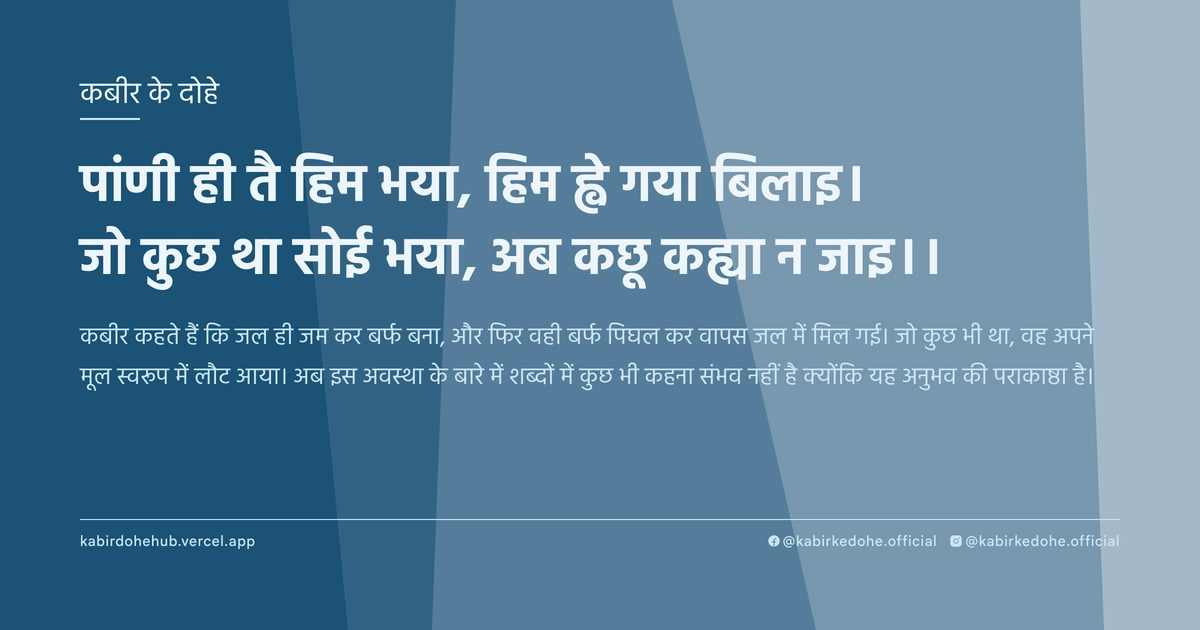
पांणी ही तै हिम भया, हिम ह्वे गया बिलाइ।
जो कुछ था सोई भया, अब कछू कह्या न जाइ।।
Paani hi tai him bhaya, him hve gaya bilai. Jo kuch tha soi bhaya, ab kachu kahya na jai.
इस पृष्ठ पर इस कबीर दोहे का अर्थ (meaning), हिंदी व्याख्या और अंग्रेज़ी अनुवाद, दार्शनिक विश्लेषण और व्यावहारिक जीवन सीख दी गई है। यह दोहा अनित्य (Impermanence) विषय से जुड़ा है — Kabir doha meaning and explanation in Hindi and English.
अर्थ (Meaning):
कबीर कहते हैं कि जल ही जम कर बर्फ बना, और फिर वही बर्फ पिघल कर वापस जल में मिल गई। जो कुछ भी था, वह अपने मूल स्वरूप में लौट आया। अब इस अवस्था के बारे में शब्दों में कुछ भी कहना संभव नहीं है क्योंकि यह अनुभव की पराकाष्ठा है।
Kabir explains that water froze to become ice, and then that ice melted back into water. Whatever existed has returned to its original essence. Now, nothing more can be said in words, for the state of absolute oneness transcends all linguistic description.
व्याख्या (Interpretation):
यह दोहा आत्मा और परमात्मा के अभेद संबंध को दर्शाता है। जल मूल तत्व है, बर्फ एक अस्थायी अवस्था (माया) है, और पिघलना मोक्ष है। जिस प्रकार बर्फ जल से अलग नहीं है, उसी प्रकार जीव ब्रह्म से अलग नहीं है। यह अद्वैत वेदांत के उस सत्य को उजागर करता है जहाँ द्वैत केवल एक भ्रम है। जब अहंकार पिघलता है, तो केवल शुद्ध चेतना शेष रहती है, जिसे शब्दों की सीमा में नहीं बांधा जा सकता।
This couplet illustrates the non-dual relationship between the soul and the Divine. Water represents the primordial element, ice symbolizes the temporary state of manifestation (Maya), and melting signifies liberation. Just as ice is not distinct from water, the individual soul is not separate from the Absolute. It highlights the Advaita Vedanta truth where duality is merely an illusion. When the ego dissolves, only pure consciousness remains, which cannot be confined by the limitations of language.
दार्शनिक विश्लेषण (Philosophical Analysis):
कबीर का यह दर्शन निर्गुण भक्ति और सूफीवाद के 'वहदत-अल-वजूद' (अस्तित्व की एकता) का संगम है। उन्होंने यहाँ पदार्थ के परिवर्तन के माध्यम से चेतना के विकास को समझाया है। उनके समय में धर्म कर्मकांडों और बाहरी पहचानों में उलझा था, जिसे कबीर ने सिरे से नकार दिया। वे तर्क देते हैं कि जैसे बर्फ का अस्तित्व जल पर निर्भर है, वैसे ही हमारा अस्तित्व उस निराकार ईश्वर पर है।
यह विश्लेषण हमें बताता है कि 'माया' कोई बाहरी शक्ति नहीं, बल्कि सत्य का एक अस्थायी रूप है। जब साधक अपनी पहचान को 'मैं' (बर्फ) से बदलकर 'हम' (जल) कर लेता है, तो वह द्वैत से मुक्त हो जाता है। यह मनोवैज्ञानिक रूपांतरण है जहाँ व्यक्ति अपनी सीमित पहचान को त्यागकर अनंतता में विलीन हो जाता है।
कबीर यहाँ ritualism के बजाय अनुभव (Anubhava) पर जोर देते हैं। वे कहते हैं कि शास्त्रों को पढ़ने से अधिक महत्वपूर्ण है उस सत्य को जीना। बर्फ का पिघलना एक आंतरिक प्रक्रिया है, बाहरी क्रिया नहीं। यह अहंकार के विसर्जन की प्रक्रिया है, जहाँ 'स्व' का बोध समाप्त हो जाता है।
ऐतिहासिक रूप से, कबीर ने जाति और धर्म की दीवारों को तोड़कर यह संदेश दिया कि मूल तत्व एक ही है। चाहे वह हिंदू हो या मुस्लिम, अंततः सब उसी एक चेतना के विभिन्न रूप हैं। यह सामाजिक समरसता का सबसे गहरा आध्यात्मिक आधार है।
अंत में, 'अब कछू कह्या न जाइ' वाक्यांश उस मौन (Silence) की ओर इशारा करता है जो ज्ञान की अंतिम सीमा है। जब ज्ञाता और ज्ञेय एक हो जाते हैं, तो भाषा अर्थहीन हो जाती है। यह वह बिंदु है जहाँ विचार समाप्त होते हैं और केवल शुद्ध अस्तित्व बचता है।
Kabir's philosophy here is a confluence of Nirgun Bhakti and the Sufi concept of 'Wahdat-al-Wujud' (Unity of Existence). He uses the physical transformation of matter to explain the evolution of consciousness. In his era, religion was entangled in rituals and external identities, which Kabir categorically rejected. He argues that just as the existence of ice depends on water, our existence depends on the Formless Divine.
This analysis reveals that 'Maya' is not an external force, but a temporary manifestation of Truth. When the seeker shifts their identity from 'I' (the ice) to 'We' (the water), they are liberated from duality. This is a psychological transformation where the individual transcends their limited identity to merge into the infinite.
Kabir emphasizes experience (Anubhava) over ritualism. He suggests that living the truth is far more vital than reading scriptures. The melting of ice is an internal process, not an external act. It is the process of the dissolution of the ego, where the sense of 'self' vanishes.
Historically, Kabir broke the barriers of caste and creed by asserting that the fundamental essence is one. Whether Hindu or Muslim, all are different forms of the same consciousness. This provides the deepest spiritual foundation for social harmony.
Finally, the phrase 'now nothing more can be said' points toward the Silence that is the ultimate frontier of knowledge. When the knower and the known become one, language becomes meaningless. This is the point where thought ends and only pure existence remains.
मूल संदेश (Core Message):
- अहंकार एक जमी हुई अवस्था है जिसे केवल प्रेम से पिघलाया जा सकता है।
- विविधता केवल एक भ्रम है; मूल तत्व सदैव एक ही रहता है।
- सत्य शब्दों में नहीं, बल्कि अनुभव के मौन में निवास करता है।
- अपनी सीमित पहचान को त्यागना ही वास्तविक स्वतंत्रता है।
- आत्मा का परमात्मा में विलीनीकरण ही जीवन का अंतिम लक्ष्य है।
- Ego is a frozen state that can only be melted by love.
- Diversity is but an illusion; the fundamental essence remains one.
- Truth resides not in words, but in the silence of experience.
- Relinquishing the limited identity is the path to true freedom.
- The merging of the soul into the Divine is the ultimate goal of life.
व्यावहारिक उदाहरण (Practical Example):
वाराणसी के एक पुराने घाट पर रहने वाली एक वृद्ध विधवा, जानकी, का जीवन दुखों की बर्फ से जमा हुआ था। उसने अपना पूरा जीवन सामाजिक नियमों और शोक की कठोरता में बिताया था। उसके लिए उसकी पहचान केवल एक 'विधवा' की थी, जिसने दुनिया से नाता तोड़ लिया था।
वह हर दिन गंगा किनारे बैठती और सोचती कि उसका जीवन व्यर्थ गया। वह अपनी पहचान को अपने दुखों से जोड़ चुकी थी, जैसे बर्फ पानी को जकड़ लेती है। वह मानती थी कि उसका अस्तित्व केवल उसकी पीड़ा है।
एक दिन उसने एक युवा साधु को देखा जो बिना किसी बाहरी आडंबर के केवल मौन में लीन था। साधु ने उससे कहा, "माँ, तुम बर्फ बन गई हो, लेकिन याद रखो कि तुम मूलतः जल हो। बर्फ केवल एक अवस्था है, तुम्हारा स्वभाव नहीं।"
जानकी को पहले यह बात समझ नहीं आई, लेकिन उसने धीरे-धीरे अपने भीतर झांकना शुरू किया। उसने महसूस किया कि उसकी 'विधवा' वाली पहचान केवल एक सामाजिक मुखौटा था, एक जमी हुई परत थी।
उसने अपने भीतर के क्रोध और विलाप को देखना शुरू किया। उसने पाया कि वह जिस दुख को अपना 'स्व' मान रही थी, वह वास्तव में एक बाहरी प्रभाव था जिसने उसकी मूल शांति को ढक लिया था।
जैसे-जैसे उसने करुणा और स्वीकार भाव को अपनाया, उसके भीतर की वह कठोर बर्फ पिघलने लगी। उसने पाया कि वह केवल एक दुखी स्त्री नहीं है, बल्कि वह उसी अनंत चेतना का हिस्सा है जो पूरी सृष्टि में बह रही है।
उसने घाट पर आने वाले अन्य असहाय लोगों की मदद करना शुरू किया। अब वह अपनी पीड़ा में नहीं, बल्कि दूसरों की सेवा में अपनी खुशी ढूंढती थी। उसका अहंकार कि "मैं सबसे अधिक दुखी हूँ", पूरी तरह समाप्त हो गया।
अंत में, जानकी एक ऐसी शांति में विलीन हो गई जहाँ न तो कोई शोक था और न ही कोई पहचान। वह अब केवल एक प्रवाह थी, जो गंगा की लहरों की तरह शांत और अनंत थी। वह जान गई थी कि जो कुछ था, वह अब उसी एक सत्य में मिल गया है।
Janaki, an elderly widow living on an old ghat in Varanasi, had a life frozen by the ice of sorrow. She spent her entire existence bound by rigid social norms and the hardness of mourning. For her, her identity was solely that of a 'widow' who had severed ties with the world.
Every day she sat by the Ganges, thinking her life had been wasted. She had fused her identity with her suffering, much like ice grips water. She believed her existence was nothing more than her pain.
One day, she encountered a young monk who sat in profound silence, devoid of any external ostentation. The monk told her, "Mother, you have become ice, but remember that you are fundamentally water. Ice is merely a state, not your nature."
Janaki did not understand at first, but she slowly began to look within. She realized that her identity as a 'widow' was merely a social mask, a frozen layer covering her true self.
She began to observe the anger and lamentation within her. She discovered that the grief she considered her 'self' was actually an external influence that had obscured her original peace.
As she embraced compassion and acceptance, the rigid ice within her began to melt. She realized she was not just a grieving woman, but a part of that infinite consciousness flowing through all creation.
She started helping other destitute people who came to the ghats. Now, she found joy not in her pain, but in the service of others. Her ego, which whispered "I am the most miserable," vanished completely.
Ultimately, Janaki merged into a peace where there was neither mourning nor identity. She became a flow, calm and infinite like the waves of the Ganges. She knew that whatever she was had now merged back into the one Truth.
अभ्यास मार्गदर्शन (Practice Guidance):
- प्रतिदिन 20 मिनट 'साक्षी भाव' का अभ्यास करें: अपने विचारों को ऐसे देखें जैसे वे बर्फ के टुकड़े हों जो धीरे-धीरे पानी में पिघल रहे हैं।
- आत्म-पूछताछ जर्नल: लिखें कि आपकी कौन सी सामाजिक या व्यक्तिगत पहचान (जैसे पद, जाति, रिश्ता) आपको सीमित कर रही है और उसे 'बर्फ' के रूप में चिन्हित करें।
- मौन का अभ्यास: दिन में एक घंटा पूर्ण मौन रहें ताकि आप शब्दों से परे उस 'अकथनीय' सत्य का अनुभव कर सकें।
- निदान चेकलिस्ट: क्या आप अभी भी अपनी पहचान को अपनी समस्याओं से जोड़ रहे हैं? यदि हाँ, तो आप अभी भी 'बर्फ' की अवस्था में हैं। क्या आप दूसरों में स्वयं को देख पा रहे हैं? यदि हाँ, तो आप 'जल' की ओर बढ़ रहे हैं।
- Practice 'Witness Consciousness' for 20 minutes daily: Observe your thoughts as if they are pieces of ice slowly melting into water.
- Self-Inquiry Journal: List the social or personal identities (e.g., rank, caste, relationship) that limit you and mark them as 'ice'.
- Practice of Silence: Spend one hour in complete silence daily to experience the 'ineffable' truth beyond words.
- Diagnostic Checklist: Are you still linking your identity to your problems? If yes, you are still in the 'ice' state. Can you see yourself in others? If yes, you are moving towards the 'water' state.
चिंतन प्रश्न (Reflection Questions):
- वह कौन सी 'जमी हुई' पहचान है जिसे आप दुनिया के सामने गर्व से दिखाते हैं, लेकिन वह आपके भीतर के विस्तार को रोक रही है?
- यदि आपकी सभी उपलब्धियां और रिश्ते आपसे छीन लिए जाएं, तो क्या आप उस 'शुद्ध जल' जैसी शांति को महसूस कर पाएंगे?
- क्या आपका डिजिटल व्यक्तित्व (Social Media Ego) आपकी वास्तविक आत्मा के ऊपर जमी एक बर्फ की परत नहीं है?
- आप किन पूर्वाग्रहों को सत्य मानकर बैठे हैं, जो वास्तव में केवल अस्थायी अवस्थाएं हैं?
- क्या आप उस मौन का सामना करने का साहस रखते हैं जहाँ आपकी कोई परिभाषा नहीं बचती?
- What is the 'frozen' identity you proudly display to the world, which actually restricts your inner expansion?
- If all your achievements and relationships were stripped away, would you be able to feel that 'pure water-like' peace?
- Is your digital persona (Social Media Ego) not a layer of ice frozen over your authentic soul?
- Which prejudices do you hold as truth, which are actually just temporary states of being?
- Do you have the courage to face the silence where no definition of 'you' remains?