
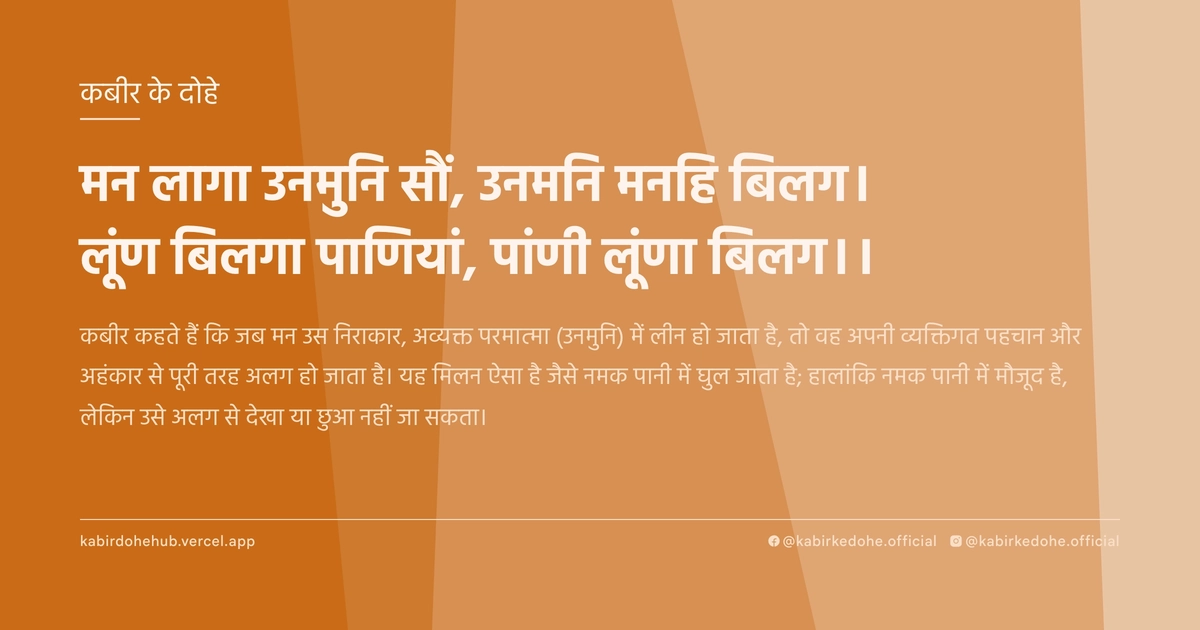
मन लागा उनमुनि सौं, उनमनि मनहि बिलग।
लूंण बिलगा पाणियां, पांणी लूंणा बिलग।।
Man laga unmuni saun, unmani manahi bilag. Loon bilga paaniya, paani loona bilag.
इस पृष्ठ पर इस कबीर दोहे का अर्थ (meaning), हिंदी व्याख्या और अंग्रेज़ी अनुवाद, दार्शनिक विश्लेषण और व्यावहारिक जीवन सीख दी गई है। यह दोहा सहज योग (Sahaja Yoga) विषय से जुड़ा है — Kabir doha meaning and explanation in Hindi and English.
अर्थ (Meaning):
कबीर कहते हैं कि जब मन उस निराकार, अव्यक्त परमात्मा (उनमुनि) में लीन हो जाता है, तो वह अपनी व्यक्तिगत पहचान और अहंकार से पूरी तरह अलग हो जाता है। यह मिलन ऐसा है जैसे नमक पानी में घुल जाता है; हालांकि नमक पानी में मौजूद है, लेकिन उसे अलग से देखा या छुआ नहीं जा सकता।
Kabir explains that when the mind merges with the Formless Absolute (Unmani), it becomes completely detached from its individual identity and ego. This union is likened to salt dissolving in water; although the salt remains present within the water, it can no longer be perceived or separated as a distinct entity.
व्याख्या (Interpretation):
इस दोहे में कबीर 'उनमुनि' अवस्था का वर्णन करते हैं, जो मन की वह स्थिति है जहाँ विचार शांत हो जाते हैं। शाब्दिक अर्थ है कि मन परमात्मा में लग गया है, लेकिन आध्यात्मिक अर्थ यह है कि द्वैत (duality) समाप्त हो गया है। नमक और पानी का रूपक अद्वैत वेदांत के उस सत्य को दर्शाता है जहाँ आत्मा (Atman) और ब्रह्म (Brahman) एक हो जाते हैं। जैसे नमक पानी में मिलकर अपना आकार खो देता है पर स्वाद बढ़ा देता है, वैसे ही साधक अपनी 'मैं' को खोकर सार्वभौमिक चेतना बन जाता है। यह माया के पर्दे का गिरना है, जहाँ ज्ञाता, ज्ञान और ज्ञेय का भेद मिट जाता है। यहाँ 'बिलग' शब्द विडंबनापूर्ण है; यह अलगाव नहीं, बल्कि पूर्ण विलीनीकरण है।
In this couplet, Kabir describes the 'Unmani' state, a condition of the mind where all conceptual thoughts cease. While the literal meaning suggests the mind attaching to the Divine, the metaphorical depth points to the annihilation of duality. The metaphor of salt and water illustrates the Advaita Vedanta principle where the Atman (individual soul) merges into Brahman (universal consciousness). Just as salt loses its physical form in water yet permeates it with taste, the seeker loses the 'I' to become the Universal Truth. This represents the piercing of Maya's veil, where the distinction between the knower, the known, and the act of knowing vanishes. The word 'bilag' (separate) is used paradoxically; it refers not to distance, but to the total dissolution of the separate ego into the whole.
दार्शनिक विश्लेषण (Philosophical Analysis):
कबीर का यह दर्शन निर्गुण भक्ति की पराकाष्ठा है, जहाँ ईश्वर किसी मूर्ति या नाम में नहीं, बल्कि स्वयं के भीतर की शून्यता में पाया जाता है। यह सूफीवाद के 'फना' (Fana) के सिद्धांत के समान है, जहाँ साधक का अहंकार ईश्वर की इच्छा में विलीन हो जाता है। कबीर ने अपने समय के कर्मकांडों और बाहरी आडंबरों का विरोध किया, क्योंकि वे जानते थे कि मोक्ष मंदिर या मस्जिद में नहीं, बल्कि आंतरिक रूपांतरण में है।
अद्वैत वेदांत के अनुसार, हम अलग-अलग प्रतीत होते हैं क्योंकि माया हमें भ्रमित करती है। कबीर यहाँ उस भ्रम के टूटने की बात कर रहे हैं। जब मन 'उनमुनि' (मन-रहित) हो जाता है, तो वह अपनी सीमित पहचान को त्याग देता है। यह मनोवैज्ञानिक स्तर पर 'अहंकार मृत्यु' (Ego Death) की प्रक्रिया है, जहाँ व्यक्ति अपनी सामाजिक पहचान, जाति और पद को पीछे छोड़ देता है।
ऐतिहासिक रूप से, कबीर ने बुनकर समुदाय से होते हुए समाज के सबसे निचले और सबसे ऊँचे स्तरों को देखा। उन्होंने महसूस किया कि जब तक मनुष्य खुद को 'अलग' मानता है, वह संघर्ष करता रहता है। नमक और पानी का उदाहरण यह सिखाता है कि एकता का अर्थ यह नहीं है कि दो चीजें एक जैसी हो जाएं, बल्कि यह है कि एक दूसरी में पूरी तरह समाहित हो जाए।
यह विश्लेषण स्पष्ट करता है कि कबीर केवल धर्म की बात नहीं कर रहे, बल्कि चेतना के विज्ञान की बात कर रहे हैं। वे बताते हैं कि सत्य को 'प्राप्त' नहीं किया जाता, बल्कि सत्य में 'घुल' जाया जाता है। यदि आप नमक की तरह अपनी कठोरता और आकार (अहंकार) को छोड़ दें, तो आप अनंत सागर बन सकते हैं।
अंततः, यह दोहा हमें सिखाता है कि आध्यात्मिक यात्रा 'पाने' की नहीं, बल्कि 'खोने' की है। जो खुद को खो देता है, वही वास्तव में खुद को पाता है। यह विरोधाभास ही कबीर की कविता की आत्मा है, जो हमें तर्क से परे अनुभव की दुनिया में ले जाती है।
Kabir's philosophy here represents the pinnacle of Nirgun Bhakti, where the Divine is found not in idols or names, but in the inner void of the self. This closely mirrors the Sufi concept of 'Fana' (annihilation), where the seeker's ego is completely dissolved into the Will of the Divine. Kabir vehemently rejected the ritualism and outward displays of his era, recognizing that liberation occurs through internal transformation rather than external pilgrimage.
According to Advaita Vedanta, the perception of separation is a product of Maya (illusion). Kabir speaks of the shattering of this illusion. When the mind becomes 'Unmani' (mindless/transcendent), it sheds its limited identity. Psychologically, this is the process of 'Ego Death,' where the individual transcends social labels, caste, and status to realize their inherent oneness with the cosmos.
Historically, emerging from the weaver community, Kabir witnessed the stark divides of society. He realized that as long as humans perceive themselves as 'separate,' conflict persists. The metaphor of salt and water teaches that unity is not about two things becoming similar, but about one completely merging into the other, altering the nature of the whole.
This analysis reveals that Kabir is discussing the science of consciousness rather than mere religion. He posits that Truth is not something to be 'acquired,' but something to be 'dissolved into.' If one can surrender their rigidity and form (the ego), like salt in water, they expand into the infinite ocean of existence.
Ultimately, this doha teaches that the spiritual journey is not about 'attaining,' but about 'losing.' He who loses themselves is the only one who truly finds themselves. This paradox is the core of Kabir's poetry, guiding the seeker from the realm of logic to the realm of direct experience.
मूल संदेश (Core Message):
- अहंकार वह दीवार है जो हमें सत्य से अलग करती है।
- विलीनीकरण ही वास्तविक प्राप्ति है, संचय नहीं।
- जब 'मैं' मिटता है, तब ईश्वर का अनुभव होता है।
- द्वैत का अंत ही शांति का आरंभ है।
- परमात्मा बाहर नहीं, बल्कि हमारी अपनी पहचान के विसर्जन में है।
- The ego is the only wall separating the seeker from the Truth.
- True attainment is not accumulation, but total dissolution.
- When the 'I' vanishes, the Divine experience begins.
- The end of duality is the beginning of absolute peace.
- God is not found externally, but in the surrender of the separate self.
व्यावहारिक उदाहरण (Practical Example):
वाराणसी के एक पुराने घाट पर माधव नाम का एक वृद्ध नाविक रहता था। माधव अपनी नाव चलाने की कला में इतना निपुण था कि उसे अपनी श्रेष्ठता का अहंकार हो गया था। वह अन्य नाविकों को तुच्छ समझता और खुद को इस नदी का स्वामी मानता था। उसका मन हमेशा इस बात में लगा रहता कि वह दूसरों से बेहतर है, जिससे उसके जीवन में अशांति और क्रोध बढ़ गया था।
एक दिन, एक शांत स्वभाव के संन्यासी उसकी नाव में सवार हुए। माधव ने अहंकारवश संन्यासी को अपनी महानता के बारे में बताना शुरू किया। संन्यासी ने मुस्कुराते हुए एक मुट्ठी नमक निकाला और उसे गंगा के पानी में डाल दिया। फिर उन्होंने माधव से कहा, "इस पानी को चखो और बताओ कि नमक कहाँ है।"
माधव ने पानी चखा, उसे कोई विशेष स्वाद नहीं आया। संन्यासी ने पूछा, "क्या नमक गायब हो गया?" माधव ने कहा, "नहीं, वह पानी में मिल गया होगा।"
संन्यासी ने धीरे से कहा, "यही तुम्हारी समस्या है, माधव। तुम इस नदी की तरह अनंत हो, लेकिन तुमने खुद को 'नाविक' नामक एक छोटे से नमक के ढेले में सीमित कर लिया है। जब तक तुम इस 'मैं' के ढेले को नहीं घोलोगे, तुम इस विराट शांति का अनुभव नहीं कर पाओगे।"
माधव को पहली बार अपनी लघुता का अहसास हुआ। उसे समझ आया कि उसका अहंकार उसे उस शांति से दूर रख रहा था जो उसके चारों ओर बह रही थी। उसने महसूस किया कि वह और यह नदी अलग नहीं हैं, बल्कि एक ही अस्तित्व के दो रूप हैं।
अगले कुछ महीनों में माधव का व्यवहार पूरी तरह बदल गया। उसने अन्य नाविकों की मदद करना शुरू किया और अपनी श्रेष्ठता का दावा छोड़ दिया। वह अब केवल नाव नहीं चलाता था, बल्कि हर यात्री में उस एक ही चेतना को देखने का प्रयास करता था।
उसका क्रोध शांत हो गया और उसकी आँखों में एक नई करुणा आ गई। वह अब खुद को 'महान नाविक' नहीं, बल्कि गंगा की एक छोटी सी लहर मानता था।
इस 'कबीर ट्विस्ट' ने माधव को एक कुशल नाविक से एक शांत योगी बना दिया। उसने जान लिया कि जब 'मैं' मिटता है, तभी 'सब' का मिलन होता है।
On an ancient ghat in Varanasi lived an elderly boatman named Madhav. Madhav was so skilled in navigating the currents that he developed a profound ego regarding his expertise. He looked down upon other boatmen and considered himself the master of the river. His mind was constantly occupied with his superiority, which brought restlessness and anger into his life.
One day, a serene monk boarded his boat. Driven by vanity, Madhav began boasting about his greatness to the monk. The monk smiled, took a handful of salt, and dropped it into the waters of the Ganges. He then asked Madhav, "Taste this water and tell me where the salt is."
Madhav tasted the water; he felt no distinct taste of salt. The monk asked, "Has the salt disappeared?" Madhav replied, "No, it must have merged with the water."
The monk softly said, "This is your struggle, Madhav. You are as infinite as this river, but you have limited yourself to a small lump of salt called 'the boatman.' Until you dissolve this lump of 'I,' you will never experience the vast peace that surrounds you."
For the first time, Madhav realized his own insignificance. He understood that his ego was the only barrier separating him from the peace flowing all around him. He realized that he and the river were not separate entities, but two expressions of the same existence.
Over the next few months, Madhav's behavior transformed completely. He began helping other boatmen and ceased all claims of superiority. He no longer just steered a boat; he sought to see the same universal consciousness in every passenger.
His anger subsided, and a new compassion filled his eyes. He no longer saw himself as a 'great boatman,' but as a tiny wave in the ocean of the Ganges.
This 'Kabir Twist' transformed Madhav from a skilled laborer into a peaceful yogi. He learned that only when the 'I' vanishes does the union with the 'All' begin.
अभ्यास मार्गदर्शन (Practice Guidance):
- प्रतिदिन 20 मिनट 'शून्य ध्यान' का अभ्यास करें, जहाँ आप अपने विचारों को केवल साक्षी भाव से देखें, बिना किसी निर्णय के।
- एक डायरी लिखें जिसमें आप उन क्षणों को दर्ज करें जब आपका अहंकार (जैसे कि सही होने की जिद) आपके रिश्तों में बाधा बना।
- दिन में तीन बार सचेत रूप से यह विचार करें: "मैं यह शरीर या यह पद नहीं हूँ, मैं वह अनंत चेतना हूँ जिसमें सब विलीन है।"
- निदान चेकलिस्ट: क्या आप अभी भी दूसरों की प्रशंसा के भूखे हैं? क्या आप अपनी उपलब्धियों को अपनी पहचान मानते हैं? यदि हाँ, तो आप अभी भी 'नमक के ढेले' के रूप में अलग हैं।
- Practice 20 minutes of 'Shunya Meditation' daily, observing your thoughts as a witness without judgment or attachment.
- Maintain a journal recording moments where your ego (such as the need to be right) created friction in your relationships.
- Three times a day, consciously contemplate: "I am not this body or this position; I am the infinite consciousness into which all merges."
- Diagnostic Checklist: Are you still craving external validation? Do you equate your achievements with your identity? If yes, you are still existing as a 'separate lump of salt'.
चिंतन प्रश्न (Reflection Questions):
- यदि आपकी सभी सामाजिक पहचान (नाम, पेशा, रिश्ता) छीन ली जाएं, तो वास्तव में आप कौन बचेंगे?
- आपकी कौन सी ऐसी मान्यताएं हैं जिन्हें आप सत्य मानकर बैठे हैं, जबकि वे केवल आपके अहंकार का विस्तार हैं?
- क्या आप वास्तव में दूसरों की भलाई चाहते हैं, या आप केवल 'भलाई करने वाले' की छवि को पसंद करते हैं?
- आपके जीवन का वह कौन सा क्षेत्र है जहाँ आप अभी भी 'नमक' की तरह अलग और कठोर बने हुए हैं?
- क्या आप अपनी डिजिटल पहचान (सोशल मीडिया) को ही अपना वास्तविक अस्तित्व मान बैठे हैं?
- शांति की खोज में आप क्या पाने की कोशिश कर रहे हैं, जबकि शायद आपको कुछ खोने की जरूरत है?
- If all your social identities (name, profession, relationships) were stripped away, who would actually remain?
- Which of your deeply held beliefs are actually just extensions of your ego rather than universal truths?
- Do you truly desire the well-being of others, or do you simply enjoy the image of being a 'benefactor'?
- In which area of your life are you still remaining as rigid and separate as a lump of salt?
- Have you mistaken your digital persona for your actual existence?
- In your search for peace, what are you trying to 'gain,' when perhaps you need to 'lose' something?