
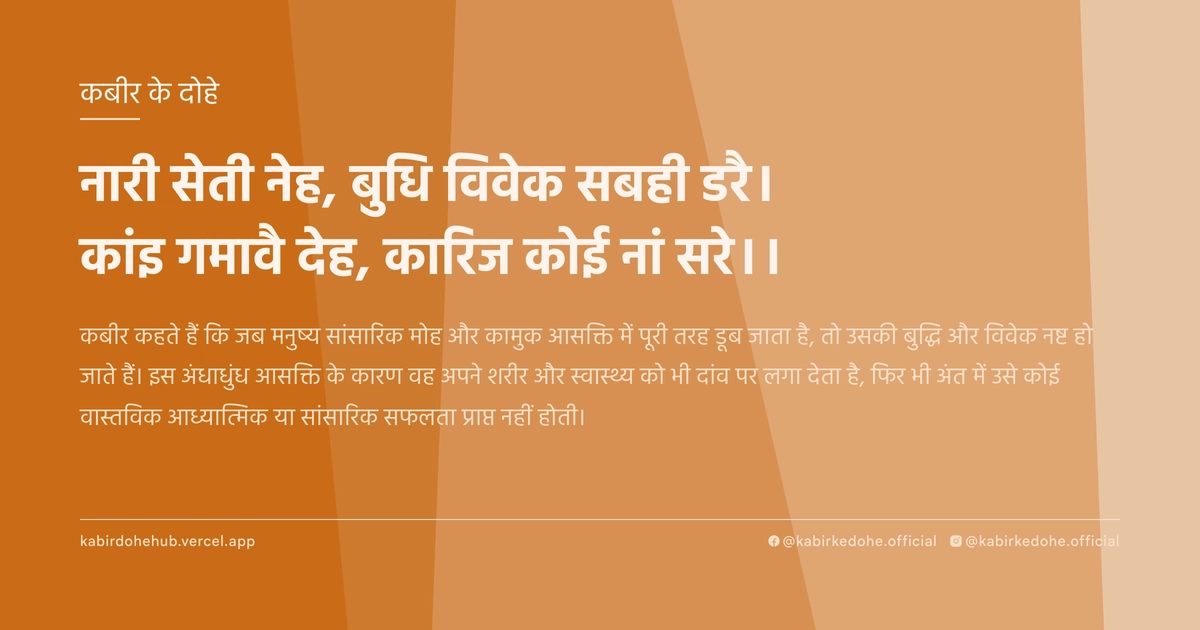
नारी सेती नेह, बुधि विवेक सबही डरै।
कांइ गमावै देह, कारिज कोई नां सरे।।
Nari seti neh, budhi vivek sabhi dare. Kain gamavai deh, kaarij koi na sare.
इस पृष्ठ पर इस कबीर दोहे का अर्थ (meaning), हिंदी व्याख्या और अंग्रेज़ी अनुवाद, दार्शनिक विश्लेषण और व्यावहारिक जीवन सीख दी गई है। यह दोहा काम (Lust) विषय से जुड़ा है — Kabir doha meaning and explanation in Hindi and English.
अर्थ (Meaning):
कबीर कहते हैं कि जब मनुष्य सांसारिक मोह और कामुक आसक्ति में पूरी तरह डूब जाता है, तो उसकी बुद्धि और विवेक नष्ट हो जाते हैं। इस अंधाधुंध आसक्ति के कारण वह अपने शरीर और स्वास्थ्य को भी दांव पर लगा देता है, फिर भी अंत में उसे कोई वास्तविक आध्यात्मिक या सांसारिक सफलता प्राप्त नहीं होती।
Kabir warns that when a person becomes consumed by worldly attachment and carnal desire, their intellect and discernment vanish. In this blind pursuit of sensory pleasure, one risks their own physical and mental well-being, yet fails to achieve any meaningful spiritual progress or lasting fulfillment.
व्याख्या (Interpretation):
यहाँ "नारी" केवल स्त्री का प्रतीक नहीं है, बल्कि यह 'माया' और सांसारिक आकर्षणों का प्रतिनिधित्व करती है। शाब्दिक अर्थ कामुकता की ओर संकेत करता है, लेकिन आध्यात्मिक स्तर पर यह उस आसक्ति (attachment) की बात है जो आत्मा को परमात्मा से दूर करती है। जब वासना हावी होती है, तो 'विवेक' (discernment) डरकर छिप जाता है, जिससे मनुष्य सही और गलत का भेद भूल जाता है। यह स्थिति निर्गुण भक्ति के मार्ग में सबसे बड़ी बाधा है क्योंकि यह द्वैत (duality) को जन्म देती है। आत्मा जब शरीर और इंद्रियों के सुखों में उलझती है, तो वह ब्रह्म के साथ अपनी एकता को भूल जाती है। अंततः, यह आसक्ति एक ऐसे चक्र में बदल जाती है जहाँ प्रयास तो बहुत होते हैं, लेकिन परिणाम शून्य रहता है क्योंकि दिशा गलत है।
In this verse, "Naari" (woman) is not merely a gendered reference but a potent symbol for 'Maya'—the cosmic illusion and all worldly attractions. While the literal meaning touches upon carnal desire, the metaphysical layer addresses the profound attachment that severs the soul's connection with the Divine. When lust or craving dominates, 'Vivek' (spiritual discernment) is eclipsed, leaving the seeker unable to distinguish the eternal from the ephemeral. This state is the primary obstacle in Nirgun Bhakti, as it reinforces the illusion of duality. When the Atman identifies with the sensory pleasures of the body, it forgets its non-dual essence with Brahman. Ultimately, this attachment creates a futile cycle where immense energy is expended, yet no spiritual fruition is achieved because the internal compass is skewed.
दार्शनिक विश्लेषण (Philosophical Analysis):
कबीर का यह दोहा उस समय के सामाजिक और धार्मिक परिवेश की प्रतिक्रिया है जहाँ बाहरी आडंबरों और इंद्रिय सुखों को आध्यात्मिक उन्नति से ऊपर रखा जा रहा था। कबीर यहाँ 'काम' (desire) को एक ऐसी अग्नि के रूप में देखते हैं जो विवेक को भस्म कर देती है। यह विचार अद्वैत वेदांत के इस सिद्धांत से मेल खाता है कि अविद्या (ignorance) के कारण ही हम स्वयं को शरीर मानते हैं और बाहरी वस्तुओं में सुख खोजते हैं।
सूफी मत के 'नफ्स' (ego/lower self) के सिद्धांत के समान, कबीर यहाँ निचले स्व के नियंत्रण की बात कर रहे हैं। जब तक मनुष्य अपनी इंद्रियों का दास है, वह 'इश्क-ए-हकीकी' (दिव्य प्रेम) का अनुभव नहीं कर सकता। कबीर का विरोध किसी व्यक्ति विशेष से नहीं, बल्कि उस 'मोह' से है जो बंधन का कारण बनता है।
वे इस बात पर जोर देते हैं कि ritualism या केवल माला जपने से मुक्ति नहीं मिलेगी यदि भीतर की वासनाएं जीवित हैं। वास्तविक भक्ति वह है जहाँ साधक अपनी कामुकता और अहंकार का विसर्जन कर दे। यह एक मनोवैज्ञानिक रूपांतरण की प्रक्रिया है जहाँ 'मैं' और 'मेरा' का भाव समाप्त होता है।
अक्सर इस दोहे को स्त्री-द्वेषी माना जाता है, लेकिन दार्शनिक दृष्टि से यह 'प्रकृति' और 'पुरुष' के संतुलन की बात है। जब प्रकृति (माया) पुरुष (चेतना) पर हावी हो जाती है, तो चेतना अपनी दिशा खो देती है। कबीर चाहते हैं कि साधक माया के जाल को पहचानकर उससे ऊपर उठे।
अंततः, यह विश्लेषण हमें सिखाता है कि मुक्ति का मार्ग इंद्रिय सुखों के दमन से नहीं, बल्कि उनके प्रति अनासक्ति (detachment) विकसित करने से है। जब विवेक जागता है, तब व्यक्ति समझ पाता है कि बाहरी दुनिया केवल एक प्रतिबिंब है और वास्तविक आनंद भीतर के शून्य में है।
Kabir's couplet is a visceral reaction to the socio-religious climate of his era, where external rituals and sensory gratifications were often mistaken for spiritual milestones. He perceives 'Kaam' (desire) as a consuming fire that incinerates 'Vivek' (discernment). This aligns seamlessly with Advaita Vedanta's premise that 'Avidya' (ignorance) leads the soul to misidentify itself with the physical body, thereby seeking fulfillment in transient external objects.
Parallel to the Sufi concept of the 'Nafs' (the lower self/ego), Kabir advocates for the subjugation of the base instincts. Until a seeker is liberated from the tyranny of the senses, they cannot experience 'Ishq-e-Haqiqi' (Divine Love). Kabir's critique is not directed at any individual or gender, but at the psychological state of 'Moha' (attachment) that binds the soul to the cycle of suffering.
He emphasizes that ritualism—be it chanting beads or fasting—is futile if the inner fires of lust and greed remain unextinguished. True Bhakti requires the annihilation of the ego and the transmutation of carnal desire into spiritual longing. This is a process of psychological alchemy where the 'I' and 'Mine' are dissolved into the Universal Consciousness.
Common literalist interpretations often misread this as misogyny; however, philosophically, it addresses the imbalance between 'Prakriti' (Nature/Maya) and 'Purusha' (Pure Consciousness). When the illusory nature of the world overwhelms the consciousness, the seeker loses their spiritual trajectory. Kabir urges the seeker to recognize the veil of Maya and transcend it.
Ultimately, this analysis reveals that liberation is not achieved through the violent suppression of desire, but through the cultivation of 'Vairagya' (dispassion). When discernment awakens, the seeker realizes that the external world is merely a reflection, and true bliss resides in the internal stillness of the void.
मूल संदेश (Core Message):
- इंद्रिय सुख क्षणिक हैं, लेकिन उनसे उत्पन्न बंधन स्थायी होते हैं।
- विवेक का अर्थ है यह जानना कि क्या वास्तव में आवश्यक है।
- मोह बुद्धि को अंधा कर देता है, जिससे सत्य ओझल हो जाता है।
- वास्तविक सफलता शरीर की संतुष्टि में नहीं, आत्मा की मुक्ति में है।
- अनासक्ति ही वह कुंजी है जो हमें माया के बंधन से मुक्त करती है।
- जब 'मैं' मिटता है, तभी 'परमात्मा' का अनुभव संभव होता है।
- Sensory pleasures are fleeting, but the bonds they create are enduring.
- True discernment is the ability to distinguish the essential from the trivial.
- Attachment blinds the intellect, veiling the ultimate truth from view.
- Real success lies not in bodily gratification, but in the liberation of the soul.
- Detachment is the only key that unlocks the chains of Maya.
- Only when the ego dissolves can the experience of the Divine begin.
व्यावहारिक उदाहरण (Practical Example):
एक समय की बात है, वाराणसी के घाटों पर माधव नाम का एक अत्यंत कुशल बुनकर रहता था। माधव अपनी कला में निपुण था और उसके द्वारा बनाए गए वस्त्रों की मांग दूर-दूर तक थी। उसकी आर्थिक स्थिति अच्छी थी, लेकिन उसका मन हमेशा एक ऐसी अतृप्ति से घिरा रहता था जो उसे कभी शांत नहीं होने देती थी।
माधव को सुंदर वस्तुओं और विलासिता का गहरा मोह था। उसने अपनी सारी जमा पूँजी और समय उन सुखों को जुटाने में लगा दिया जो उसे क्षणिक आनंद देते थे। वह दिन-रात केवल इस सोच में डूबा रहता कि कैसे वह और अधिक वैभव प्राप्त करे और अपनी इंद्रियों को संतुष्ट करे।
इस दौड़ में उसने अपने स्वास्थ्य की अनदेखी की। वह देर रात तक जागता, सही खान-पान छोड़ चुका था और उसका स्वभाव चिड़चिड़ा हो गया था। उसकी बुद्धि अब केवल इस बात पर केंद्रित थी कि वह अपनी वासनाओं और भौतिक इच्छाओं को कैसे पूरा करे। वह अपने परिवार और पुराने मित्रों को भूल चुका था।
एक दिन माधव की मुलाकात एक वृद्ध संन्यासी से हुई, जो घाट पर मौन बैठे थे। संन्यासी ने माधव की आँखों में वह बेचैनी देखी और उससे पूछा, "पुत्र, तुम क्या खोज रहे हो? वह जो तुम्हें मिल रहा है, क्या वह तुम्हें तृप्त कर रहा है?"
माधव ने गर्व से अपने रेशमी वस्त्रों और धन का प्रदर्शन किया, लेकिन संन्यासी ने मुस्कुराते हुए कहा, "तुमने शरीर को तो सजा लिया, लेकिन विवेक को गिरवी रख दिया। तुम उस मृगतृष्णा के पीछे भाग रहे हो जहाँ पानी तो दिखता है, पर प्यास कभी नहीं बुझती।"
यह बात माधव के हृदय में गहरे तक चुभी। उसने महसूस किया कि जिस 'सुख' के पीछे वह भाग रहा था, उसने वास्तव में उसकी मानसिक शांति और शारीरिक स्वास्थ्य को नष्ट कर दिया था। वह जितना अधिक पाने की कोशिश करता, उतना ही खाली महसूस करता।
संन्यासी ने उसे समझाया कि असली आनंद बाहरी आकर्षणों में नहीं, बल्कि भीतर के संतोष में है। माधव को समझ आया कि उसकी 'बुद्धि और विवेक' मोह की चादर में लिपटे हुए थे, जिससे वह जीवन के वास्तविक उद्देश्य को देख ही नहीं पा रहा था।
उस दिन के बाद माधव ने अपनी जीवनशैली बदल दी। उसने विलासिता का त्याग नहीं किया, बल्कि उसके प्रति अपनी 'आसक्ति' को खत्म कर दिया। उसने अपनी कला को अब केवल धन कमाने का साधन नहीं, बल्कि ईश्वर की सेवा का माध्यम बनाया।
उसने गरीब बच्चों को बुनना सिखाना शुरू किया और अपना समय ध्यान में लगाने लगा। जैसे ही उसने बाहरी मोह को छोड़ा, उसका स्वास्थ्य सुधरने लगा और उसके मन में एक ऐसी शांति आई जो उसने पहले कभी महसूस नहीं की थी।
माधव का जीवन अब एक उदाहरण बन गया कि कैसे विवेक की जागृति मनुष्य को वासनाओं के नरक से निकालकर शांति के शिखर पर ले जा सकती है। उसने जान लिया कि जब तक मोह रहता है, तब तक कोई भी कार्य वास्तव में सफल नहीं होता।
Once, on the ghats of Varanasi, lived a master weaver named Madhav. Madhav was unparalleled in his craft, and his exquisite fabrics were coveted across distant lands. While he possessed material wealth, his mind was plagued by a persistent restlessness that refused to subside.
Madhav was deeply enamored by luxury and sensory pleasures. He spent his entire savings and countless hours accumulating objects and experiences that provided only fleeting gratification. His mind became a prisoner to the constant pursuit of more, driven by an insatiable hunger for worldly indulgence.
In this relentless pursuit, he neglected his own well-being. He suffered from chronic insomnia, ignored his health, and became increasingly irritable. His intellect, once sharp for weaving, was now solely focused on how to satisfy his cravings and expand his hoard of luxuries.
One evening, Madhav encountered an elderly sanyasi sitting in profound silence by the river. The monk observed the turmoil in Madhav's eyes and asked, "My son, what is it that you seek? Does that which you have acquired truly quench your thirst?"
Madhav proudly displayed his silk robes and gold, but the sanyasi smiled gently and replied, "You have adorned the body, but you have mortgaged your discernment. You are chasing a mirage—where water appears in the distance, but the thirst remains eternal."
These words pierced Madhav's heart. He suddenly realized that the 'pleasure' he had chased had actually eroded his mental peace and physical vitality. The more he tried to grasp, the emptier he felt inside, as if he were pouring water into a broken pot.
The sanyasi explained that true bliss does not reside in external attractions but in internal contentment. Madhav realized that his 'intellect and discernment' were wrapped in the shroud of attachment, blinding him to the actual purpose of his existence.
From that day forward, Madhav transformed his life. He did not necessarily discard his wealth, but he severed his 'attachment' to it. He ceased viewing his art as a mere tool for accumulation and began treating it as a form of selfless service to the Divine.
He started teaching weaving to orphaned children and dedicated his mornings to silent meditation. As he released his grip on external cravings, his health improved, and a profound serenity descended upon his soul, a peace he had never known before.
Madhav's life became a testament to how the awakening of discernment can rescue a person from the hell of desire and lead them to the peak of tranquility. He understood that as long as attachment reigns, no worldly achievement is a true success.
अभ्यास मार्गदर्शन (Practice Guidance):
- प्रतिदिन 20 मिनट 'साक्षी भाव' का अभ्यास करें: अपने भीतर उठने वाली इच्छाओं को बिना किसी निर्णय के केवल देखें, जैसे आप किसी और को देख रहे हों।
- स्व-पूछताछ जर्नल: हर रात लिखें कि आज किस क्षण में मेरा 'विवेक' मेरी 'इच्छा' से हार गया? उस भावना का विश्लेषण करें।
- डिजिटल उपवास: सप्ताह में एक दिन सभी सोशल मीडिया और विलासिता के उपकरणों से दूर रहें ताकि मस्तिष्क बाहरी उत्तेजनाओं के बिना शांत होना सीखे।
- निदान चेकलिस्ट: क्या मैं किसी वस्तु या व्यक्ति के बिना अधूरा महसूस करता हूँ? क्या मेरी खुशी बाहरी परिस्थितियों पर निर्भर है? यदि हाँ, तो समझें कि मोह हावी है।
- Practice 'Sakshi Bhav' (Witness Consciousness) for 20 minutes daily: Observe the desires arising within you without judgment, as if you are watching a stranger.
- Self-Inquiry Journaling: Every night, record a specific moment where your 'desire' overpowered your 'discernment.' Analyze the underlying emotional trigger.
- Digital Fasting: Dedicate one day a week to be completely free from social media and luxury gadgets, allowing the mind to find stillness without external stimulation.
- Diagnostic Checklist: Do I feel incomplete without a certain object or person? Is my happiness contingent on external circumstances? If yes, recognize that attachment is dominating your consciousness.
चिंतन प्रश्न (Reflection Questions):
- मेरे जीवन में वह कौन सी 'आसक्ति' है जिसे मैं प्रेम का नाम दे रहा हूँ, जबकि वह वास्तव में मेरा बंधन है?
- यदि आज मेरी सारी भौतिक उपलब्धियाँ छीन ली जाएँ, तो मेरे व्यक्तित्व का क्या बचेगा?
- मैं अपनी छवि (Image) को बनाए रखने के लिए अपने विवेक के साथ कितना समझौता करता हूँ?
- क्या मेरी इच्छाएँ वास्तव में मेरी अपनी हैं, या वे समाज द्वारा थोपे गए प्रोग्राम हैं?
- वह कौन सा डर है जो मुझे अपनी वासनाओं को छोड़ने से रोकता है?
- क्या मैं वास्तव में स्वतंत्र हूँ, या मैं अपनी इच्छाओं का एक परिष्कृत गुलाम हूँ?
- What attachment in my life am I labeling as 'love,' while it is actually a chain of bondage?
- If all my material achievements were stripped away today, what would remain of my identity?
- How often do I compromise my inner discernment to maintain a curated public image?
- Are my desires truly my own, or are they merely social programs imposed upon me?
- What is the specific fear that prevents me from letting go of my cravings?
- Am I truly free, or am I simply a sophisticated slave to my own impulses?