
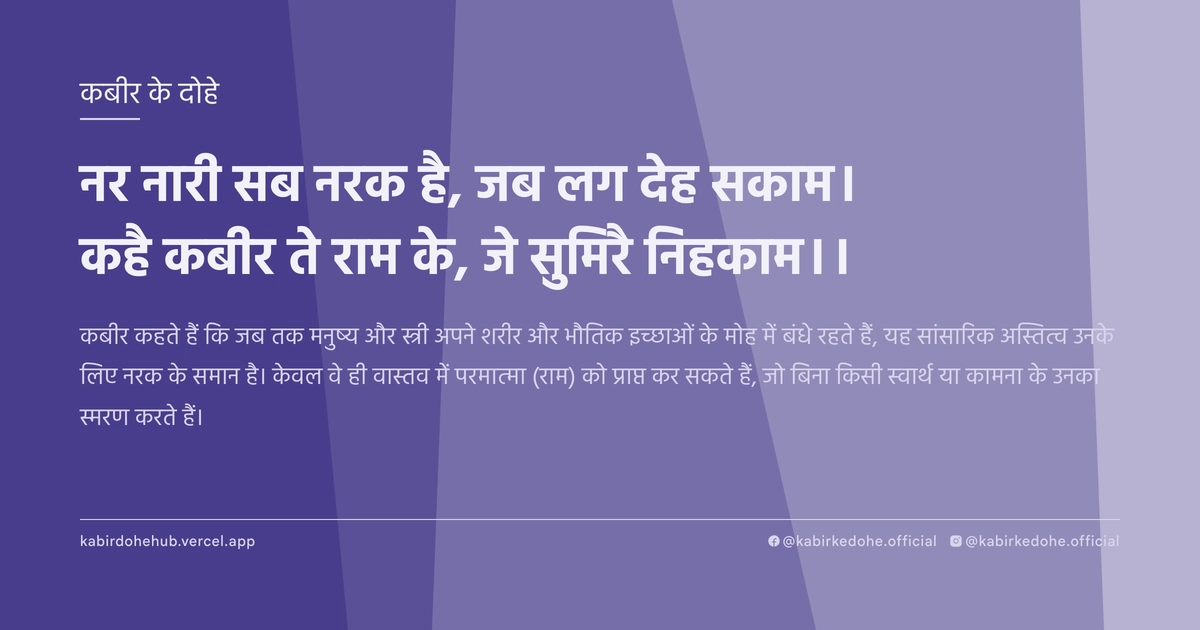
नर नारी सब नरक है, जब लग देह सकाम।
कहै कबीर ते राम के, जे सुमिरै निहकाम।।
Nar nari sab narak hai, jab lag deh sakam. Kahe Kabir te Ram ke, je sumire nihkam.
इस पृष्ठ पर इस कबीर दोहे का अर्थ (meaning), हिंदी व्याख्या और अंग्रेज़ी अनुवाद, दार्शनिक विश्लेषण और व्यावहारिक जीवन सीख दी गई है। यह दोहा मुक्ति (Liberation) विषय से जुड़ा है — Kabir doha meaning and explanation in Hindi and English.
अर्थ (Meaning):
कबीर कहते हैं कि जब तक मनुष्य और स्त्री अपने शरीर और भौतिक इच्छाओं के मोह में बंधे रहते हैं, यह सांसारिक अस्तित्व उनके लिए नरक के समान है। केवल वे ही वास्तव में परमात्मा (राम) को प्राप्त कर सकते हैं, जो बिना किसी स्वार्थ या कामना के उनका स्मरण करते हैं।
Kabir asserts that as long as men and women remain tethered to the desires of the physical body and material cravings, their existence is akin to a living hell. Only those who remember the Divine (Ram) without any selfish motive or desire for reward can truly attain spiritual liberation.
व्याख्या (Interpretation):
इस दोहे का शाब्दिक अर्थ है कि शारीरिक वासना और इच्छाएं मनुष्य को दुखों के चक्र में फंसाए रखती हैं। यहाँ 'नरक' का तात्पर्य किसी पाताल लोक से नहीं, बल्कि मानसिक अशांति और अतृप्ति से है। कबीर 'देह सकाम' के माध्यम से उस अहंकार की बात कर रहे हैं जो शरीर को ही सत्य मानता है। जब साधक 'निहकाम' यानी निष्काम भाव से राम का सुमिरन करता है, तो वह द्वैत से अद्वैत की ओर बढ़ता है। यह निर्गुण भक्ति का सार है जहाँ ईश्वर किसी बाहरी मूर्ति में नहीं, बल्कि कामना-रहित चेतना में मिलता है। अंततः, यह दोहा माया के पर्दे को हटाकर आत्मा और ब्रह्म की एकता को पहचानने का आह्वान है।
Literally, the verse suggests that physical lust and worldly desires trap humans in a cycle of suffering. Here, 'hell' does not refer to a subterranean realm, but to the state of mental turmoil and perpetual dissatisfaction. Through 'deh sakaam,' Kabir addresses the ego that mistakes the physical vessel for the ultimate reality. When a seeker remembers Ram 'nihkaam'—without desire—they transition from duality to non-duality. This is the essence of Nirgun Bhakti, where the Divine is found not in an external idol, but within a desireless consciousness. Ultimately, the couplet calls for piercing the veil of Maya to realize the oneness of Atman and Brahman.
दार्शनिक विश्लेषण (Philosophical Analysis):
कबीर का यह दर्शन उस समय के कट्टरपंथी धार्मिक ढांचे पर प्रहार करता है जहाँ मोक्ष केवल कर्मकांडों से संभव माना जाता था। वे स्पष्ट करते हैं कि बाहरी अनुष्ठान तब तक व्यर्थ हैं जब तक आंतरिक वासनाओं का अंत नहीं होता। यह विचार अद्वैत वेदांत के 'माया' सिद्धांत से मेल खाता है, जहाँ शरीर और उसकी इच्छाएं सत्य को ढक लेती हैं।
सूफीवाद के 'फना' (अहंकार का विनाश) के सिद्धांत की तरह, कबीर यहाँ 'सकाम' भाव के विनाश की बात करते हैं। जब तक 'मैं' और 'मेरा' का भाव है, तब तक ईश्वर और जीव के बीच एक पर्दा रहता है। यह पर्दा ही वह नरक है जिसमें मनुष्य अपनी पूरी जिंदगी बिता देता है, जबकि मुक्ति उसके भीतर ही छिपी होती है।
कबीर का 'राम' दशरथ पुत्र राम नहीं, बल्कि वह निराकार तत्व है जो कण-कण में व्याप्त है। वे तर्क देते हैं कि यदि आप ईश्वर से कुछ माँगने के लिए प्रार्थना कर रहे हैं, तो आप वास्तव में ईश्वर की नहीं, बल्कि अपनी इच्छाओं की पूजा कर रहे हैं। सच्ची भक्ति वह है जो फल की इच्छा से मुक्त हो।
ऐतिहासिक रूप से, कबीर ने जाति और वर्ग के भेदभाव को इसलिए नकारा क्योंकि शरीर (देह) ही वह बंधन है जो मनुष्य को ऊंच-नीच में बांटता है। यदि शरीर की कामनाएं समाप्त हो जाएं, तो केवल शुद्ध चेतना बचती है, जिसमें कोई जाति या लिंग नहीं होता।
मनोवैज्ञानिक स्तर पर, यह दोहा हमें सिखाता है कि हमारी अतृप्ति ही हमारा सबसे बड़ा दुख है। जब हम बाहरी वस्तुओं में सुख खोजते हैं, तो हम एक अंतहीन दौड़ में फंस जाते हैं। निष्काम स्मरण का अर्थ है अपनी चेतना को बाहरी दुनिया से हटाकर आंतरिक शांति की ओर मोड़ना।
Kabir's philosophy strikes at the heart of the dogmatic religious structures of his era, where salvation was deemed possible only through rigid rituals. He clarifies that external rites are futile as long as internal cravings persist. This aligns with the Advaita Vedanta concept of 'Maya,' where the body and its desires obscure the ultimate truth.
Similar to the Sufi concept of 'Fana' (the annihilation of the ego), Kabir speaks of the destruction of 'sakaam' or desire-driven intent. As long as the sense of 'I' and 'mine' exists, a veil remains between the Divine and the individual. This veil is the 'hell' in which humans spend their lives, while liberation remains hidden within.
Kabir's 'Ram' is not the historical son of Dasharatha, but the formless element pervading every atom. He argues that if one prays to God to obtain something, they are not worshipping God, but rather their own desires. True devotion is that which is liberated from the expectation of reward.
Historically, Kabir rejected caste and class distinctions because the physical body (deh) is the very bond that creates these artificial hierarchies. If bodily cravings cease, only pure consciousness remains, which possesses neither caste nor gender.
Psychologically, this couplet teaches us that our insatiability is our greatest suffering. When we seek happiness in external objects, we enter an endless race. 'Nihkaam' remembrance means shifting one's consciousness from the external world toward internal stillness.
मूल संदेश (Core Message):
- इच्छाएं ही आत्मा की बेड़ियाँ और मानसिक नरक का द्वार हैं।
- शरीर के मोह से मुक्ति ही वास्तविक आध्यात्मिक स्वतंत्रता है।
- बिना किसी शर्त के किया गया सुमिरन ही परमात्मा से मिलाता है।
- स्वार्थ का त्याग ही भक्ति की पहली और अंतिम सीढ़ी है।
- अद्वैत की प्राप्ति के लिए 'मैं' और 'मेरा' का विसर्जन अनिवार्य है।
- Desires are the shackles of the soul and the gateway to mental hell.
- Liberation from bodily attachment is the only true spiritual freedom.
- Remembrance without conditions is the only path to the Divine.
- The renunciation of selfishness is the first and final step of devotion.
- The dissolution of 'I' and 'mine' is essential to realize non-duality.
व्यावहारिक उदाहरण (Practical Example):
वाराणसी के एक पुराने घाट पर माधव नाम का एक वृद्ध नाविक रहता था। माधव का पूरा जीवन पर्यटकों को घुमाने और उनसे अधिक से अधिक पैसे कमाने की होड़ में बीता। वह हमेशा इस चिंता में रहता कि उसकी नाव सबसे तेज चले और वह सबसे अमीर नाविक बने। इस लालच ने उसे चिड़चिड़ा बना दिया था; वह अपने परिवार और शांति से दूर हो गया था।
एक दिन उसकी नाव एक गहरे भंवर में फंस गई। उसने अपनी पूरी ताकत लगा दी, लेकिन नाव टस से मस नहीं हुई। वह चिल्लाया, "हे भगवान, मुझे बचा लो, मैं तुम्हें बहुत दान दूंगा!"
तभी किनारे पर बैठे एक फकीर ने जोर से कहा, "माधव, तू अभी भी सौदा कर रहा है! तू भगवान को नहीं, अपने लालच को पुकार रहा है।"
माधव को अचानक एहसास हुआ कि उसकी पूरी जिंदगी एक सौदा रही है। उसने अपनी आँखें बंद कीं और पहली बार बिना कुछ मांगे, केवल समर्पण के भाव से उस निराकार शक्ति को याद किया। उसने महसूस किया कि उसकी घबराहट और अहंकार ही उसका असली 'नरक' था।
जैसे ही उसने 'सकाम' भाव छोड़ा, उसका मन शांत हुआ। उसने देखा कि नाव को बचाने का रास्ता उसकी ताकत में नहीं, बल्कि पानी की लहरों के साथ तालमेल बिठाने में था। उसने शांति से चप्पू चलाया और धीरे-धीरे सुरक्षित किनारे पर आ गया।
उस दिन के बाद माधव बदला हुआ इंसान था। वह अब भी नाव चलाता था, लेकिन अब उसका उद्देश्य केवल पैसा कमाना नहीं था। वह यात्रियों की सेवा निस्वार्थ भाव से करने लगा।
उसने पाया कि जब उसने फल की चिंता छोड़ दी, तो उसका काम ही उसकी पूजा बन गया। उसकी नाव अब केवल नदी पार नहीं कराती थी, बल्कि वह लोगों को शांति का अनुभव कराता था।
माधव ने समझा कि शरीर की इच्छाओं का अंत ही वास्तविक स्वर्ग है। उसने अपने जीवन के शेष वर्ष बिना किसी शिकायत के, एक शांत साक्षी की तरह बिताए।
उसका जीवन अब एक बोझ नहीं, बल्कि एक उत्सव बन गया था क्योंकि उसने 'निहकाम' सुमिरन की शक्ति को पहचान लिया था।
वाराणसी के उस घाट पर अब माधव को लोग एक नाविक नहीं, बल्कि एक जीवित संत के रूप में जानने लगे थे।
On an ancient ghat in Varanasi lived an elderly boatman named Madhav. Madhav's entire life had been spent in a race to ferry as many tourists as possible and earn the maximum amount of money. He was always consumed by the worry that his boat should be the fastest and he the wealthiest boatman. This greed had made him irritable; he had grown distant from his family and inner peace.
One day, his boat got caught in a deep whirlpool. He exerted all his strength, but the boat would not budge. He screamed, "O Lord, save me, and I will give you great donations!"
Just then, a fakir sitting on the shore shouted, "Madhav, you are still bargaining! You are not calling God; you are calling your greed."
Madhav suddenly realized that his entire life had been a series of transactions. He closed his eyes and, for the first time, without asking for anything, remembered the formless power with a sense of total surrender.
He felt that his anxiety and ego were his true 'hell.' The moment he let go of the 'sakaam' (desire-driven) intent, his mind became still. He realized that the way to save the boat lay not in brute force, but in aligning himself with the rhythm of the waves.
He rowed calmly and slowly reached the safe shore. After that day, Madhav was a changed man. He still rowed the boat, but his purpose was no longer merely to accumulate wealth. He began serving his passengers selflessly.
He discovered that when he stopped worrying about the reward, his work itself became his worship. His boat no longer just crossed the river; it provided passengers with a sense of peace.
Madhav understood that the end of bodily cravings is the true heaven. He spent the remaining years of his life as a calm witness, without a single complaint.
His life was no longer a burden but a celebration, for he had recognized the power of 'nihkaam' remembrance.
On that ghat of Varanasi, people began to know Madhav not as a boatman, but as a living saint.
अभ्यास मार्गदर्शन (Practice Guidance):
- प्रतिदिन 20 मिनट मौन बैठें और अपने भीतर उठने वाली इच्छाओं को केवल एक साक्षी (Observer) की तरह देखें, उन्हें रोकने या पूरा करने की कोशिश न करें।
- एक 'निस्वार्थ सेवा' डायरी बनाएँ। प्रतिदिन एक ऐसा कार्य करें जिसका कोई व्यक्तिगत लाभ न हो और अनुभव करें कि कैसे अहंकार कम होता है।
- जब भी किसी वस्तु की तीव्र इच्छा हो, स्वयं से पूछें: "क्या यह मेरी आत्मा की आवश्यकता है या केवल शरीर का मोह?"
- निदान चेकलिस्ट: यदि आप कार्य के परिणाम की चिंता में बेचैन हैं, तो आप 'सकाम' अवस्था में हैं। यदि आप कार्य में पूर्णतः लीन हैं और परिणाम के प्रति तटस्थ हैं, तो आप 'निहकाम' मार्ग पर हैं।
- Sit in silence for 20 minutes daily and observe the desires arising within you as a mere witness, without trying to suppress or fulfill them.
- Maintain a 'Selfless Service' journal. Perform one act daily that offers no personal gain and observe how the ego diminishes.
- Whenever a strong craving arises, ask yourself: "Is this a need of my soul, or merely an attachment of the body?"
- Diagnostic Checklist: If you are anxious about the result of your actions, you are in the 'sakaam' state. If you are fully immersed in the action and neutral toward the outcome, you are on the 'nihkaam' path.
चिंतन प्रश्न (Reflection Questions):
- मेरी कौन सी ऐसी इच्छाएं हैं जिन्हें मैं अपनी पहचान मान बैठा हूँ, जबकि वे केवल मेरे शरीर का मोह हैं?
- क्या मेरी प्रार्थनाएं वास्तव में ईश्वर के प्रति प्रेम हैं, या वे केवल मेरी मांगों की एक सूची हैं?
- यदि आज मुझसे मेरी सारी सामाजिक और भौतिक उपलब्धियां छीन ली जाएं, तो क्या मेरे भीतर कोई शांति शेष रहेगी?
- मैं दूसरों की मदद करते समय अपनी छवि (Image) को कितना महत्व देता हूँ?
- मेरे जीवन का वह कौन सा क्षेत्र है जहाँ मैं अभी भी 'सौदा' कर रहा हूँ बजाय समर्पण के?
- Which of my desires have I mistaken for my identity, while they are merely attachments of the body?
- Are my prayers truly expressions of love for the Divine, or are they merely a list of my demands?
- If all my social and material achievements were stripped away today, would any peace remain within me?
- How much importance do I give to my public image while performing acts of kindness?
- In which area of my life am I still 'bargaining' instead of surrendering?