
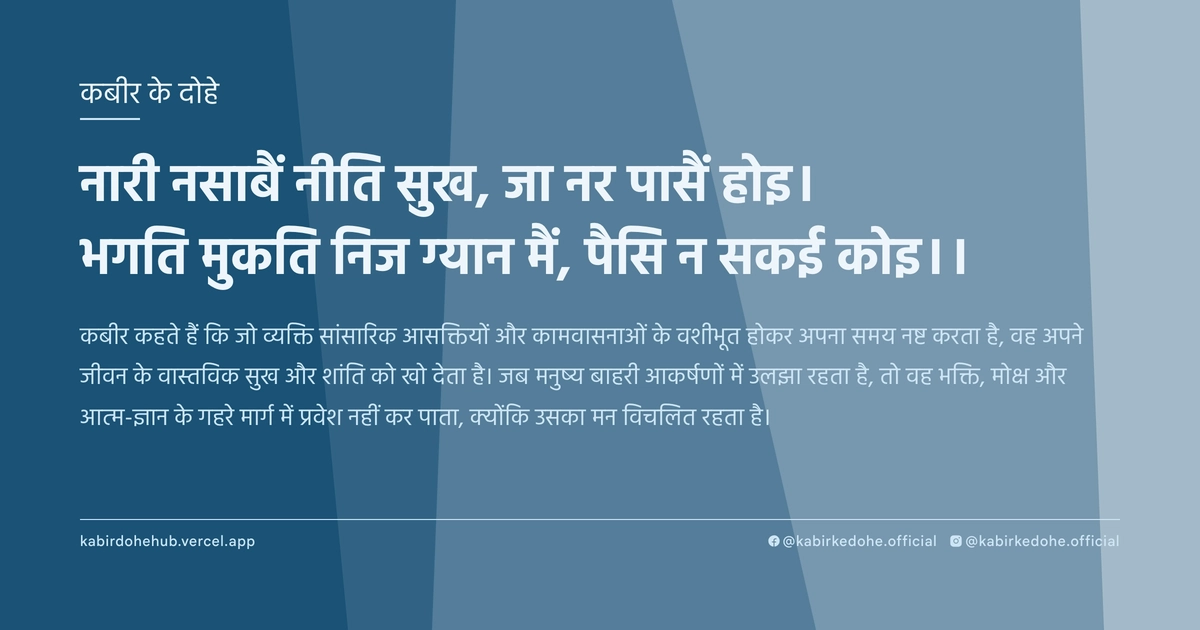
नारी नसाबैं नीति सुख, जा नर पासैं होइ।
भगति मुकति निज ग्यान मैं, पैसि न सकई कोइ।।
Nari nasabain niti sukh, ja nar pasain hoye. Bhagti mukti nij gyan main, paisi na sakai koi.
इस पृष्ठ पर इस कबीर दोहे का अर्थ (meaning), हिंदी व्याख्या और अंग्रेज़ी अनुवाद, दार्शनिक विश्लेषण और व्यावहारिक जीवन सीख दी गई है। यह दोहा काम (Lust) विषय से जुड़ा है — Kabir doha meaning and explanation in Hindi and English.
अर्थ (Meaning):
कबीर कहते हैं कि जो व्यक्ति सांसारिक आसक्तियों और कामवासनाओं के वशीभूत होकर अपना समय नष्ट करता है, वह अपने जीवन के वास्तविक सुख और शांति को खो देता है। जब मनुष्य बाहरी आकर्षणों में उलझा रहता है, तो वह भक्ति, मोक्ष और आत्म-ज्ञान के गहरे मार्ग में प्रवेश नहीं कर पाता, क्योंकि उसका मन विचलित रहता है।
Kabir asserts that a person consumed by worldly attachments and the pursuit of sensory pleasures squanders their inner peace and spiritual prosperity. When an individual is enslaved by external attractions and carnal desires, they find themselves unable to penetrate the depths of devotion, liberation, and self-realization, as their consciousness remains fragmented and distracted.
व्याख्या (Interpretation):
यहाँ 'नारी' शब्द केवल स्त्री के लिए नहीं, बल्कि 'माया' और समस्त सांसारिक आकर्षणों का प्रतीक है। कबीर समझाते हैं कि जब इंद्रियाँ बाहरी विषयों में लीन होती हैं, तो अंतर्मुखी होने की क्षमता समाप्त हो जाती है। यह स्थिति द्वैत (Duality) की है, जहाँ मनुष्य स्वयं को शरीर और वासनाओं तक सीमित मान लेता है। निर्गुण भक्ति का मार्ग पूर्ण वैराग्य और मानसिक अनुशासन की मांग करता है। जब तक 'मैं' और 'मेरा' का अहंकार और काम वासना का पर्दा रहता है, तब तक आत्मा और ब्रह्म की एकता (Advaita) का अनुभव असंभव है। यह दोहा मानवीय स्थिति के उस विरोधाभास को दर्शाता है जहाँ हम सुख खोजते हैं, लेकिन उसी सुख के साधनों में फंसकर शाश्वत आनंद से दूर हो जाते हैं।
In this context, 'Naari' (woman) serves as a metaphor for 'Maya'—the cosmic illusion and all forms of worldly attachment. Kabir explains that when the senses are preoccupied with external objects, the capacity for introversion is extinguished. This represents the state of Duality, where the human identifies solely with the physical body and its cravings. The path of Nirgun Bhakti demands absolute detachment and rigorous mental discipline. As long as the veil of ego and carnal desire persists, the non-dual realization of Atman-Brahman remains inaccessible. This doha highlights the central paradox of the human condition: we seek happiness, yet we are imprisoned by the very instruments of pleasure we believe will bring us fulfillment.
दार्शनिक विश्लेषण (Philosophical Analysis):
कबीर का यह दृष्टिकोण उनके समय के सामाजिक और धार्मिक परिवेश की प्रतिक्रिया है, जहाँ कर्मकांड और बाहरी आडंबरों का बोलबाला था। वे स्पष्ट करते हैं कि मोक्ष किसी मंदिर, मस्जिद या बाहरी अनुष्ठान से नहीं, बल्कि आंतरिक शुद्धिकरण से मिलता है। यहाँ 'नारी' का उल्लेख पितृसत्तात्मक दृष्टिकोण से अधिक, योगिक दृष्टिकोण से है, जहाँ काम (Kama) को आध्यात्मिक प्रगति में सबसे बड़ी बाधा माना गया है।
अद्वैत वेदांत के अनुसार, माया वह शक्ति है जो सत्य को छुपाती है। कबीर यहाँ माया के उस रूप की बात कर रहे हैं जो मनुष्य को 'भ्रम' में रखता है। जब व्यक्ति इंद्रिय सुखों को ही अंतिम सत्य मान लेता है, तो वह अपनी वास्तविक प्रकृति (Pure Consciousness) को भूल जाता है। यह विस्मृति ही बंधन का कारण है।
सूफी मत के 'नफ्स' (Nafs) या निम्नतर अहंकार की अवधारणा यहाँ सटीक बैठती है। सूफीवाद में भी वासनाओं पर विजय पाना ईश्वर (Allah) के मिलन की पहली शर्त है। कबीर इन दोनों परंपराओं को जोड़ते हुए कहते हैं कि जब तक मन बाहरी दुनिया में भटक रहा है, वह 'शून्य' या 'परब्रह्म' का अनुभव नहीं कर सकता।
कबीर का विरोध केवल स्त्री या पुरुष के प्रति नहीं, बल्कि उस 'आसक्ति' (Attachment) के प्रति है जो विवेक को नष्ट कर देती है। वे जाति और धर्म के बंधनों को तोड़कर एक ऐसी चेतना की बात करते हैं जो शरीर से परे है। उनके लिए भक्ति कोई क्रिया नहीं, बल्कि एक अवस्था है जहाँ साधक पूरी तरह से समर्पित और विरक्त हो जाता है।
मनोवैज्ञानिक स्तर पर, यह दोहा इच्छाओं के अंतहीन चक्र (Hedonic Treadmill) की चेतावनी है। जब हम बाहरी उत्तेजनाओं पर निर्भर होते हैं, तो हमारी आंतरिक शांति क्षणभंगुर हो जाती है। वास्तविक ज्ञान (Gyaan) तभी संभव है जब हम बाहरी शोर को शांत कर सकें और अपने भीतर के मौन को सुन सकें।
Kabir's perspective is a direct reaction to the socio-religious climate of his era, dominated by ritualism and external piety. He clarifies that liberation is not achieved through temples, mosques, or outward ceremonies, but through internal purification. The reference to 'Naari' is less about gender and more about the yogic understanding of 'Kama' (desire) as the primary obstacle to spiritual ascent.
According to Advaita Vedanta, Maya is the force that obscures the ultimate truth. Kabir addresses the aspect of Maya that keeps the human in a state of delusion. When an individual mistakes sensory pleasure for the ultimate reality, they forget their true nature as Pure Consciousness. This forgetfulness is the very root of bondage.
This aligns closely with the Sufi concept of 'Nafs' or the lower ego. In Sufism, conquering the desires of the flesh is the prerequisite for union with the Divine. Kabir bridges these traditions, asserting that as long as the mind wanders in the external world, it cannot experience the 'Shunya' (Void) or the Supreme Brahman.
Kabir's critique is not directed at individuals, but at the 'attachment' that destroys discernment. He transcends caste and creed to advocate for a consciousness that exists beyond the physical form. For him, Bhakti is not a ritualistic act but a state of being characterized by total surrender and detachment.
Psychologically, this doha warns against the 'Hedonic Treadmill'—the endless cycle of craving. When we rely on external stimuli for happiness, our inner peace becomes fragile and fleeting. True Gyaan (Knowledge) is only possible when we silence the external noise and listen to the profound silence within.
मूल संदेश (Core Message):
- बाहरी आकर्षण आत्मा की गहराई में जाने के मार्ग की बाधा हैं।
- इंद्रिय सुख क्षणभंगुर हैं, जबकि आत्म-ज्ञान शाश्वत आनंद देता है।
- मोह का त्याग ही वास्तविक प्रेम और मुक्ति का एकमात्र द्वार है।
- जब तक 'मैं' और 'मेरा' है, तब तक परमात्मा का अनुभव असंभव है।
- शांति बाहर खोजने की वस्तु नहीं, बल्कि भीतर जगाने वाली अवस्था है।
- External attractions are obstacles on the path to the soul's depths.
- Sensory pleasures are fleeting, while self-realization grants eternal bliss.
- Renunciation of attachment is the only gateway to true love and liberation.
- As long as 'I' and 'Mine' persist, the experience of the Divine is impossible.
- Peace is not an object to be found outside, but a state to be awakened within.
व्यावहारिक उदाहरण (Practical Example):
वाराणसी के घाटों पर रहने वाले एक वृद्ध बुनकर, माधव की कहानी है। माधव अपने काम में निपुण था, लेकिन उसका मन हमेशा इस बात की चिंता में रहता था कि उसके बेटे और बहु उसे कितना सम्मान देंगे और उसकी संपत्ति का क्या होगा। वह अपनी पूरी ऊर्जा परिवार के मोह और सांसारिक सुखों की योजना बनाने में लगा देता था।
वह अक्सर मंदिर जाता, दान करता, लेकिन उसका मन कभी शांत नहीं हुआ। वह जितना अधिक बाहरी सुखों और रिश्तों में उलझता गया, उसकी आंतरिक बेचैनी उतनी ही बढ़ती गई। उसे लगता था कि यदि वह और अधिक धन संचित करेगा, तो उसे शांति मिलेगी।
एक दिन उसकी मुलाकात एक घुमक्कड़ संत से हुई, जिसने माधव की व्याकुलता को देखा। संत ने उससे पूछा, "तुम जिस सुख की तलाश कर रहे हो, क्या वह तुम्हारे नियंत्रण में है?" माधव ने कहा, "मैं बस अपने परिवार की खुशी और अपनी प्रतिष्ठा चाहता हूँ।"
संत ने मुस्कुराते हुए कहा, "तुम उस धागे को पकड़ने की कोशिश कर रहे हो जो टूट चुका है। तुम्हारी आसक्ति ही तुम्हारा दुख है। तुम बाहरी दुनिया में सुख खोज रहे हो, जबकि वह तुम्हारे भीतर ही है।"
माधव को पहली बार अहसास हुआ कि उसकी 'नारी' (यहाँ मोह और सांसारिक आसक्ति) उसे वास्तविक शांति से दूर ले जा रही थी। उसने महसूस किया कि वह रिश्तों के नाम पर केवल अपनी इच्छाओं को संतुष्ट कर रहा था, प्रेम को नहीं।
उस रात माधव ने अपनी सारी चिंताएं त्यागने का निर्णय लिया। उसने अपनी संपत्ति का मोह छोड़ा और केवल अपने कर्म और ईश्वर के प्रति समर्पित हो गया। उसने बाहरी दिखावे के बजाय मौन ध्यान का अभ्यास शुरू किया।
धीरे-धीरे, माधव के जीवन में एक अद्भुत परिवर्तन आया। वह अब भी अपने परिवार के साथ था, लेकिन अब वह उनके प्रति आसक्त नहीं, बल्कि प्रेमपूर्ण था। उसने पाया कि जब उसने पाने की इच्छा छोड़ दी, तो उसे वह शांति मिल गई जिसकी तलाश वह जीवन भर कर रहा था।
अंततः, माधव ने जाना कि भक्ति और मुक्ति किसी बाहरी वस्तु या व्यक्ति में नहीं, बल्कि अपनी वासनाओं के विसर्जन में है। वह अब एक सच्चा साधक बन चुका था, जिसने माया के पर्दे को हटाकर सत्य का साक्षात्कार किया था।
Consider the story of Madhav, an elderly weaver living on the ghats of Varanasi. Madhav was master of his craft, yet his mind was perpetually plagued by anxiety over how much respect his son and daughter-in-law would show him and the fate of his meager assets.
He spent his entire energy planning for worldly comforts and clinging to familial attachments. He frequently visited temples and gave donations, yet his mind remained a storm of unrest. He believed that accumulating more wealth would eventually bring him peace.
One day, he encountered a wandering sanyasi who noticed Madhav's agitation. The saint asked, "The happiness you seek—is it truly within your control?" Madhav replied, "I only desire the happiness of my family and the preservation of my prestige."
The saint smiled and said, "You are trying to hold onto a thread that has already snapped. Your attachment is your suffering. You seek joy in the external world, while it resides within you."
For the first time, Madhav realized that his 'Naari' (symbolizing his attachments and worldly cravings) was leading him away from genuine peace. He understood that in the name of relationships, he was merely feeding his own ego and desires, not practicing true love.
That night, Madhav decided to surrender his anxieties. He let go of the obsession with property and dedicated himself solely to his work and the Divine. He replaced external displays of piety with the practice of silent meditation.
Gradually, a profound transformation occurred in Madhav's life. He remained with his family, but he was no longer attached to them; instead, he loved them unconditionally. He discovered that once he ceased the desire to possess, he found the peace he had sought for a lifetime.
Ultimately, Madhav learned that Bhakti and Mukti do not reside in external objects or people, but in the dissolution of one's own cravings. He became a true seeker, having lifted the veil of Maya to witness the Truth.
अभ्यास मार्गदर्शन (Practice Guidance):
- प्रतिदिन 20 मिनट 'साक्षी भाव' (Witness Consciousness) का अभ्यास करें, जहाँ आप अपनी इच्छाओं को बिना किसी निर्णय के केवल देखें।
- एक डायरी लिखें जिसमें उन तीन बाहरी चीजों की सूची हो जिनसे आप सबसे अधिक जुड़े हुए हैं, और विश्लेषण करें कि यदि वे कल चले जाएं, तो आपकी पहचान पर क्या प्रभाव पड़ेगा।
- व्यवहार परिवर्तन: जब भी किसी भौतिक वस्तु या व्यक्ति के प्रति तीव्र इच्छा जागे, तो 10 गहरी सांसें लें और स्वयं से पूछें, "क्या यह इच्छा मेरी आत्मा की शांति बढ़ा रही है या मेरे अहंकार को?"
- डायग्नोस्टिक चेकलिस्ट: यदि आप छोटी-छोटी बातों पर विचलित होते हैं, दूसरों की सफलता से ईर्ष्या करते हैं, या अपनी खुशी को बाहरी परिस्थितियों पर निर्भर पाते हैं, तो आप अभी भी 'माया' के प्रभाव में हैं।
- Practice 'Sakshi Bhav' (Witness Consciousness) for 20 minutes daily, observing your desires and cravings without judgment or attachment.
- Maintain a journal listing three external attachments you hold most dear, then analyze how your identity would be affected if they were gone tomorrow.
- Behavioral Shift: Whenever an intense desire for a material object or person arises, take 10 deep breaths and ask yourself, "Is this craving enhancing my soul's peace or inflating my ego?"
- Diagnostic Checklist: If you find yourself easily agitated by trivialities, envious of others' success, or dependent on external conditions for happiness, you are still under the influence of 'Maya'.
चिंतन प्रश्न (Reflection Questions):
- मेरी कौन सी ऐसी 'सांसारिक इच्छाएं' हैं जिन्हें मैं अपनी पहचान का हिस्सा मान बैठा हूँ?
- क्या मेरा प्रेम वास्तव में निस्वार्थ है, या यह केवल मेरी अपनी जरूरतों को पूरा करने का एक तरीका है?
- जब मैं अकेला होता हूँ, तो मुझे अपनी आंतरिक शून्यता से डर क्यों लगता है?
- मैं अपनी डिजिटल छवि (Social Media Ego) को बनाए रखने के लिए अपनी वास्तविक शांति का कितना बलिदान दे रहा हूँ?
- क्या मैं वास्तव में मुक्त होना चाहता हूँ, या मैं केवल अपनी वर्तमान सुख-सुविधाओं के साथ समझौता करना चाहता हूँ?
- Which 'worldly desires' have I mistakenly integrated into my core identity?
- Is my love truly selfless, or is it merely a mechanism to satisfy my own emotional needs?
- Why do I feel fear when confronted with the internal void during moments of absolute solitude?
- How much of my inner peace am I sacrificing to maintain my digital persona and social ego?
- Do I genuinely desire liberation, or am I merely seeking a more comfortable form of bondage?