
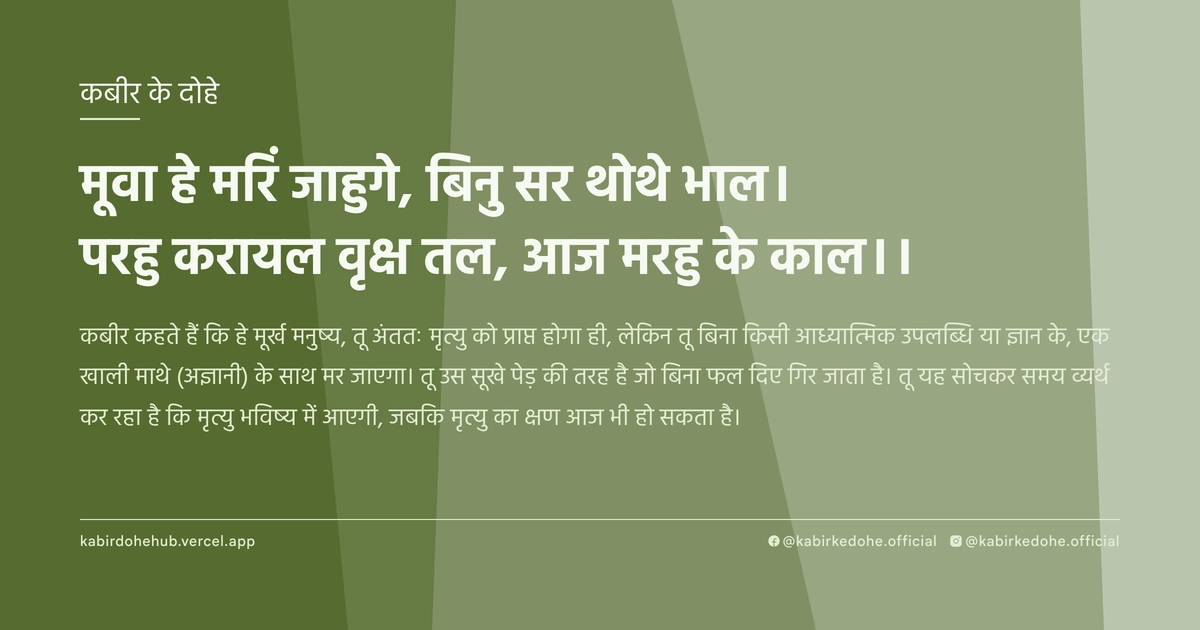
मूवा हे मरिं जाहुगे, बिनु सर थोथे भाल।
परहु करायल वृक्ष तल, आज मरहु के काल।।
Muva he marin jahuge, bin sar thothe bhaal. Parahu karayal vriksh tal, aaj marahu ke kaal.
इस पृष्ठ पर इस कबीर दोहे का अर्थ (meaning), हिंदी व्याख्या और अंग्रेज़ी अनुवाद, दार्शनिक विश्लेषण और व्यावहारिक जीवन सीख दी गई है। यह दोहा मृतुक्यता (Mortality) विषय से जुड़ा है — Kabir doha meaning and explanation in Hindi and English.
अर्थ (Meaning):
कबीर कहते हैं कि हे मूर्ख मनुष्य, तू अंततः मृत्यु को प्राप्त होगा ही, लेकिन तू बिना किसी आध्यात्मिक उपलब्धि या ज्ञान के, एक खाली माथे (अज्ञानी) के साथ मर जाएगा। तू उस सूखे पेड़ की तरह है जो बिना फल दिए गिर जाता है। तू यह सोचकर समय व्यर्थ कर रहा है कि मृत्यु भविष्य में आएगी, जबकि मृत्यु का क्षण आज भी हो सकता है।
Kabir addresses the oblivious human soul, warning that death is an absolute certainty, yet most face it with an empty mind, devoid of spiritual realization. He compares the ignorant person to a withered tree that falls without ever bearing fruit. The warning is stark: do not procrastinate your spiritual awakening by assuming death is a distant event; it can claim you this very moment.
व्याख्या (Interpretation):
यहाँ 'बिनु सर थोथे भाल' का अर्थ उस व्यक्ति से है जिसने जीवन भर केवल भौतिकता का संचय किया और आत्म-ज्ञान की खोज नहीं की। कबीर एक गहरे विरोधाभास को प्रस्तुत करते हैं—मृत्यु अनिवार्य है, फिर भी मनुष्य उसे नकारता है। यह दोहा निर्गुण भक्ति के उस सिद्धांत पर आधारित है जहाँ शरीर को एक नश्वर वस्त्र माना गया है। 'करायल वृक्ष' माया के उस प्रभाव का प्रतीक है जो मनुष्य को बाहरी आडंबरों में उलझाए रखता है, जिससे वह आंतरिक रिक्तता को नहीं देख पाता। अद्वैत वेदांत के परिप्रेक्ष्य में, यह अज्ञान (Avidya) की स्थिति है जहाँ जीव स्वयं को ब्रह्म से अलग मानकर संसार के क्षणभंगुर सुखों में लिप्त रहता है। अंततः, यह दोहा हमें याद दिलाता है कि बिना आत्म-साक्षात्कार के जीवन एक व्यर्थ प्रयास है।
The phrase 'bin sar thothe bhaal' refers to an individual who has spent a lifetime accumulating material wealth while neglecting the quest for self-realization. Kabir presents a profound paradox: death is the only certainty, yet humans live in a state of collective denial. This verse is rooted in the Nirgun Bhakti tradition, viewing the physical body as a transient garment. The 'withered tree' symbolizes the influence of Maya, which entangles the soul in external rituals and vanity, masking an internal void. From the lens of Advaita Vedanta, this represents the state of Avidya (ignorance), where the Jiva perceives itself as separate from Brahman. Ultimately, the doha asserts that a life lived without spiritual awakening is a wasted opportunity, emphasizing the urgency of returning to the Source before the physical vessel collapses.
दार्शनिक विश्लेषण (Philosophical Analysis):
कबीर का यह दोहा उस समय के सामाजिक और धार्मिक परिवेश पर एक कड़ा प्रहार है जहाँ लोग केवल कर्मकांडों और बाहरी दिखावे में विश्वास करते थे। कबीर ने स्पष्ट किया कि मोक्ष किसी मंदिर, मस्जिद या तीर्थयात्रा से नहीं, बल्कि आंतरिक शुद्धि और अहंकार के विसर्जन से मिलता है। यह दृष्टिकोण सूफीवाद के 'फना' (अहंकार का विनाश) के सिद्धांत से मेल खाता है, जहाँ साधक अपनी व्यक्तिगत पहचान को ईश्वर की इच्छा में विलीन कर देता है।
यहाँ 'थोथे भाल' का अर्थ केवल बौद्धिक शून्यता नहीं, बल्कि आध्यात्मिक शून्यता है। कबीर तर्क देते हैं कि यदि मनुष्य ने अपने भीतर के 'साक्षी' (Witness) को नहीं जगाया, तो उसकी सारी उपलब्धियाँ मृत्यु के समय धूल के समान हो जाएंगी। यह अद्वैत वेदांत के उस सत्य की पुष्टि करता है कि केवल वह सत्य जो शाश्वत है, वही वास्तव में 'प्राप्त' किया जा सकता है; बाकी सब माया का खेल है।
कबीर का विद्रोह केवल धर्म के विरुद्ध नहीं, बल्कि उस मानसिक जड़ता के विरुद्ध है जो मनुष्य को वर्तमान क्षण से काट देती है। वे 'आज' और 'काल' के बीच के अंतर को मिटाकर मृत्यु को एक शिक्षक के रूप में प्रस्तुत करते हैं। जब मनुष्य यह स्वीकार कर लेता है कि उसका समय सीमित है, तभी वह वास्तविक साधना की ओर अग्रसर होता है।
यह विश्लेषण हमें बताता है कि कबीर के लिए 'मृत्यु' केवल शरीर का अंत नहीं, बल्कि एक अवसर है। यदि व्यक्ति जीवित रहते हुए 'मरना' सीख ले (अर्थात अहंकार का त्याग कर दे), तो वह वास्तविक जीवन को प्राप्त करता है। यह मनोवैज्ञानिक रूपांतरण की वह प्रक्रिया है जहाँ भय, जागरूकता में बदल जाता है।
अंततः, यह दोहा हमें चेतावनी देता है कि हम अपनी आध्यात्मिक तैयारी में देरी न करें। यह एक आह्वान है कि हम अपनी चेतना को विस्तृत करें और उस निराकार ब्रह्म के साथ एकाकार हों, जिससे हम इस संसार में आए हैं और जिसमें हमें वापस लौटना है।
Kabir's verse serves as a scathing critique of the socio-religious climate of his era, where spiritual merit was erroneously equated with outward rituals and caste-based superiority. He asserts that liberation (Mukti) is not found in temples, mosques, or pilgrimages, but through internal purification and the annihilation of the ego. This perspective aligns seamlessly with the Sufi concept of 'Fana', where the seeker dissolves their individual identity into the Divine Will.
The 'empty forehead' (thothe bhaal) does not signify a lack of intellectual knowledge, but a void of spiritual realization. Kabir argues that unless one awakens the 'Sakshi' (the Witness) within, all worldly achievements become as ephemeral as dust at the moment of death. This reinforces the Advaita Vedanta truth that only the Eternal is truly 'attained'; everything else is a projection of Maya.
Kabir's rebellion is not merely against organized religion, but against the mental inertia that detaches humans from the present moment. By collapsing the distinction between 'today' and 'tomorrow' (aaj and kaal), he presents death as the ultimate teacher. Only when a human acknowledges the finitude of existence does the genuine impulse for spiritual discipline arise.
This analysis reveals that for Kabir, 'death' is not just a biological end, but a spiritual catalyst. He suggests that if one can 'die' while still alive—meaning the death of the ego—they attain true life. This is a psychological transformation where the fear of death is transmuted into a state of heightened awareness.
Ultimately, the doha warns against the procrastination of spiritual awakening. It is a call to expand one's consciousness and merge with the Nirgun Brahman, the formless source from which all existence emerges and to which all must inevitably return.
मूल संदेश (Core Message):
- मृत्यु एक सत्य है, अज्ञानता एक विकल्प है।
- बाहरी कर्मकांड आंतरिक रिक्तता को नहीं भर सकते।
- अहंकार का त्याग ही वास्तविक जीवन की शुरुआत है।
- वर्तमान क्षण ही एकमात्र समय है जब जागृति संभव है।
- बिना प्रेम और ज्ञान के जीवन एक सूखे वृक्ष के समान है।
- Death is an absolute truth; ignorance is a choice.
- External rituals cannot fill an internal void.
- The surrender of ego is the true beginning of life.
- The present moment is the only window for awakening.
- A life without love and wisdom is like a withered tree.
व्यावहारिक उदाहरण (Practical Example):
वाराणसी के घाटों पर रहने वाले एक वृद्ध विधवा, जानकी, का जीवन केवल दूसरों की सेवा और मंदिर की सीढ़ियों पर बैठने में बीत रहा था। वह मानती थी कि उसके जीवन का उद्देश्य केवल मृत्यु की प्रतीक्षा करना और मोक्ष के लिए प्रार्थना करना है। वह हर दिन घंटों माला जपती, लेकिन उसके मन में अभी भी अपने परिवार के प्रति गहरी कड़वाहट और समाज के प्रति शिकायतें थीं।
एक दिन, उसने एक फकीर को देखा जो सड़क किनारे बैठकर जोर-जोर से हंस रहा था। जब जानकी ने उससे पूछा कि वह इस दुखद संसार में क्यों हंस रहा है, तो फकीर ने कबीर का यह दोहा सुनाया। फकीर ने कहा, "माता, आप मोक्ष की प्रार्थना तो कर रही हैं, लेकिन आपका मन अभी भी पुराने दुखों के बोझ से दबा है। आप उस सूखे पेड़ की तरह हैं जो केवल खड़ा है, लेकिन उसके भीतर कोई जीवन नहीं है।"
जानकी को यह बात चुभ गई। उसने महसूस किया कि वह केवल 'मृत्यु की प्रतीक्षा' कर रही थी, न कि 'जीवन को जी' रही थी। उसने महसूस किया कि उसकी माला केवल एक यांत्रिक क्रिया थी, जबकि उसका हृदय क्रोध और ईर्ष्या से भरा था। यह उसके लिए एक 'कबीर मोड़' था।
उसने तय किया कि वह केवल प्रार्थना नहीं करेगी, बल्कि अपने भीतर की कड़वाहट को समाप्त करेगी। उसने उन लोगों को माफ करना शुरू किया जिन्होंने उसे चोट पहुँचाई थी। उसने महसूस किया कि क्षमा ही वास्तविक साधना है।
धीरे-धीरे, जानकी का व्यवहार बदलने लगा। वह अब केवल मंदिर नहीं जाती थी, बल्कि उन बच्चों को पढ़ाना शुरू किया जो घाटों पर भीख मांगते थे। उसने अपनी आंतरिक रिक्तता को सेवा और प्रेम से भरना शुरू किया।
उसने पाया कि जब उसने अपने अहंकार और शिकायतों को त्याग दिया, तो उसे वह शांति मिली जो उसे वर्षों की माला जपने से नहीं मिली थी। वह अब मृत्यु से डरती नहीं थी, क्योंकि उसने जीवन को सार्थक बना लिया था।
उसकी आँखों में अब एक नई चमक थी। वह समझ गई थी कि 'खाली माथा' वह नहीं है जिसके पास धन नहीं, बल्कि वह है जिसके पास प्रेम और करुणा नहीं है।
जब अंततः उसका समय आया, तो वह शांत थी। वह अब वह 'सूखा पेड़' नहीं थी, बल्कि एक ऐसा वृक्ष बन चुकी थी जिसने अपनी आत्मा के फलों से दूसरों के जीवन को सुगंधित किया था।
Janaki, an elderly widow living on the ghats of Varanasi, spent her days in a cycle of ritualistic service and sitting on temple steps. She believed her life's purpose was simply to wait for death and pray for salvation. Every day she spent hours chanting beads, yet her heart remained heavy with deep resentment toward her family and grievances against society.
One day, she encountered a wandering dervish sitting by the road, laughing heartily. When Janaki asked why he laughed in such a sorrowful world, the dervish recited this specific doha by Kabir. He told her, "Mother, you pray for liberation, but your mind is still burdened by old wounds. You are like a withered tree—standing, but devoid of inner life."
These words pierced Janaki's heart. She realized she had been 'waiting for death' rather than 'living life.' She recognized that her chanting was a mechanical act, while her internal state was a storm of anger and jealousy. This was her 'Kabir Twist.'
She decided that she would not merely pray, but would actively work to dissolve the bitterness within. She began the arduous process of forgiving those who had wronged her, realizing that forgiveness is the highest form of spiritual practice.
Gradually, Janaki's behavior shifted. She stopped spending all her time in the temple and began teaching the street children who begged on the ghats. She started filling her internal void with selfless service and unconditional love.
She discovered that by relinquishing her ego and her list of grievances, she attained a peace that years of rote chanting had never provided. She no longer feared death because she had finally made her life meaningful.
There was now a new light in her eyes. She understood that an 'empty forehead' does not belong to the poor, but to those who lack love and compassion in their hearts.
When her time finally came, she was profoundly serene. She was no longer that 'withered tree,' but had become a flourishing presence whose spiritual fruits had fragranced the lives of others.
अभ्यास मार्गदर्शन (Practice Guidance):
- प्रतिदिन 20 मिनट 'मृत्यु-चिंतन' (Memento Mori) करें: विचार करें कि यदि आज अंतिम दिन हो, तो क्या आपका मन शांत है या अधूरा?
- आत्म-निरीक्षण जर्नल: लिखें कि आपके जीवन के कौन से हिस्से 'सूखे पेड़' की तरह हैं—अर्थात वे आदतें या रिश्ते जिनमें अब कोई जीवन या प्रेम नहीं बचा है।
- अहंकार विसर्जन अभ्यास: दिन में एक बार जानबूझकर ऐसी स्थिति पैदा करें जहाँ आप अपनी राय को गलत साबित होते देखें और बिना रक्षात्मक हुए उसे स्वीकार करें।
- डायग्नोस्टिक चेकलिस्ट: क्या मैं केवल बाहरी अनुष्ठानों (पूजा, प्रार्थना) पर निर्भर हूँ? क्या मेरे भीतर करुणा की वास्तविक वृद्धि हो रही है? क्या मैं भविष्य की चिंता में वर्तमान की शांति खो रहा हूँ?
- Daily 'Death Contemplation' (Memento Mori): Spend 20 minutes reflecting on the reality that if today were your last day, would your mind be at peace or cluttered with unfinished emotional business?
- Self-Inquiry Journaling: Identify the 'withered branches' of your life—habits, grudges, or relationships that no longer bear fruit or provide spiritual growth.
- Ego-Dissolution Practice: Once a day, intentionally place yourself in a situation where your opinion is proven wrong, and practice accepting it without becoming defensive.
- Diagnostic Checklist: Am I relying solely on external rituals? Is there a genuine increase in my capacity for compassion? Am I sacrificing present peace for a hypothetical future?
चिंतन प्रश्न (Reflection Questions):
- यदि आज आपकी भौतिक पहचान (नाम, पद, संपत्ति) छीन ली जाए, तो आपके पास 'अंदर' क्या बचेगा?
- आप अपनी आध्यात्मिक प्रगति का प्रमाण बाहरी प्रशंसा में खोजते हैं या आंतरिक मौन में?
- वह कौन सा 'सूखा वृक्ष' (पुरानी धारणा) है जिसे आप अब भी पकड़े हुए हैं, जबकि वह मर चुका है?
- क्या आपकी धार्मिकता दूसरों को छोटा महसूस कराने का एक साधन बन गई है?
- आप मृत्यु के भय को अपनी जागरूकता बढ़ाने के लिए कैसे उपयोग कर सकते हैं?
- If your physical identity (name, title, wealth) were stripped away today, what would actually remain 'inside'?
- Do you seek evidence of your spiritual progress in external validation or in internal silence?
- What 'withered tree' (outdated belief) are you still clinging to, even though it has long since died?
- Has your religiosity become a tool to make others feel inferior?
- How can you transmute the fear of death into a catalyst for heightened consciousness?