
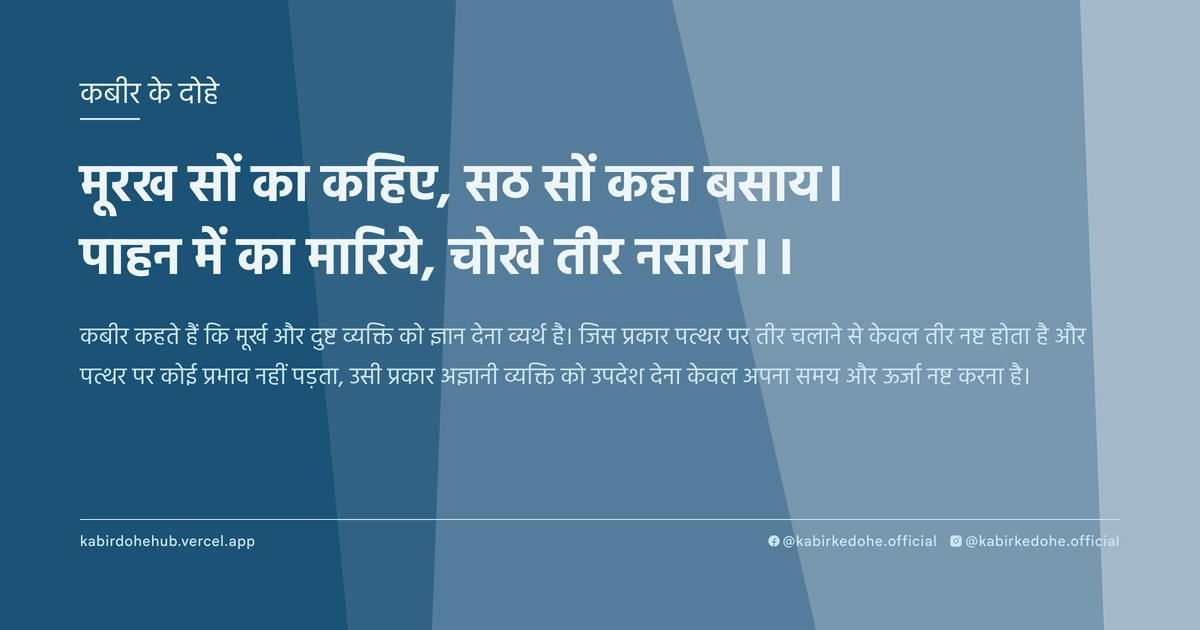
मूरख सों का कहिए, सठ सों कहा बसाय।
पाहन में का मारिये, चोखे तीर नसाय।।
Murakh son ka kahiye, sath son kaha basay. Pahan me ka maariye, chokhe teer nasay.
इस पृष्ठ पर इस कबीर दोहे का अर्थ (meaning), हिंदी व्याख्या और अंग्रेज़ी अनुवाद, दार्शनिक विश्लेषण और व्यावहारिक जीवन सीख दी गई है। यह दोहा अहंकार (The Ego) विषय से जुड़ा है — Kabir doha meaning and explanation in Hindi and English.
अर्थ (Meaning):
कबीर कहते हैं कि मूर्ख और दुष्ट व्यक्ति को ज्ञान देना व्यर्थ है। जिस प्रकार पत्थर पर तीर चलाने से केवल तीर नष्ट होता है और पत्थर पर कोई प्रभाव नहीं पड़ता, उसी प्रकार अज्ञानी व्यक्ति को उपदेश देना केवल अपना समय और ऊर्जा नष्ट करना है।
Kabir asserts that attempting to impart wisdom to a fool or a malicious person is a futile endeavor. Just as firing an arrow at a stone only results in the destruction of the arrow without leaving a mark on the rock, offering spiritual guidance to the stubbornly ignorant only wastes the teacher's own energy and precious resources.
व्याख्या (Interpretation):
यह दोहा बाहरी मूर्खता के बजाय आंतरिक अहंकार की जड़ता की बात करता है। यहाँ 'पाहन' या पत्थर उस कठोर अहंकार का प्रतीक है जो सत्य को स्वीकार करने से इनकार करता है। जब व्यक्ति स्वयं को पूर्ण मानता है, तो वह ज्ञान के प्रति अभेद्य हो जाता है। यह निर्गुण भक्ति के उस पहलू को दर्शाता है जहाँ केवल वही सत्य को पा सकता है जिसका हृदय कोमल और ग्रहणशील हो। माया ने जब बुद्धि को जकड़ लिया, तो तर्क और उपदेश बेअसर हो जाते हैं।
This couplet addresses the inertia of internal ego rather than mere intellectual ignorance. The 'stone' symbolizes a hardened ego that refuses to acknowledge the Truth. When an individual believes they are already complete or superior, they become impermeable to wisdom. This aligns with Nirgun Bhakti, suggesting that only those with a receptive, humble heart can perceive the formless Divine. When Maya clouds the intellect, logic and sermons become ineffective, creating a paradox where the seeker must first realize their own emptiness before they can be filled with Truth.
दार्शनिक विश्लेषण (Philosophical Analysis):
कबीर का यह दृष्टिकोण उनके समय के धार्मिक पाखंड और कट्टरता के प्रति एक तीखी प्रतिक्रिया है। उन्होंने देखा कि लोग केवल बाहरी कर्मकांडों में फंसे थे और जब उन्हें आंतरिक शुद्धि का मार्ग बताया गया, तो उन्होंने उसे ठुकरा दिया। यह विश्लेषण अद्वैत वेदांत के उस सिद्धांत से मेल खाता है जहाँ 'अविद्या' (अज्ञान) आत्मा और ब्रह्म के बीच एक पर्दे की तरह कार्य करती है। यदि यह पर्दा पत्थर की तरह कठोर हो जाए, तो कोई भी बाहरी ज्ञान उसे भेद नहीं सकता।
सूफी मत में भी 'नफ्स' या अहंकार के विनाश की बात कही गई है। कबीर यहाँ चेतावनी दे रहे हैं कि आध्यात्मिक ऊर्जा का निवेश सही स्थान पर होना चाहिए। एक गुरु या साधक के लिए यह आवश्यक है कि वह पहचाने कि सामने वाला व्यक्ति 'पात्र' है या नहीं। यह उपदेश नहीं, बल्कि एक मनोवैज्ञानिक सत्य है कि परिवर्तन केवल तभी संभव है जब व्यक्ति के भीतर परिवर्तन की तड़प हो।
कबीर जाति और धर्म के भेदभाव को नकारते हुए यह स्पष्ट करते हैं कि मूर्खता किसी विशेष वर्ग की बपौती नहीं है, बल्कि यह एक मानसिक अवस्था है। जो व्यक्ति अपने अहंकार में डूबा है, वह चाहे पंडित हो या मौलवी, पत्थर के समान ही है। यहाँ 'तीर' का अर्थ है वह सत्य या शब्द जो हृदय को भेदकर जागृति लाता है।
इस विश्लेषण का मुख्य बिंदु यह है कि सत्य को थोपा नहीं जा सकता। यह एक आंतरिक खोज है। यदि कोई व्यक्ति सत्य के प्रति पूरी तरह बंद है, तो उसे जबरन समझाने का प्रयास करना केवल साधक की अपनी शांति को भंग करता है। यह 'अहं' के विलीनीकरण की प्रक्रिया है, जहाँ ज्ञान का अहंकार भी एक बाधा बन जाता है।
अंततः, यह दोहा हमें विवेकपूर्ण संवाद की शिक्षा देता है। यह सिखाता है कि मौन कभी-कभी सबसे शक्तिशाली उपदेश होता है। जब शब्द विफल हो जाते हैं, तब केवल अनुभव और आचरण ही मार्ग दिखा सकते हैं, लेकिन उसके लिए भी सामने वाले का हृदय खुला होना अनिवार्य है।
Kabir's perspective is a sharp reaction to the religious hypocrisy and bigotry of his era. He observed people entrenched in external rituals who rejected the path of internal purification. This analysis aligns with Advaita Vedanta's concept of 'Avidya' (ignorance), which acts as a veil between the Atman and Brahman. If this veil becomes as hard as stone, no external knowledge can penetrate it.
In Sufism, the annihilation of the 'Nafs' (ego) is central. Kabir warns that spiritual energy must be invested wisely. A teacher or seeker must discern if the listener is a 'patra' (a worthy vessel). This is not a moral judgment but a psychological truth: transformation is only possible when there is an internal longing for change.
By rejecting caste and creed, Kabir clarifies that ignorance is not the monopoly of any specific class; it is a state of mind. Whether a priest or a cleric, one blinded by ego is as inert as a rock. Here, the 'arrow' represents the Truth or the Word (Shabd) intended to pierce the heart and awaken the soul.
The core point is that Truth cannot be imposed; it is an internal discovery. Attempting to force enlightenment upon someone who is completely closed off only disturbs the peace of the practitioner. It highlights the process of dissolving the 'Aham' (I-ness), where even the pride of possessing knowledge becomes an obstacle.
Ultimately, this couplet teaches the wisdom of discerning communication. It suggests that silence is sometimes the most powerful sermon. When words fail, only experience and conduct can lead the way, but even then, the openness of the recipient's heart is a prerequisite.
मूल संदेश (Core Message):
- अहंकार सत्य के मार्ग में सबसे बड़ी बाधा है।
- विवेकपूर्ण मौन, व्यर्थ के शब्दों से श्रेष्ठ है।
- परिवर्तन केवल आंतरिक तड़प से संभव है, दबाव से नहीं।
- अपनी ऊर्जा को वहां लगाएं जहां वह फलित हो सके।
- सत्य को थोपना अहंकार है, सत्य को जीना भक्ति है।
- बाहरी ज्ञान तब तक व्यर्थ है जब तक हृदय कोमल न हो।
- Ego is the greatest obstacle on the path to Truth.
- Discerning silence is superior to futile words.
- Transformation is possible only through internal longing, not pressure.
- Invest your energy where it can actually bear fruit.
- Imposing Truth is ego; living Truth is devotion.
- External knowledge is useless until the heart becomes receptive.
व्यावहारिक उदाहरण (Practical Example):
वाराणसी के एक पुराने घाट पर रहने वाली एक वृद्ध विधवा, जानकी, अपनी पूरी जिंदगी दूसरों की सेवा और भक्ति में बिता चुकी थी। वह शांत थी और उसकी आँखों में एक गहरा ठहराव था। उसी घाट पर एक युवा और अहंकारी विद्वान आता था, जो अपनी शास्त्र विद्या के दम पर सबको नीचा दिखाता था। वह जानकी को बार-बार यह समझाने की कोशिश करता कि उसकी सरल भक्ति व्यर्थ है और उसे जटिल दर्शन सीखने चाहिए।
विद्वान घंटों तक जानकी को उपदेश देता, उसे बताता कि वह कितनी अज्ञानी है और कैसे उसके तरीके गलत हैं। जानकी बस मुस्कुराती और चुपचाप सुनती। विद्वान को लगता कि वह उसे बदल रहा है, लेकिन वास्तव में वह अपनी ही ऊर्जा नष्ट कर रहा था। जानकी जानती थी कि वह विद्वान अभी 'पत्थर' की अवस्था में है, जहाँ उसका अहंकार उसे सत्य देखने नहीं दे रहा।
एक दिन, विद्वान ने चिल्लाकर पूछा, "तुम कुछ जवाब क्यों नहीं देतीं? क्या तुम्हें मेरी बातें समझ नहीं आ रहीं?"
जानकी ने शांति से उत्तर दिया, "बेटा, मैं तो सुन रही हूँ, लेकिन तुम मुझे नहीं सुन रहे। तुम मुझसे बात नहीं कर रहे, बल्कि अपने ज्ञान के दर्पण में खुद को देख रहे हो।"
विद्वान को लगा कि यह एक साधारण जवाब है, लेकिन उस रात उसे नींद नहीं आई। उसे महसूस हुआ कि उसने महीनों तक जिस 'अज्ञान' से लड़ने की कोशिश की, वह वास्तव में उसके अपने भीतर का अहंकार था। वह जानकी को बदलने की कोशिश में खुद को खो रहा था।
उसने महसूस किया कि जानकी की चुप्पी वास्तव में एक दर्पण थी जिसने उसे उसकी अपनी मूर्खता दिखा दी। वह जिसे पत्थर समझ रहा था, वह वास्तव में एक हीरा था, और वह खुद एक ऐसा तीर था जो पत्थर से टकराकर टूट रहा था।
अगले दिन, विद्वान ने उपदेश देना बंद कर दिया। उसने जानकी के चरणों में बैठकर केवल मौन रहना सीखा। उसने समझा कि ज्ञान शब्दों में नहीं, बल्कि उस रिक्तता में है जहाँ अहंकार समाप्त हो जाता है।
उसका व्यवहार बदल गया। अब वह लोगों को सुधारने के बजाय उन्हें समझने लगा। उसकी विद्वत्ता अब अहंकार का हथियार नहीं, बल्कि करुणा का माध्यम बन गई।
इस प्रकार, जानकी की चुप्पी ने वह काम कर दिया जो विद्वान के हजारों शब्द नहीं कर पाए थे। यह कबीर के उस सत्य का प्रमाण था कि जब तक हृदय कठोर हो, शब्द व्यर्थ हैं।
विद्वान ने अंततः जाना कि वास्तविक ज्ञान वह नहीं है जो दूसरों को बताया जाए, बल्कि वह है जो स्वयं के भीतर जिया जाए।
In the ancient ghats of Varanasi lived an elderly widow named Janki, who had spent her entire life in selfless service and devotion. She possessed a profound stillness in her eyes. On the same ghat, a young, arrogant scholar would frequent, using his mastery of scriptures to belittle others. He constantly tried to convince Janki that her simple devotion was futile and that she must learn complex philosophies.
The scholar would lecture Janki for hours, telling her how ignorant she was and how wrong her methods were. Janki would simply smile and listen in silence. The scholar believed he was transforming her, but in reality, he was merely wasting his own energy. Janki knew that the scholar was currently in the state of a 'stone,' where his ego prevented him from seeing the Truth.
One day, the scholar shouted, "Why don't you respond? Do you not understand my words?"
Janki replied calmly, "My son, I am listening, but you are not listening to me. You are not speaking to me; you are merely looking at yourself in the mirror of your own knowledge."
The scholar initially dismissed this as a simple reply, but that night, he could not sleep. He realized that the 'ignorance' he had been fighting for months was actually his own internal ego. In trying to change Janki, he was losing himself.
He realized that Janki's silence was a mirror reflecting his own folly. What he perceived as a stone was actually a diamond, and he was the arrow breaking itself against the rock.
The next day, the scholar stopped lecturing. He sat at Janki's feet and learned the art of silence. He understood that knowledge does not reside in words, but in the emptiness where the ego vanishes.
His behavior shifted. Instead of trying to 'fix' people, he began to understand them. His erudition was no longer a weapon of ego, but a medium of compassion.
Thus, Janki's silence achieved what the scholar's thousands of words could not. This was a testament to Kabir's truth: when the heart is hardened, words are useless.
The scholar finally understood that true knowledge is not that which is taught to others, but that which is lived within oneself.
अभ्यास मार्गदर्शन (Practice Guidance):
- प्रतिदिन 15 मिनट मौन अभ्यास करें, जहाँ आप किसी को सही साबित करने की इच्छा का त्याग करें।
- एक डायरी लिखें जिसमें उन क्षणों को दर्ज करें जब आपने किसी ऐसे व्यक्ति से बहस की जो सुनने को तैयार नहीं था, और विश्लेषण करें कि इससे आपकी मानसिक शांति पर क्या प्रभाव पड़ा।
- स्व-पूछताछ: जब आप किसी को उपदेश देते हैं, तो पूछें, "क्या मैं वास्तव में उसकी मदद करना चाहता हूँ या मैं केवल अपनी श्रेष्ठता सिद्ध करना चाहता हूँ?"
- निदान चेकलिस्ट: यदि आप दूसरों के विचार न बदलने पर क्रोध या हताशा महसूस करते हैं, तो यह संकेत है कि आप 'पत्थर पर तीर' चलाने की कोशिश कर रहे हैं।
- व्यवहार परिवर्तन: विवादित चर्चाओं के दौरान 'मौन' को एक सक्रिय उपकरण के रूप में उपयोग करें, न कि केवल एक प्रतिक्रिया के रूप में।
- Practice 15 minutes of daily silence, consciously relinquishing the desire to prove anyone wrong.
- Keep a journal recording moments when you argued with someone unwilling to listen, analyzing how it affected your inner peace.
- Self-Inquiry: When offering advice, ask, "Do I truly wish to help this person, or am I merely seeking to validate my own superiority?"
- Diagnostic Checklist: If you feel anger or frustration when others do not change their views, it is a sign that you are 'firing arrows at a stone.'
- Behavioral Shift: Use 'silence' as an active tool during conflicted discussions, rather than just a passive reaction.
चिंतन प्रश्न (Reflection Questions):
- मेरे जीवन में वह 'पत्थर' कौन है जिसे मैं बदलने की कोशिश कर रहा हूँ, और क्या वह पत्थर वास्तव में मेरे अपने अहंकार का प्रतिबिंब है?
- क्या मेरी मदद करने की इच्छा वास्तव में करुणा है, या यह मेरी अपनी श्रेष्ठता की भूख है?
- जब मैं दूसरों की मूर्खता पर क्रोध करता हूँ, तो मैं किस आंतरिक कमी को ढकने की कोशिश कर रहा होता हूँ?
- क्या मैं अपनी डिजिटल पहचान (सोशल मीडिया) पर अजनबियों को 'सही' करने के प्रयास में अपनी मानसिक शांति का बलिदान दे रहा हूँ?
- मेरे जीवन का वह कौन सा क्षेत्र है जहाँ मेरा मौन मेरे शब्दों से अधिक प्रभावशाली साबित हुआ है?
- क्या मैं सत्य को एक हथियार की तरह उपयोग करता हूँ या एक औषधि की तरह?
- Who is the 'stone' in my life that I am trying to change, and is that stone actually a reflection of my own ego?
- Is my desire to help others truly compassion, or is it a hunger for my own superiority?
- When I feel anger at the ignorance of others, what internal void am I attempting to cover?
- Am I sacrificing my mental peace in an attempt to 'correct' strangers within my digital identity (social media)?
- In which area of my life has my silence proven more impactful than my words?
- Do I use the Truth as a weapon or as a medicine?