
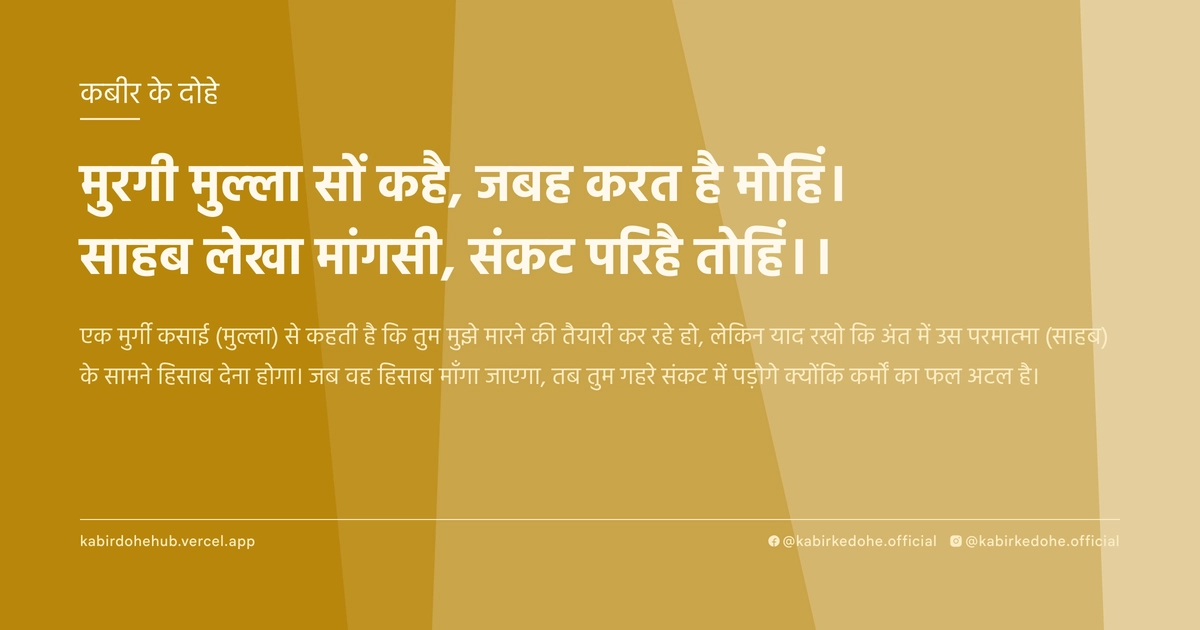
मुरगी मुल्ला सों कहै, जबह करत है मोहिं।
साहब लेखा मांगसी, संकट परिहै तोहिं।।
Murgi mulla son kahai, jabah karat hai mohin. Sahab lekha maangsi, sankat parihai tohin.
इस पृष्ठ पर इस कबीर दोहे का अर्थ (meaning), हिंदी व्याख्या और अंग्रेज़ी अनुवाद, दार्शनिक विश्लेषण और व्यावहारिक जीवन सीख दी गई है। यह दोहा अहिंसा (Non-violence) विषय से जुड़ा है — Kabir doha meaning and explanation in Hindi and English.
अर्थ (Meaning):
एक मुर्गी कसाई (मुल्ला) से कहती है कि तुम मुझे मारने की तैयारी कर रहे हो, लेकिन याद रखो कि अंत में उस परमात्मा (साहब) के सामने हिसाब देना होगा। जब वह हिसाब माँगा जाएगा, तब तुम गहरे संकट में पड़ोगे क्योंकि कर्मों का फल अटल है।
A hen speaks to the butcher, observing her imminent slaughter. She warns him that while he holds the power of life and death now, the Ultimate Lord (Sahab) will eventually demand an account of his actions. In that divine reckoning, the butcher will find himself in a crisis of consequence.
व्याख्या (Interpretation):
यह दोहा शाब्दिक रूप से एक पशु और उसके शिकारी के बीच का संवाद है, परंतु आध्यात्मिक स्तर पर यह 'कर्म' और 'न्याय' के सार्वभौमिक सिद्धांत को दर्शाता है। यहाँ मुर्गी निरीह आत्मा का प्रतीक है और मुल्ला उस अहंकार का, जो स्वयं को कर्ता और नियंता मानता है। यह निरगुण भक्ति की उस धारा को उजागर करता है जहाँ ईश्वर किसी धर्म विशेष का नहीं, बल्कि संपूर्ण सृष्टि का न्यायधीश है। माया हमें यह विश्वास दिलाती है कि हम दूसरों पर प्रभुत्व जमा सकते हैं, परंतु अद्वैत वेदांत के अनुसार, हम जो दूसरों को देते हैं, वही लौटकर हमारे पास आता है। यह विरोधाभास है कि शिकारी स्वयं शिकार बन जाता है जब वह समय के चक्र (कालचक्र) के सामने खड़ा होता है। अंततः, यह आत्मा की अमरता और शरीर की नश्वरता के बीच के संघर्ष को दर्शाता है।
Literally, this is a dialogue between a prey and a predator, but spiritually, it serves as a profound treatise on the law of Karma and cosmic justice. The hen symbolizes the innocent soul, while the butcher represents the egoic mind that believes it possesses absolute control over others. This aligns with Nirgun Bhakti, suggesting that the Divine is not a sectarian deity but a universal witness to all actions. Maya creates the illusion of power and hierarchy, leading the oppressor to believe they are exempt from consequence. However, according to Advaita Vedanta, the perceived separation between the 'slayer' and the 'slain' is an illusion; any harm inflicted on another is ultimately harm inflicted upon the Self. The central paradox lies in the butcher's perceived strength, which is actually a spiritual vulnerability. The 'account' mentioned is the inevitable confrontation with the Truth of one's own existence.
दार्शनिक विश्लेषण (Philosophical Analysis):
कबीर का यह दोहा उनके युग की सामाजिक और धार्मिक कट्टरता पर एक तीखा प्रहार है। उस समय धर्म के नाम पर कर्मकांड और बाहरी दिखावे का बोलबाला था, जहाँ कुछ लोग स्वयं को धर्म का रक्षक मानकर दूसरों का शोषण करते थे। कबीर यहाँ यह स्पष्ट करते हैं कि ईश्वर किसी विशेष पोशाक, नाम या जाति में नहीं बसता, बल्कि वह 'साहब' है जो सबके कर्मों का लेखा-जोखा रखता है। यह विचार सूफीवाद के 'इन्सान-ए-कामिल' और वेदांत के 'ब्रह्म' के करीब है, जहाँ नैतिकता को धर्म से ऊपर रखा गया है।
यहाँ कबीर ritualism (कर्मकांड) का खंडन करते हुए यह समझाते हैं कि केवल प्रार्थना करना या धार्मिक पहचान रखना पर्याप्त नहीं है। यदि आपके कर्म क्रूर हैं, तो आपकी धार्मिक पहचान आपको बचा नहीं पाएगी। यह मनोवैज्ञानिक रूप से व्यक्ति को उसके 'अहंकार' (Ego) से मुक्त करने का प्रयास है। जब मनुष्य यह महसूस करता है कि वह ब्रह्मांडीय न्याय के अधीन है, तब उसका अहंकार पिघलने लगता है और वह करुणा की ओर बढ़ता है।
दार्शनिक रूप से, यह दोहा 'अहिंसा' के सिद्धांत को केवल शारीरिक हिंसा तक सीमित नहीं रखता, बल्कि मानसिक और आध्यात्मिक हिंसा की बात करता है। कबीर यह तर्क देते हैं कि जो व्यक्ति दूसरे की पीड़ा में आनंद लेता है, वह वास्तव में अपनी ही आत्मा का विनाश कर रहा होता है। यह अद्वैत की उस स्थिति को दर्शाता है जहाँ 'मैं' और 'तू' का भेद मिट जाता है और केवल एक ही चेतना शेष रहती है।
ऐतिहासिक संदर्भ में, कबीर ने ऐसे समय में यह बात कही जब समाज ऊंच-नीच और छुआछूत में बंटा था। उन्होंने यह संदेश दिया कि न्याय की तराजू सबके लिए समान है, चाहे वह कोई शक्तिशाली मुल्ला हो, पंडित हो या कोई साधारण व्यक्ति। यह समानता का वह बीज था जिसने आगे चलकर सामाजिक क्रांति को जन्म दिया।
अंततः, यह दोहा हमें चेतावनी देता है कि हम बाहरी दुनिया के शोर और सत्ता के मद में इतने अंधे न हो जाएं कि हम अपने आंतरिक विवेक की आवाज़ खो दें। वास्तविक मुक्ति कर्मकांडों में नहीं, बल्कि उन कर्मों में है जो निस्वार्थ और दयालु हों। यह अहंकार के विसर्जन और परमात्मा के साथ एकाकार होने की यात्रा है।
Kabir's couplet is a searing critique of the social and religious dogmatism prevalent during his era. In a time dominated by rigid ritualism and sectarian identity, where some claimed divine authority to oppress others, Kabir asserts that the Divine (Sahab) transcends all labels. He posits that God is not the property of any specific religion or caste but is the Universal Witness who maintains the ledger of every action. This perspective resonates with the Sufi concept of the 'Perfect Human' and the Vedantic notion of Brahman, where ethics are prioritized over outward piety.
By challenging the butcher, Kabir dismantles the fallacy of ritualism. He argues that religious identity is a hollow shield if it does not manifest as compassion. This is a psychological intervention designed to shatter the 'Ahamkara' (ego). When an individual realizes they are subject to a cosmic law of accountability, the illusion of superiority vanishes, paving the way for genuine spiritual awakening and empathy.
Philosophically, this doha expands the definition of 'Ahimsa' (non-violence) beyond the mere absence of physical harm. It addresses the spiritual violence inherent in the act of exploitation. From the lens of Advaita Vedanta, since there is only one consciousness pervading the universe, the act of harming another is an act of self-destruction. The butcher is not just killing a hen; he is severing his own connection with the Divine.
Historically, Kabir operated in a society fractured by caste and creed. His insistence on a universal accountability was a radical call for equality. He suggests that the scales of justice are blind to social status, whether one is a powerful cleric or a marginalized laborer. This egalitarian vision was central to the Bhakti movement's goal of democratizing spirituality.
Ultimately, the couplet warns against the intoxication of power and the blindness of the ego. It suggests that true liberation is not found in the performance of rites, but in the purity of one's conduct. The 'crisis' mentioned is the moment of spiritual awakening where the soul must face the truth of its actions, stripped of all worldly masks. It is a call for the annihilation of the false self to reveal the eternal Atman.
मूल संदेश (Core Message):
- अहंकार एक भ्रम है जो हमें हमारी नश्वरता से दूर ले जाता है।
- शक्ति का वास्तविक पैमाना करुणा है, न कि नियंत्रण।
- हर क्रिया का एक प्रतिफल होता है, जो समय आने पर अवश्य मिलता है।
- बाहरी धार्मिक पहचान आंतरिक शुद्धि का विकल्प नहीं हो सकती।
- परमात्मा के समक्ष हम केवल अपने कर्मों के साथ खड़े होते हैं।
- Ego is a veil that blinds us to our own spiritual fragility.
- The true measure of power is compassion, not the ability to dominate.
- Every action carries a seed of consequence that must eventually bloom.
- External religious identity is no substitute for internal purity of heart.
- Before the Divine, we stand stripped of titles, defined only by our deeds.
व्यावहारिक उदाहरण (Practical Example):
एक समय की बात है, वाराणसी के घाटों पर माधव नाम का एक वृद्ध कुम्हार रहता था। माधव अपनी कला में निपुण था, लेकिन उसका स्वभाव अत्यंत कठोर था। वह अपने सहायकों और अपने परिवार के साथ बहुत रूखा व्यवहार करता था और उन्हें तुच्छ समझता था। वह मानता था कि उसकी कुशलता उसे दूसरों से श्रेष्ठ बनाती है और वह अपनी सत्ता का उपयोग उन्हें मानसिक रूप से प्रताड़ित करने के लिए करता था।
माधव का एक युवा सहायक था, जिसे वह दिन भर डांटता और अपमानित करता। एक दिन, माधव ने एक बहुत ही सुंदर और बड़ा मिट्टी का घड़ा बनाया, जिसे वह शहर के सबसे बड़े व्यापारी को बेचने वाला था। वह अपनी सफलता के नशे में चूर था और अपने सहायक की मेहनत को पूरी तरह अनदेखा कर रहा था।
तभी उसने देखा कि एक छोटा सा पक्षी, जो उसके आंगन में घोंसला बना रहा था, एक भारी तूफान में अपने अंडों को बचाने की कोशिश कर रहा था। माधव ने उस पक्षी की तड़प को देखा और उसे हटाने के लिए एक पत्थर उठाया। जैसे ही उसने पत्थर फेंकने के लिए हाथ उठाया, उसे अचानक कबीर का यह दोहा याद आया जो उसने बचपन में सुना था—"साहब लेखा मांगसी"।
उसे महसूस हुआ कि जिस तरह वह उस नन्हे पक्षी की जान लेने की ताकत रखता है, उसी तरह कोई अदृश्य शक्ति उसके जीवन का हिसाब ले सकती है। उसे अपनी पूरी जिंदगी एक फिल्म की तरह दिखने लगी—कैसे उसने अपने सहायकों का दिल दुखाया, कैसे उसने अपने अहंकार में अपनों को छोटा दिखाया।
एक गहरा कंपन उसके भीतर हुआ। उसने पत्थर नीचे रख दिया और पहली बार अपने सहायक की ओर देखा, जिसकी आँखों में डर और थकान थी। माधव को एहसास हुआ कि उसकी कला की श्रेष्ठता उसके व्यवहार की कुरूपता को नहीं ढक सकती।
उसने उसी क्षण अपने सहायक का हाथ पकड़ा और उससे क्षमा मांगी। यह बदलाव अचानक था, लेकिन गहरा था। उसने अपने सहायकों को केवल मजदूर नहीं, बल्कि अपने परिवार का हिस्सा मानना शुरू किया।
समय के साथ, माधव की कार्यशाला केवल मिट्टी के बर्तनों का केंद्र नहीं रही, बल्कि करुणा और प्रेम का केंद्र बन गई। उसके बर्तनों में अब एक अलग ही चमक थी, क्योंकि वे अब अहंकार से नहीं, बल्कि प्रेम से बनाए जा रहे थे।
माधव ने सीखा कि असली शक्ति दूसरों को दबाने में नहीं, बल्कि उन्हें उठाने में है। उसका जीवन अब 'लेखा' देने के डर से नहीं, बल्कि 'सेवा' के आनंद से संचालित था।
Once in the ancient lanes of Varanasi, there lived an elderly potter named Madhav. Madhav was a master of his craft, but his heart had grown hard like unbaked clay. He treated his assistants and family with coldness and contempt, believing that his artistic brilliance gave him the right to dominate others. He viewed his subordinates as mere tools for his success.
Among his assistants was a young man who bore Madhav's verbal abuse and humiliation daily without complaint. One afternoon, Madhav completed a magnificent, oversized urn, intended for the city's wealthiest merchant. Overwhelmed by his own ego, Madhav ignored the sweat and toil of his assistant who had prepared the clay for days.
While admiring his work, Madhav noticed a small bird struggling in the courtyard, trying to protect its nest from a sudden, violent gust of wind. In a fit of irritation at the bird's noise, Madhav picked up a heavy stone to drive the creature away, intending to destroy the nest.
As he raised his arm, a dormant memory of Kabir's words surfaced in his mind: "Sahab lekha maangsi"—The Lord will demand an account. A sudden, chilling realization struck him: the power he held over the bird was a mirror of the power others held over him in the cosmic order.
He saw his life flash before him—the tears of his assistants, the loneliness of his children, and the arrogance with which he had walked the earth. He realized that while he felt like the master of his workshop, he was merely a servant to his own ego, and that this ego would be his undoing in the final reckoning.
Madhav dropped the stone. For the first time in decades, he truly looked at his assistant, seeing not a tool, but a human being with a soul as precious as his own. The fear of the 'divine account' transformed into a sudden, overwhelming surge of empathy.
He reached out and held the young man's hand, asking for forgiveness in a voice that trembled with genuine emotion. This was the 'Kabir Twist'—the shift from the illusion of power to the reality of interconnectedness.
From that day forward, Madhav's workshop became a sanctuary of kindness. He shared the profits with his workers and treated them as equals. The urns he produced thereafter were said to possess a celestial glow, for they were no longer shaped by pride, but by love.
अभ्यास मार्गदर्शन (Practice Guidance):
- प्रतिदिन 15 मिनट मौन बैठें और विचार करें कि आज आपने अपनी शक्ति का उपयोग किसी की सहायता के लिए किया या किसी को नियंत्रित करने के लिए।
- एक 'कर्म पत्रिका' (Karma Journal) बनाएँ, जिसमें उन क्षणों को लिखें जब आपने अहंकारवश किसी के साथ गलत व्यवहार किया और फिर उसे सुधारने का प्रयास करें।
- व्यवहार परिवर्तन: जब भी आप किसी छोटे या कमजोर व्यक्ति को निर्देश दें, तो पहले मन में यह दोहराएं कि 'हम दोनों एक ही चेतना के अंश हैं'।
- निदान चेकलिस्ट: क्या आप दूसरों की गलतियों पर तुरंत क्रोधित होते हैं? क्या आप अपनी सफलता का श्रेय केवल स्वयं को देते हैं? यदि हाँ, तो आप अभी भी अहंकार के प्रभाव में हैं।
- Spend 15 minutes in daily silence, contemplating whether you used your power today to uplift someone or to control them.
- Maintain a 'Karma Journal' to record instances where ego led to unkindness, and consciously plan how to rectify those actions through service.
- Behavioral Shift: Before giving an order to someone in a subordinate position, mentally recite: 'We are both manifestations of the same Universal Consciousness.'
- Diagnostic Checklist: Do you react with immediate anger to others' mistakes? Do you attribute all your success solely to your own effort? If yes, you are still operating under the veil of ego.
चिंतन प्रश्न (Reflection Questions):
- मेरे जीवन में वह कौन सा क्षेत्र है जहाँ मैं स्वयं को दूसरों से श्रेष्ठ मानता हूँ और क्यों?
- यदि आज मेरा 'लेखा' (हिसाब) माँगा जाए, तो मेरी कौन सी आदतें मुझे सबसे अधिक लज्जित करेंगी?
- क्या मेरी धार्मिक या सामाजिक पहचान मेरे भीतर की क्रूरता को छिपाने का एक मुखौटा है?
- मैं उन लोगों के साथ कैसा व्यवहार करता हूँ जिनसे मुझे भविष्य में कोई लाभ मिलने की उम्मीद नहीं है?
- क्या मैं वास्तव में क्षमा करता हूँ, या मैं केवल अपनी श्रेष्ठता सिद्ध करने के लिए क्षमा का ढोंग करता हूँ?
- In which area of my life do I secretly believe I am superior to others, and what is the root of that belief?
- If my 'divine account' were audited today, which of my habits would cause me the most shame?
- Is my religious or social identity a mask used to conceal internal shadows or cruelty?
- How do I treat those who have absolutely nothing to offer me in terms of social or material gain?
- Do I truly practice forgiveness, or do I use the act of forgiving to reinforce my own sense of moral superiority?