
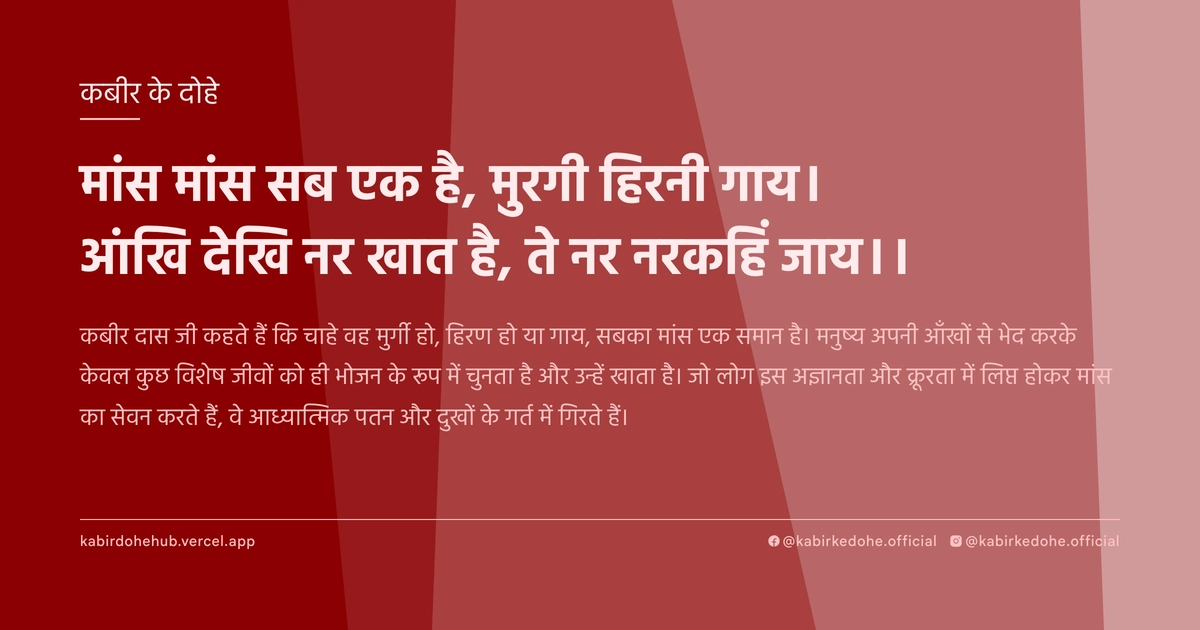
मांस मांस सब एक है, मुरगी हिरनी गाय।
आंखि देखि नर खात है, ते नर नरकहिं जाय।।
Maans maans sab ek hai, murgi hirni gaay. Aankhi dekhi nar khaat hai, te nar narkahin jaaye.
इस पृष्ठ पर इस कबीर दोहे का अर्थ (meaning), हिंदी व्याख्या और अंग्रेज़ी अनुवाद, दार्शनिक विश्लेषण और व्यावहारिक जीवन सीख दी गई है। यह दोहा अहिंसा (Non-violence) विषय से जुड़ा है — Kabir doha meaning and explanation in Hindi and English.
अर्थ (Meaning):
कबीर दास जी कहते हैं कि चाहे वह मुर्गी हो, हिरण हो या गाय, सबका मांस एक समान है। मनुष्य अपनी आँखों से भेद करके केवल कुछ विशेष जीवों को ही भोजन के रूप में चुनता है और उन्हें खाता है। जो लोग इस अज्ञानता और क्रूरता में लिप्त होकर मांस का सेवन करते हैं, वे आध्यात्मिक पतन और दुखों के गर्त में गिरते हैं।
Kabir asserts that the flesh of a chicken, a deer, or a cow is essentially the same. Humans, driven by selective perception, choose specific creatures to consume based on arbitrary distinctions. Those who persist in this cycle of violence and ignorance, consuming the life-force of others, inevitably descend into spiritual darkness and suffer the consequences of their cruelty.
व्याख्या (Interpretation):
इस दोहे का शाब्दिक अर्थ पशु-वध की निंदा है, परंतु गहरा अर्थ 'अद्वैत' की भावना में निहित है। कबीर यहाँ 'मांस' को केवल भौतिक शरीर नहीं, बल्कि उस चेतना के प्रतीक के रूप में देख रहे हैं जो हर जीव में समान है। जब हम किसी जीव को 'भोजन' मानते हैं, तो हम अपनी चेतना को सीमित कर लेते हैं और यह भूल जाते हैं कि आत्मा का स्वरूप सर्वव्यापी है। यह माया का प्रभाव है कि हम कुछ जानवरों को 'पालतू' और कुछ को 'भोजन' मानते हैं। निर्गुण भक्ति का मार्ग यह सिखाता है कि ईश्वर किसी मंदिर या मूर्ति में नहीं, बल्कि हर जीवित इकाई के भीतर स्पंदित है। अतः, किसी जीव की हत्या करना स्वयं के ही एक अंश की हत्या करने के समान है। यह विरोधाभास है कि मनुष्य शांति की खोज करता है, लेकिन अपनी थाली में हिंसा परोसता है।
While the literal meaning condemns the slaughter of animals, the deeper metaphysical layer is rooted in 'Advaita' or non-duality. Kabir views 'flesh' not merely as biological matter, but as a symbol of the universal consciousness that permeates every living being. When we categorize a creature as 'food,' we succumb to the illusion of Maya, creating artificial boundaries between the self and the other. In the path of Nirgun Bhakti, the Divine is not confined to idols but vibrates within every sentient entity. Therefore, killing another being is equivalent to murdering a fragment of one's own soul. The central paradox lies in the human pursuit of spiritual peace while simultaneously nourishing the body with the remnants of violence and suffering.
दार्शनिक विश्लेषण (Philosophical Analysis):
कबीर का यह दोहा उनके युग के सामाजिक और धार्मिक पाखंड पर एक कड़ा प्रहार है। उस समय, समाज में जाति और धर्म के नाम पर कड़े विभाजन थे, जहाँ कुछ समुदायों द्वारा पशु-बलि को धार्मिक मान्यता प्राप्त थी। कबीर ने इस प्रथा को सिरे से खारिज करते हुए तर्क दिया कि यदि ईश्वर एक है और सबमें व्याप्त है, तो किसी भी जीव की हत्या पवित्र नहीं हो सकती। यह दृष्टिकोण सीधे तौर पर 'अहिंसा परमो धर्म:' के सिद्धांत से जुड़ता है, लेकिन यह केवल नैतिक उपदेश नहीं बल्कि एक आध्यात्मिक आवश्यकता है।
अद्वैत वेदांत के परिप्रेक्ष्य में, यह दोहा 'ब्रह्म' की सर्वव्यापकता को दर्शाता है। यदि आत्मा (Atman) और परमात्मा (Brahman) एक ही हैं, तो प्रत्येक जीव में वही दिव्य प्रकाश है। मांस भक्षण इस एकता के बोध को नष्ट करता है और अहंकार (Ego) को पुष्ट करता है कि 'मैं' श्रेष्ठ हूँ और 'यह' मेरा भोजन है। यह अहंकार ही वह पर्दा है जो मनुष्य को सत्य से दूर रखता है।
सूफीवाद के 'वहदत-अल-वजूद' (अस्तित्व की एकता) के सिद्धांत के साथ भी यह विचार मेल खाता है। सूफी संत मानते हैं कि संपूर्ण सृष्टि ईश्वर का ही प्रतिबिंब है। कबीर का संदेश है कि जब तक हम दूसरों के दर्द को अपना नहीं मानते, तब तक हम ईश्वर के करीब नहीं पहुँच सकते। हिंसा केवल शारीरिक नहीं होती, बल्कि मानसिक और आध्यात्मिक भी होती है।
कबीर यहाँ कर्म के सिद्धांत (Law of Karma) की बात करते हैं। 'नरक' यहाँ किसी भौगोलिक स्थान का नाम नहीं है, बल्कि वह मानसिक अवस्था है जहाँ व्यक्ति अपनी क्रूरता और अज्ञानता के कारण घिर जाता है। जब हम किसी जीव को कष्ट देते हैं, तो हम अपने भीतर के करुणा भाव को मार देते हैं, जो वास्तव में हमारी आध्यात्मिक मृत्यु है।
अंततः, यह विश्लेषण हमें यह समझने पर मजबूर करता है कि आहार केवल शरीर का पोषण नहीं है, बल्कि यह हमारी चेतना को प्रभावित करता है। सात्विक आहार और करुणा का भाव ही वह कुंजी है जिससे मोक्ष का द्वार खुलता है। कबीर हमें भौतिक स्वाद से ऊपर उठकर सार्वभौमिक प्रेम और दया के मार्ग पर चलने की प्रेरणा देते हैं।
This couplet is a fierce critique of the social and religious hypocrisies of Kabir's era. During his time, animal sacrifice was often cloaked in religious legitimacy, used by various sects to assert spiritual authority. Kabir dismantled this by arguing that if the Divine is one and omnipresent, no act of slaughter can be deemed 'sacred.' This perspective aligns with the principle of 'Ahimsa' (non-violence), treating it not as a mere moral suggestion but as a spiritual imperative.
From the lens of Advaita Vedanta, the verse emphasizes the omnipresence of Brahman. If the individual soul (Atman) and the universal soul (Brahman) are identical, then every living creature carries the same divine spark. The act of consuming flesh reinforces the illusion of separation, strengthening the ego's belief in a hierarchy where 'I' am the consumer and 'it' is the consumed. This ego is the primary veil preventing the realization of Truth.
This philosophy resonates deeply with the Sufi concept of 'Wahdat-al-Wujud' (Unity of Existence). Sufi mystics believe the entire universe is a reflection of the Divine. Kabir suggests that until we perceive the suffering of another as our own, we remain estranged from God. Violence is not merely a physical act; it is a psychological and spiritual rupture that severs our connection to the universal heart.
Kabir invokes the Law of Karma, where 'Hell' (Narak) is not a subterranean destination but a state of consciousness. The 'hell' he refers to is the internal torment and spiritual stagnation that result from a heart hardened by cruelty. By extinguishing the life of another, one effectively extinguishes their own capacity for empathy, which is the essence of spiritual death.
Ultimately, this analysis reveals that diet is not just about biological nutrition but about the cultivation of consciousness. A diet rooted in compassion (Sattva) is the gateway to liberation. Kabir urges us to transcend the fleeting pleasure of the palate to embrace a higher, universal love that recognizes the sanctity of all life.
मूल संदेश (Core Message):
- सभी जीवित प्राणियों में एक ही दिव्य चेतना का वास है।
- स्वाद की तृप्ति के लिए किसी का जीवन लेना आध्यात्मिक पतन है।
- भेदभाव केवल अज्ञानता और माया का परिणाम है।
- सच्ची भक्ति वह है जो हर जीव में ईश्वर को देखे।
- अहिंसा केवल क्रिया नहीं, बल्कि आत्मा की उच्चतम अवस्था है।
- जब हम करुणा अपनाते हैं, तब हम स्वयं को मुक्त करते हैं।
- A single divine consciousness resides within all living beings.
- Sacrificing a life for the sake of taste is a spiritual descent.
- Discrimination is merely the result of ignorance and Maya.
- True devotion is seeing the Divine in every living entity.
- Non-violence is not just an act, but the highest state of the soul.
- In embracing compassion for others, we liberate ourselves.
व्यावहारिक उदाहरण (Practical Example):
वाराणसी के एक पुराने घाट पर रामदीन नाम का एक बूढ़ा नाविक रहता था। वह जीवन भर नाव चलाने के साथ-साथ मछली पकड़कर अपना गुजारा करता था। रामदीन का मानना था कि यह उसका पेशा है और प्रकृति ने मछलियों को भोजन के लिए बनाया है। वह अपनी कला में निपुण था और बड़ी कुशलता से जाल फेंकता था।
एक दिन, घाट पर एक फकीर आया जिसने कबीर के इस दोहे का पाठ किया। रामदीन ने हँसते हुए कहा, "बाबा, मछली तो बेजुबान है, इसे खाने में कौन सा पाप है?" फकीर ने शांत भाव से उत्तर दिया, "रामदीन, तू मछली नहीं खा रहा, तू उस तड़प को खा रहा है जो वह मछली अपनी आखिरी सांस तक महसूस करती है। क्या तूने कभी सोचा है कि उसकी आँखों में भी वही डर है जो तेरे बच्चों की आँखों में होता है जब वे डरते हैं?"
रामदीन को पहले तो यह बात अजीब लगी, लेकिन उस रात उसे नींद नहीं आई। उसे बार-बार वह दृश्य याद आने लगा जब मछलियाँ जाल में फंसकर छटपटाती थीं। उसने महसूस किया कि वह अब तक केवल मांस देख रहा था, जीवन नहीं।
अगले दिन, रामदीन ने अपना जाल किनारे रख दिया। उसके परिवार ने विरोध किया क्योंकि उनकी आय का स्रोत वही था। लेकिन रामदीन के भीतर एक अजीब सी शांति थी। उसने तय किया कि वह अब केवल नाव चलाकर लोगों को पार कराएगा, किसी का जीवन नहीं छीनेगा।
शुरुआत में उसे आर्थिक तंगी का सामना करना पड़ा। उसे कई रातें आधे पेट सोना पड़ा। लेकिन उसने देखा कि उसकी मानसिक बेचैनी खत्म हो गई थी। वह अब मछलियों को पानी में तैरते देख खुश होता था, न कि उन्हें पकड़ने की योजना बनाता था।
धीरे-धीरे उसकी ईमानदारी और दयालुता की चर्चा पूरे घाट पर फैल गई। लोग उसकी नाव पर सवारी करना पसंद करने लगे क्योंकि वे उसकी आँखों में एक नई चमक और करुणा देखते थे। उसकी आय पहले से कम थी, लेकिन उसका संतोष कई गुना बढ़ गया था।
एक दिन एक अमीर व्यापारी ने उससे पूछा, "तुमने अपना लाभदायक व्यवसाय क्यों छोड़ दिया?" रामदीन ने मुस्कुराकर कहा, "साहब, मैं अब तक दूसरों की मौत का व्यापार कर रहा था, अब मैं जीवन की यात्रा का साथी हूँ।"
यह 'कबीर ट्विस्ट' था—रामदीन ने केवल अपना पेशा नहीं बदला, बल्कि अपनी पूरी चेतना बदल ली। उसने समझ लिया कि जब हम किसी जीव के प्रति दया दिखाते हैं, तो वास्तव में हम अपने भीतर की मानवता को जीवित करते हैं।
On an ancient ghat in Varanasi lived an elderly boatman named Ramdeen. For decades, he had supplemented his meager income by fishing. Ramdeen believed that this was simply his trade and that nature had designed fish to be food. He was skilled in his craft, casting his nets with precision and efficiency.
One day, a wandering dervish arrived at the ghat and recited Kabir's verse about the oneness of all flesh. Ramdeen laughed and asked, "Baba, the fish is voiceless; what sin is there in eating it?" The dervish replied calmly, "Ramdeen, you are not eating a fish; you are consuming the agony that the fish feels until its final breath. Have you ever considered that the terror in its eyes is the same terror your own children feel when they are frightened?"
Initially, Ramdeen found this notion absurd, but that night, sleep evaded him. He kept visualizing the frantic struggle of the fish trapped in his nets. He realized that until now, he had seen only 'meat,' never 'life.'
The following morning, Ramdeen set aside his nets. His family protested, as fishing was a primary source of their livelihood. However, a strange, newfound peace had settled within Ramdeen. He decided he would only ferry people across the river, refusing to take another life.
In the beginning, he faced severe financial hardship. There were nights he went to bed hungry. Yet, he noticed that his chronic mental restlessness had vanished. He began to find joy in watching the fish swim freely in the river rather than plotting how to capture them.
Gradually, his reputation for honesty and compassion spread throughout the ghats. People preferred his boat because they sensed a new radiance and kindness in his presence. While his income was lower, his contentment had multiplied manifold.
One day, a wealthy merchant asked him, "Why did you abandon a profitable business?" Ramdeen smiled and replied, "Sir, I was trading in death; now, I am a companion to life's journey."
This was the 'Kabir Twist'—Ramdeen didn't just change his profession; he transformed his consciousness. He understood that by showing mercy to another creature, he was actually reviving the dormant humanity within himself.
अभ्यास मार्गदर्शन (Practice Guidance):
- दैनिक करुणा ध्यान: प्रतिदिन 10 मिनट शांत बैठें और कल्पना करें कि आपके शरीर की चेतना अन्य जीवों (पशु-पक्षियों) में भी उसी तरह प्रवाहित हो रही है।
- आहार जागरूकता: भोजन ग्रहण करने से पहले 30 सेकंड के लिए रुकें और विचार करें कि इस भोजन के पीछे कितनी हिंसा या शांति जुड़ी है।
- आत्म-पूछताछ जर्नल: लिखें कि आप किन जीवों को 'कम महत्वपूर्ण' मानते हैं और क्यों? यह विश्लेषण करें कि यह भेदभाव आपके अहंकार से कैसे जुड़ा है।
- व्यवहार परिवर्तन: सप्ताह में एक बार किसी ऐसे जीव की मदद करें जो असहाय हो (जैसे सड़क के घायल पशु को पानी देना या दाना डालना)।
- डायग्नोस्टिक चेकलिस्ट: क्या मैं अभी भी स्वाद को जीवन से ऊपर रखता हूँ? क्या मैं किसी जीव की पीड़ा को देखकर उदासीन हूँ? क्या मैं अपनी सुविधा के लिए दूसरों के शोषण को सही ठहराता हूँ?
- Daily Compassion Meditation: Spend 10 minutes in silence, visualizing your consciousness flowing into other sentient beings (animals and birds) as identical to your own.
- Dietary Mindfulness: Pause for 30 seconds before eating to contemplate the amount of violence or peace associated with the food on your plate.
- Self-Inquiry Journaling: Document which creatures you consider 'less significant' and why. Analyze how this discrimination is linked to your internal ego.
- Behavioral Shift: Once a week, actively assist a helpless creature (e.g., providing water to a stray animal or feeding birds) to cultivate active empathy.
- Diagnostic Checklist: Do I still prioritize taste over life? Am I indifferent to the suffering of animals? Do I justify the exploitation of others for my own convenience?
चिंतन प्रश्न (Reflection Questions):
- मैं किन जानवरों को 'पालतू' और किन्हें 'भोजन' मानता हूँ, और इस विभाजन का आधार क्या है?
- क्या मेरी करुणा केवल उन लोगों या जीवों तक सीमित है जिनसे मुझे कोई लाभ मिलता है?
- जब मैं किसी जीव की पीड़ा देखता हूँ, तो क्या मैं वास्तव में उसे महसूस करता हूँ या केवल एक दर्शक बना रहता हूँ?
- मेरा 'डिजिटल ईगो' मुझे दूसरों के प्रति संवेदनशील बनाता है या केवल दिखावे की करुणा सिखाता है?
- क्या मैं अपनी सुख-सुविधाओं के लिए अनजाने में किसी और के शोषण का समर्थन कर रहा हूँ?
- यदि मेरा अस्तित्व किसी अन्य जीव की निर्भरता पर टिका है, तो क्या मैं वास्तव में स्वतंत्र हूँ?
- Which animals do I categorize as 'pets' and which as 'food,' and what is the fundamental basis for this divide?
- Is my compassion limited only to those beings from whom I derive some form of benefit or emotional comfort?
- When I witness the suffering of a creature, do I truly feel it, or do I remain a detached observer?
- Does my 'digital ego' make me genuinely sensitive to others, or does it only teach me the performance of compassion?
- Am I unconsciously supporting the exploitation of others to maintain my own standard of living?
- If my existence depends on the subjugation of another being, can I truly claim to be free?