
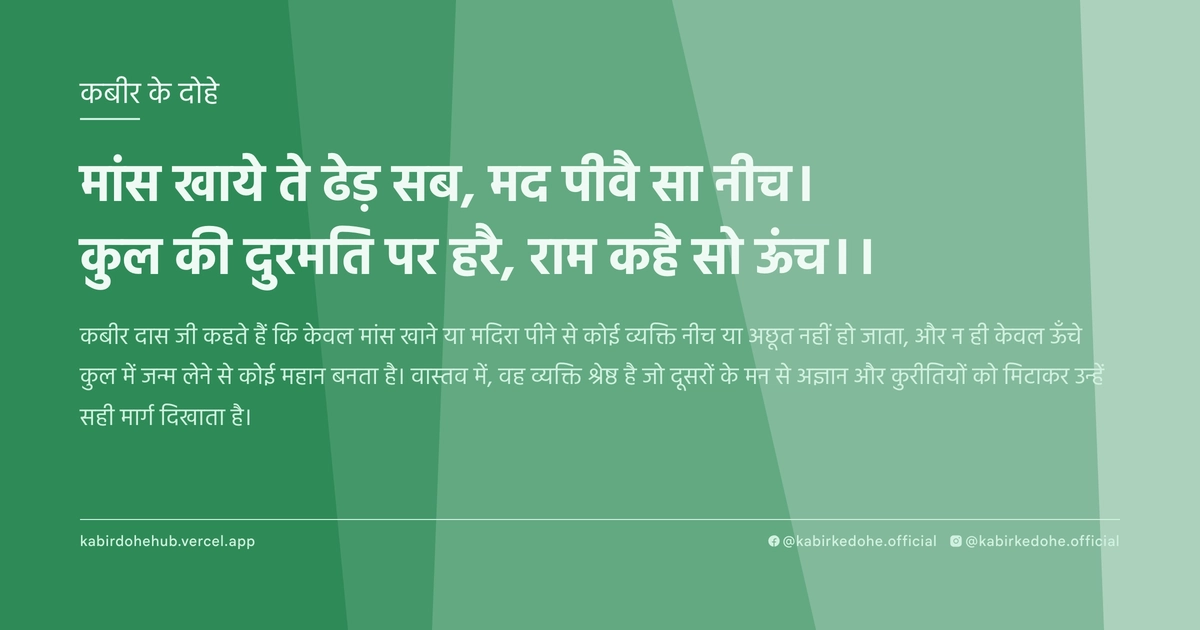
मांस खाये ते ढेड़ सब, मद पीवै सा नीच।
कुल की दुरमति पर हरै, राम कहै सो ऊंच।।
Maans khaaye te dhed sab, mad peevai sa neech. Kul ki durmati par harai, Ram kahai so oonch.
इस पृष्ठ पर इस कबीर दोहे का अर्थ (meaning), हिंदी व्याख्या और अंग्रेज़ी अनुवाद, दार्शनिक विश्लेषण और व्यावहारिक जीवन सीख दी गई है। यह दोहा अहिंसा (Non-violence) विषय से जुड़ा है — Kabir doha meaning and explanation in Hindi and English.
अर्थ (Meaning):
कबीर दास जी कहते हैं कि केवल मांस खाने या मदिरा पीने से कोई व्यक्ति नीच या अछूत नहीं हो जाता, और न ही केवल ऊँचे कुल में जन्म लेने से कोई महान बनता है। वास्तव में, वह व्यक्ति श्रेष्ठ है जो दूसरों के मन से अज्ञान और कुरीतियों को मिटाकर उन्हें सही मार्ग दिखाता है।
Kabir asserts that consuming meat or alcohol does not inherently render a person low or impure, nor does birth into a high lineage grant true nobility. The truly exalted individual is one who possesses the wisdom and compassion to eradicate the delusions and misguided beliefs of others, guiding them toward spiritual truth.
व्याख्या (Interpretation):
इस दोहे का शाब्दिक अर्थ सामाजिक वर्जनाओं और खान-पान की शुद्धता पर प्रहार करना है। गहरे स्तर पर, कबीर 'शुद्धता' की परिभाषा को भौतिक से हटाकर आध्यात्मिक धरातल पर ले जाते हैं। यहाँ 'मांस' और 'मद' केवल भौतिक वस्तुओं के प्रतीक नहीं हैं, बल्कि उन बाहरी पैमानों के प्रतीक हैं जिन्हें समाज 'पाप' या 'अपराध' मानता है। कबीर निरगुण भक्ति के माध्यम से यह समझाते हैं कि आत्मा का कोई कुल या जाति नहीं होती। माया का सबसे बड़ा जाल वह सामाजिक श्रेणीबद्धता है जो मनुष्य को मनुष्य से अलग करती है। जब कोई व्यक्ति अपने अहंकार को मिटाकर दूसरों के अज्ञान (दुरमति) को दूर करता है, तब वह वास्तव में 'ऊँचा' या ब्रह्म के करीब होता है। यह अद्वैत वेदांत के उस सिद्धांत की पुष्टि करता है जहाँ केवल चेतना का स्तर ही वास्तविक भेद है, न कि शारीरिक क्रियाएँ या जन्म।
Literally, this couplet challenges social taboos regarding dietary purity and caste. On a deeper metaphorical level, Kabir shifts the definition of 'purity' from the physical realm to the spiritual plane. Here, 'meat' and 'intoxicants' are not merely substances but symbols of the external metrics by which society judges morality. Through Nirgun Bhakti, Kabir explains that the Atman (soul) possesses no lineage or caste. The greatest illusion of Maya is the social hierarchy that segregates humanity. When an individual annihilates their ego to dispel the ignorance (durmati) of others, they become truly 'exalted' or aligned with the Divine. This validates the Advaita Vedanta principle that the only real distinction lies in the level of consciousness, not in physical actions or ancestral birth.
दार्शनिक विश्लेषण (Philosophical Analysis):
कबीर का यह दोहा उस युग की प्रतिक्रिया है जब भारतीय समाज जातिवाद और कर्मकांडीय शुद्धता के चरम पर था। उन्होंने ब्राह्मणवादी श्रेष्ठता और सूफी संतों के बीच के सेतु का कार्य किया, जहाँ उन्होंने यह स्पष्ट किया कि ईश्वर किसी विशेष कुल की जागीर नहीं है। कबीर का विरोध केवल मांस या मदिरा के सेवन से नहीं था, बल्कि उस पाखंड से था जहाँ व्यक्ति बाहरी शुद्धता का ढोंग करता था लेकिन भीतर से घृणा और अहंकार से भरा रहता था।
दार्शनिक रूप से, यह विचार सूफीवाद के 'इन्सान-ए-कामिल' (पूर्ण मनुष्य) और वेदांत के 'जीवन्मुक्ति' से मिलता-जुलता है। कबीर तर्क देते हैं कि नैतिक श्रेष्ठता का मापदंड 'परहित' (दूसरों का कल्याण) होना चाहिए। यदि कोई व्यक्ति ऊँचे कुल का है लेकिन उसका मन संकीर्ण है, तो वह आध्यात्मिक रूप से 'नीच' है। इसके विपरीत, एक निम्न जाति का व्यक्ति यदि ज्ञान का प्रकाश फैलाता है, तो वह सर्वोच्च है।
यहाँ 'दुरमति' का अर्थ केवल गलत विचार नहीं, बल्कि वह संस्कारित अज्ञान है जो पीढ़ियों से चला आ रहा है। कबीर इसे 'कुल की दुरमति' कहते हैं, जिसका अर्थ है कि पारिवारिक और सामाजिक कंडीशनिंग मनुष्य की दृष्टि को धुंधला कर देती है। इस अज्ञान का निवारण ही वास्तविक साधना है।
यह विश्लेषण हमें यह समझने पर मजबूर करता है कि धर्म केवल नियमों का पालन नहीं, बल्कि चेतना का विस्तार है। कबीर का मार्ग 'सहज मार्ग' है, जो बाहरी आडंबरों को नकार कर आंतरिक सत्य की खोज पर बल देता है। वे बताते हैं कि वास्तविक पवित्रता करुणा और ज्ञान में निहित है, न कि किसी विशेष भोजन के त्याग में।
अंततः, कबीर का संदेश अहंकार के विसर्जन का है। जब हम दूसरों को अपनी जाति, धर्म या आदतों के आधार पर आंकना बंद कर देते हैं, तभी हम उस अद्वैत सत्य का अनुभव कर पाते हैं जहाँ सब कुछ एक ही परमात्मा का अंश है। यह सामाजिक क्रांति और आध्यात्मिक उत्थान का एक अद्भुत संगम है।
This doha is a direct response to an era where Indian society was gripped by rigid caste hierarchies and ritualistic purity. Kabir acted as a bridge between Brahmanical structures and Sufi mysticism, clarifying that the Divine is not the private property of any specific lineage. His critique was not merely about the consumption of meat or alcohol, but against the hypocrisy where individuals performed outward purity while remaining internally consumed by hatred and ego.
Philosophically, this aligns with the Sufi concept of 'Al-Insan al-Kamil' (the Perfect Human) and the Vedantic notion of 'Jivanmukti'. Kabir argues that the metric of moral superiority must be 'Parhit' (the welfare of others). A person born into a high caste who harbors a narrow mind is spiritually 'low,' whereas a person from a marginalized background who spreads the light of wisdom is supreme.
'Durmati' here refers not just to wrong thoughts, but to the conditioned ignorance passed down through generations. By calling it 'Kul ki durmati,' Kabir suggests that familial and social conditioning blinds human perception. The eradication of this ignorance is the only true spiritual practice.
This analysis forces us to realize that religion is not the adherence to rules, but the expansion of consciousness. Kabir's 'Sahaj Marg' (the Natural Path) rejects external pomposity in favor of internal truth. He posits that true sanctity resides in compassion and knowledge, not in the avoidance of specific foods.
Ultimately, Kabir's message is about the dissolution of the ego. When we stop judging others based on caste, religion, or habits, we experience the Advaita truth where everything is a manifestation of the one Universal Consciousness. It is a profound intersection of social revolution and spiritual evolution.
मूल संदेश (Core Message):
- बाहरी शुद्धता एक भ्रम है; आंतरिक करुणा ही वास्तविक सत्य है।
- कुल और जाति केवल सामाजिक लेबल हैं, आत्मा का कोई रंग नहीं होता।
- श्रेष्ठता का पैमाना ज्ञान और परोपकार है, न कि जन्म या परंपरा।
- अज्ञानता की बेड़ियाँ तोड़ना ही सबसे बड़ी आध्यात्मिक उपलब्धि है।
- मनुष्य की पहचान उसके कर्मों से होती है, उसकी आदतों से नहीं।
- External purity is an illusion; internal compassion is the only reality.
- Lineage and caste are mere social labels; the soul has no color.
- The metric of superiority is wisdom and altruism, not birth or tradition.
- Breaking the chains of conditioned ignorance is the greatest spiritual feat.
- A human is identified by their deeds, not by their habits.
व्यावहारिक उदाहरण (Practical Example):
एक समय की बात है, वाराणसी के घाटों पर माधव नाम का एक वृद्ध व्यक्ति रहता था, जो शहर के सबसे प्रतिष्ठित ब्राह्मण परिवार से था। माधव अपनी कुल-परंपरा और शुद्धता के प्रति इतना कट्टर था कि वह उन लोगों से बात तक नहीं करता था जिन्हें वह 'अपवित्र' मानता था। वह दिन भर मंत्रोच्चार करता और स्वयं को आध्यात्मिक रूप से श्रेष्ठ समझता था।
उसी घाट के पास एक छोटी सी झोपड़ी में रहिमान नाम का एक व्यक्ति रहता था, जो पेशे से एक कसाई था और शराब भी पीता था। समाज की नजरों में रहिमान सबसे 'नीच' व्यक्ति था। माधव उसे देखते ही अपना चेहरा फेर लेता और मन ही मन उसकी निंदा करता कि वह कितना पापी है।
एक बार वाराणसी में भीषण बाढ़ आई। घाटों पर अफरा-तफरी मच गई। माधव का पैर फिसल गया और वह गहरे पानी के तेज बहाव में बहने लगा। वह चिल्लाया, लेकिन उसके अपने 'कुल' के लोग डर के मारे किनारे पर खड़े रहे, क्योंकि पानी का बहाव बहुत खतरनाक था।
तभी रहिमान ने अपनी जान की परवाह किए बिना पानी में छलांग लगा दी। उसने अपनी पूरी ताकत लगाकर माधव को किनारे तक पहुँचाया और उसकी जान बचाई। माधव पूरी तरह कांप रहा था और उसकी सांसें उखड़ी हुई थीं।
जब माधव ने होश संभाला, तो उसने देखा कि जिस व्यक्ति को वह 'नीच' समझकर घृणा करता था, उसी ने उसे जीवनदान दिया था। रहिमान ने बस इतना कहा, "बाबा, पानी में न कोई ब्राह्मण होता है न कोई कसाई, बस एक डूबता हुआ इंसान होता है।"
माधव को कबीर की पंक्तियाँ याद आईं। उसे अहसास हुआ कि उसकी 'शुद्धता' केवल एक भ्रम था, जबकि रहिमान की 'अशुद्धता' के पीछे एक विशाल हृदय और निस्वार्थ करुणा छिपी थी।
उस दिन माधव का अहंकार टूट गया। उसने महसूस किया कि वह ऊँचे कुल का होने के बावजूद मानसिक रूप से कितना छोटा था। उसने अपनी कट्टरता को त्याग दिया और रहिमान के साथ मित्रता कर ली।
माधव ने अब अपना जीवन केवल मंत्र पढ़ने में नहीं, बल्कि लोगों के बीच की दूरियों को मिटाने में लगाया। उसने समाज को सिखाया कि असली महानता मांस या मदिरा के त्याग में नहीं, बल्कि मनुष्य के भीतर की घृणा को मिटाने में है।
Once, on the ghats of Varanasi, lived an elderly man named Madhav, hailing from one of the city's most prestigious Brahmin families. Madhav was so rigid about his lineage and purity that he refused to even speak to those he deemed 'impure.' He spent his days chanting mantras, convinced of his own spiritual superiority.
Nearby, in a small hut, lived a man named Rahiman, who worked as a butcher and occasionally drank alcohol. In the eyes of society, Rahiman was the most 'vile' of men. Whenever Madhav saw him, he would turn his face away in disgust, mentally condemning him as a sinner.
One year, a devastating flood hit Varanasi. Chaos ensued on the ghats. Madhav slipped and was swept away by the powerful, churning current of the river. He screamed for help, but the people of his own 'noble' circle stood frozen on the shore, terrified by the raging waters.
Without a second thought, Rahiman dove into the torrent. Fighting the current with all his strength, he managed to grab Madhav and pull him safely back to the shore. Madhav lay shivering, gasping for air, his world spinning.
As Madhav regained consciousness, he realized that the very man he had despised as 'low' had saved his life. Rahiman simply smiled and said, "Baba, in the water, there is no Brahmin and no butcher; there is only a drowning human."
In that moment, Kabir's words echoed in Madhav's mind. He realized that his 'purity' was a mere illusion, while Rahiman's perceived 'impurity' masked a heart of immense courage and selfless compassion.
Madhav's ego shattered. He recognized that despite his high birth, he had been spiritually stunted. He abandoned his bigotry and formed a genuine friendship with Rahiman.
Madhav stopped spending his life solely in ritualistic chanting and began working to bridge the divides between people. He taught the community that true greatness lies not in the avoidance of certain foods, but in the eradication of hatred from the human heart.
अभ्यास मार्गदर्शन (Practice Guidance):
- प्रतिदिन 15 मिनट मौन ध्यान करें और विचार करें कि आपकी कौन सी मान्यताएं दूसरों के प्रति आपके मन में पूर्वाग्रह पैदा करती हैं।
- एक 'अहंकार डायरी' लिखें: जब भी आप किसी को अपने से छोटा या 'नीच' महसूस करें, तो उस भावना को लिखें और विश्लेषण करें कि यह भावना आपके किस डर या असुरक्षा से आ रही है।
- सप्ताह में एक बार ऐसे व्यक्ति के साथ समय बिताएं या उसकी मदद करें जिसे समाज हाशिए पर रखता है, बिना किसी उपदेश या श्रेष्ठता की भावना के।
- डायग्नोस्टिक चेकलिस्ट: क्या मैं किसी व्यक्ति के चरित्र का आकलन उसके खान-पान या जन्म से करता हूँ? क्या मैं अपनी नैतिकता को बाहरी नियमों से जोड़ता हूँ या आंतरिक करुणा से? यदि उत्तर 'हाँ' है, तो आप अभी भी माया के प्रभाव में हैं।
- Practice 15 minutes of silent meditation daily, contemplating which of your beliefs create prejudices against others.
- Maintain an 'Ego Journal': Whenever you feel superior to someone or perceive them as 'low,' record the emotion and analyze which fear or insecurity is driving that judgment.
- Once a week, spend time with or help someone marginalized by society, doing so without any sense of charity or moral superiority.
- Diagnostic Checklist: Do I judge a person's character based on their diet or birth? Do I link my morality to external rules or internal compassion? If the answer is 'Yes,' you are still under the influence of Maya.
चिंतन प्रश्न (Reflection Questions):
- मेरे जीवन में ऐसा कौन सा 'मानसिक खान-पान' (विचार) है जो मुझे दूसरों से श्रेष्ठ महसूस कराता है?
- यदि मेरा सामाजिक पद और कुल छीन लिया जाए, तो मेरे भीतर क्या बचेगा जो वास्तव में 'मूल्यवान' है?
- मैं किन लोगों को 'नीच' मानता हूँ और यह धारणा मेरे किस आंतरिक डर को छिपा रही है?
- क्या मेरी नैतिकता केवल सामाजिक स्वीकृति पाने का एक साधन है, या यह वास्तव में करुणा से उपजी है?
- मैं अपने जीवन में 'दुरमति' (गलत धारणाओं) को मिटाने के लिए क्या ठोस कदम उठा रहा हूँ?
- क्या मैं वास्तव में उस व्यक्ति को स्वीकार कर सकता हूँ जिसके मूल्य मेरे मूल्यों के बिल्कुल विपरीत हैं?
- What is the 'mental diet' (thought patterns) in my life that makes me feel superior to others?
- If my social status and lineage were stripped away, what would remain within me that is truly 'valuable'?
- Whom do I perceive as 'low,' and what internal fear is this perception masking?
- Is my morality merely a tool for social acceptance, or does it genuinely spring from compassion?
- What concrete steps am I taking to eradicate 'durmati' (misguided beliefs) from my own mind?
- Can I truly accept a person whose values are diametrically opposed to my own?