
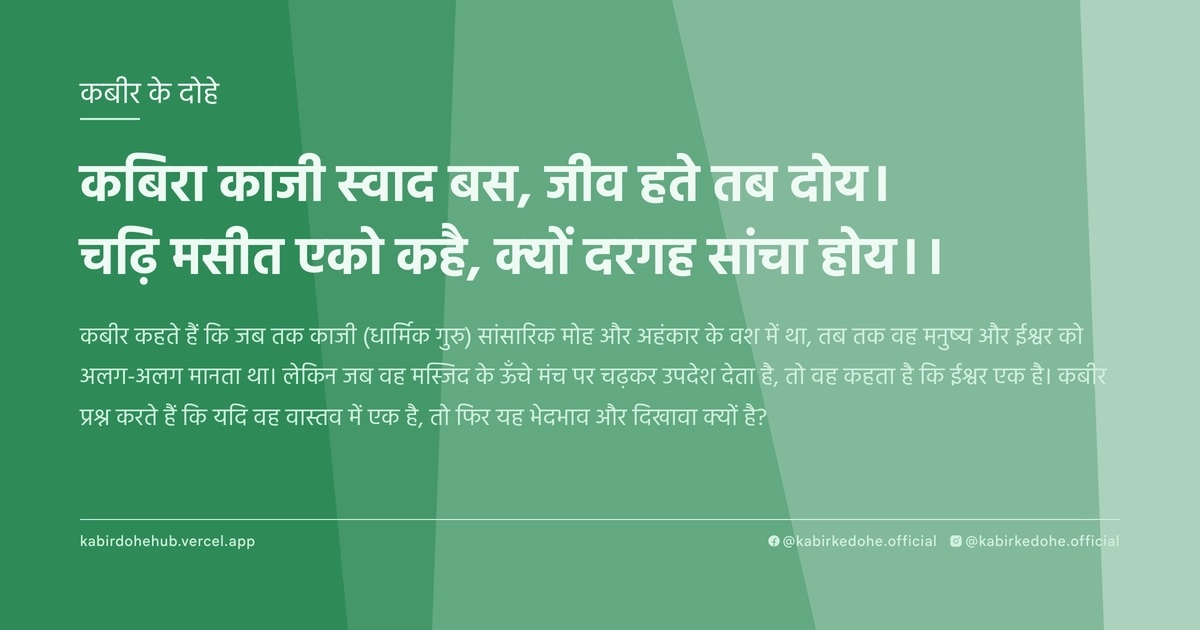
कबिरा काजी स्वाद बस, जीव हते तब दोय।
चढ़ि मसीत एको कहै, क्यों दरगह सांचा होय।।
Kabira kaji swad bas, jeev hate tab doy. Chadhi masit eko kahai, kyon dargah sancha hoye.
इस पृष्ठ पर इस कबीर दोहे का अर्थ (meaning), हिंदी व्याख्या और अंग्रेज़ी अनुवाद, दार्शनिक विश्लेषण और व्यावहारिक जीवन सीख दी गई है। यह दोहा पंडित-मुल्ला विरोध (Anti-clericalism) विषय से जुड़ा है — Kabir doha meaning and explanation in Hindi and English.
अर्थ (Meaning):
कबीर कहते हैं कि जब तक काजी (धार्मिक गुरु) सांसारिक मोह और अहंकार के वश में था, तब तक वह मनुष्य और ईश्वर को अलग-अलग मानता था। लेकिन जब वह मस्जिद के ऊँचे मंच पर चढ़कर उपदेश देता है, तो वह कहता है कि ईश्वर एक है। कबीर प्रश्न करते हैं कि यदि वह वास्तव में एक है, तो फिर यह भेदभाव और दिखावा क्यों है?
Kabir observes that as long as the Qazi (religious cleric) was immersed in worldly desires and ego, he perceived a duality between the soul and the Divine. However, upon ascending the pulpit of the mosque, he proclaims the unity of God. Kabir challenges this hypocrisy, asking why the truth of oneness is only preached from a position of power while lived experience remains fragmented.
व्याख्या (Interpretation):
इस दोहे का शाब्दिक अर्थ धार्मिक पाखंड पर प्रहार है, लेकिन इसका गहरा आध्यात्मिक अर्थ अद्वैत (Non-duality) की खोज है। 'दोय' शब्द द्वैत का प्रतीक है—जहाँ भक्त और भगवान, या मैं और तू अलग-अलग महसूस होते हैं। जब काजी 'मसीत' (मस्जिद) पर चढ़ता है, तो वह केवल शब्दों से 'एक' की बात करता है, लेकिन उसका हृदय अभी भी 'स्वाद' यानी इंद्रिय सुखों और अहंकार में फंसा है। यह निरगुण भक्ति का सार है कि ईश्वर किसी विशेष स्थान या पद में नहीं, बल्कि अहंकार के विसर्जन में मिलता है। माया यहाँ उस पर्दे की तरह है जो सत्य को ढकता है, जिससे मनुष्य केवल बाहरी कर्मकांडों में उलझकर रह जाता है। अंततः, यह दोहा आत्मा और ब्रह्म की एकता के मार्ग में खड़े 'अहंकार' रूपी अवरोध को दर्शाता है।
Literally, this verse critiques religious hypocrisy, but metaphorically, it explores the tension between dualism and non-duality (Advaita). The term 'doy' signifies the illusion of separation—the perceived gap between the self and the Absolute. When the Qazi ascends the 'masit' (mosque pulpit), he speaks of oneness, yet his internal state remains tethered to 'swaad' (sensual cravings and ego). This aligns with Nirgun Bhakti, asserting that the Formless Divine is not found in institutional authority but in the dissolution of the 'I'. Maya acts as the veil that obscures this truth, leading the seeker to mistake ritualistic performance for spiritual realization. The central paradox presented is that one can preach unity while embodying division, highlighting the gap between intellectual knowledge and experiential truth.
दार्शनिक विश्लेषण (Philosophical Analysis):
कबीर का यह दोहा उनके युग के सामाजिक और धार्मिक संघर्षों का प्रतिबिंब है, जहाँ धर्म का उपयोग मुक्ति के बजाय सत्ता और नियंत्रण के लिए किया जा रहा था। कबीर ने स्पष्ट रूप से उन सभी परंपराओं को नकारा जो ईश्वर को किसी एक धर्म, जाति या मंदिर-मस्जिद तक सीमित करती थीं। उनका दृष्टिकोण 'सहज मार्ग' का था, जो बाहरी आडंबरों के बजाय आंतरिक शुद्धता पर जोर देता है।
दार्शनिक रूप से, यह अद्वैत वेदांत के करीब है, जहाँ यह माना जाता है कि केवल 'ब्रह्म' सत्य है और जगत का द्वैत एक भ्रम है। जब तक मनुष्य अपनी व्यक्तिगत पहचान (अहंकार) को पकड़े रहता है, वह ईश्वर को अपने से अलग देखता है। कबीर यहाँ 'काजी' के माध्यम से उस मानसिक स्थिति का वर्णन कर रहे हैं जहाँ ज्ञान केवल बौद्धिक स्तर पर है, अनुभव स्तर पर नहीं।
सूफीवाद के 'फना' (अहंकार का विनाश) के सिद्धांत से भी इसका गहरा संबंध है। सूफी संत मानते हैं कि जब तक 'मैं' जीवित है, 'वह' (ईश्वर) नहीं मिल सकता। काजी का मस्जिद पर चढ़कर 'एक' कहना केवल एक सामाजिक मुखौटा है; वास्तविक एकता तब होती है जब व्यक्ति अपनी सामाजिक स्थिति और धार्मिक पहचान को पूरी तरह त्याग देता है।
कबीर यहाँ कर्मकांडीय धर्म (Ritualism) की निरर्थकता को सिद्ध करते हैं। वे तर्क देते हैं कि यदि ईश्वर वास्तव में एक है और सर्वव्यापी है, तो उसे खोजने के लिए किसी विशेष मंच या पद की आवश्यकता नहीं है। यह विचार उस समय के रूढ़िवादी समाज के लिए एक क्रांतिकारी चुनौती थी, जो धर्म को श्रेणियों में विभाजित करता था।
मनोवैज्ञानिक स्तर पर, यह दोहा 'संज्ञानात्मक विसंगति' (Cognitive Dissonance) को दर्शाता है। काजी जानता है कि सत्य क्या है, लेकिन वह अपनी सामाजिक प्रतिष्ठा और सत्ता को बनाए रखने के लिए उस सत्य को केवल शब्दों तक सीमित रखता है। कबीर हमें चेतावनी देते हैं कि आध्यात्मिक प्रगति केवल शब्दों के दोहराव से नहीं, बल्कि व्यवहार में परिवर्तन और अहंकार के पूर्ण विसर्जन से आती है।
This doha reflects the socio-religious tensions of Kabir's era, where religion was often weaponized for power and control rather than liberation. Kabir explicitly rejects any tradition that confines the Divine to a specific religion, caste, or physical structure like a temple or mosque. His approach is that of the 'Sahaja Marg' (the natural path), emphasizing internal purity over external performance.
Philosophically, this aligns with Advaita Vedanta, which posits that only Brahman is real and the perceived duality of the world is an illusion (Maya). As long as an individual clings to their personal identity (ego), they perceive God as separate from themselves. Kabir uses the 'Qazi' as a symbol for the state where knowledge is merely intellectual and not experiential.
There is also a profound connection to the Sufi concept of 'Fana' (annihilation of the self). Sufism teaches that as long as the 'I' exists, the 'He' cannot be realized. The Qazi's proclamation of oneness from the pulpit is a social mask; true unity occurs only when one transcends social status and religious labels entirely.
Kabir demonstrates the futility of ritualism, arguing that if the Divine is truly one and omnipresent, there is no need for a specific platform or hierarchy to access that truth. This was a revolutionary challenge to the orthodox society of his time, which thrived on the categorization of faith.
Psychologically, the verse highlights 'cognitive dissonance.' The Qazi knows the truth but restricts it to rhetoric to maintain his social prestige. Kabir warns that spiritual evolution does not come from the repetition of sacred words, but from a fundamental shift in behavior and the total dissolution of the ego.
मूल संदेश (Core Message):
- शब्दों का ज्ञान केवल सूचना है, अनुभव ही वास्तविक ज्ञान है।
- अहंकार वह पर्दा है जो आत्मा को परमात्मा से अलग करता है।
- धार्मिक पद सत्य की प्राप्ति की गारंटी नहीं देते।
- सच्ची एकता तब आती है जब 'मैं' का भाव समाप्त हो जाता है।
- बाहरी कर्मकांड आंतरिक रूपांतरण का विकल्प नहीं हो सकते।
- ईश्वर किसी विशेष स्थान पर नहीं, बल्कि अहंकार शून्य हृदय में है।
- Intellectual knowledge is mere information; experience is true wisdom.
- Ego is the veil that separates the soul from the Absolute.
- Religious titles provide no guarantee of spiritual realization.
- True unity emerges only when the sense of 'I' is annihilated.
- External rituals cannot substitute for internal transformation.
- The Divine is not in a specific place, but in an ego-less heart.
व्यावहारिक उदाहरण (Practical Example):
एक समय की बात है, वाराणसी के घाटों पर रहने वाला एक वृद्ध बुनकर था, जिसका नाम माधव था। माधव अपने काम में निपुण था, लेकिन वह स्वभाव से बहुत अहंकारी था। वह मानता था कि उसके द्वारा बुने गए वस्त्र सबसे श्रेष्ठ हैं क्योंकि वह धर्म के नियमों का पालन करता था और हर दिन मंदिर जाता था।
माधव अक्सर अपने साथी बुनकरों को नीचा दिखाता था, यह दावा करते हुए कि वे अशुद्ध हैं और उनकी भक्ति सच्ची नहीं है। वह खुद को एक 'आध्यात्मिक गुरु' मानता था और दूसरों को उपदेश देता था कि ईश्वर केवल शुद्ध हृदय और सही रीति-रिवाजों से मिलता है।
एक दिन, शहर में एक फकीर आया, जिसके पास कोई संपत्ति नहीं थी और जिसके कपड़े फटे हुए थे। वह फकीर घाट पर बैठकर बस मुस्कुरा रहा था और लोगों को देख रहा था। माधव ने उसे देखा और मन ही मन उसका उपहास किया, यह सोचकर कि ऐसा व्यक्ति कभी ईश्वर को नहीं जान सकता।
जब माधव ने उस फकीर से पूछा कि वह यहाँ क्या कर रहा है, तो फकीर ने बस इतना कहा, "मैं उस एक को देख रहा हूँ जो तुम्हारे भीतर भी है और मेरे भीतर भी, लेकिन तुम उसे अपने रेशमी धागों और मंदिर की सीढ़ियों के पीछे छिपाए हुए हो।"
माधव को यह बात चुभी। उसने तर्क दिया कि वह धर्म का पालन करता है, जबकि वह फकीर एक भिखारी है। फकीर ने शांति से उत्तर दिया, "तुम मंदिर की सीढ़ियों पर चढ़कर एकता की बात करते हो, लेकिन जब तुम नीचे उतरते हो, तो तुम अपने भाइयों को छोटा समझते हो। तुम्हारी एकता केवल तुम्हारी जुबान पर है, तुम्हारे व्यवहार में नहीं।"
यह बात माधव के हृदय में गहरे तक उतर गई। उसे अचानक अहसास हुआ कि उसका पूरा जीवन एक दिखावा था। वह दूसरों को सुधारने की कोशिश कर रहा था, जबकि वह खुद अहंकार के जाल में फंसा हुआ था।
उस रात माधव सो नहीं सका। उसने महसूस किया कि जिस 'एक' ईश्वर की वह बात करता था, वह वास्तव में उसके अहंकार के कारण उससे दूर था। उसने महसूस किया कि उसकी धार्मिकता केवल एक मुखौटा थी।
अगली सुबह, माधव ने अपने अहंकार को त्याग दिया। उसने अपने साथी बुनकरों से माफी मांगी और उनके साथ मिलकर काम करना शुरू किया। अब वह उपदेश नहीं देता था, बल्कि सेवा करता था।
उसने पाया कि जब उसने 'मैं' और 'तुम' का भेद मिटाया, तो उसे वह शांति मिली जो उसे वर्षों तक मंदिर की सीढ़ियों पर चढ़कर भी नहीं मिली थी।
माधव का जीवन अब एक जीवित उदाहरण बन गया था कि सत्य शब्दों में नहीं, बल्कि व्यवहार में होता है। वह अब केवल एक बुनकर नहीं था, बल्कि एक ऐसा इंसान था जिसने वास्तव में 'एक' को पा लिया था।
Once, in the ghats of Varanasi, lived an elderly weaver named Madhav. Madhav was masterly in his craft, but he was deeply arrogant. He believed the clothes he wove were superior because he strictly followed religious laws and visited the temple every day.
Madhav often belittled his fellow weavers, claiming they were impure and their devotion was flawed. He viewed himself as a spiritual guide, lecturing others that God is only found through a pure heart and correct rituals.
One day, a wandering dervish arrived in the city. He possessed no wealth and wore tattered clothes. The dervish sat by the ghat, simply smiling and observing the people passing by.
Madhav saw him and mocked him internally, thinking that such a man could never know the Divine. When Madhav finally asked the dervish what he was doing there, the dervish replied, "I am looking for the One who is within you and within me, but you have hidden Him behind your silk threads and temple stairs."
Madhav felt stung. He argued that he followed the faith, while the dervish was merely a beggar. The dervish calmly replied, "You speak of unity while ascending the temple stairs, but when you descend, you look down upon your brothers. Your unity exists only on your tongue, not in your conduct."
These words pierced Madhav's heart. He suddenly realized that his entire life had been a performance. He had spent his time trying to 'correct' others while remaining trapped in the web of his own ego.
Madhav could not sleep that night. He realized that the 'One' God he spoke of was actually distant because of his own arrogance. He saw that his religiosity was nothing more than a mask.
The next morning, Madhav renounced his pride. He apologized to his fellow weavers and began working with them as equals. He stopped giving lectures and started serving others.
He discovered that once he erased the distinction between 'I' and 'Thou,' he found a peace that years of climbing temple stairs had never provided.
Madhav's life became a living testament that truth resides not in words, but in action. He was no longer just a weaver of cloth, but a weaver of souls who had truly realized the Oneness.
अभ्यास मार्गदर्शन (Practice Guidance):
- दैनिक आत्म-निरीक्षण: प्रतिदिन 15 मिनट मौन बैठें और विचार करें कि आज आपने कितनी बार अपनी श्रेष्ठता सिद्ध करने के लिए दूसरों को छोटा महसूस कराया।
- अहंकार का विसर्जन: दिन में कम से कम एक ऐसा कार्य करें जिसमें आप अपनी पहचान या पद को पूरी तरह भूलकर किसी की निस्वार्थ सेवा करें।
- जर्नलिंग प्रॉम्प्ट: लिखें—"यदि मेरी सामाजिक और धार्मिक पहचान छीन ली जाए, तो मेरे भीतर क्या बचेगा? क्या वह 'मैं' वास्तव में ईश्वर से अलग है?"
- डायग्नोस्टिक चेकलिस्ट: क्या मैं दूसरों को उपदेश देते समय स्वयं उन नियमों का पालन करता हूँ? क्या मेरी प्रार्थना मुझे विनम्र बनाती है या अहंकारी? क्या मैं केवल शब्दों में एकता की बात करता हूँ या व्यवहार में भी?
- Daily Self-Inquiry: Spend 15 minutes in silence daily, reflecting on how many times you made others feel inferior to assert your own superiority.
- Ego Dissolution: Perform at least one act of selfless service each day where you completely forget your social status or identity.
- Journaling Prompt: Write—"If my social and religious identities were stripped away, what would remain within me? Is that 'I' truly separate from the Divine?"
- Diagnostic Checklist: Do I follow the rules I preach to others? Does my prayer make me humble or arrogant? Do I speak of unity only in words, or does it manifest in my behavior?
चिंतन प्रश्न (Reflection Questions):
- क्या मेरी धार्मिक या नैतिक पहचान वास्तव में मुझे एक बेहतर इंसान बनाती है, या यह केवल मेरे अहंकार को पोषण देने का एक तरीका है?
- मैं दुनिया के सामने जिस 'आदर्श' व्यक्तित्व को प्रस्तुत करता हूँ, वह मेरे आंतरिक अंधेरे और पूर्वाग्रहों से कितना अलग है?
- क्या मैं वास्तव में समानता में विश्वास करता हूँ, या मैं केवल उन लोगों के साथ समानता चाहता हूँ जो मेरे जैसे हैं?
- मेरे जीवन का वह कौन सा 'मंच' (पद/प्रतिष्ठा) है जहाँ चढ़कर मैं सत्य बोलता हूँ, लेकिन नीचे उतरकर उसे भूल जाता हूँ?
- यदि मुझे पता चले कि मेरा सबसे बड़ा शत्रु ही वास्तव में मेरा प्रतिबिंब है, तो मेरा व्यवहार उसके प्रति कैसे बदलेगा?
- क्या मेरी डिजिटल पहचान (सोशल मीडिया) मेरे वास्तविक आध्यात्मिक संघर्षों को छिपाने का एक साधन बन गई है?
- Does my religious or moral identity actually make me a better human, or is it merely a tool to feed my ego?
- How different is the 'ideal' persona I present to the world from my internal shadows and biases?
- Do I truly believe in equality, or do I only desire equality with those who are similar to me?
- What is the 'pulpit' (status/position) in my life where I speak the truth, only to forget it once I descend?
- If I discovered that my greatest enemy is actually a reflection of myself, how would my behavior toward them change?
- Has my digital identity (social media) become a means to hide my actual spiritual struggles?