
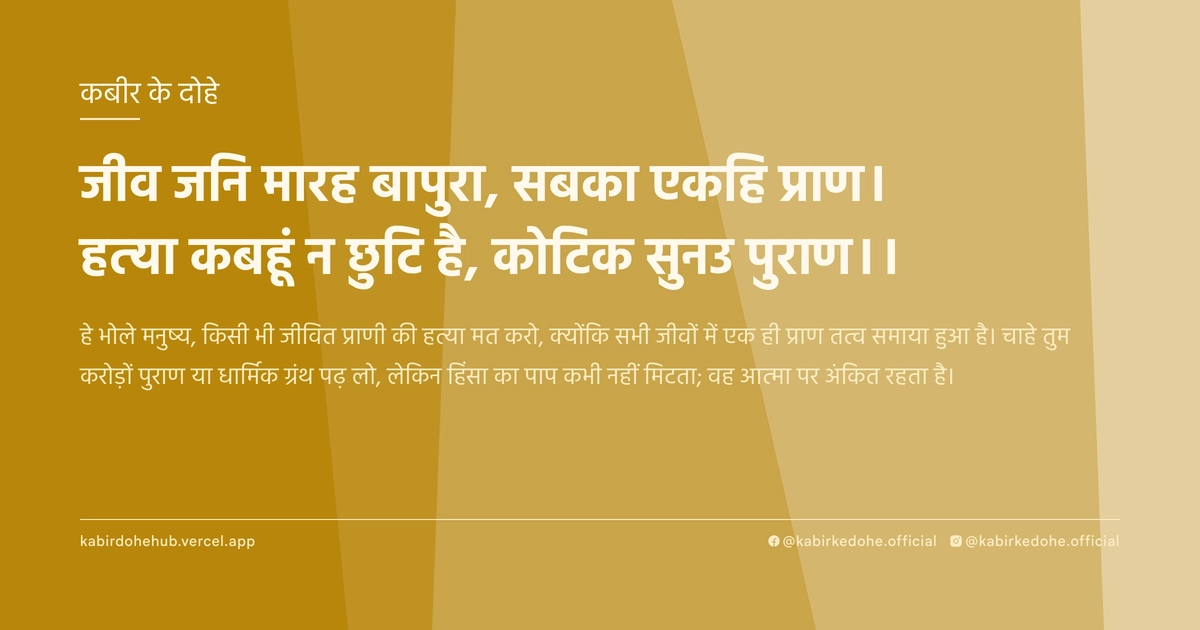
जीव जनि मारह बापुरा, सबका एकहि प्राण।
हत्या कबहूं न छुटि है, कोटिक सुनउ पुराण।।
Jeev jani maarah baapura, sabka ekhi praan. Hatya kabahun na chuti hai, kotik sunau puraan.
इस पृष्ठ पर इस कबीर दोहे का अर्थ (meaning), हिंदी व्याख्या और अंग्रेज़ी अनुवाद, दार्शनिक विश्लेषण और व्यावहारिक जीवन सीख दी गई है। यह दोहा अहिंसा (Non-violence) विषय से जुड़ा है — Kabir doha meaning and explanation in Hindi and English.
अर्थ (Meaning):
हे भोले मनुष्य, किसी भी जीवित प्राणी की हत्या मत करो, क्योंकि सभी जीवों में एक ही प्राण तत्व समाया हुआ है। चाहे तुम करोड़ों पुराण या धार्मिक ग्रंथ पढ़ लो, लेकिन हिंसा का पाप कभी नहीं मिटता; वह आत्मा पर अंकित रहता है।
O innocent soul, do not slay any living being, for the same vital breath animates every creature. No matter how many millions of scriptures or Puranas you recite, the karmic stain of killing never vanishes; it remains etched upon the soul.
व्याख्या (Interpretation):
इस दोहे का शाब्दिक अर्थ जीव हत्या के निषेध से शुरू होता है, लेकिन इसका गहरा आध्यात्मिक अर्थ 'अद्वैत' में निहित है। कबीर यहाँ 'एकहि प्राण' की बात कर रहे हैं, जो यह संकेत देता है कि परमात्मा किसी एक मंदिर या मनुष्य में नहीं, बल्कि हर सूक्ष्म जीव में व्याप्त है। यह निर्गुण भक्ति का सार है जहाँ ईश्वर को किसी रूप में नहीं, बल्कि एक सार्वभौमिक चेतना के रूप में देखा जाता है। माया हमें यह विश्वास दिलाती है कि हम और अन्य जीव अलग हैं, जबकि सत्य यह है कि हम सब एक ही ब्रह्म के अंश हैं। जब हम किसी दूसरे को चोट पहुँचाते हैं, तो वास्तव में हम स्वयं को ही चोट पहुँचा रहे होते हैं। यह विरोधाभास है कि मनुष्य मोक्ष की खोज में ग्रंथों को पढ़ता है, लेकिन करुणा को भूल जाता है, जबकि करुणा ही वास्तविक मोक्ष का द्वार है।
The literal meaning begins with a prohibition against killing, but the deeper spiritual essence lies in 'Advaita' or non-duality. Kabir speaks of 'one single breath,' signaling that the Divine is not confined to a temple or a human form, but permeates every microscopic being. This is the core of Nirgun Bhakti, where God is perceived not as a persona, but as a universal consciousness. Maya creates the illusion of separation between the self and the other, whereas the truth is that all are fragments of the same Brahman. When we harm another, we are essentially harming ourselves. The central paradox is that humans seek liberation through the intellectual study of scriptures while ignoring compassion, yet compassion is the only true gateway to liberation.
दार्शनिक विश्लेषण (Philosophical Analysis):
कबीर का यह दोहा उस समय के सामाजिक और धार्मिक पाखंड पर एक तीखा प्रहार है जहाँ पशु बलि और कर्मकांडों को धर्म का नाम दिया जाता था। कबीर ने स्पष्ट किया कि बाहरी अनुष्ठान, जैसे कि पुराणों का पाठ करना, आंतरिक हिंसा के पाप को नहीं धो सकते। यह दृष्टिकोण सूफी मत के 'वहदत-उल-वजूद' (अस्तित्व की एकता) से मेल खाता है, जहाँ संपूर्ण सृष्टि को ईश्वर का प्रतिबिंब माना जाता है।
अद्वैत वेदांत के परिप्रेक्ष्य में, यह दोहा 'अहं ब्रह्मास्मि' (मैं ही ब्रह्म हूँ) के व्यावहारिक अनुप्रयोग को दर्शाता है। यदि मैं ही ब्रह्म हूँ और सामने वाला भी ब्रह्म है, तो हिंसा का कोई तर्क नहीं बचता। कबीर यहाँ केवल शारीरिक हत्या की बात नहीं कर रहे, बल्कि उस मानसिक क्रूरता की भी बात कर रहे हैं जो अहंकार से उपजती है।
भक्ति आंदोलन के दौरान, कबीर ने जाति और वर्ग के भेदों को नकारते हुए 'प्राण' की एकता पर जोर दिया। उनके लिए धर्म का अर्थ मंदिर जाना नहीं, बल्कि जीव मात्र के प्रति दया भाव रखना था। यह एक मनोवैज्ञानिक रूपांतरण की मांग करता है जहाँ व्यक्ति 'मैं' और 'तू' के द्वैत से ऊपर उठकर 'एक' की अनुभूति करे।
अक्सर लोग इस दोहे को केवल शाकाहार के समर्थन के रूप में देखते हैं, लेकिन यह एक व्यापक दार्शनिक सत्य है। यह अहंकार के विलीनीकरण की प्रक्रिया है। जब तक व्यक्ति खुद को दूसरों से श्रेष्ठ या अलग मानता है, वह हिंसा करता है। जब यह अहंकार नष्ट होता है, तब केवल प्रेम शेष रहता है।
अंततः, कबीर यह समझाते हैं कि ज्ञान केवल शब्दों का संग्रह नहीं है। यदि पुराण पढ़ने के बाद भी हृदय में करुणा नहीं जागी, तो वह ज्ञान व्यर्थ है। वास्तविक आध्यात्मिकता वह है जो मनुष्य को संवेदनशील बनाए और उसे समस्त अस्तित्व के साथ एकाकार कर दे।
This couplet is a sharp critique of the social and religious hypocrisy of Kabir's era, where animal sacrifices and rituals were sanctified as religion. Kabir clarifies that external rituals, such as the recitation of Puranas, cannot cleanse the karmic stain of internal violence. This perspective aligns with the Sufi concept of 'Wahdat-ul-Wujud' (Unity of Existence), where the entire creation is seen as a reflection of the Divine.
From the lens of Advaita Vedanta, this verse demonstrates the practical application of 'Aham Brahmasmi' (I am Brahman). If I am Brahman and the other is also Brahman, there is no logical ground for violence. Kabir is not merely discussing physical killing, but also the mental cruelty born from the ego.
During the Bhakti movement, Kabir emphasized the unity of the 'Prana' (life force), rejecting caste and class distinctions. For him, religion was not about visiting temples but about harboring compassion for all living beings. This requires a psychological transformation where the individual transcends the duality of 'I' and 'Thou' to experience the 'One'.
Common literalist misconceptions often reduce this verse to a mere endorsement of vegetarianism, but it is a broader philosophical truth. It is a process of the annihilation of the ego. As long as a person considers themselves superior or separate, they are capable of violence. When the ego dissolves, only love remains.
Ultimately, Kabir explains that knowledge is not just a collection of words. If the heart does not awaken to compassion after reading scriptures, that knowledge is futile. True spirituality is that which makes a human sensitive and merges them with the totality of existence.
मूल संदेश (Core Message):
- अहंकार ही हिंसा का मूल कारण है, इसे मिटाएं।
- ग्रंथों का ज्ञान व्यर्थ है यदि हृदय में करुणा नहीं है।
- सभी जीवित प्राणियों में एक ही ईश्वरीय तत्व व्याप्त है।
- अहिंसा केवल शारीरिक नहीं, बल्कि मानसिक और वाचिक भी है।
- सच्ची आध्यात्मिकता जीव मात्र के प्रति संवेदनशीलता में है।
- कर्म का फल अटल है; हिंसा का दाग पुराणों से नहीं मिटता।
- Ego is the root cause of violence; dissolve it completely.
- Scriptural knowledge is futile if the heart lacks compassion.
- A single Divine element permeates all living beings.
- Non-violence is not just physical, but also mental and verbal.
- True spirituality lies in sensitivity toward all existence.
- The fruit of karma is inevitable; violence cannot be erased by rituals.
व्यावहारिक उदाहरण (Practical Example):
एक समय की बात है, वाराणसी के घाटों पर माधव नाम का एक वृद्ध बुनकर रहता था। माधव अपने काम में निपुण था, लेकिन उसका स्वभाव अत्यंत कठोर था। वह छोटे कीड़ों और मक्खियों को देखते ही उन्हें बेरहमी से कुचल देता था, यह सोचकर कि ये तुच्छ जीव उसके काम में बाधा डाल रहे हैं। वह खुद को बहुत धार्मिक मानता था और प्रतिदिन घंटों पुराणों का पाठ करता था।
एक दिन, माधव की मुलाकात एक फकीर से हुई जो घाट की सीढ़ियों पर बैठा था। माधव ने गर्व से अपनी धार्मिकता और पुराणों के ज्ञान का बखान किया। फकीर ने मुस्कुराते हुए माधव से पूछा, 'यदि तुम इन ग्रंथों के सार को जानते हो, तो क्या तुम बता सकते हो कि इस चींटी और तुम्हारे भीतर क्या अंतर है?'
माधव ने तुच्छता से उत्तर दिया, 'यह एक तुच्छ कीट है और मैं एक ईश्वर-भक्त मनुष्य हूँ। इसकी कोई कीमत नहीं है।' फकीर ने शांति से एक छोटा सा दर्पण निकाला और उसे सूरज की रोशनी में इस तरह घुमाया कि एक तीव्र किरण माधव की आँख पर पड़ी। माधव दर्द से चिल्लाया।
फकीर ने कहा, 'जैसे यह एक छोटी सी किरण तुम्हारी आँखों में असहनीय दर्द पैदा कर सकती है, वैसे ही तुम्हारा एक छोटा सा प्रहार उस जीव के लिए पूरे ब्रह्मांड का अंत होता है। तुम पुराण पढ़ते हो, लेकिन क्या तुमने उस प्राण को देखा जो उस चींटी को चला रहा है? वह प्राण वही है जो तुम्हें चला रहा है।'
माधव को अचानक एक गहरा झटका लगा। उसे महसूस हुआ कि वह अब तक केवल शब्दों को पढ़ रहा था, सत्य को नहीं। उसने महसूस किया कि उसकी धार्मिकता केवल एक मुखौटा था, जबकि उसके भीतर करुणा का पूर्ण अभाव था।
उस दिन के बाद, माधव का जीवन पूरी तरह बदल गया। उसने न केवल जीवों को मारना बंद किया, बल्कि वह हर छोटे जीव के प्रति संवेदनशील हो गया। वह अब पुराण इसलिए नहीं पढ़ता था कि वह श्रेष्ठ दिखे, बल्कि इसलिए पढ़ता था ताकि वह अपनी करुणा को और गहरा कर सके।
उसने देखा कि जब उसने दूसरों के प्रति दया भाव रखा, तो उसके मन की अशांति अपने आप समाप्त हो गई। उसका काम अब केवल जीविका का साधन नहीं, बल्कि एक साधना बन गया।
गाँव के लोग हैरान थे कि जो माधव कभी क्रोधित रहता था, वह अब इतना शांत और सौम्य कैसे हो गया। माधव ने उन्हें सिखाया कि असली पूजा मंदिर में नहीं, बल्कि हर जीवित प्राणी की रक्षा में है।
इस प्रकार, एक साधारण बुनकर ने शब्दों के ज्ञान को अनुभव के ज्ञान में बदला और वास्तव में 'एकहि प्राण' के रहस्य को समझा।
Once, in the ghats of Varanasi, lived an elderly weaver named Madhav. Madhav was skilled in his craft, but his nature was incredibly harsh. He would ruthlessly crush small insects and flies, believing these trivial creatures were merely obstacles to his work. He considered himself deeply religious, spending hours every day reciting the Puranas.
One day, Madhav encountered a Fakir sitting on the steps of the ghat. Madhav proudly boasted about his religious devotion and his knowledge of the scriptures. The Fakir smiled and asked, 'If you know the essence of these texts, can you tell me what difference there is between this ant and the life within you?'
Madhav replied dismissively, 'This is a trivial insect, and I am a God-fearing human. It has no value.' The Fakir calmly took out a small mirror and angled it so that a sharp beam of sunlight hit Madhav directly in the eye. Madhav cried out in pain.
The Fakir said, 'Just as this tiny beam of light causes unbearable pain to your eyes, your small act of violence is the end of the entire universe for that creature. You read the Puranas, but have you seen the Prana that moves that ant? That same Prana is what moves you.'
Madhav felt a profound shock. He realized he had been reading only words, not the Truth. He understood that his religiosity was merely a mask, while his heart was devoid of compassion.
After that day, Madhav's life changed completely. He not only stopped killing creatures but became deeply sensitive to every small living being. He no longer read the Puranas to appear superior, but to deepen his capacity for compassion.
He noticed that as he cultivated kindness toward others, the turmoil in his own mind vanished. His weaving was no longer just a means of livelihood, but a spiritual practice.
The villagers were astonished that Madhav, who was once so angry, had become so calm and gentle. Madhav taught them that true worship is not found in temples, but in the protection of every living being.
Thus, a simple weaver transformed the knowledge of words into the knowledge of experience and truly understood the mystery of the 'One Single Breath'.
अभ्यास मार्गदर्शन (Practice Guidance):
- दैनिक अभ्यास: प्रतिदिन 10 मिनट मौन बैठें और यह विचार करें कि आपके शरीर के बाहर जो भी जीव है, उसमें वही चेतना है जो आपके भीतर है।
- आत्म-निरीक्षण जर्नल: उन क्षणों को लिखें जब आपने किसी जीव (चाहे वह एक कीट ही क्यों न हो) के प्रति क्रोध या घृणा महसूस की। विश्लेषण करें कि वह घृणा कहाँ से आई।
- व्यवहारिक परिवर्तन: सचेत होकर चलें (Mindful Walking) ताकि अनजाने में किसी छोटे जीव की हत्या न हो। अपनी आहार आदतों में अहिंसा को प्राथमिकता दें।
- निदान चेकलिस्ट: क्या मैं किसी जीव को उसकी उपयोगिता के आधार पर आंकता हूँ? क्या मेरी धार्मिकता दूसरों के प्रति क्रूरता को सही ठहराती है? क्या मैं वास्तव में करुणा महसूस करता हूँ या केवल दिखावा करता हूँ?
- Daily Practice: Sit in silence for 10 minutes daily and contemplate that the consciousness animating the creature outside your body is the same as the one within you.
- Self-Inquiry Journal: Record moments when you felt anger or hatred toward any living being, even a small insect. Analyze the origin of that hatred.
- Behavioral Change: Practice Mindful Walking to ensure you do not unintentionally harm small creatures. Prioritize non-violence in your dietary habits.
- Diagnostic Checklist: Do I judge a living being based on its utility? Does my religiosity justify cruelty toward others? Do I truly feel compassion, or am I merely performing it?
चिंतन प्रश्न (Reflection Questions):
- क्या मेरी 'धार्मिक' पहचान मुझे उन लोगों या जीवों को तुच्छ समझने की अनुमति देती है जो मेरी तरह नहीं हैं?
- मैं अपनी डिजिटल पहचान (सोशल मीडिया) पर तो शांति की बात करता हूँ, लेकिन क्या मेरे निजी जीवन में सूक्ष्म हिंसा मौजूद है?
- क्या मैं केवल उन्हीं जीवों की रक्षा करता हूँ जो 'सुंदर' या 'पालतू' हैं, और दूसरों को अनदेखा कर देता हूँ?
- यदि मुझे पता चले कि जिस जीव को मैं मार रहा हूँ वह मेरा ही एक रूप है, तो क्या मेरा व्यवहार बदल जाएगा?
- मेरे जीवन में 'ज्ञान' और 'करुणा' के बीच कितना अंतराल है?
- क्या मैं वास्तव में अहिंसक हूँ, या मैं केवल हिंसा करने में असमर्थ हूँ?
- Does my 'religious' identity allow me to belittle people or creatures who are not like me?
- I speak of peace in my digital identity, but does subtle violence exist in my private life?
- Do I protect only those creatures that are 'cute' or 'domesticated' while ignoring others?
- If I realized that the creature I am harming is another form of myself, would my behavior change?
- What is the gap between 'knowledge' and 'compassion' in my life?
- Am I truly non-violent, or am I simply unable to commit violence?