
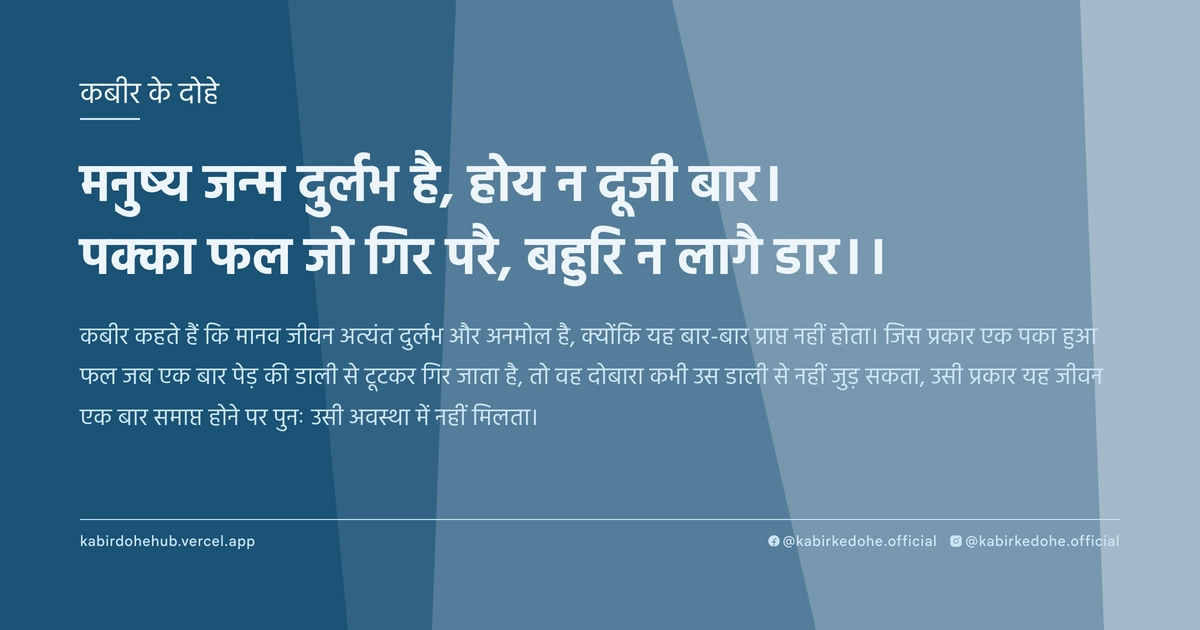
मनुष्य जन्म दुर्लभ है, होय न दूजी बार।
पक्का फल जो गिर परै, बहुरि न लागै डार।।
Manushya janm durlabh hai, hoye na dooji baar. Pakka phal jo gir parai, bahuri na laagai daar.
इस पृष्ठ पर इस कबीर दोहे का अर्थ (meaning), हिंदी व्याख्या और अंग्रेज़ी अनुवाद, दार्शनिक विश्लेषण और व्यावहारिक जीवन सीख दी गई है। यह दोहा मृतुक्यता (Mortality) विषय से जुड़ा है — Kabir doha meaning and explanation in Hindi and English.
अर्थ (Meaning):
कबीर कहते हैं कि मानव जीवन अत्यंत दुर्लभ और अनमोल है, क्योंकि यह बार-बार प्राप्त नहीं होता। जिस प्रकार एक पका हुआ फल जब एक बार पेड़ की डाली से टूटकर गिर जाता है, तो वह दोबारा कभी उस डाली से नहीं जुड़ सकता, उसी प्रकार यह जीवन एक बार समाप्त होने पर पुनः उसी अवस्था में नहीं मिलता।
Kabir asserts that human birth is an exceedingly rare and precious opportunity that does not recur easily. He uses the metaphor of a ripe fruit: once it falls from the branch, it can never re-attach itself to the tree. Similarly, once this fleeting human life passes, the opportunity for spiritual liberation is lost.
व्याख्या (Interpretation):
इस दोहे का शाब्दिक अर्थ जीवन की नश्वरता और उसकी दुर्लभता को रेखांकित करना है। आध्यात्मिक स्तर पर, 'मनुष्य जन्म' केवल शारीरिक अस्तित्व नहीं, बल्कि वह चेतना है जो आत्म-साक्षात्कार में सक्षम है। 'पका फल' उस परिपक्वता का प्रतीक है जहाँ आत्मा सांसारिक मोह से मुक्त होने के लिए तैयार है। निर्गुण भक्ति के संदर्भ में, यह चेतावनी है कि माया के जाल में उलझकर हम इस दुर्लभ अवसर को व्यर्थ न गँवा दें। अद्वैत वेदांत के अनुसार, यह जीवन ब्रह्म के साथ एकाकार होने का एक द्वार है। यदि हम अहंकार और कर्मों के बंधन में बंधे रहे, तो हम उस 'डाली' यानी दैवीय स्रोत से अलग होकर पुनर्जन्म के चक्र में फंसे रहेंगे। यह विरोधाभास है कि हम अनंत काल तक जीने की इच्छा रखते हैं, जबकि हम इस क्षण की दुर्लभता को भूल जाते हैं।
Literally, the couplet emphasizes the fragility and rarity of human existence. Spiritually, 'human birth' refers not merely to biological life, but to the specific state of consciousness capable of self-realization. The 'ripe fruit' symbolizes the peak of spiritual maturity where the soul is ready to detach from worldly illusions. In the context of Nirgun Bhakti, this is a stern warning against wasting this rare chance by remaining entangled in Maya. According to Advaita Vedanta, this life is a portal to realize the non-duality of Atman and Brahman. If we remain bound by ego and karma, we risk falling away from the 'branch'—the divine source—and remaining trapped in the cycle of Samsara. The central paradox lies in our desire for eternal life while remaining oblivious to the singular rarity of the present moment.
दार्शनिक विश्लेषण (Philosophical Analysis):
कबीर का यह दृष्टिकोण उनके समय के कर्मकांडीय धर्म और जाति व्यवस्था के विरुद्ध एक सशक्त प्रहार था। उन्होंने यह स्पष्ट किया कि मोक्ष किसी विशेष जाति या धर्म के लिए आरक्षित नहीं है, बल्कि यह केवल 'मानव' होने और जागरूक होने का परिणाम है। यह विचार सूफी मत के 'इन्सान-ए-कामिल' (पूर्ण मानव) की अवधारणा से मिलता-जुलता है, जहाँ मनुष्य का लक्ष्य अपनी पशु प्रवृत्तियों को त्यागकर ईश्वरीय गुणों को प्राप्त करना है।
दार्शनिक रूप से, कबीर यहाँ समय की अपरिवर्तनीयता (Irreversibility of Time) पर जोर दे रहे हैं। वे हमें याद दिलाते हैं कि आध्यात्मिक साधना के लिए शरीर और मन का तालमेल आवश्यक है, जो केवल मानव रूप में संभव है। यह अद्वैत वेदांत के उस सत्य की पुष्टि करता है कि शरीर नश्वर है, लेकिन चेतना का विकास केवल इस भौतिक धरातल पर ही संभव है।
कबीर ritualism (कर्मकांड) का विरोध करते हुए कहते हैं कि तीर्थयात्रा या बाहरी दिखावे से दुर्लभ जन्म की सार्थकता नहीं सिद्ध होती। सार्थकता केवल 'सहज' मार्ग और आंतरिक रूपांतरण से आती है। उनके लिए, जीवन का अर्थ केवल जीवित रहना नहीं, बल्कि 'जागना' है।
मनोवैज्ञानिक स्तर पर, यह दोहा 'मृत्यु की जागरूकता' (Memento Mori) पैदा करता है। जब मनुष्य को यह अहसास होता है कि अवसर सीमित हैं, तो उसका अहंकार (Ego) टूटने लगता है और वह वर्तमान क्षण में पूरी तीव्रता के साथ जीने और प्रेम करने के लिए प्रेरित होता है।
अंततः, कबीर का संदेश यह है कि आध्यात्मिक आलस्य (Spiritual Procrastination) सबसे बड़ा पाप है। वे हमें चेतावनी देते हैं कि हम कल के भरोसे न बैठें, क्योंकि 'कल' एक भ्रम है और केवल 'अभी' ही सत्य है।
Kabir's perspective serves as a potent critique of the ritualistic religion and rigid caste hierarchies of his era. He clarifies that liberation is not reserved for a specific caste or creed but is the result of being 'human' and becoming consciously aware. This aligns with the Sufi concept of 'Al-Insan al-Kamil' (The Perfect Human), where the goal is to transcend animalistic instincts to embody divine attributes.
Philosophically, Kabir emphasizes the irreversibility of time. He argues that spiritual practice requires a specific alignment of body and mind that is only possible in human form. This validates the Advaita Vedanta premise that while the body is transient, the evolution of consciousness toward the Absolute requires this physical grounding.
By rejecting ritualism, Kabir suggests that pilgrimages or outward displays of piety do not justify the rarity of human birth. Meaning is found only through the 'Sahaja' (natural/spontaneous) path and internal transformation. For him, living is not merely breathing; it is 'awakening.'
Psychologically, this doha invokes 'Memento Mori'—the awareness of death. When a human realizes that opportunities are finite, the ego begins to dissolve, prompting them to live and love with absolute intensity in the present moment.
Ultimately, Kabir warns against 'spiritual procrastination.' He asserts that relying on tomorrow is a delusion, as 'tomorrow' is a construct of Maya, and only the 'Now' is the ultimate truth.
मूल संदेश (Core Message):
- समय की अपरिवर्तनीयता को पहचानें।
- आध्यात्मिक आलस्य का त्याग करें।
- वर्तमान क्षण ही एकमात्र सत्य है।
- मानव शरीर चेतना के विकास का साधन है।
- अहंकार का विसर्जन ही वास्तविक उपलब्धि है।
- Recognize the irreversibility of time.
- Abandon all forms of spiritual procrastination.
- The present moment is the only absolute truth.
- The human form is the vehicle for conscious evolution.
- The dissolution of ego is the only true achievement.
व्यावहारिक उदाहरण (Practical Example):
एक समय की बात है, वाराणसी के घाटों पर माधव नाम का एक वृद्ध बुनकर रहता था। माधव अपने काम में निपुण था, लेकिन उसका मन हमेशा इस बात की शिकायत में रहता था कि उसने अपनी जवानी केवल कपड़ों की बुनाई में बिता दी और कभी ईश्वर की खोज नहीं की। वह अक्सर कहता, "काश मुझे एक और जीवन मिले, तो मैं सब कुछ त्याग कर संन्यासी बन जाऊँगा।"
एक दिन माधव की मुलाकात एक घुमक्कड़ फकीर से हुई, जिसने कबीर का यह दोहा सुनाया। फकीर ने माधव को एक सड़ा हुआ फल दिखाया और पूछा, "क्या यह फल दोबारा पेड़ पर लग सकता है?"
माधव ने हँसकर कहा, "नहीं, यह तो असंभव है।"
फकीर ने गंभीरता से कहा, "ठीक वैसे ही तुम्हारा यह जीवन है। तुम जिस 'अगले जन्म' की प्रतीक्षा कर रहे हो, वह एक मृगतृष्णा है। तुम बुनकर होकर भी ईश्वर को पा सकते हो, बशर्ते तुम अपनी बुनाई को ही प्रार्थना बना लो।"
यह बात माधव के हृदय में गहराई तक उतर गई। उसे अहसास हुआ कि वह जिस पूर्णता की तलाश में था, वह भविष्य में नहीं, बल्कि उसके वर्तमान के धागों में छिपी है। उसने अपनी शिकायतें छोड़ दीं और तय किया कि वह हर कपड़े के धागे को प्रेम और जागरूकता के साथ पिरोएगा।
अब माधव केवल कपड़े नहीं बुनता था, बल्कि वह हर कपड़े के साथ एक प्रार्थना बुनता था। उसने अपने घर के दरवाजे उन सभी के लिए खोल दिए जिन्हें समाज ने ठुकरा दिया था, चाहे वे किसी भी जाति के हों।
उसने महसूस किया कि संन्यास का अर्थ घर छोड़ना नहीं, बल्कि मोह छोड़ना है। उसकी बुनाई अब एक ध्यान बन गई थी।
उसने अपने जीवन के अंतिम वर्षों में वह शांति प्राप्त की, जिसे वह दशकों तक भविष्य के किसी काल्पनिक जन्म में खोजने की कोशिश कर रहा था।
उसकी इस रूपांतरण यात्रा ने गाँव के अन्य लोगों को भी प्रेरित किया कि वे अपने साधारण कार्यों को ही असाधारण साधना बना लें।
माधव अब मृत्यु से नहीं डरता था, क्योंकि उसने अपने 'दुर्लभ जन्म' के फल को समय रहते चख लिया था।
Once, on the ghats of Varanasi, lived an elderly weaver named Madhav. Madhav was skilled in his craft, but his heart was perpetually filled with regret that he had spent his youth merely weaving cloth and had never sought God. He often lamented, "If only I were granted another life, I would renounce everything and become a sannyasi."
One day, Madhav met a wandering fakir who recited this specific doha of Kabir. The fakir showed Madhav a rotten fruit and asked, "Can this fruit ever re-attach itself to the tree?"
Madhav laughed and replied, "No, that is impossible."
The fakir said solemnly, "Exactly so is your life. The 'next birth' you are waiting for is a mirage. You can find the Divine even as a weaver, provided you turn your weaving into a prayer."
These words pierced Madhav's heart. He realized that the perfection he sought was not in some distant future, but hidden within the threads of his present.
He abandoned his complaints and decided to weave every thread with love and mindfulness. Madhav no longer just made clothes; he wove a prayer into every garment.
He opened his doors to all those rejected by society, regardless of their caste, embodying the spirit of universal love.
He understood that renunciation does not mean leaving one's home, but leaving behind attachment (Moha).
In his final years, he attained the peace he had spent decades trying to find in a hypothetical future life.
His transformation inspired others in the village to turn their mundane daily chores into extraordinary spiritual practices.
Madhav no longer feared death, for he had tasted the fruit of his 'rare birth' while the opportunity lasted.
अभ्यास मार्गदर्शन (Practice Guidance):
- प्रतिदिन 15 मिनट मौन रहकर इस विचार का चिंतन करें कि यह वर्तमान क्षण आपके जीवन का सबसे दुर्लभ अवसर है।
- एक 'कृतज्ञता पत्रिका' (Gratitude Journal) बनाएँ, जिसमें उन तीन चीजों को लिखें जिनके लिए आप आज आभारी हैं, यह याद करते हुए कि ये अनुभव दोबारा नहीं मिलेंगे।
- व्यवहार परिवर्तन: किसी भी कार्य को 'कल' पर टालने की आदत को पहचानें और उसे तुरंत 'अभी' में करने का प्रयास करें।
- निदान चेकलिस्ट: क्या आप अक्सर भविष्य की कल्पनाओं में खोए रहते हैं? क्या आप अपनी वर्तमान परिस्थितियों को बदलने के बजाय भाग्य को दोष देते हैं? यदि हाँ, तो आप इस ज्ञान को जीने में विफल हो रहे हैं।
- Spend 15 minutes daily in silence, contemplating the thought that this present moment is the rarest opportunity of your existence.
- Maintain a 'Gratitude Journal,' listing three things you are thankful for today, reminding yourself that these specific experiences are non-recurring.
- Behavioral Shift: Identify the habit of procrastinating spiritual or emotional growth to 'tomorrow' and consciously act in the 'Now.'
- Diagnostic Checklist: Do you frequently lose yourself in future fantasies? Do you blame fate instead of transforming your current state? If yes, you are failing to embody this wisdom.
चिंतन प्रश्न (Reflection Questions):
- यदि आज आपका अंतिम दिन हो, तो क्या आप अपने वर्तमान 'अहंकार' और 'पहचान' को साथ ले जाना चाहेंगे?
- आप अपनी ऊर्जा का कितना प्रतिशत उन चीजों में लगाते हैं जो वास्तव में दुर्लभ हैं, और कितना उन चीजों में जो क्षणभंगुर हैं?
- क्या आपकी डिजिटल पहचान (Social Media Ego) आपको वास्तविक जीवन के दुर्लभ अनुभवों से दूर कर रही है?
- आप किस डर के कारण अपनी आध्यात्मिक यात्रा को 'सही समय' के इंतजार में टाल रहे हैं?
- क्या आप वास्तव में एक 'मनुष्य' के रूप में जी रहे हैं, या केवल एक सामाजिक मशीन की तरह कार्य कर रहे हैं?
- If today were your final day, would you wish to carry your current 'ego' and 'identity' with you?
- What percentage of your energy is spent on things that are truly rare versus things that are merely fleeting?
- Is your digital identity (Social Media Ego) distancing you from the rare, tangible experiences of real life?
- What specific fear is making you postpone your spiritual journey in wait for the 'right time'?
- Are you truly living as a 'human' (conscious being), or are you merely functioning as a social machine?